


Abstract
The Internet of Medical Things (IoMT) has become a core component of the modern healthcare system, but its increasing connectivity also exposes medical networks to diverse cyber threats. Although recent threat detection frameworks have demonstrated strong predictive performance, many still operate as black-box models. They offer limited or no interpretability of their decisions. This paper proposes an explainable hybrid IDS framework for multiclass IoMT intrusion detection. The proposed framework partitions network traffic features into semantically related groups and employs specialized expert networks to learn complementary traffic representations. A gate-balanced Mixture-of-Experts (MoE) routing mechanism adaptively aggregates expert outputs, while a cross-expert self-attention module captures contextual dependencies among expert representations. Furthermore, the proposed framework incorporates multi-level interpretability through SHAP, LIME, and expert-routing analysis to explain both feature contributions and internal decision behavior. We evaluate the proposed framework on two recent IoMT benchmarks, namely CICIoMT2024 and IoMT-TrafficData, under 6-class, 19-class, and 9-class multiclass settings, respectively. On CICIoMT2024, the proposed IDS achieves 99.76% accuracy and an MCC of 0.9951 in the 6-class setting, while attaining 99.07% accuracy and an MCC of 0.9892 in the 19-class setting. On IoMT-TrafficData, the proposed framework achieves 99.92% accuracy and an MCC of 0.9988 in the 9-class setting. The explainability results further show that the model identifies meaningful traffic features and exhibits class-dependent expert specialization, thereby improving transparency in its decisions. These findings confirm that the proposed framework provides an effective and interpretable solution for securing IoMT systems.
1. Introduction
The IoMT has fundamentally transformed the modern healthcare system by enabling real-time patient monitoring, smart diagnostics, telemedicine, and faster clinical decision-making. However, the continuous connectivity that greatly enhances healthcare quality also expands the cyberattack surface of the medical system [1,2]. IoMT networks usually integrate a wide range of devices, wireless communication links, protocol diversity, resource-constrained endpoints, and highly sensitive health data, making them attractive targets for various cyber attacks such as denial-of-service, spoofing, reconnaissance, and protocol-specific attacks. As a result, IDSs have become a core and fundamental security mechanism for preserving confidentiality, integrity, availability, and operational continuity in IoMT infrastructure [3,4].
The security vulnerabilities in IoMT environments are particularly critical as its directly related to patient safety and the reliability of healthcare services. Unlike traditional IT systems, IoMT devices usually operate with limited computational power and memory resources, heterogeneous communication protocols, and long-term operational devices make regular firmware or cryptographic updates difficult [5]. These limitations prevent the direct deployment of traditional security measures and create fertile ground for different kinds of cyber attacks, including Man-in-the-Middle (MitM) Distributed Denial-of-Service (DDoS) and other cyber attacks. The impact of successful intrusions extends beyond data breaches, and consequences compromised medical system and devices are a direct threat to human life. This makes IoMT security more critical as compared to conventional network security [6,7,8].
In this context, IDS plays as a critical security layer by monitoring network activity and identifying malicious traffic in real time [8,9]. An effective IDS for IoMT environments must be capable of handling various challenges simultaneously. These challenges include high-dimensional, heterogeneous network feature spaces, diverse and evolving attack types, severe class imbalance between attack and normal traffic, low-latency operational requirements, and the need for interpretability to support clinical and regulatory decision making [10]. Fulfilling these requirements at the same time represents one of the most demanding open problems in cybersecurity research.
Earlier studies have explored IoMT intrusion detection using both conventional ML and early DL methods. Traditional classifiers such as Decision Trees (DTs), Random Forests (RFs), k-Nearest Neighbors (KNN), and Support Vector Machines (SVMs) have shown promising performance on benchmark datasets [10]. However, these methods generally depend on manual feature engineering and often struggle to generalize across heterogeneous protocols and dynamic traffic conditions. Their robustness and performance also tend to decline under concept drift, which is very common in real-world IoMT environments. DL methods have further enhanced feature learning and detection performance. Convolutional Neural Networks (CNNs) can capture local traffic patterns effectively [11], but they are not well-suited for capturing long-term temporal patterns. RNNs such as GRU and LSTM can overcome this limitation partially by learning sequential relationships [12]. However, these models often suffer from limited parallel processing efficiency, and their single-branch design may not fully capture both local temporal patterns and global inter-feature relationships in network traffic.
Transformer-based models have also improved sequence representation learning [13]. Transformer Variants such as Tab Transformer [14] and FT-Transformer [15] have demonstrated strong performance on structured data tasks. However, the direct use of transformer-only architectures in intrusion detection may be computationally expensive, while TCN [16,17], although efficient for causal sequence modeling, may fail to capture broader global dependencies as effectively. Therefore, there is a need for an explainable IoMT IDS framework capable of learning specialized representations from heterogeneous traffic characteristics, adaptively selecting the most relevant feature-group experts, and modeling dependencies among expert representations within a unified architecture.
Although many DL-based IDS models achieve high predictive performance, most of them operate as black-box [18,19]. This limited interpretability and transparency are a major concern in healthcare and critical infrastructure, where explanations are needed for trust, auditing, and regulatory compliance. In real IoMT deployments, security analysts and engineers must understand not only whether an alert is generated, but also which traffic features and learned components contribute to the final decision. These limitations motivate the design of an explainable IoMT intrusion detection framework capable of learning specialized representations from heterogeneous traffic features, adaptively routing traffic instances to relevant experts, modeling inter-expert dependencies, and providing transparent decision-making through multi-level interpretability. In this context, two recent IoMT benchmark CICIoMT2024 and IoMTTraffic-Data are suitable for evaluating such architectures under realistic and diverse IoMT traffic conditions.
1.1. Contribution
To overcome the identified gaps and limitations, this paper introduced an explainable hybrid DL IDS framework for IoMT. The key contributions of this study are summarized as follows:
- 1.
- We propose an explainable intrusion detection framework for IoMT environments that combines feature-group expert learning, adaptive Mixture-of-Experts (MoE) routing, and cross-expert self-attention to capture diverse traffic characteristics and improve multiclass intrusion detection performance.
- 2.
- We introduce a feature-group-aware learning strategy that automatically partitions network traffic features into semantically related groups and employs specialized expert networks to learn complementary representations from temporal, protocol, size, statistical, and other traffic attributes.
- 3.
- We develop a gate-balanced MoE routing mechanism that dynamically assigns expert importance through adaptive routing probabilities while incorporating balance and entropy regularization to encourage effective expert utilization and prevent expert collapse during training.
- 4.
- We incorporate a cross-expert self-attention module that models contextual dependencies among expert representations, enabling the framework to capture complementary relationships across multiple feature groups and generate enriched traffic embeddings for intrusion detection.
- 5.
- We enhance the explainability of the proposed framework by integrating SHAP and LIME to provide complementary global feature importance analysis and local instance-level explanations, while expert-routing analysis offers additional insight into the decision-making process of the MoE classifier, thereby improving the transparency and trustworthiness of intrusion detection decisions.
1.2. Organization
The remaining sections of this paper is organized as follows: Section 2 discusses the related work. Section 3 describes the proposed IDS framework and training procedure. Section 4 presents the implementation setup, datasets, preprocessing steps, and evaluation metrics. Section 5 presents the performance outcomes and discusses the key findings. Finally, Section 6 concludes the paper and suggests future research directions.
2. Related Work
In recent years, many ML and DL approaches have been proposed to improve intrusion detection in IoMT environments using a variety of benchmark datasets. In ref. [20], the authors introduced an IoMT IDS framework that combine convolutional and recurrent neural network components together with reinforcement learning (RL), namely Q-Network (DQN) and Proximal Policy Optimization (PPO), to detect evolving cyber threats. They used Enhanced Mutual Information Feature Selection on the CICIoMT2024, their hybrid model learned both temporal and spatial traffic patterns, achieved 99.58% accuracy in binary classification task, and 77.73% accuracy in 18-class multiclass detection. Similarly, ref. [21] presented a hybrid IoMT security framework integrating CNN, LSTM, and RL, reporting 99.49% accuracy in binary, 99.12% in 6-class, and 98.56% in 19-class classification. A simpler LSTM-based architecture was proposed in [22] for attack classification on the CICIoMT2024 dataset, where it achieved 98% accuracy in 19-class classification. Beyond IoMT-specific studies, ref. [23] proposed a hybrid CNN-LSTM framework for general IoT threat detection and evaluated it on the IoT-23, CICIDS2017, and N-BaIoT datasets, obtaining 95% accuracy on IoT-23 and 99% accuracy on both CICIDS2017 and N-BaIoT.
Transformer-based methods have also gained increasing attention. In ref. [24], the authors proposed the Memory Feedback Transformer (MF-Transformer), which combines MF-LSTM into all Transformer layers to better learn both spatial and temporal dependencies. The model was evaluated on the ECU-IoHT, WUSTL-EHMS-2020, and X-IIoTID datasets, achieving 99.88%, 99.42%, and 99.12% accuracy for signature detection, and 99.98%, 99.71%, and 99.18% for anomaly detection, respectively. Likewise, ref. [25] introduced a lightweight Transformer-based IDS for medical IoT that combines flow and packet-level features through depth-wise separable convolutions and a two-layer Transformer encoder. Using the IoT Healthcare and IoMT-TrafficData datasets, the model achieved up to 97.9% F1-score in multiclass classification. In ref. [26], a Transformer-based framework was proposed specifically for spoofing attack detection in IoMT, achieving 99.71% accuracy in binary classification. In ref. [27], the authors combined TabTransformer and Random Forest to detect attacks such as DDoS and DoS in biometric healthcare systems using the CICIoMT2024 dataset, and reported 99.5% classification accuracy.
More recently, Mixture-of-Experts (MoE) and hybrid expert-based methods have also been explored. MedMixtral 8x7B, proposed in [28], is a medical large language model based on an MoE architecture for IoMT-enabled e-healthcare. Although it is not primarily an intrusion detection model, it demonstrates the potential of expert-based architectures in resource-constrained IoMT settings through an offloading strategy that improves deployment feasibility and user privacy. In ref. [29], an IoT threat detection framework combining ConvNeXt, sparse BiLSTM experts, and a symmetric linear routing-based sparse MoE mechanism.They utilized CIC-IDS2018, BoT-IoT, and TON-IoT, achieving 94.08%, 99.99%, and 99.78% accuracy, respectively. Another related study [30] proposed a CPS-oriented intrusion detection framework that integrates signature-based intrusion detection with ML and DL techniques, including an MoE model and a context-aware CPS-SNORT ruleset for deep packet inspection of G-code instructions. The reported results exceeded 99% accuracy for known attack detection, 85% accuracy in semi-supervised settings, and 99.9% accuracy for behavioral anomaly detection using LSTM. Finally, ref. [31] addressed IoMT ransomware detection using a hybrid framework that combines Random Forest or XGBoost with Temporal Convolutional Networks (TCNs). Experiments on a synthetic IoMT ransomware dataset showed that both XGBoost+TCN and Random Forest+TCN outperformed their standalone baselines, with the best result reaching 91.24% accuracy. Table 1 summarizes recent neural network approaches for securing IoMT systems.
Table 1.
Summary of recent DL-based intrusion detection approaches for IoMT/IoT environments.
3. Proposed Architecture
This section presents the proposed framework for explainable IoMT intrusion detection. The framework is designed to improve intrusion detection performance while maintaining transparency in its decision-making process. The individual components of the framework are described in detail in the following subsections.
3.1. Overview of the Proposed Framework
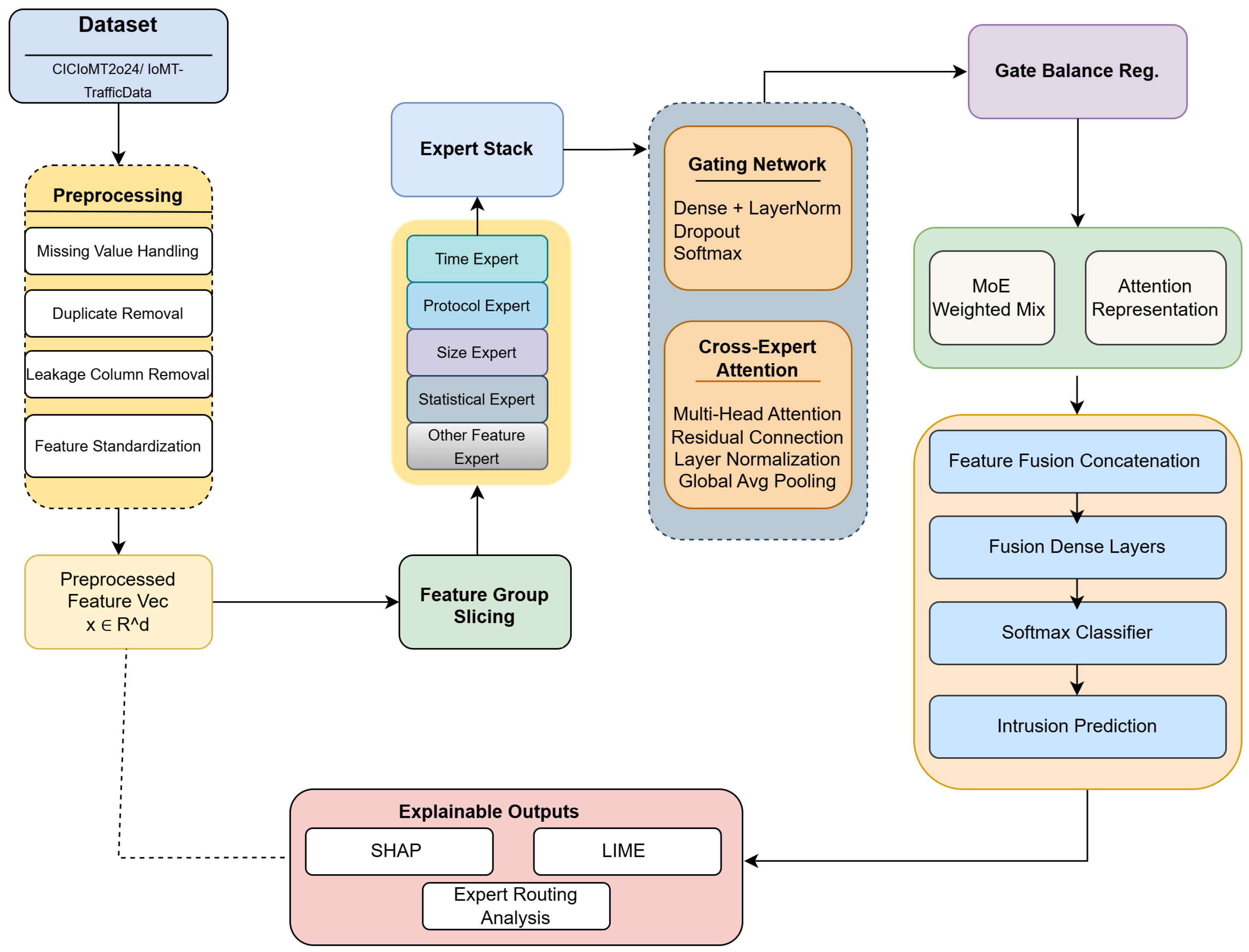
Let the preprocessed traffic sample be represented by , where d denotes the number of input features. The proposed framework first partitions the input feature vector into multiple semantically related feature groups, which are subsequently processed by dedicated expert networks to learn specialized traffic representations. The resulting expert outputs are aggregated through a gate-balanced MoE routing mechanism that adaptively determines the contribution of each expert for a given traffic instance. To further capture dependencies among expert representations, a cross-expert self-attention module is employed to model inter-expert interactions and complementary feature relationships. The MoE representation and attention-enhanced representation are then fused and passed to a multiclass classification module for final intrusion detection. Furthermore, SHAP, LIME, and expert-routing analysis are incorporated to provide both feature-level and model-level interpretability.
3.2. Input Layer
Let the raw traffic sample be represented by
where d denotes the number of input features. To improve training stability and mitigate feature skewness [32], selected non-negative heavy-tailed features are transformed using
Subsequently, feature standardization is applied as
where and denote the mean and standard deviation estimated from the training data. The same transformation is applied to the validation and test sets to avoid information leakage. The resulting standardized feature vector
is used as the input to the proposed framework. The normalized feature space facilitates stable optimization and serves as the basis for subsequent feature-group expert learning and adaptive expert routing.
3.3. Feature-Group Expert Learning Module
To capture diverse characteristics of IoMT traffic, the proposed framework partitions the normalized feature vector into multiple semantically related feature groups. Specifically, features are automatically assigned to five disjoint groups representing temporal characteristics, protocol information, size and rate measurements, statistical attributes, and miscellaneous features. Let
denote the resulting set of feature groups. For each group , a dedicated expert network is employed to learn specialized representations from the corresponding subset of features,
where denotes the input to the k-th expert. This feature-group-aware design promotes expert specialization and enables the framework to learn complementary representations from different aspects of IoMT network traffic [33,34].
3.4. Gate-Balanced Mixture-of-Experts Routing
For each feature group , the proposed framework employs a dedicated expert network to learn a specialized representation. Each expert consists of two fully connected layers with Layer Normalization and Dropout regularization. The output of the (k)-th expert is given by
where denotes the expert network associated with feature group , and represents the learned expert representation [34]. The outputs of all experts are subsequently stacked to form the expert representation matrix
where K denotes the total number of experts. Rather than assigning equal importance to all experts, the proposed framework employs a gating network that dynamically determines the contribution of each expert for a given traffic instance.
3.4.1. Gating Network
To adaptively determine the contribution of each expert, the proposed framework employs a gating network that generates expert routing probabilities from the input feature vector. The routing weights are computed as
where and are trainable parameters, is a temperature coefficient, and denotes the routing probabilities assigned to the K experts. The Softmax operation ensures that the expert weights sum to one, enabling adaptive expert selection for each traffic sample.
3.4.2. Gate Balance Regularization
To prevent the gating network from consistently selecting a small subset of experts, the proposed framework incorporates a gate balance regularization mechanism. Let denote the routing probabilities obtained from Equation (4). The average routing probability across a mini-batch is computed as
where N denotes the batch size. A balance loss is introduced to encourage uniform expert utilization,
where K is the number of experts. In addition, an entropy-based regularization term is employed to discourage overly confident routing decisions,
The final gate regularization objective is given by
where and control the contributions of the balance and entropy regularization terms, respectively [34,35].
3.4.3. Expert Mixture Aggregation
The final expert representation is obtained by combining the outputs of all experts according to the routing probabilities generated by the gating network [36]. Specifically, the MoE representation is computed as
where denotes the routing probability assigned to the k-th expert and represents the corresponding expert output. Through this adaptive weighted aggregation, the framework dynamically emphasizes the most relevant expert representations for each traffic sample while preserving complementary information from multiple feature groups.
3.5. Cross-Expert Self-Attention Module
Although the MoE aggregation captures the relative importance of individual experts, dependencies may still exist among expert representations. To model such interactions, the proposed framework incorporates a cross-expert self-attention module that learns contextual relationships among expert outputs. Given the stacked expert representation matrix , self-attention is computed as
where , , and denote the query, key, and value projections of , respectively. The resulting attention output is combined with the original expert representations through a residual connection followed by layer normalization,
The final attention-enhanced representation is obtained using global average pooling,
where summarizes the contextual information learned across all expert representations [37,38].
3.6. Fusion and Multiclass Classification
To jointly exploit the complementary information learned through adaptive expert routing and cross-expert attention, the corresponding representations are concatenated to form a unified feature representation,
where and denote the MoE and attention-enhanced representations, respectively. The fused representation is subsequently processed by fully connected layers to learn a compact discriminative embedding,
where denotes the nonlinear activation function and and are trainable parameters. Finally, the probability distribution over the intrusion classes is obtained through a Softmax classifier,
where represents the predicted class probabilities.
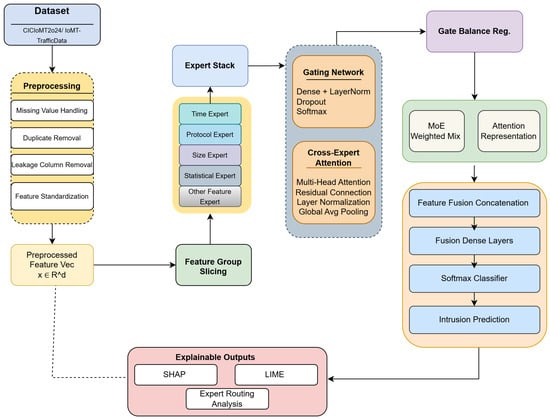
Figure 1 illustrates the structural diagram, while Algorithm 1 presents the step-by-step process of the proposed framework.
| Algorithm 1 HybridMoE-IDS for IoMT Intrusion Detection |
|
Figure 1.
Diagram of the proposed framework.
3.7. Interpretability of the Proposed Framework
To improve transparency, the proposed framework is analyzed using a combination of post hoc interpretability techniques and internal model behavior analysis. It is important to note that SHAP and LIME are employed strictly as post hoc explanation tools after model training and are not involved in feature selection, model optimization, or any part of the learning process. Specifically, SHAP is used to quantify global and local feature attributions, while LIME provides instance-level explanations for representative predictions. In addition, the gating outputs of the Mixture-of-Experts (MoE) module are examined to analyze expert utilization patterns across different attack categories. This combined analysis enables a comprehensive interpretation of the model at the feature level, sample level, and expert-routing level, providing insights into the decision behavior of the proposed intrusion detection framework.
3.7.1. SHAP-Based Feature Attribution
SHAP explains model predictions by assigning each input feature a contribution value derived from Shapley values in cooperative game theory. For a given sample, the SHAP value of feature i measures how much that feature contributes to the deviation of the prediction from the baseline output. Formally, the contribution of feature i can be written as
where F denotes the full feature set, , and S is a subset of features excluding i. In the proposed framework, SHAP is used to identify the most influential traffic attributes for attack discrimination, generate global feature-importance rankings, and analyze class-specific decision behavior. This is particularly useful in IoMT IDS settings, where understanding dominant traffic indicators is essential for model trust and security analysis [39,40,41].
3.7.2. LIME-Based Local Explanation
LIME explains an individual prediction by approximating the complex model locally with an interpretable surrogate model. Instead of interpreting the full nonlinear decision surface, LIME focuses on the neighborhood around a target sample and highlights the features that most strongly support or oppose the predicted class. The local explanation is obtained by solving
where f represents the original model, g denotes an interpretable surrogate selected from the model family G, defines the local neighborhood around sample , measures the approximation error, and controls model complexity. In this work, LIME is used to provide case-specific explanations for representative correctly classified and misclassified samples, thereby showing which traffic features drive individual IDS decisions. Such local explanations complement SHAP by offering human-readable evidence for specific alerts [40,41,42].
3.7.3. Expert Routing and Gating Output Analysis
In addition to feature-level explanations, the proposed framework provides model-level interpretability through the analysis of expert routing behavior. Specifically, the gating network produces a routing probability vector for each traffic sample, indicating the relative contribution of individual experts to the final prediction. By examining the distribution of routing probabilities across different intrusion classes, it is possible to identify expert specialization patterns and understand how the framework allocates attention to different feature groups. For a given traffic sample, the routing probability assigned to the k-th expert is represented by , where larger values indicate greater reliance on the corresponding expert. The average routing probability for each expert can be computed across samples belonging to the same attack category, enabling the visualization of expert utilization patterns. Such analysis provides insights into which feature groups are most influential for detecting specific intrusion types.
Unlike conventional black-box classifiers, the proposed framework exposes its internal decision process through the gating mechanism. Consequently, expert routing analysis complements SHAP and LIME explanations by revealing not only which features contribute to a prediction but also which expert representations are primarily responsible for the final decision. This additional level of transparency facilitates model auditing and improves the interpretability of intrusion detection outcomes in IoMT environments [33,43].
4. Experimental Design
This section presents the benchmark datasets, preprocessing strategy, implementation settings, and evaluation metrics used to assess the proposed IDS framework. All experiments were conducted under multiclass intrusion detection settings in order to evaluate the capability of the model to distinguish benign traffic from multiple attack categories in IoMT environments.
4.1. Benchmark Datasets
Two recent IoMT datasets were used in this study, namely CICIoMT2024 and IoMT-TrafficData. CICIoMT2024 is a recent benchmark dataset developed for security assessment in IoMT environments. It was generated from an IoMT testbed containing real and simulated healthcare-related devices and includes multiple cyberattack scenarios collected over different communication settings [5]. The dataset covers diverse attack categories and protocol conditions, which makes it suitable for evaluating intrusion detection models under heterogeneous IoMT traffic behavior. In this work, CICIoMT2024 was used in both 6 classes and 19 classes multiclass settings in order to evaluate the proposed framework at different levels of attack granularity. IoMT-TrafficData is another recent dataset specifically introduced for benchmarking intrusion detection in IoMT networks. It contains benign traffic together with multiple attack classes and provides flow-based traffic representations that are suitable for ML and DL based intrusion detection [44]. In this study, the IP-based flow representation was used because it offers structured flow-level features appropriate for the proposed hybrid architecture.
Table 2 indicates that both CICIoMT2024 and IoMT-TrafficData exhibit substantial class imbalance. For CICIoMT2024, the DDoS and DoS classes account for approximately 66.63% and 25.32% of all samples, respectively, whereas the Spoofing class represents only 0.20% of the dataset, resulting in a largest-to-smallest class ratio exceeding 328:1. Similarly, IoMT-TrafficData is dominated by the camoverflow class (50.57%), while arpspoofing and slowread constitute only 0.35% and 0.28% of the samples, respectively, yielding a largest-to-smallest class ratio of approximately 182:1. Rather than modifying the original data distribution through over or under-sampling techniques, this study preserves the natural class proportions to reflect realistic IoMT network traffic conditions. To ensure a fair assessment under these imbalanced settings, the proposed framework is evaluated using macro-averaged precision, recall, and F1-score, where each class contributes equally to the final metric regardless of its frequency. Consequently, the reported performance reflects the model’s effectiveness across both majority and minority attack categories instead of being dominated by the most frequent classes.
Table 2.
Instance distribution of the datasets used in this study.
4.2. Preprocessing Strategy
A dataset-aware preprocessing pipeline was applied before model training. First, invalid entries such as missing values, NaN values, and infinite values were handled during the data cleaning stage. Duplicate samples were removed where necessary to reduce redundancy and improve data consistency. For CICIoMT2024, the official data split was preserved as the base experimental setting. In the 6-class experiments, fine-grained labels were mapped into broader attack families to form a coarse multiclass benchmark. In the 19-class experiments, labels were harmonized into a consistent multiclass taxonomy in order to support stable evaluation across the provided split. For IoMT-TrafficData, the multiclass target was defined using the traffic label, while the helper binary field is_attack was removed from the input features to avoid target leakage. After target separation, only numerical attributes were retained for model input, resulting in a fixed-length tabular feature representation compatible with the proposed framework. To improve feature stability, a selective transformation was applied to non-negative heavy-tailed attributes. Afterward, all retained numerical features were scaled using Z-score normalization. IoMT-TrafficData was first divided into a training and a test subset. Using a stratified split, the validation set was then created from the training portion only. For CICIoMT2024, validation data were drawn from the training portion while preserving the official train-test split. This preprocessing procedure ensured a leakage-aware and reproducible experimental workflow.
4.3. Implementation Details and Hyperparameter Settings
The proposed framework was implemented in a Python 3.12.7 environment using TensorFlow 2.19.0/Keras 3.10.0 for network construction and training, scikit-learn was used for preprocessing and performance evaluation, while we employed SHAP and LIME for interpretability analysis. All experiments were carried out in a Jupyter Notebook 7.2.2 on a machine equipped with 16 GB RAM. The model was trained using the Adam optimizer with a learning rate of and a batch size of 64. A dropout rate of 0.25 was used for regularization. The maximum number of training epochs was set according to the dataset and experiment type, while model selection was guided by validation performance. Early stopping and learning-rate scheduling were employed when necessary to improve convergence stability and reduce unnecessary training epochs. For the proposed framework, the expert representation dimension, fusion dimension, and routing configuration were selected empirically based on validation performance. In the main experiments, the model employed feature-group-specific expert networks, gate-balanced Mixture-of-Experts (MoE) routing, and a cross-expert self-attention module to capture complementary traffic characteristics. Gate-balancing regularization was incorporated during training to encourage stable expert utilization and prevent expert dominance across different traffic classes. The principal hyperparameters used in this work are summarized in Table 3.
Table 3.
Main hyperparameter settings used in the experiments.
4.4. Evaluation Metrics
The proposed framework was evaluated on standard multiclass classification metrics, including accuracy, recall, precision, and F1-score. Because recent IoMT-specific datasets often shows class imbalance, both macro-level and weighted performance measures were considered during analysis.
Accuracy is defined as
where , , , and represent true positives, true negatives, false positives, and false negatives predictions respectively.
Precision and recall are computed as
The F1-score, which provides a balance between precision and recall, is given by
5. Results and Discussion
This section presents the experimental results of the proposed IDS framework on the benchmark IoMT datasets and discusses the corresponding interpretability outcomes. The analysis is organized to first examine the optimization behavior of the model, followed by predictive performance evaluation, and then multi-level explainability analysis. In addition to standard classification results, feature-level and expert-level interpretation are also provided to better understand how the proposed framework reaches its decisions.
5.1. 6-Class Results on CICIoMT2024
5.1.1. Classification Performance Analysis
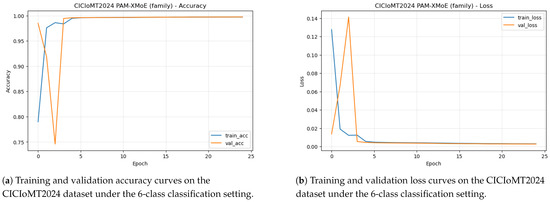
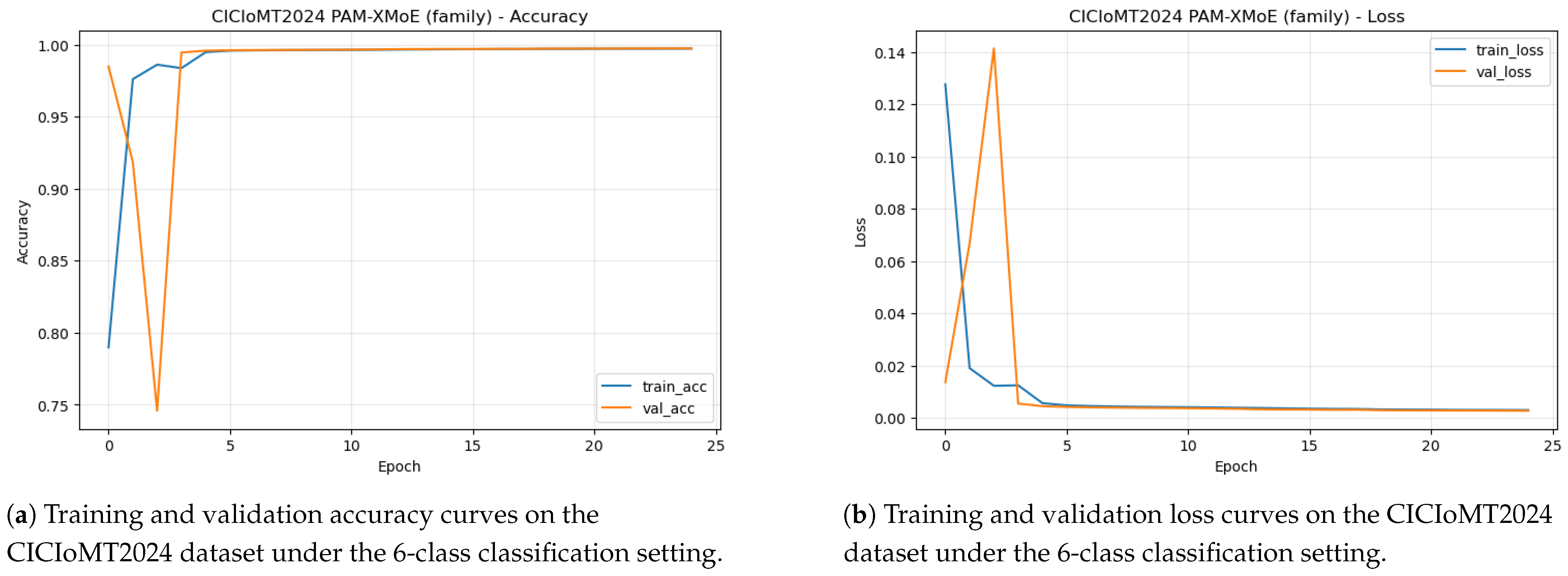
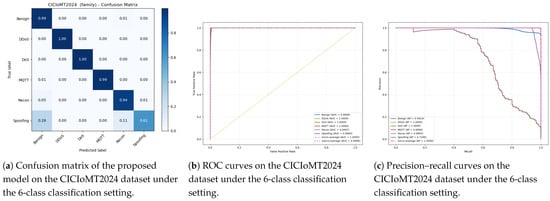
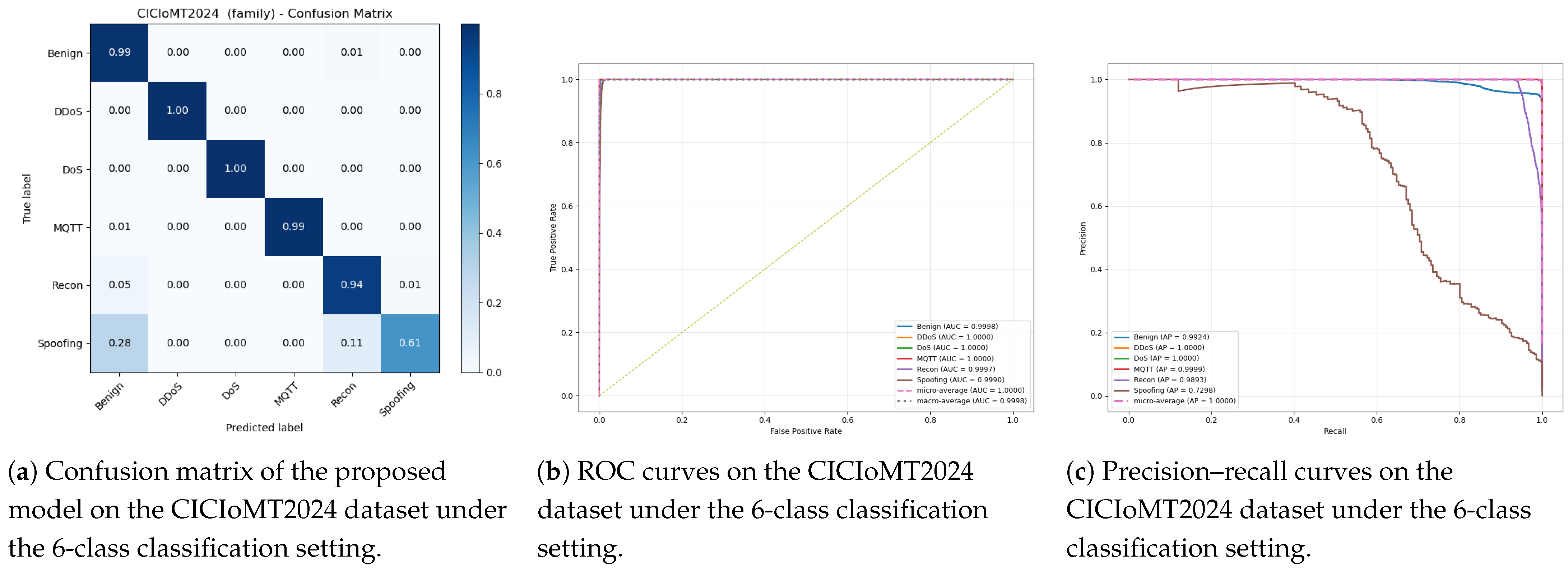
This subsection provides the 6-class evaluation of the proposed IDS on the CICIoMT2024 dataset. In this setting, the model is required to distinguish benign traffic from six broad traffic families, namely Benign, DDoS, DoS, MQTT, Recon, and Spoofing. Compared with the fine-grained (19-class) setting, 6-class classification provides a more general view of the ability of the model to separate major attack categories while still preserving meaningful multiclass discrimination. Figure 2a illustrates the training and validation accuracy curves, while Figure 2b shows the corresponding loss curves. The proposed model converges rapidly within the first few epochs, with both training and validation accuracy increasing toward near-saturated values and both loss curves decreasing sharply. Although a brief fluctuation appears in the early validation trajectory, the model quickly stabilizes and maintains highly consistent optimization behavior afterward. This pattern indicates that the proposed hybrid architecture learns discriminative 6-class IoMT traffic representations efficiently and does not exhibit sustained signs of overfitting. The close agreement between the training and validation curves further suggests that the learned representation generalizes well across the validation subset. The normalized confusion matrix in Figure 3a shows that the proposed framework achieves very strong discrimination for most traffic families. In particular, DDoS and DoS are classified almost perfectly, while Benign, MQTT, and Recon also maintain high recall. The main residual difficulty is concentrated in the Spoofing family, which is more frequently confused with Benign and, to a lesser extent, Recon. This indicates that spoofing traffic shares greater statistical overlap with normal and reconnaissance-related behavior than the more dominant attack families. Overall, the 6-class setting confirms that the proposed model is highly effective at coarse-grained intrusion discrimination, with the main limitation restricted to the minority spoofing class. Furthermore, the ROC and one-vs-rest Precision–Recall curves in Figure 3b,c further support this conclusion. The ROC results are near-saturated for all classes, with a macro-average AUC of approximately 0.9998 and a micro-average AUC of 1.0000, indicating extremely strong class separability. The Precision–Recall curves provide a more informative view under class imbalance and show that most classes retain very high average precision, whereas Spoofing exhibits a noticeably weaker profile. This is consistent with the confusion matrix and confirms that the remaining 6-class challenge lies in separating spoofing behavior from benign and reconnaissance traffic rather than in distinguishing the dominant attack families. Table 4 compares the proposed IDS with Logistic Regression (LR), AdaBoost (AB), and Deep Neural Network (DNN) on the CICIoMT2024 dataset [5] under both 6-class and 19-class settings. The proposed model achieves the best performance in all reported metrics, reaching 99.7590% accuracy and 0.9291 F1-score at the 6-class, and 99.0667% accuracy and 0.8429 F1-score at the 19-class setting. These results indicate that the proposed framework provides more reliable and robust multiclass intrusion detection than the baseline models, particularly in the more challenging 19-class classification setting.
Figure 2.
Training behavior of the proposed framework on the CICIoMT2024 dataset under the 6-class classification setting.
Figure 3.
Performance evaluation of the proposed model on the CICIoMT2024 6-class classification task. (a) Confusion matrix. (b) ROC curves. (c) Precision–recall curves.
Table 4.
Comparison of baseline models and the proposed IDS on the CICIoMT2024 dataset under the 6-class and 19-class classification setting.
Table 5 presents the per-class performance of proposed IDS on the CICIoMT2024 dataset under the 6-class setting. The proposed framework achieves an overall accuracy of 99.76% and an MCC of 0.9951, demonstrating excellent detection capability across the major attack families. The model attains near-perfect precision, recall, and F1-scores for the DDoS, DoS, and MQTT classes, indicating highly reliable classification of these attack categories. Similarly, strong performance is observed for the Recon class, with an F1-score of 0.9600. Although the Spoofing class exhibits comparatively lower performance, it remains the most challenging category due to its similarity to benign traffic patterns. Overall, the high macro-averaged precision (0.9381), recall (0.9215), and F1-score (0.9291) confirm the effectiveness and robustness of framework for 6-class IoMT intrusion detection.
Table 5.
Per class Performance on the CICIoMT2024 dataset under the 6-class classification setting.
5.1.2. Explainability and Interpretability Analysis
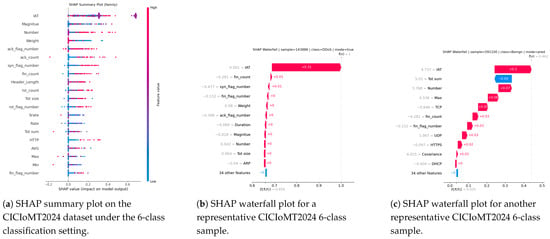
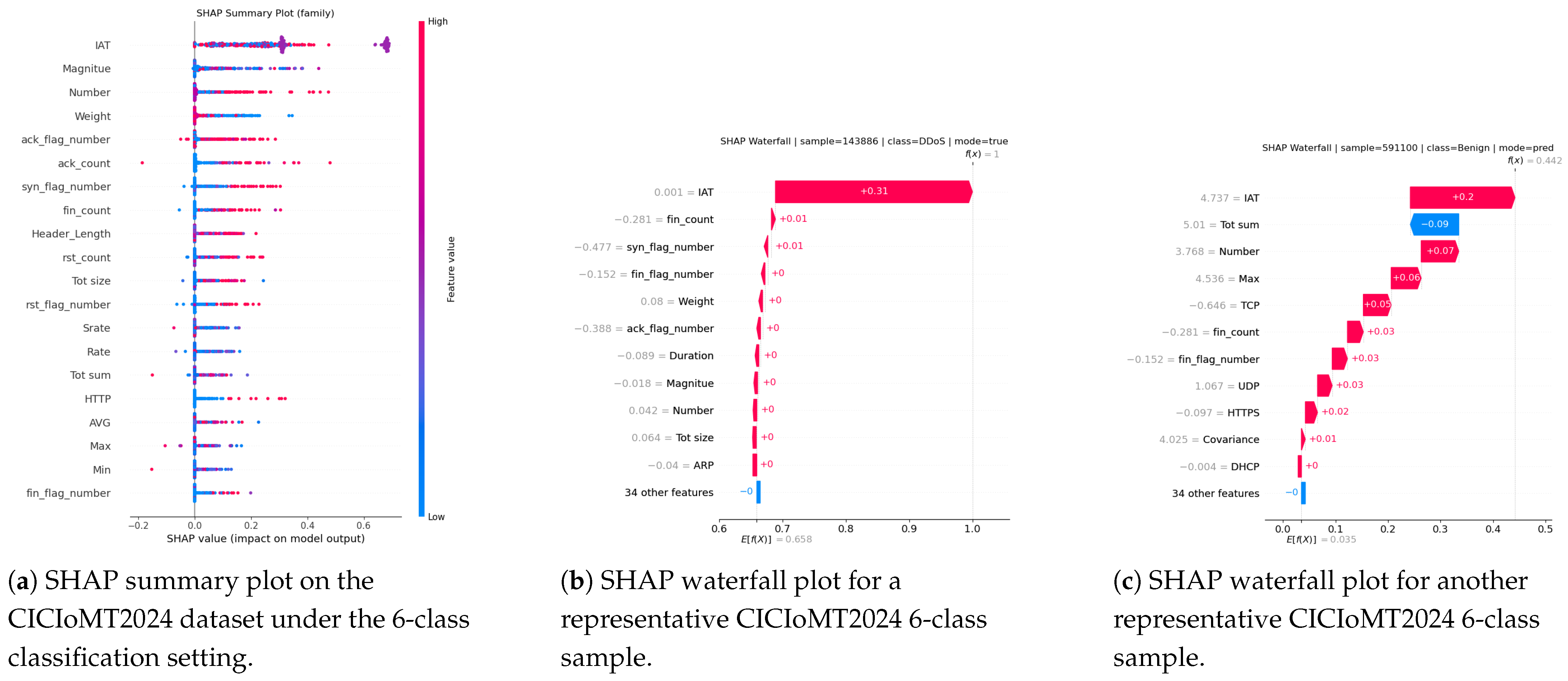
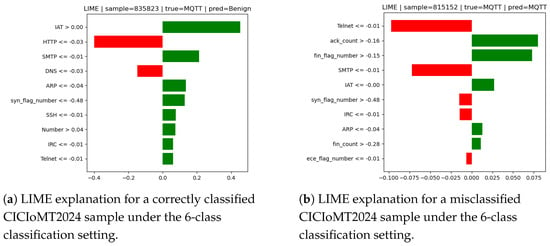
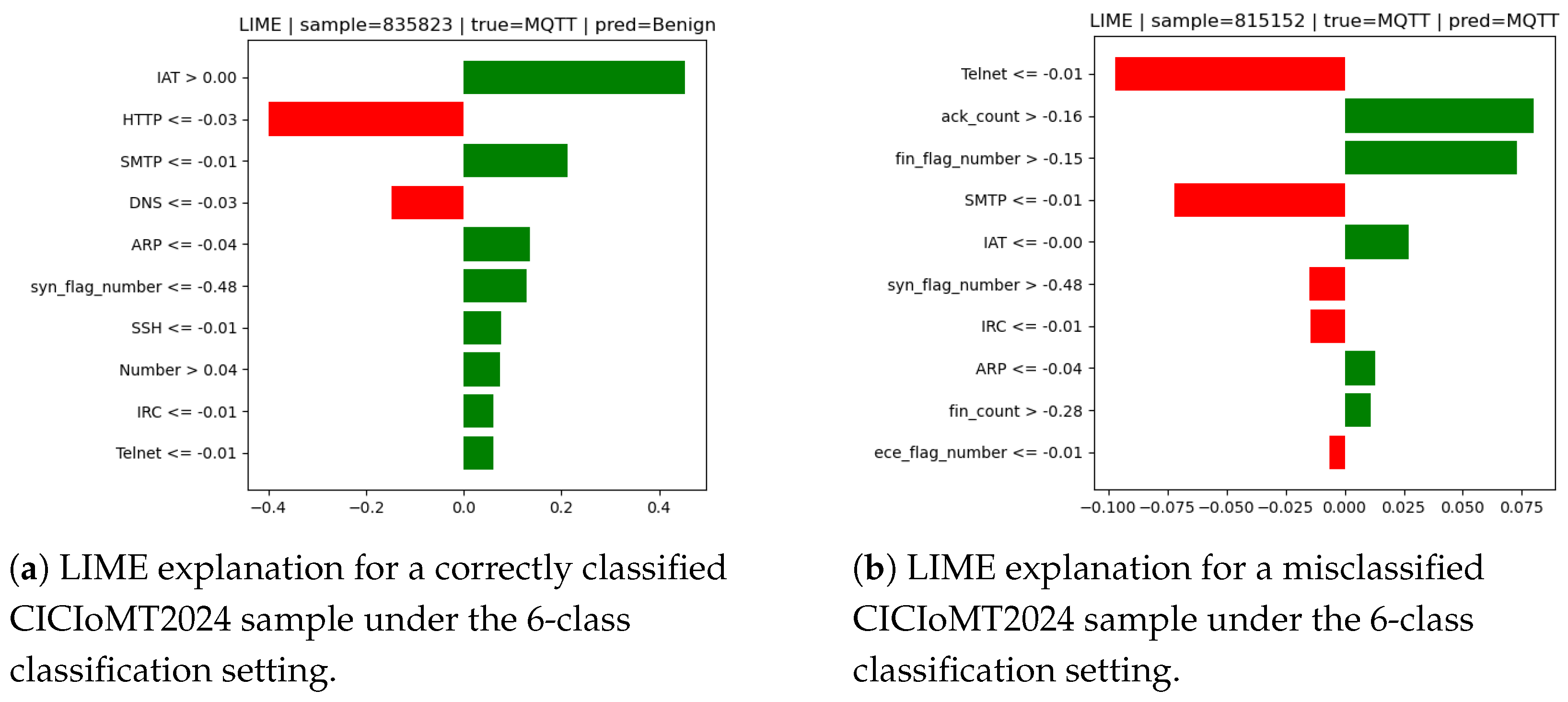
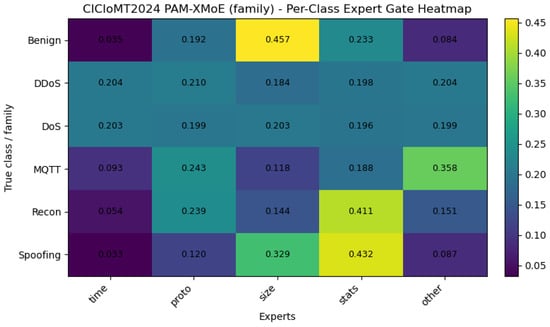
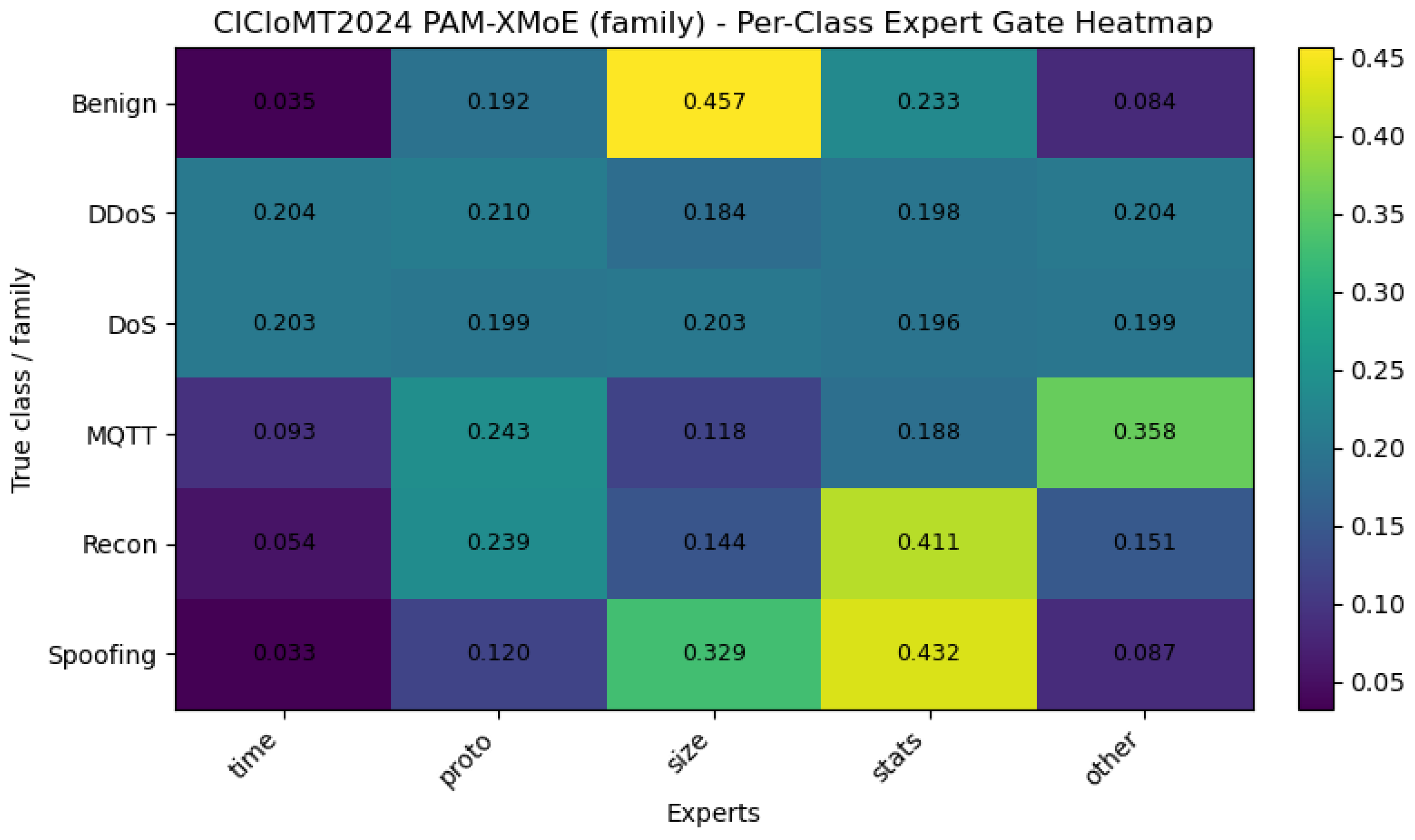
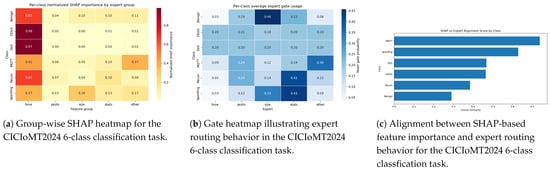
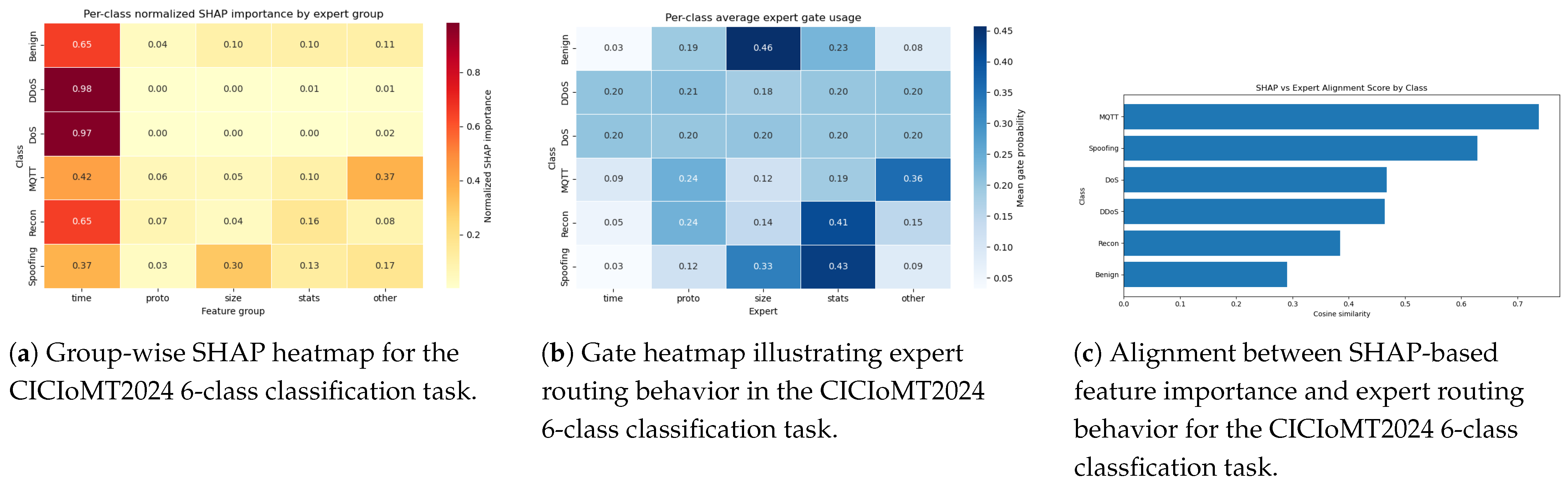
The SHAP summary plot in Figure 4a shows that 6-class classification decisions are driven by a compact group of informative features, with IAT emerging as the dominant attribute, followed by variables such as Magnitude, Number, Weight, and several flag- and count-related features. The representative SHAP waterfall plots in Figure 4b,c further demonstrate how these features accumulate to support individual predictions. In the DDoS example, IAT provides the strongest positive contribution, supported by packet-count and flag-related features, whereas in the benign prediction case, the decision is mainly driven by IAT, Number, and Max, with opposing influence from Tot sum. The LIME explanations in Figure 5a,b provide complementary local evidence by showing how timing and protocol-related variables support correct MQTT detection in one case and contribute to a benign-side decision in a more difficult sample. Figure 6 shows clear class-dependent routing in the MoE module. Benign traffic is routed mainly to the size expert, while MQTT is associated more with the other expert. Recon and Spoofing rely more on the stats expert, whereas DDoS and DoS exhibit more distributed routing across experts. This suggests that the gating mechanism adapts expert selection according to family-specific traffic characteristics. Figure 7a–c show the relationship between feature-group importance and expert routing across traffic families. The SHAP-group heatmap indicates that the time group is dominant for most classes, especially DDoS and DoS, while MQTT and Spoofing rely on a more distributed set of groups. The gate heatmap shows complementary class-dependent routing, with Benign favoring the size expert, MQTT the other expert, and Recon and Spoofing the stats expert. Figure 7c quantifies the agreement between these views. The highest alignment is observed for MQTT and Spoofing, while Benign and Recon show lower alignment. Overall, the results confirm meaningful class-dependent routing and broad consistency between SHAP-based feature importance and internal expert usage.
Figure 4.
SHAP-based global and local explanations for the CICIoMT2024 dataset under the 6-class classification setting. (a) SHAP summary plot showing global feature importance. (b,c) SHAP waterfall plots illustrating local feature contributions for representative predictions.
Figure 5.
LIME-based local explanations for representative correct and incorrect predictions on the CICIoMT2024 dataset under the 6-class classification setting.
Figure 6.
Gate heatmap illustrating expert routing behavior in the CICIoMT2024 under 6-class classification setting.
Figure 7.
Interpretability analysis of the proposed model on the CICIoMT2024 6-class classification task.
5.2. 19-Class Results on CICIoMT2024
5.2.1. Classification Performance Analysis
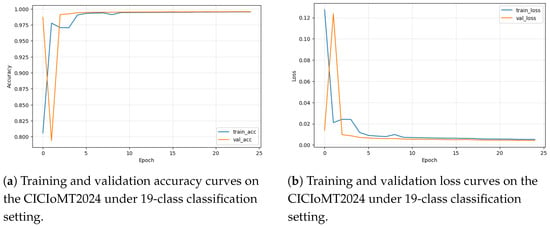
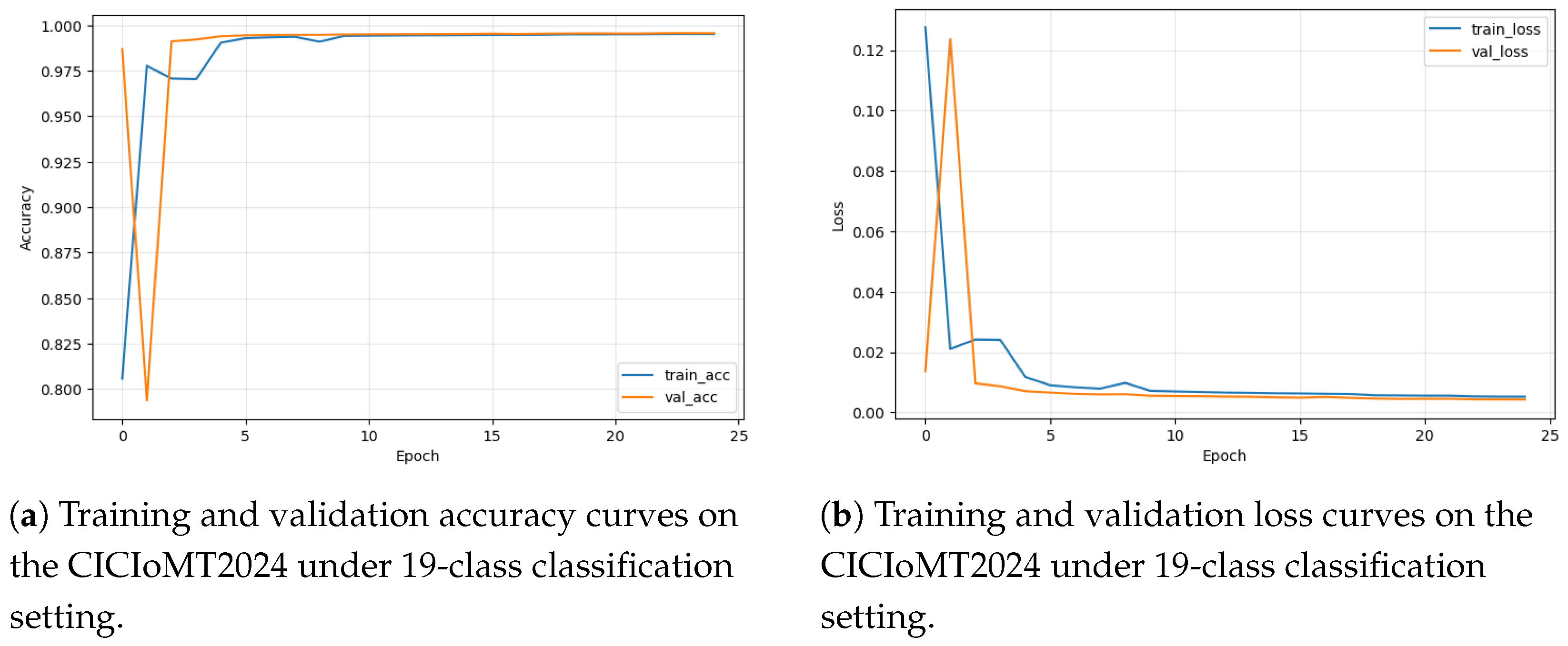
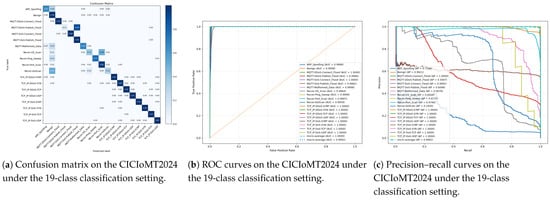
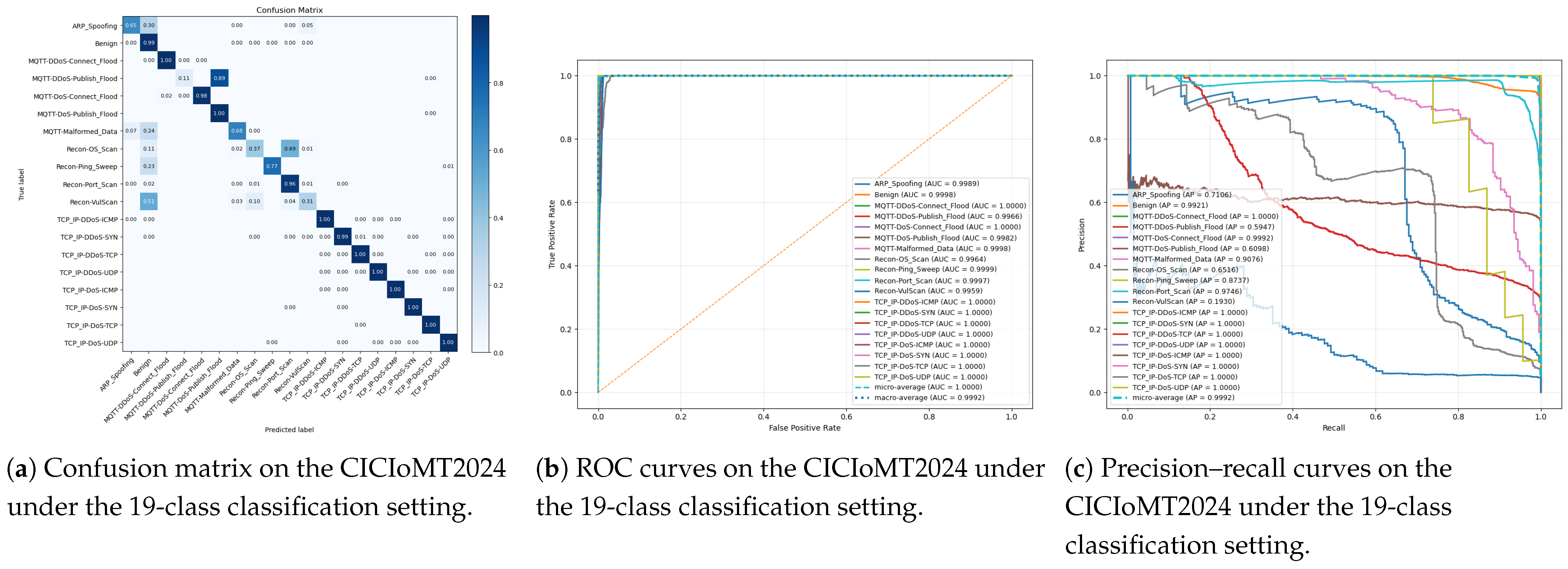
This subsection evaluates the proposed IDS framework under the harmonized 19-class setting of CICIoMT2024. Compared with the 6-class classification task, 19-class classification is more challenging because the model must distinguish individual attack subtypes with partially overlapping traffic behavior. As shown in Figure 8a,b, the model converges rapidly after a brief early fluctuation in validation performance and then remains stable across the remaining epochs. This behavior indicates effective optimization and suggests that the hybrid IDS framework is able to learn discriminative subtype-level representations without obvious instability. The normalized confusion matrix in Figure 9a shows that the proposed framework performs extremely well on several TCP/IP DoS and DDoS subclasses, many of which are classified almost perfectly. However, the remaining difficulty is concentrated in minority or semantically similar classes. In particular, ARP_Spoofing is often confused with Benign, Recon_OS_Scan is strongly confused with Recon_Port_Scan, and Recon_VulScan remains one of the most challenging categories. Some confusion is also observed among related MQTT subtypes, especially for publish-flood variants. These results indicate that the proposed model handles dominant fine-grained attack classes very effectively, while subtype-level ambiguity remains the main source of residual error. Furthermore, the ROC and one-vs-rest Precision–Recall curves in Figure 9b,c provide a more complete picture of class separability. The ROC curves remain near-saturated for most classes, with a macro-average AUC of approximately 0.9992, which confirms strong overall discrimination. In contrast, the Precision–Recall curves reveal the real difficulty of minority and behaviorally close classes. While dominant TCP/IP attack types preserve nearly ideal precision–recall behavior, weaker classes such as Recon_VulScan, Recon_OS_Scan, ARP_Spoofing, and certain MQTT subclasses show noticeably lower average precision. Therefore, the 19-class evaluation confirms that the main challenge is not broad attack-family detection, but the separation of minority and closely related subtypes under multiclass imbalance.
Figure 8.
Training behavior of the proposed model on the CICIoMT2024 under a 19-class classification setting.
Figure 9.
Performance evaluation of the proposed model on the CICIoMT2024 19-class classification task. (a) Confusion matrix. (b) ROC curves. (c) Precision–recall curves.
Table 6 presents the per class performance of proposed IDS on the CICIoMT2024 dataset under the 19-class classification setting. The proposed framework achieves an overall accuracy of 99.07%, a macro F1-score of 0.8428, and an MCC of 0.9891, demonstrating strong discrimination among closely related attack categories. Most MQTT and TCP/IP attack classes achieve near-perfect precision, recall, and F1-scores. Lower performance is observed for ARP-Spoofing, Recon-OS Scan, Recon-VulScan, and MQTT-DDoS-Publish Flood, indicating the increased difficulty of distinguishing certain minority and highly similar attack subclasses. Hower, the overall results confirm the effectiveness of proposed IDS for 19-class IoMT intrusion detection.
Table 6.
Per-class performance on CICIoMT2024 under the 19-class classification setting.
5.2.2. Explainability and Interpretability Analysis
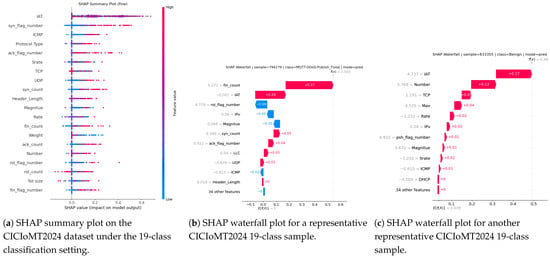
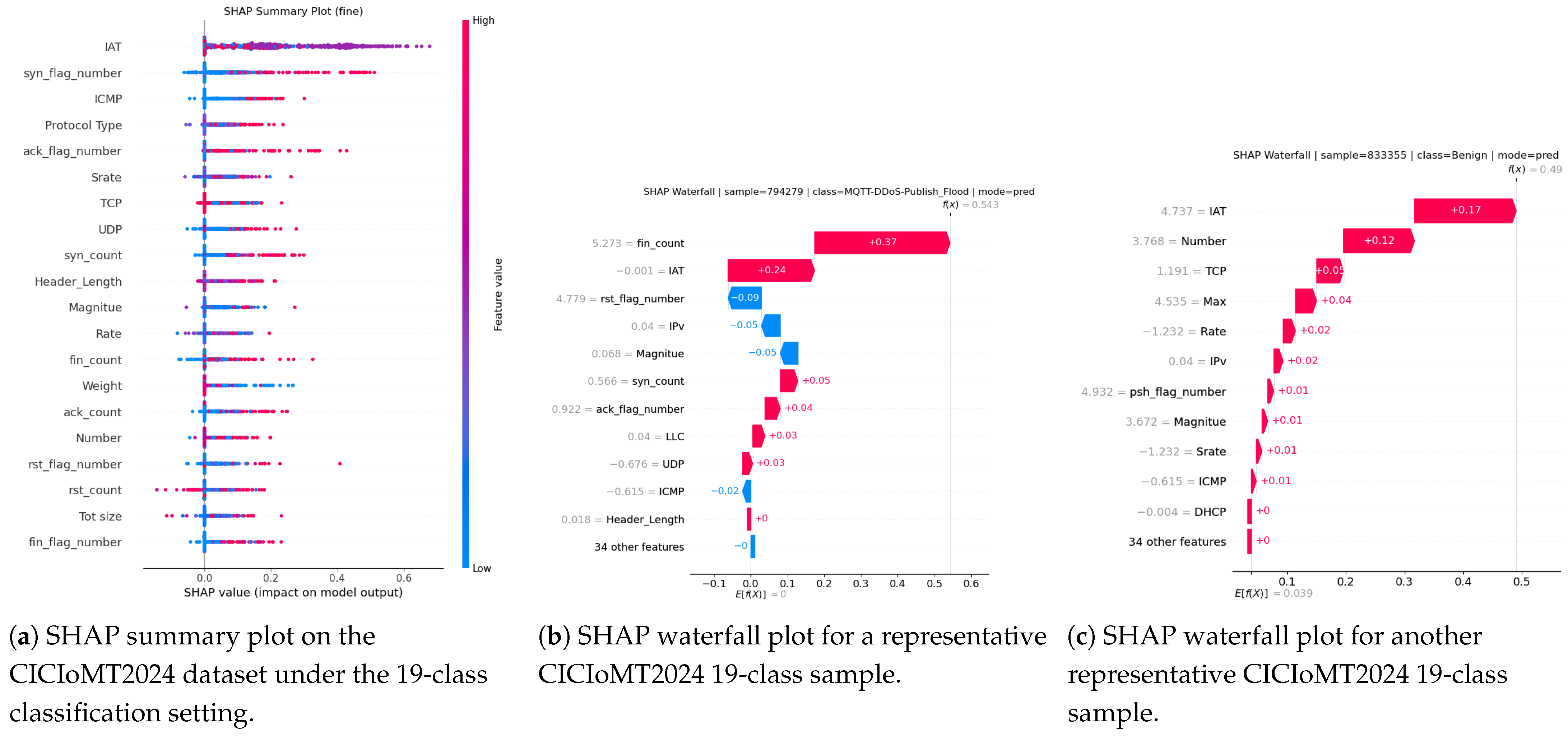
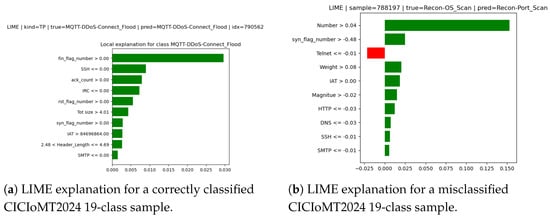
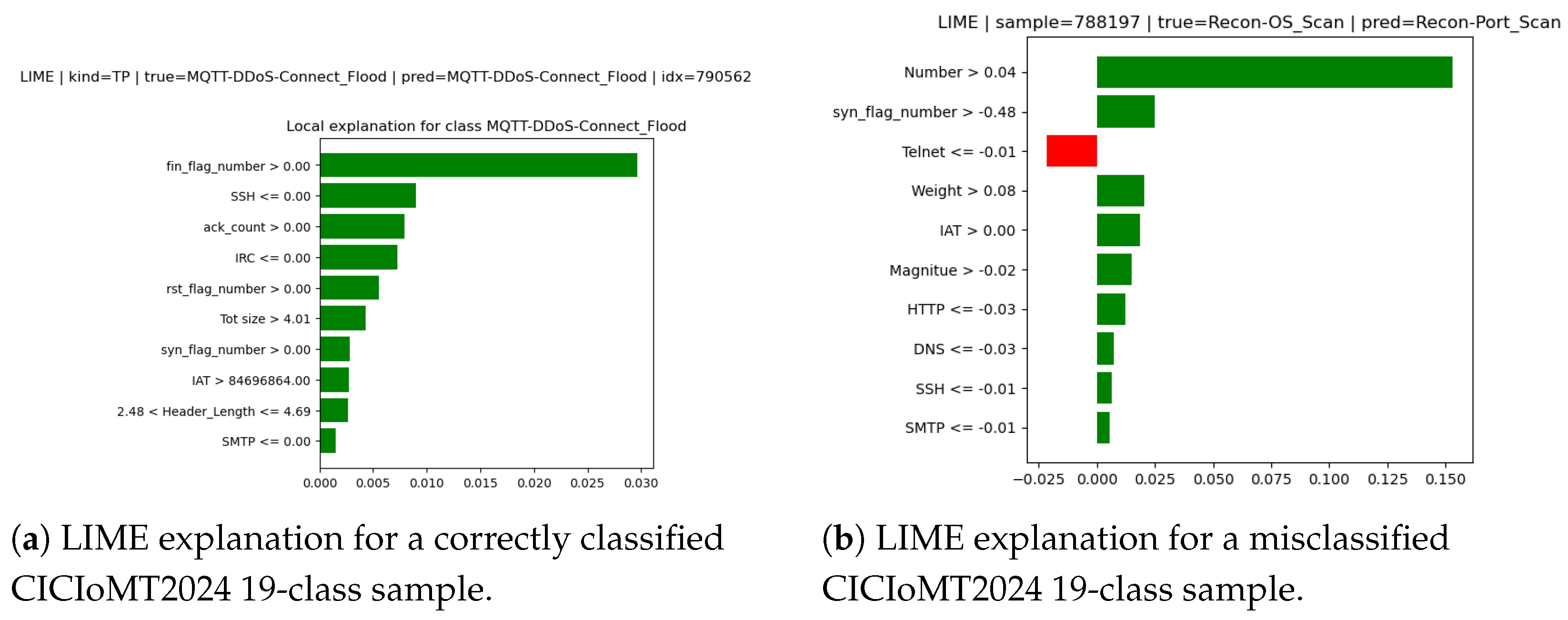
The SHAP summary plot in Figure 10a shows that subtype-level decisions are driven mainly by a compact set of informative traffic attributes, with IAT emerging as the dominant feature, followed by variables such as syn_flag_number, ICMP, Protocol Type, and ack_flag_number. The representative SHAP waterfall plots in Figure 10b,c further illustrate how these features contribute to individual predictions. In the MQTT-related example, fin_count and IAT act as the strongest positive contributors, while in the benign prediction case, IAT, Number, and TCP-related features drive the decision. The LIME explanations in Figure 11a,b provide additional local support for these observations by showing which features support or oppose the final class assignment in representative correct and difficult samples.
Figure 10.
SHAP-based global and local explanations for the CICIoMT2024 dataset under the 19-class classification setting. (a) SHAP summary plot showing global feature importance. (b,c) SHAP waterfall plots illustrating local feature contributions for representative predictions.
Figure 11.
LIME-based local explanations for representative correct and incorrect predictions in the CICIoMT2024 19-class task.
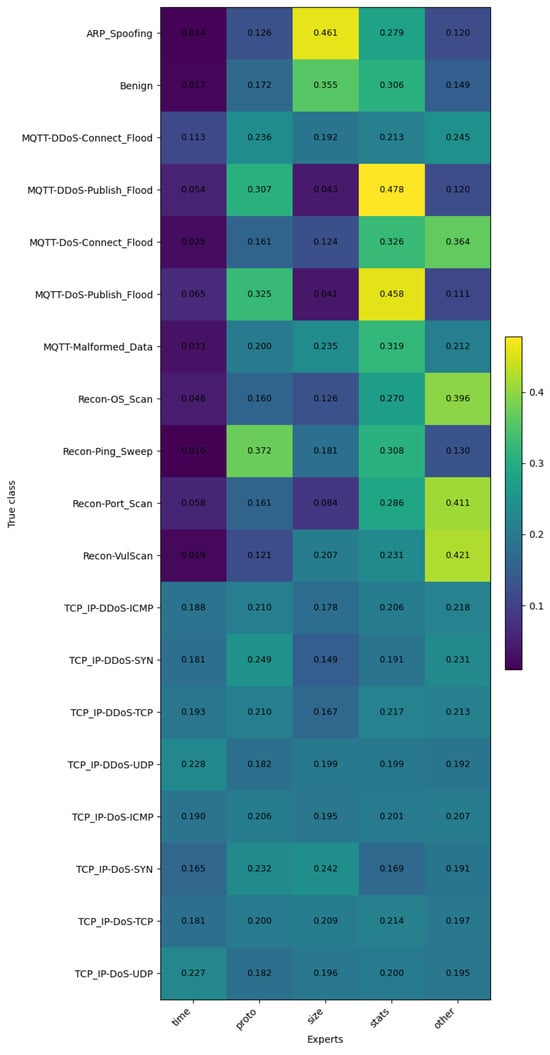
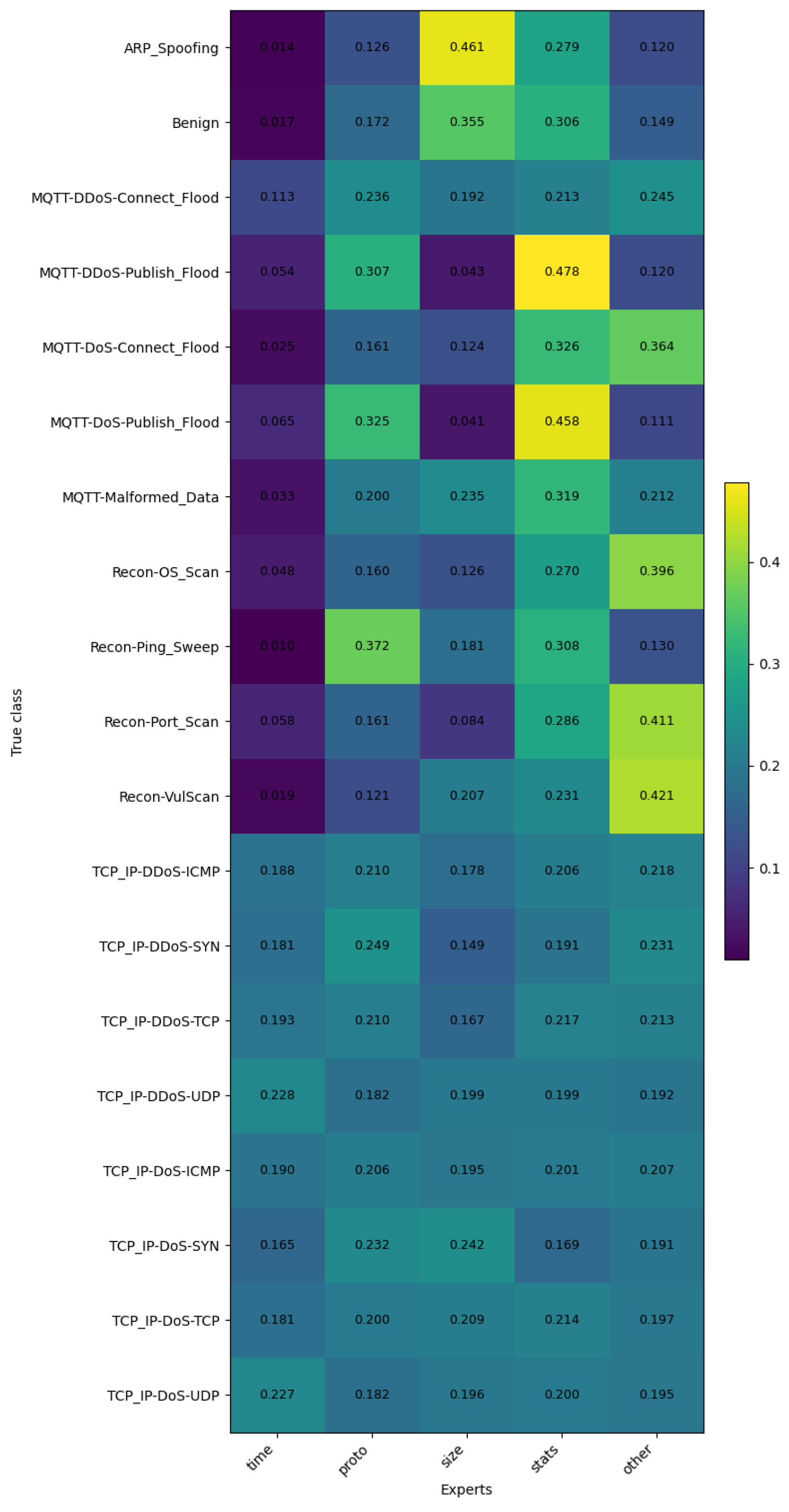
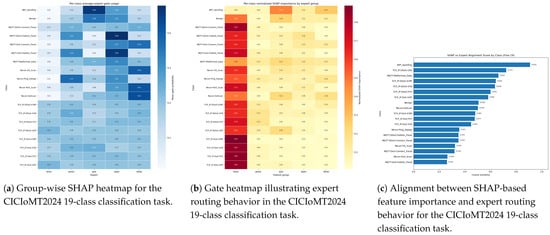
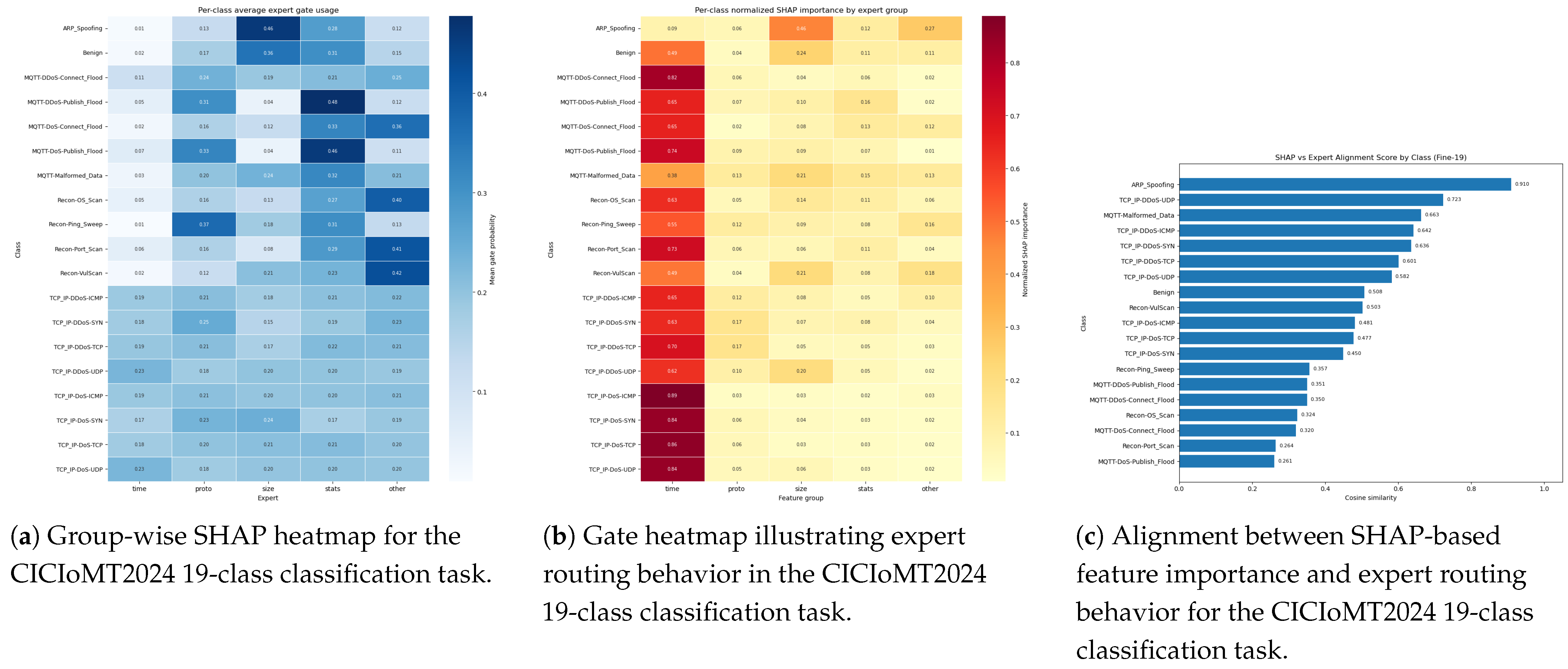
The 19-class LIME explanations shown in Figure 11a,b highlight subtype-specific decision patterns. For MQTT-DDoS-Connect_Flood, the prediction is mainly driven by packet-flag and timing-related features such as fin_flag_number, ack_count, and IAT. In contrast, the Recon-OS_Scan explanation is influenced more by features such as syn_flag_number and Magnitude, while protocol-related attributes such as SMTP, Telnet, and ARP oppose the decision. This confirms that the model learns distinct local evidence for different fine-grained attack subtypes. Figure 12 shows that the time group dominates most TCP/IP attack subclasses, while ARP_Spoofing depends more strongly on the size group. Several MQTT and reconnaissance-related classes exhibit a more distributed importance profile across proto, stats, and other, indicating subtype-dependent feature-group relevance. Figure 13a–c provide an expert-level view of the fine-grained decision process. The per-class SHAP-group heatmap shows that the time group dominates most TCP/IP DoS and DDoS subclasses, whereas classes such as ARP_Spoofing rely more strongly on the size group and some MQTT or reconnaissance classes show more distributed importance across proto, stats, and other. The gate-usage heatmap reveals corresponding class-dependent routing behavior: ARP_Spoofing and Benign are routed more strongly toward the size and stats experts, MQTT flood variants show stronger preference for stats, proto, and other experts, while many TCP/IP attack subclasses exhibit a more uniform routing profile. Finally, the SHAP–expert alignment scores show that the agreement between feature-group importance and expert routing is class dependent, with the strongest alignment observed for ARP_Spoofing and several TCP/IP DDoS subclasses. Overall, these results indicate that the proposed MoE layer does not behave uniformly across classes, but instead provides meaningful subtype-sensitive routing behavior that complements the feature-level explanations.
Figure 12.
Gate heatmap illustrating expert routing behavior on the CICIoMT2024 under 19-class classification task.
Figure 13.
Interpretability analysis of the proposed model on the CICIoMT2024 19-class classification task.
5.3. Results on IoMT-TrafficData
5.3.1. Classification Performance Analysis
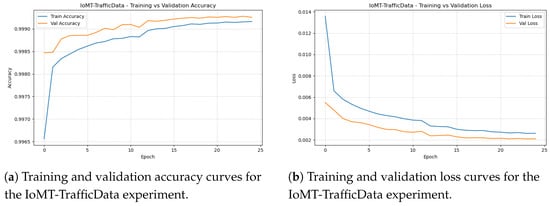
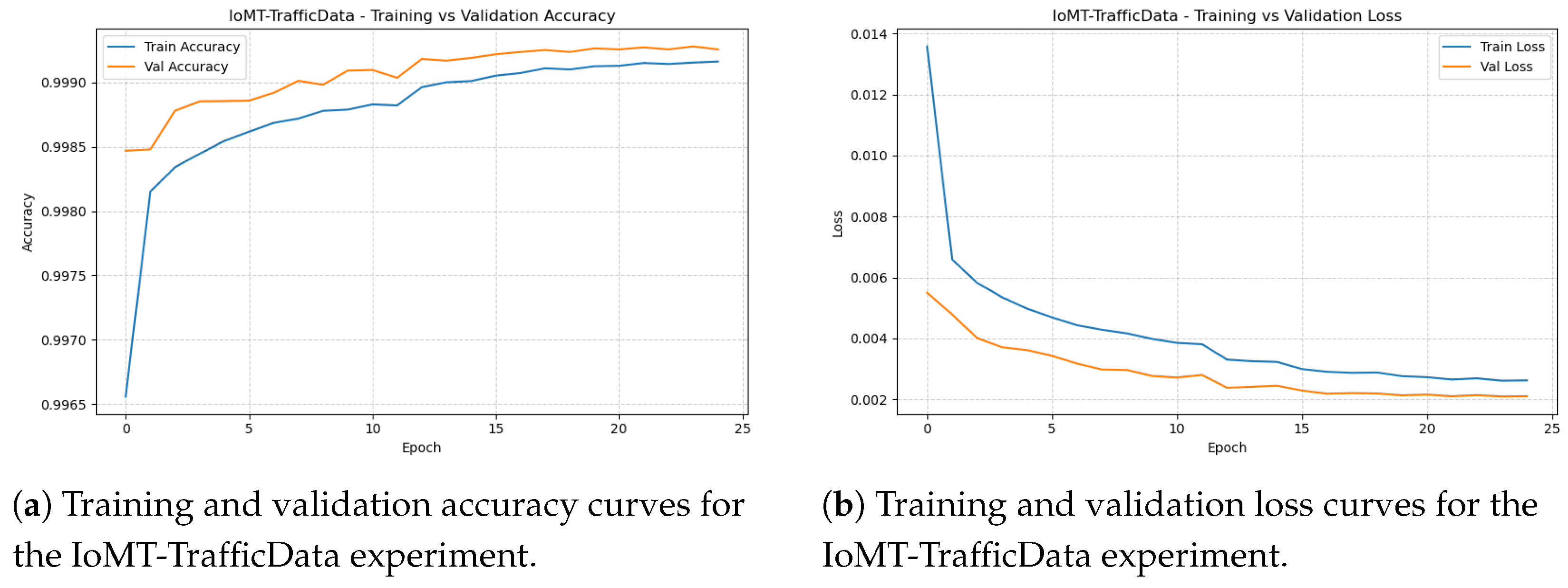
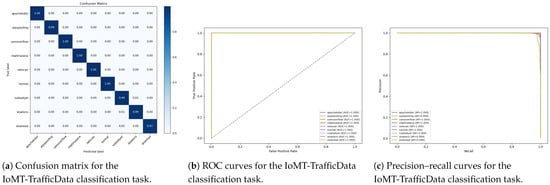
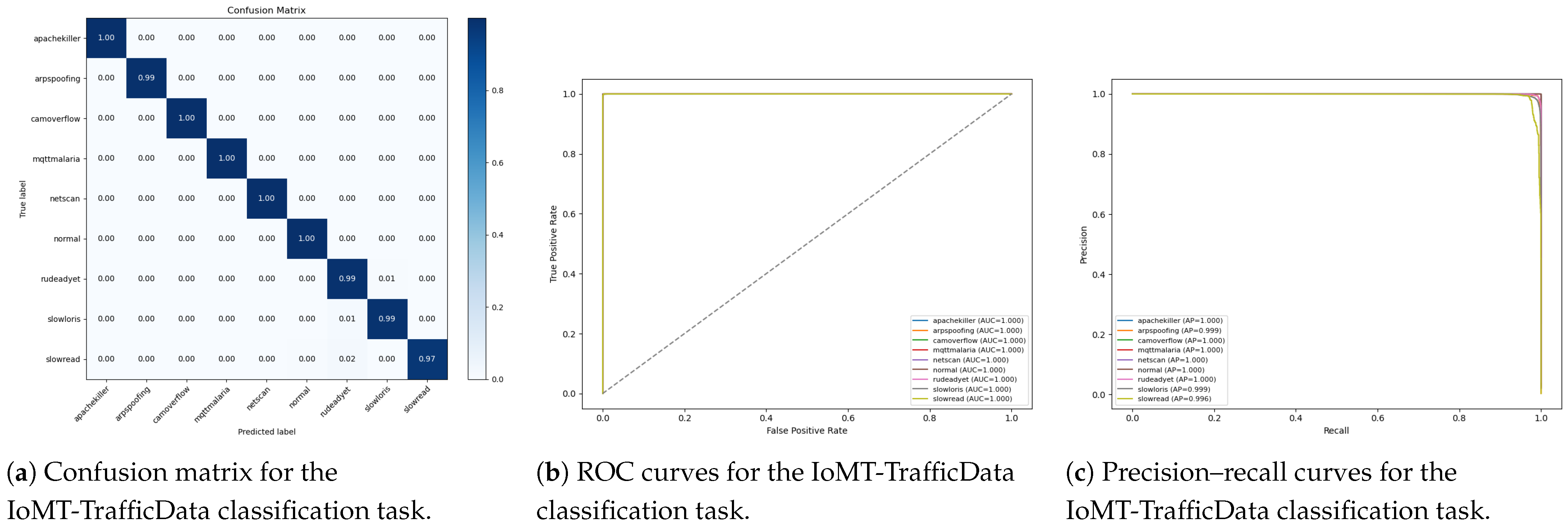
This subsection evaluates the proposed IDS framework on the IoMT-TrafficData dataset under the 9-class multiclass setting. After removing the leakage-prone helper field is_attack, the model was trained on the flow-based traffic representation defined by the traffic label. As shown in Figure 14a,b, the model converges rapidly and then remains highly stable across the remaining epochs. The training and validation accuracy curves increase smoothly toward near-saturated values, while the corresponding loss curves decrease consistently without instability. The close agreement between the training and validation trajectories indicates that the proposed architecture learns robust flow-level representations and generalizes well on this dataset. The normalized confusion matrix in Figure 15a shows that the proposed framework achieves nearly perfect discrimination for most classes. In particular, apachekiller, camoverflow, mqttmalaria, netscan, and normal are classified almost perfectly, while only minor confusion is observed among a few behaviorally closer classes. The most noticeable residual errors occur between rudeadyet and slowloris, and to a lesser extent between slowread and rudeadyet. These patterns indicate that the remaining errors are concentrated in classes with more similar traffic characteristics rather than in the dominant attack categories. Overall, the confusion matrix confirms that the proposed model provides very strong multiclass discrimination on IoMT-TrafficData. Furthermore, the ROC and Precision–Recall curves in Figure 15b,c further support this conclusion. The ROC curves are essentially saturated for all classes, with class-wise AUC values of approximately 1.000, indicating extremely strong separability in the one-vs-rest setting. The Precision–Recall curves provide a more informative perspective on the remaining hard cases and show that most classes retain near-ideal average precision, while slowread, slowloris, and arpspoofing exhibit slightly weaker but still very strong profiles. These results confirm that the proposed framework achieves highly reliable performance on the dataset, with only limited degradation on a few relatively harder classes. Table 7 compares the proposed IDS with LR, NB, SVM, and DNN on the IoMT-TrafficData dataset [44]. The proposed model achieves the best overall performance, with 99.92% accuracy and 99.42% for precision, recall, and F1-score. These results indicate that the proposed framework provides highly effective multiclass intrusion detection on IoMT-TrafficData.
Figure 14.
Training behavior of the proposed model on the IoMT-TrafficData dataset.
Figure 15.
Performance evaluation of the proposed model on the IoMT-TrafficData classification task. (a) Confusion matrix. (b) ROC curves. (c) Precision–recall curves.
Table 7.
Performance comparison of baseline models and the proposed IDS on the IoMT-TrafficData dataset.
Table 8 presents the per class performance of the proposed framework on the IoMT-TrafficData dataset. The proposed framework achieves an overall accuracy of 99.92% and an MCC of 0.9988, indicating excellent detection performance across all attack categories. Most classes achieve near-perfect precision, recall, and F1-scores, demonstrating the effectiveness of the proposed expert-based architecture in distinguishing diverse IoMT attacks. The high macro-averaged precision (0.9938), recall (0.9937), and F1-score (0.9937) further confirm the robustness and generalization capability of PAM-XMoE for multiclass IoMT intrusion detection.
Table 8.
Per-class performance of the proposed framework on the IoMT-TrafficData dataset.
5.3.2. Explainability and Interpretability Analysis
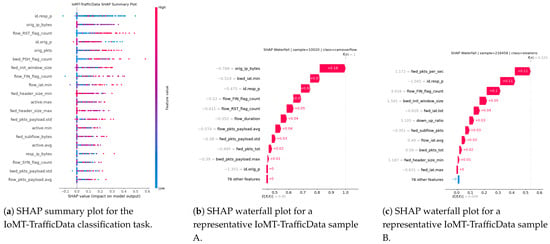
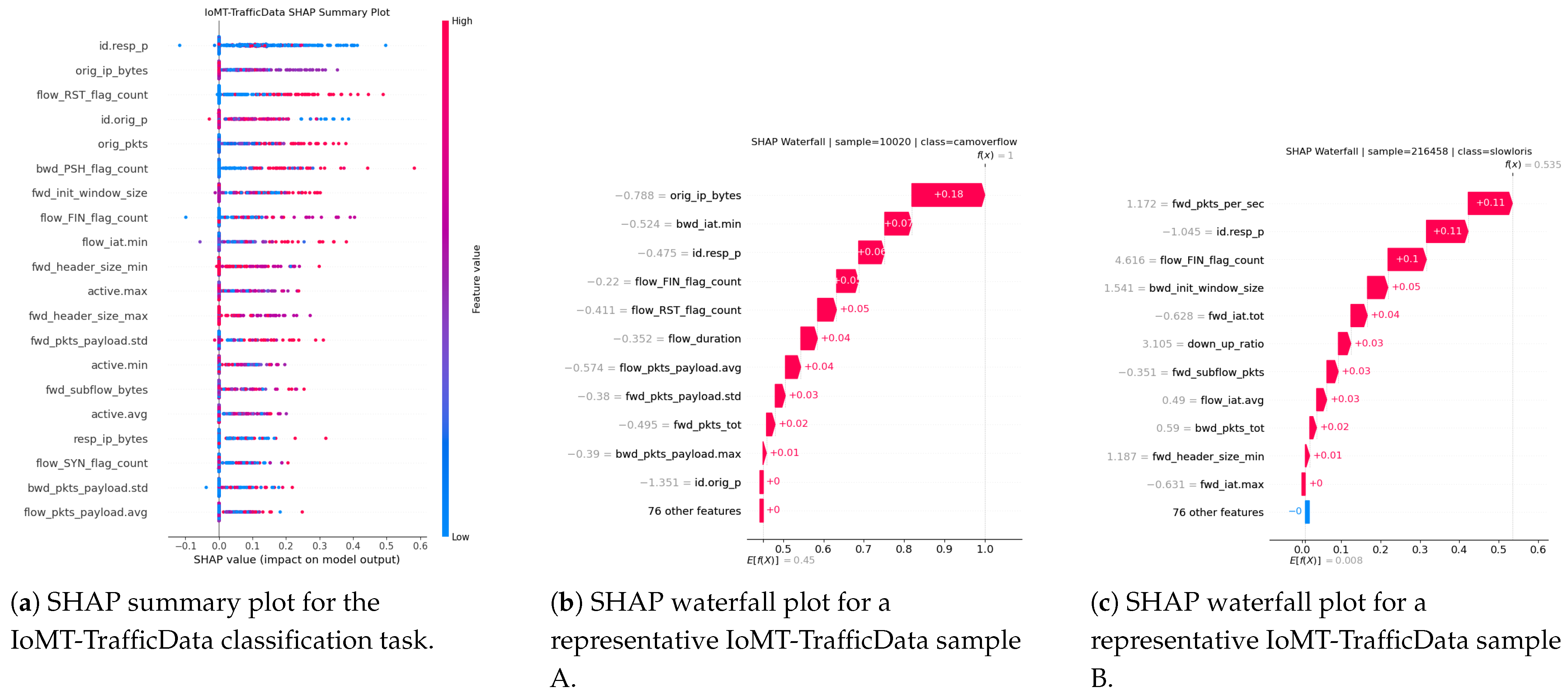
The SHAP summary plot in Figure 16a shows that the model relies on a compact set of influential flow attributes, led by id.resp_p, orig_ip_bytes, flow_RST_flag_count, id.orig_p, and orig_pkts. This indicates that the model primarily distinguishes traffic classes through endpoint-port behavior, byte-level flow characteristics, and flag-related activity. The representative SHAP waterfall plots in Figure 16b,c provide additional local insight. In the correctly classified camoverflow example, the prediction is mainly driven by features such as orig_ip_bytes, bwd_iat.min, and id.resp_p, whereas in the slowloris example the decision is supported by fwd_pkts_per_sec, id.resp_p, and flow_FIN_flag_count. These examples show that different traffic classes are explained by distinct local feature combinations rather than by a single uniform decision pattern.
Figure 16.
SHAP-based global and local explanations for the IoMT-TrafficData classification task. (a) SHAP summary plot showing global feature importance. (b,c) SHAP waterfall plots illustrating local feature contributions for two representative predictions.
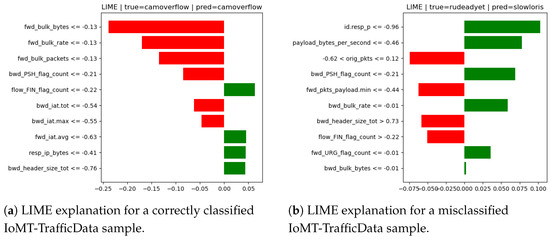
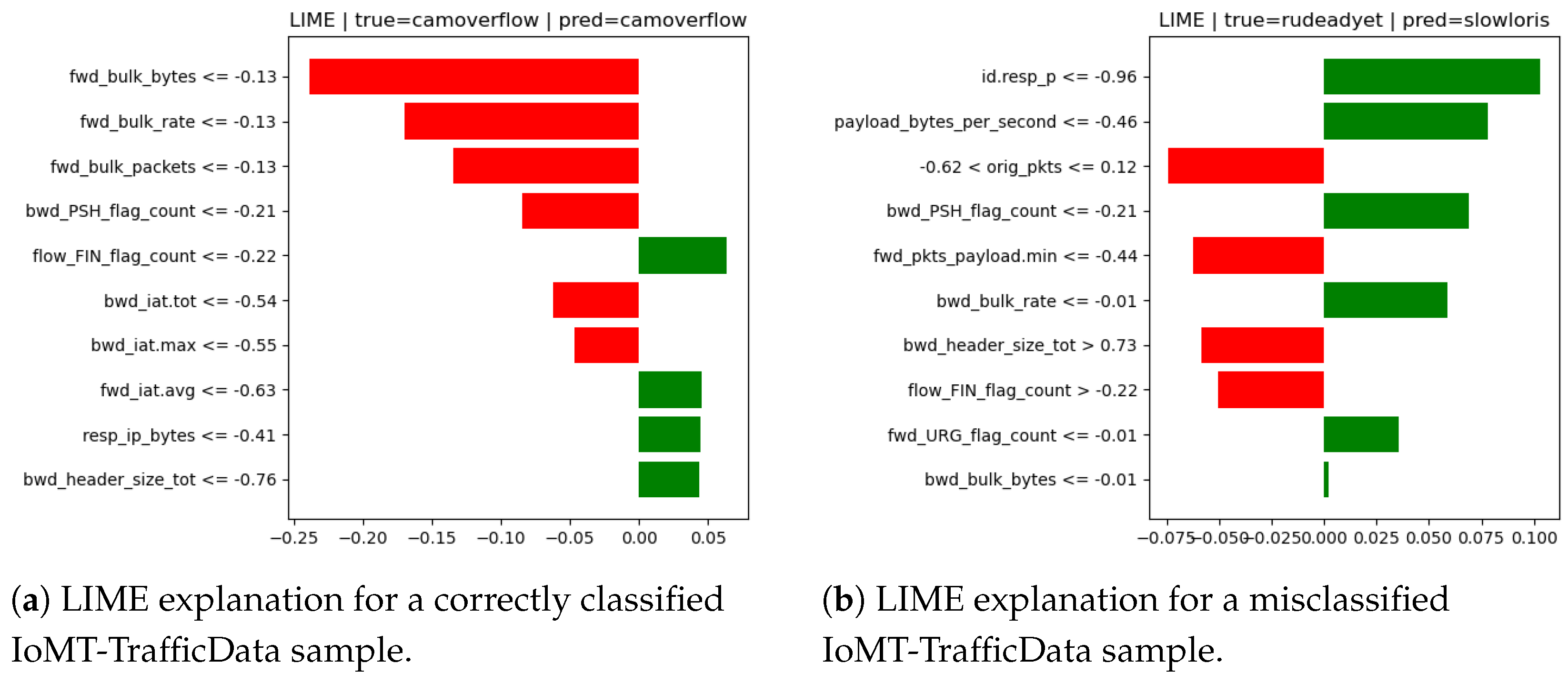
The LIME explanations in Figure 17a,b provide complementary sample-level evidence. In the correctly classified camoverflow example, the decision is influenced by a combination of bulk-traffic and backward-packet features, including fwd_bulk_bytes, fwd_bulk_rate, and flow_FIN_flag_count. In contrast, the misclassified example, where a true rudeadyet sample is predicted as slowloris, is driven by features such as id.resp_p, payload_bytes_per_second, and bwd_PSH_flag_count, while other packet- and header-related attributes contribute in the opposite direction. This local explanation is useful because it clarifies why the two classes can overlap in difficult cases despite the strong overall performance.
Figure 17.
LIME-based local explanations for representative correct and incorrect predictions in the IoMT-TrafficData task.
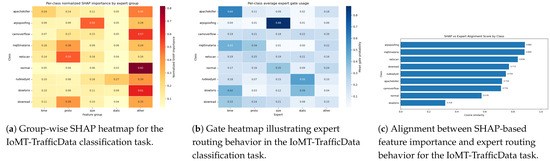
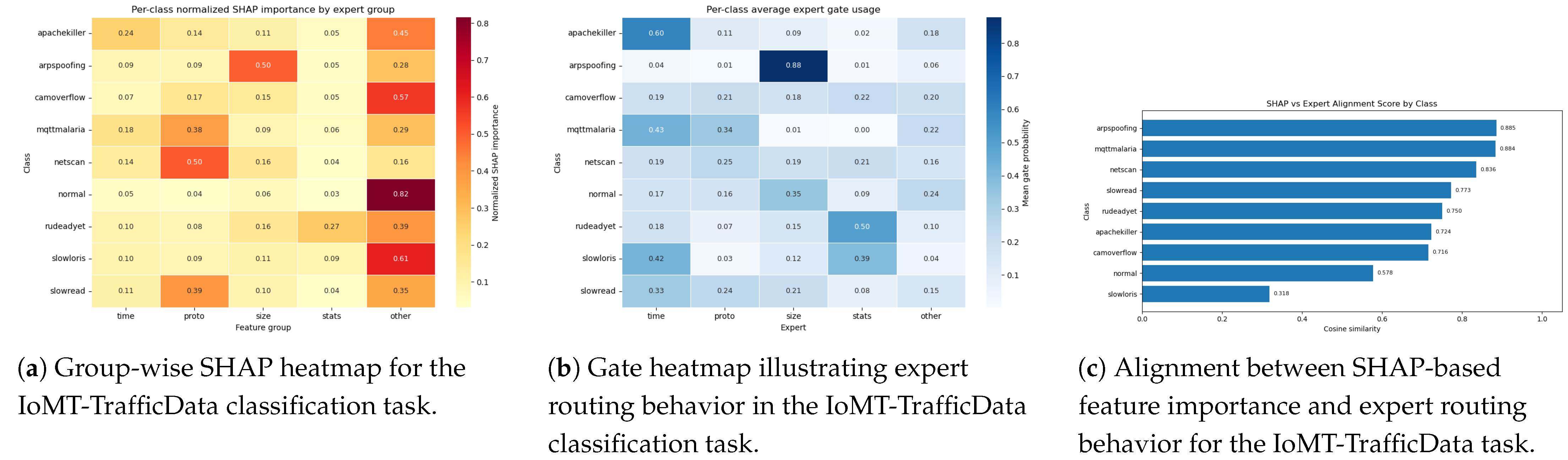
Figure 18a–c provide an expert-level view of the decision process. The SHAP-group heatmap shows that different classes depend on different grouped representations: arpspoofing is driven mainly by the size group, mqttmalaria, netscan, and slowread rely more strongly on the proto group, while apachekiller, camoverflow, normal, and slowloris depend most on the other group. The gate-usage heatmap reveals corresponding class-dependent routing behavior: apachekiller, mqttmalaria, and slowloris are routed more strongly toward the time expert, arpspoofing toward the size expert, and rudeadyet toward the stats expert, while some classes such as camoverflow and netscan exhibit a more distributed routing profile. The SHAP–expert alignment scores further show that the agreement between feature-group importance and expert routing is strongest for arpspoofing, mqttmalaria, and netscan, whereas slowloris shows noticeably weaker alignment. Overall, these results indicate that the proposed Mixture-of-Experts layer provides meaningful class-sensitive routing behavior that complements the feature-level explanations and strengthens the interpretability of the model on IoMT-TrafficData.
Figure 18.
Interpretability analysis of the proposed model on the IoMT-TrafficData dataset.
5.4. Ablation Study
The ablation results in Table 9 demonstrate the contribution of each proposed component across the CICIoMT2024 family-level, CICIoMT2024 fine-level, and IoMT-TrafficData classification tasks. The full model consistently achieves the best overall performance, obtaining accuracies of 0.9976, 0.9907, and 0.9992 with macro F1-scores of 0.9291, 0.8428, and 0.9937 on the three datasets, respectively. These results confirm the complementary roles of the MoE gate, cross-expert attention, and the proposed classification architecture. For the CICIoMT2024 family-level classification task, removing the MoE gate, removing cross-expert attention, or replacing the attention mechanism with simple concatenation results in only marginal reductions in accuracy (0.9939–0.9955) but noticeable decreases in macro precision, recall, and F1-score compared with the full model. In particular, the macro F1-score decreases from 0.9291 to 0.8688, 0.8666, and 0.8685, respectively, indicating that the proposed gating and attention mechanisms primarily enhance balanced recognition across different traffic families rather than only improving overall accuracy. The importance of these components becomes more pronounced in the CICIoMT2024 fine-level classification task, which involves distinguishing a larger number of attack categories. While the ablated variants maintain accuracies above 0.9867, their macro F1-scores decrease to 0.7699, 0.7631, and 0.7688 compared with 0.8428 for the full model. The larger gap between accuracy and macro metrics suggests that the proposed MoE gate and cross-expert attention significantly improve the detection of minority and fine-grained attack classes, leading to a more balanced classification performance. The standard MLP classifier exhibits the weakest performance on CICIoMT2024, achieving accuracies of 0.8133 and 0.8063 with macro F1-scores of 0.7710 and 0.6253 for the family-level and fine-level settings, respectively. The substantial degradation relative to the full model demonstrates that a conventional classifier is insufficient to capture the heterogeneous and complex characteristics of IoMT traffic without the proposed expert specialization and adaptive feature interaction mechanisms. On the IoMT-TrafficData dataset, all variants achieve very high performance, with macro F1-scores ranging from 0.9882 to 0.9911, indicating that the dataset is comparatively less challenging. Nevertheless, the full model still consistently provides the highest accuracy (0.9992), macro precision (0.9938), macro recall (0.9937), and macro F1-score (0.9937), outperforming all ablated versions. Overall, the ablation study verifies that the MoE gate, cross-expert attention, and specialized expert learning jointly enhance the robustness, balanced classification capability, and generalization performance of the proposed IoMT intrusion detection framework across datasets with varying levels of classification complexity.
Table 9.
Ablation study results on CICIoMT2024 family-level and fine-level classification settings.
5.5. Comparison of Proposed IDS Against Representative IoMT Intrusion Detection Methods
Table 10 presents a comparative evaluation of the proposed PAM-XMoE model against representative IoMT intrusion detection methods. The results show that the proposed approach significantly outperforms existing techniques, including HCLR-IDS [20], LSTM [21], and ConvNext–MoEs [29]. In particular, while LSTM achieves competitive performance, it lacks generalization across all metrics, and both HCLR-IDS and ConvNext–MoEs show relatively lower detection capability, especially in recall and F1-score. In contrast, the proposed PAM-XMoE consistently achieves the best performance across all evaluation metrics, demonstrating its superior ability to capture complex IoMT traffic patterns and improve detection reliability.
Table 10.
Comparison with representative IoMT intrusion detection methods with proposed IDS.
6. Conclusions
This paper presented an explainable hybrid intrusion detection framework for IoMT environments. The proposed framework integrates feature-group-aware expert learning, gate-balanced MoE routing, and cross-expert self-attention to capture complementary traffic characteristics from heterogeneous IoMT network traffic. In addition to predictive modeling, the framework incorporates multi-level interpretability through SHAP, LIME, and expert-routing analysis, enabling both feature-level and internal model-behavior interpretation. The effectiveness of the proposed framework was validated on two recent IoMT benchmark datasets, namely CICIoMT2024 and IoMT-TrafficData. On CICIoMT2024, the model achieved 99.76% accuracy, 92.91% macro F1-score, and an MCC of 0.9951 in the 6-class classification setting, while attaining 99.07% accuracy, 84.29% macro F1-score, and an MCC of 0.9892 in the 19-class classification setting. On IoMT-TrafficData, the proposed framework achieved 99.92% accuracy, 99.37% macro F1-score, and an MCC of 0.9988 for the multiclass task. These results demonstrate that the proposed architecture is highly effective for both coarse-grained and fine-grained multiclass intrusion detection under heterogeneous IoMT traffic conditions. The interpretability analysis further showed that the framework does not operate as a purely black-box detector. SHAP and LIME identified meaningful traffic attributes that influence both global and local predictions, while the expert-routing analysis revealed class-dependent expert utilization and meaningful alignment between feature-group importance and MoE routing behavior. Therefore, the proposed framework provides not only strong detection capability but also improved transparency for security analysts and healthcare stakeholders. Overall, the findings indicate that the proposed Hybrid-IDS offers an effective and interpretable solution for IoMT intrusion detection. Future work will focus on extending the framework to additional IoMT datasets, improving minority-class discrimination in fine-grained settings, and investigating lightweight deployment for real-time medical network environments.
Limitations and Future Research Directions
Despite the promising performance achieved by the proposed IDS, several limitations should be acknowledged. First, the proposed framework introduces additional computational overhead compared with conventional machine learning and single-network deep learning models due to the use of multiple expert networks, adaptive gating, and cross-expert attention mechanisms. Although the model remains relatively compact in size, training time increases with dataset scale and model complexity. Second, while focal loss and gate-balanced routing help mitigate class imbalance, performance degradation can still occur for minority classes and highly similar attack categories, particularly in fine-grained multiclass settings. This challenge remains an open issue for IoMT intrusion detection and warrants further investigation. Third, the scalability of the proposed expert-based architecture to substantially larger feature spaces, larger numbers of traffic classes, or continuously evolving attack types has not yet been fully explored. Additional studies are required to assess the behavior of the routing mechanism and expert specialization under more complex deployment scenarios. Finally, although the proposed framework demonstrates strong performance on benchmark datasets, real-world IoMT environments may introduce practical challenges related to resource constraints, latency requirements, dynamic traffic distributions, and previously unseen attacks. Future work will therefore focus on lightweight model optimization, real-time edge deployment, continual learning strategies, and evaluation on additional real-world IoMT datasets.
Author Contributions
Conceptualization, A.K. and Y.L.; methodology, A.K. and Y.L.; software, A.K.; validation, A.K., Y.L., I.K. and M.M.K.; formal analysis, A.K.; investigation, A.K.; resources, Y.L.; data curation, A.K.; writing original draft preparation, A.K.; writing review and editing, Y.L., I.K. and M.M.K.; visualization, Y.L.; project administration and supervision, Y.L. supervised the study and provided overall research guidance. All authors have read and agreed to the published version of the manuscript.
Funding
This research received no external funding.
Data Availability Statement
The link to the dataset used in this study is provided in the paper.
Conflicts of Interest
The authors declare no conflicts of interest.
References
- Qureshi, R.; Koo, I. A Comprehensive Survey of Cybersecurity Threats and Data Privacy Issues in Healthcare Systems. Appl. Sci. 2026, 16, 1511. [Google Scholar] [CrossRef]
- Javeed, D.; Gao, T.; Saeed, M.S.; Kumar, P.; Kumar, R.; Jolfaei, A. A softwarized intrusion detection system for iot-enabled smart healthcare system. In ACM Transactions on Internet Technology; ACM Digital Library: New York, NY, USA, 2023. [Google Scholar]
- Hassan, S.R.; Tanveer, M.U.; Prajapat, S.; Shabaz, M. A Comprehensive Survey on Intrusion Detection in Internet of Medical Things: Datasets, Federated Learning, Blockchain, and Future Research Directions. ICT Express 2025, 11, 1291–1310. [Google Scholar] [CrossRef]
- Naghib, A.; Soleimanian Gharehchopogh, F.; Zamanifar, A. A Comprehensive and Systematic Literature Review on Intrusion Detection Systems in the Internet of Medical Things: Current Status, Challenges, and Opportunities. Artif. Intell. Rev. 2025, 58, 114. [Google Scholar] [CrossRef]
- Dadkhah, S.; Pinto Neto, E.C.; Ferreira, R.; Molokwu, R.C.; Sadeghi, S.; Ghorbani, A.A. CICIoMT2024: A Benchmark Dataset for Multi-Protocol Security Assessment in IoMT. Internet Things 2024, 28, 101351. [Google Scholar] [CrossRef]
- Ramesh, K.; Miller, N.C.; Faridi, A.; Aloul, F.A.; Zualkernan, I.A.; Sajun, A.R. Efficient Machine Learning Frameworks for Strengthening Cybersecurity in Internet of Medical Things (IoMT) Ecosystems. In 2024 IEEE International Conference on Internet of Things and Intelligence Systems (IoTaIS); IEEE: New York, NY, USA, 2024; pp. 92–98. [Google Scholar] [CrossRef]
- Dzamesi, L.; Elsayed, N. A Review on the Security Vulnerabilities of the IoMT against Malware Attacks and DDoS. In 2025 IEEE 4th International Conference on Computing and Machine Intelligence (ICMI); IEEE: New York, NY, USA, 2025; pp. 1–8. [Google Scholar] [CrossRef]
- Benahmed, H.; M’hamedi, M.; Merzoug, M.; Hadjila, M.; Bekkouche, A.; Etchiali, A.; Mahmoudi, S. HBiLD-IDS: An Efficient Hybrid BiLSTM-DNN Model for Real-Time Intrusion Detection in IoMT Networks. Information 2025, 16, 669. [Google Scholar] [CrossRef]
- Javeed, D.; Gao, T.; Saeed, M.S.; Kumar, P. An intrusion detection system for edge-envisioned smart agriculture in extreme environment. IEEE Internet Things J. 2023, 11, 26866–26876. [Google Scholar] [CrossRef]
- Yacoubi, M.; Moussaoui, O.; Drocourt, C. AI for IoMT Security: A Comprehensive Survey of Intrusion Detection and System Architectures. Internet Things 2026, 36, 101869. [Google Scholar] [CrossRef]
- Hassen, S.; Abdlrazaq, A. Contextual Deep Semantic Feature Driven Multi-Types Network Intrusion Detection System for IoT-Edge Networks. Zanco J. Pure Appl. Sci. 2024, 36, 132–147. [Google Scholar] [CrossRef]
- Zhang, Y.; Muniyandi, R.C.; Qamar, F. A Review of Deep Learning Applications in Intrusion Detection Systems: Overcoming Challenges in Spatiotemporal Feature Extraction and Data Imbalance. Appl. Sci. 2025, 15, 1552. [Google Scholar] [CrossRef]
- Kalakoti, R.; Nõmm, S.; Bahsi, H. Explainable Transformer-Based Intrusion Detection in Internet of Medical Things (IoMT) Networks. In 2024 International Conference on Machine Learning and Applications (ICMLA); IEEE: New York, NY, USA, 2024; pp. 1164–1169. [Google Scholar] [CrossRef]
- Alzahrani, A.I.A.; Al-Rasheed, A.; Ksibi, A.; Ayadi, M.; Asiri, M.M.; Zakariah, M. Anomaly Detection in Fog Computing Architectures Using Custom Tab Transformer for Internet of Things. Electronics 2022, 11, 4017. [Google Scholar] [CrossRef]
- Saraniya, S.; Sowmiya, M.V.; Kalpana, B.N.; Karthi, M. Securing Networks: Unleashing the Power of the FT-Transformer for Intrusion Detection. In 2024 International Conference on Computer, Electrical & Communication Engineering (ICCECE); IEEE: New York, NY, USA, 2024; pp. 1–7. [Google Scholar] [CrossRef]
- Keles, F.D.; Wijewardena, P.M.; Hegde, C. On the Computational Complexity of Self-Attention. In 34th International Conference on Algorithmic Learning Theory; Agrawal, S., Orabona, F., Eds.; PMLR: New York, NY, USA, 2023; Volume 201, pp. 597–619. [Google Scholar]
- Akhi, M.; Eising, C.; Dhirani, L.L. TCN-Based DDoS Detection and Mitigation in 5G Healthcare-IoT: A Frequency Monitoring and Dynamic Threshold Approach. IEEE Access 2025, 13, 12709–12733. [Google Scholar] [CrossRef]
- Hosain, Y.; Çakmak, M. XAI-XGBoost: An Innovative Explainable Intrusion Detection Approach for Securing Internet of Medical Things Systems. Sci. Rep. 2025, 15, 22278. [Google Scholar] [CrossRef] [PubMed]
- Javeed, D.; Gao, T.; Kumar, P.; Jolfaei, A. An explainable and resilient intrusion detection system for industry 5.0. IEEE Trans. Consum. Electron. 2023, 70, 1342–1350. [Google Scholar] [CrossRef]
- Shaikh, J.A.; Wang, C.; Sima, M.W.U.; Arshad, M.; Owais, M.; Hassan, D.S.M.; Alkanhel, R.; Muthanna, M.S.A. A Deep Reinforcement Learning-Based Robust Intrusion Detection System for Securing IoMT Healthcare Networks. Front. Med. 2025, 12, 1524286. [Google Scholar] [CrossRef] [PubMed]
- Sharma, N.; Shambharkar, P.G. Multi-attention DeepCRNN: An Efficient and Explainable Intrusion Detection Framework for Internet of Medical Things Environments. Knowl. Inf. Syst. 2025, 67, 5783–5849. [Google Scholar] [CrossRef]
- Akar, G.; Sahmoud, S.; Onat, M.; Cavusoglu, U.; Malondo, E. L2D2: A Novel LSTM Model for Multi-Class Intrusion Detection Systems in the Era of IoMT. IEEE Access 2025, 13, 7002–7013. [Google Scholar] [CrossRef]
- Nazir, A.; He, J.; Zhu, N.; Qureshi, S.S.; Qureshi, S.U.; Ullah, F.; Wajahat, A.; Pathan, M.S. A Deep Learning-Based Novel Hybrid CNN-LSTM Architecture for Efficient Detection of Threats in the IoT Ecosystem. Ain Shams Eng. J. 2024, 15, 102777. [Google Scholar] [CrossRef]
- Shaikh, J.A.; Wang, C.; Saifullah; Sima, M.W.U.; Arshad, M.; Rathore, W.U.A. Memory Feedback Transformer Based Intrusion Detection System for IoMT Healthcare Networks. Internet Things 2025, 32, 101597. [Google Scholar] [CrossRef]
- Bhuvaneswari, E.; Uthradevi, G.; Kinol, A.M.J.; Shanthi, P. Edgeguardmed: Transformer-Based Intrusion Detection with Packet-Flow Fusion for Resilient IoMT. In Biomedical Materials & Devices; Springer: Berlin/Heidelberg, Germany, 2025. [Google Scholar] [CrossRef]
- Alsharaiah, M.A.; Almaiah, M.A.; Shehab, R.; Obeidat, M.; El-Qirem, F.A.; Aldhyani, T. An Explainable AI-Driven Transformer Model for Spoofing Attack Detection in Internet of Medical Things (IoMT) Networks. Discov. Appl. Sci. 2025, 7, 488. [Google Scholar] [CrossRef]
- Pande, S.D.; Mahore, T.R.; Joshi, A.A.; Kute, V.B.; Sagne, S.S.; Dahat, A.V. An Explainable Hybrid TabTransformer–Random Forest Model for Biometric Security in IoMT Healthcare Systems. In Recent Advances in Computational Intelligence Applications for Biometrics and Biomedical Devices; Khamparia, A., Gupta, D., Dey, N., Ashour, A.S., Fong, S.J., Eds.; Academic Press: Cambridge, MA, USA, 2026; pp. 285–300. [Google Scholar] [CrossRef]
- Yuan, X.; Kong, W.; Luo, Z.; Xu, M. Efficient Inference Offloading for Mixture-of-Experts Large Language Models in Internet of Medical Things. Electronics 2024, 13, 2077. [Google Scholar] [CrossRef]
- Yang, J.; Zhang, K.; Zheng, R.; Li, C.; Zheng, J. IoT Network Security Threat Detection Algorithm Integrating Symmetric Routing and a Sparse Mixture-of-Experts Model. Symmetry 2026, 18, 63. [Google Scholar] [CrossRef]
- Rahim, K.; Nasir, Z.U.I.; Ikram, N.; Qureshi, H.K. Integrating Contextual Intelligence with Mixture of Experts for Signature and Anomaly-Based Intrusion Detection in CPS Security. Neural Comput. Appl. 2025, 37, 5991–6007. [Google Scholar] [CrossRef]
- Alashour, A.; Arbane, R.; Salem, O.; Mehaoua, A. Learning and Temporal Convolutional Networks for Enhanced Ransomware Detection in IoMT Environments. In 2025 IEEE International Conference on E-health Networking, Application & Services (HealthCom); IEEE: New York, NY, USA, 2025; pp. 1–6. [Google Scholar] [CrossRef]
- Kavun, S. AdaptiveBayes: Comprehensive empirical analysis and algorithmic enhancement framework. In Proceedings of the Workshop on Cybersecurity Providing in Information and Telecommunication Systems (CPITS-II 2025), Kyiv, Ukraine, 26 October 2025; pp. 149–176. [Google Scholar]
- Zhou, Y.; Lei, T.; Liu, H.; Du, N.; Huang, Y.; Zhao, V.Y.; Dai, A.M.; Chen, Z.; Le, Q.V.; Laudon, J. Mixture-of-Experts with Expert Choice Routing. In Advances in Neural Information Processing Systems; ACM Digital Library: New York, NY, USA, 2022; Volume 35, pp. 7103–7114. [Google Scholar]
- Shazeer, N.; Mirhoseini, A.; Maziarz, K.; Davis, A.; Le, Q.; Hinton, G.; Dean, J. Outrageously large neural networks: The sparsely-gated mixture-of-experts layer. arXiv 2017, arXiv:1701.06538. [Google Scholar]
- Ilias, L.; Doukas, G.; Lamprou, V.; Ntanos, C.; Askounis, D. Convolutional Neural Networks and Mixture of Experts for Intrusion Detection in 5G Networks and beyond. Front. Artif. Intell. 2025, 8, 1708953. [Google Scholar] [CrossRef] [PubMed]
- Nikolic, S.; Oguz, I.; Psaltis, D. Exploring expert specialization through unsupervised training in sparse mixture of experts. arXiv 2025, arXiv:2509.10025. [Google Scholar]
- Vaswani, A.; Shazeer, N.; Parmar, N.; Uszkoreit, J.; Jones, L.; Gomez, A.N.; Kaiser, L.; Polosukhin, I. Attention Is All You Need. In Advances in Neural Information Processing Systems; ACM Digital Library: New York, NY, USA, 2017; Volume 30. [Google Scholar]
- Lin, M.; Chen, Q.; Yan, S. Network In Network. arXiv 2013, arXiv:1312.4400. [Google Scholar]
- Lundberg, S.M.; Lee, S.I. A Unified Approach to Interpreting Model Predictions. In Advances in Neural Information Processing Systems; ACM Digital Library: New York, NY, USA, 2017; Volume 30, pp. 4765–4774. [Google Scholar]
- Turgut, Z.; Başarslan, M.S. XBiDeep: A Novel Explainable Artificial Intelligence Based Intrusion Detection System for Internet of Medical Things Environment. Internet Things 2025, 33, 101675. [Google Scholar] [CrossRef]
- Georgiades, M.; Hussain, F. An Explainable AI Approach for Interpretable Cross-Layer Intrusion Detection in Internet of Medical Things. Electronics 2025, 14, 3218. [Google Scholar] [CrossRef]
- Ribeiro, M.T.; Singh, S.; Guestrin, C. “Why Should I Trust You?”: Explaining the Predictions of Any Classifier. In 22nd ACM SIGKDD International Conference on Knowledge Discovery and Data Mining; ACM Digital Library: New York, NY, USA, 2016; pp. 1135–1144. [Google Scholar] [CrossRef]
- Jacobs, R.A.; Jordan, M.I.; Nowlan, S.J.; Hinton, G.E. Adaptive Mixtures of Local Experts. Neural Comput. 1991, 3, 79–87. [Google Scholar] [CrossRef] [PubMed]
- Areia, J.; Bispo, I.A.; Santos, L.; Costa, R.L.d.C. IoMT-TrafficData: Dataset and Tools for Benchmarking Intrusion Detection in Internet of Medical Things. IEEE Access 2024, 12, 115370–115385. [Google Scholar] [CrossRef]

Disclaimer/Publisher’s Note: The statements, opinions and data contained in all publications are solely those of the individual author(s) and contributor(s) and not of MDPI and/or the editor(s). MDPI and/or the editor(s) disclaim responsibility for any injury to people or property resulting from any ideas, methods, instructions or products referred to in the content. |
© 2026 by the authors. Licensee MDPI, Basel, Switzerland. This article is an open access article distributed under the terms and conditions of the Creative Commons Attribution (CC BY) license.