


Abstract
Tire and road wear particles (TRWPs) are major sources of non-exhaust traffic emissions. However, a limited understanding of their generation mechanisms and the lack of efficient collection methods under realistic driving conditions hinder accurate assessment. This study addresses these challenges by developing a vehicle-based methodology for the controlled recovery and characterization of TRWPs in the near-field region, rather than for direct quantification of real-world emissions. An autonomous electric vehicle was employed to ensure stable driving conditions and eliminate exhaust interference. Near-field distribution of TRWPs was visualized using a high-sensitivity optical scattering system. Based on this, a sealed tire enclosure with a high-power on-vehicle vacuum collection system was designed to enhance particle containment and recovery. Controlled circular driving tests were conducted on a dedicated outdoor test track under well-defined and repeatable conditions to enable system-level evaluation of TRWP generation and collection relative to measured tire wear. Particles were analyzed by thermogravimetric analysis, microscopy, scanning electron microscopy–energy-dispersive X-ray spectroscopy, and particle imaging. The results demonstrated stable, reproducible TRWP generation with ~60% collection efficiency relative to tire mass loss. These values are reported as system-dependent recovery indicators rather than precise emission estimates. Additional tests with an expanded recovery protocol indicated that collection efficiency can increase to ~81% (range: 73–91%), highlighting the influence of collection coverage. The collected TRWPs exhibited heterogeneous morphology, bimodal size distribution, and a mixed rubber–mineral composition in the 10–100 μm range. Spatial analysis revealed that TRWPs predominantly accumulated within a narrow zone around the driving lane. While the controlled experimental configuration enables reproducible particle generation and high-efficiency recovery, it represents a simplified driving scenario and may not fully capture the variability of real-world traffic conditions, including straight-line driving and transient maneuvers. Overall, this study demonstrates a technical framework for reproducible and comparative recovery of tire-associated particles under identical, well-defined conditions. The approach is intended to support controlled characterization studies while explicitly acknowledging limitations related to representativeness, particle origin attribution, and quantitative emission relevance, rather than to establish emission factors or mechanistic descriptions of TRWP generation.
1. Introduction
Tire and road wear particles (TRWPs) are generated by the friction between vehicle tires and road surfaces. This friction is essential for ensuring a safe and comfortable journey. However, this same friction gradually wears down both tire tread and road pavement, leading to the generation of TRWPs. These particles consist of a mixture of tire tread and road pavement materials. Non-exhaust traffic emissions, including tire wear particles, have been recognized for several decades, with early studies dating back to the 1970s [1,2]; however, in recent years, TRWPs have received increasing attention due to their potential environmental impacts [3,4]. TRWPs account for 5–30% by mass of the non-exhaust particles associated with road traffic [5,6]. They spread through the environment via multiple pathways, including air emissions, runoff into water systems, and soil deposition [7]. However, significant gaps remain in our understanding of the mechanisms governing the generation and distribution of TRWPs under realistic driving conditions. A comprehensive understanding of their formation processes is therefore essential to accurately determine when, where, and to what extent TRWPs are distributed [8,9].
Several studies have examined the specific aspects of TRWP emissions, including emission rates [10], particle size distributions [8], and chemical composition [9]. However, the mechanisms controlling TRWP generation and distribution at the tire–road interface remain poorly understood. In addition, effective approaches for directly capturing TRWPs at their points of origin have received limited attention.
Research on TRWPs, including their generation mechanisms, environmental fate, and potential impacts, is actively being conducted worldwide [10,11,12,13,14,15]. These efforts involve contributions from academic institutions, governmental agencies, and industry-supported initiatives aimed at improving understanding of TRWP generation, transport, fate, and potential environmental impact.
Previous studies have reported several approaches for the collection of TRWPs, including outdoor vehicle-based tests, indoor drum testing, and laboratory-scale experiments [16,17,18]. Outdoor collection methods enable TRWP generation under conditions representative of real-world driving; however, they are often affected by contamination from road dust and background particles, which complicates sample purity and quantitative analysis [16,17]. For example, De Oliveira et al. [10] deployed an instrumented vehicle across five road types with an air intake positioned behind the front wheels to capture emitted particles. While this approach yielded realistic emission factors reaching up to 78 ± 8 µg/km on suburban roads, the study acknowledged that contributions from resuspended road dust and background particles co-collected at the inlet could not be fully excluded, introducing uncertainty in TRWP-specific quantification. Similarly, Truong et al. [19] demonstrated that particles collected at the rear of the wheel during on-road experiments on different route types contained mixed-source contributions. This, in turn, makes it inherently difficult to isolate tire-derived particles from road-abraded and resuspended material. This purity challenge is further highlighted by Wagner et al. [12], whose review of road dust chemical composition found that tire tread rubber accounts for only ~3% of bulk road dust mass on average, rising to less than 10% even in the finest size fraction (<10 µm). The review confirms that open-road sampling yields highly diluted TRWP samples.
Indoor methods, such as drum tests, allow for controlled environmental conditions and improved reproducibility; however, discrepancies between laboratory conditions and actual road environments remain a key limitation [17]. Schubert et al. [18] highlighted this challenge on an outer drum test bed, where a degumming agent (talcum powder) was required to prevent tire adhesion to the drum surface. While this enabled measurable wear rates, the talcum powder itself introduced extraneous particles into the measurement stream, making it extremely difficult to distinguish genuine TWP emissions from the additive background even with a flow-optimized enclosure. Hesse et al. [20] compared on-road and single-wheel dynamometer test methods and identified road surface condition, driver behavior, and emissions from external ambient sources as major confounding factors on on-road measurements. However, the single-wheel dynamometer produced particle number concentrations that were low across multiple driving scenarios that raise questions about whether dynamometer conditions adequately stimulate the tribological mechanisms that generate representative particle populations.
Similarly, laboratory-scale experiments facilitate high-throughput particle generation and detailed analysis; however, they often lack realistic tire–road interaction dynamics, which limits their applicability to real-world emission scenarios [18]. For example, Kim and Lee [13], using a tire simulator, demonstrated that particle matter concentrations (PM2.5 and PM10) were strongly correlated with tire speed (r > 0.94) and load (r > 0.99). This indicates that particle generation is highly sensitive to test conditions. Even small deviations from real-world speed or load can therefore reduce the representativeness of the generated particles. Park et al. [15], similarly, reported that particle size distribution and concentration vary with tire–road contact parameters. This suggests that simplified laboratory setups cannot reproduce the full range of real driving conditions, leading to limited environmental relevance. Furthermore, Wahlström et al. [17] conducted pin-on-disk tribometer experiments under representative urban conditions. They found that airborne TRWP concentrations were negligible under moderate conditions. Measurable emissions occurred only under harsh contact conditions, which are not representative of typical driving. This highlights a trade-off between particle yield and real-world relevance in laboratory-scale approaches.
Previous studies on TRWPs have primarily focused on collecting representative samples of emissions under laboratory or on-road conditions, rather than recovering the majority of generated particles [16,17,18,19,21]. While these approaches are appropriate for emission characterization, they are not designed to achieve high overall collection efficiency. In related fields, such as brake wear emissions, enclosure-based systems that isolate the brake–disk assembly have been successfully applied to enable controlled particle collection. However, applying a similar enclosure concept to the tire–road interface under realistic driving conditions remains challenging due to the dynamic contact, deformation, and interaction between the tire and road surface. These challenges highlight the need for experimental methodologies that can balance realistic driving conditions with improved particle containment and recovery.
To address these research gaps, this study aimed to develop a methodology for visualizing and quantitatively assessing TRWP emission, distribution, and deposition at the tire–road interface. The study focused on establishing an experimental framework for TRWP investigations under controlled outdoor driving conditions, with emphasis on the collection and evaluation of emitted particles. Accordingly, a vehicle-based TRWP collection methodology was developed and verified using an autonomous driving platform in an outdoor environment. By stabilizing the driving conditions and integrating a sealed collection structure with real-time vacuum sampling, this approach aims to improve collection efficiency and particle purity while maintaining relevance to real-world driving conditions.
The scope of this research extends beyond standard tire wear testing to include particle generation and collection arising from tire–road surface interactions under realistic driving conditions [13,21]. While existing standardized methods, such as indoor drum tests for tire wear measurement (ISO/DIS 18511-2) [22] and the generation and collection of TRWP-road simulator laboratory method (ISO 22638:2024) [23], provide valuable benchmarks, the present study adopts an outdoor experimental configuration to examine particle generation and near-field behavior under well-defined and repeatable conditions. Compared to these standard methods, the proposed approach is intended to provide a controlled experimental framework for investigating TRWP generation mechanisms and particle behavior at the tire–road interface, rather than attempting to replicate the full complexity of real-world traffic emissions.
Accordingly, the results should be interpreted within the context of the experimental configuration, and their direct applicability to real-world emission factors is limited. This research is not intended as a regulatory compliance test, but rather as a scientific investigation of the generation and characteristics of TRWPs. Accordingly, a multifaceted approach was adopted, involving the design of collection methods, optimization of test conditions, and evaluation of the chemical composition, morphology, and size distribution of the collected particles. By expanding the experimental scope, this study provides a structured experimental approach that can support the source analysis of TRWPs, improve understanding of their near-field distribution, and inform the development of emission reduction technologies and product design considerations.
2. Materials and Methods
2.1. Visualization of Particle Diffusion Behavior in TRWPs
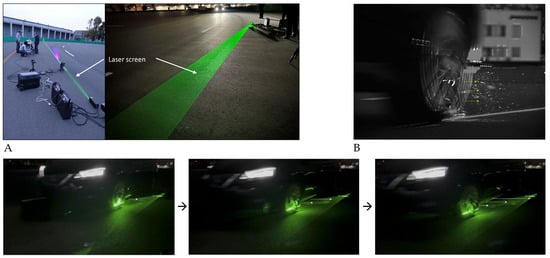
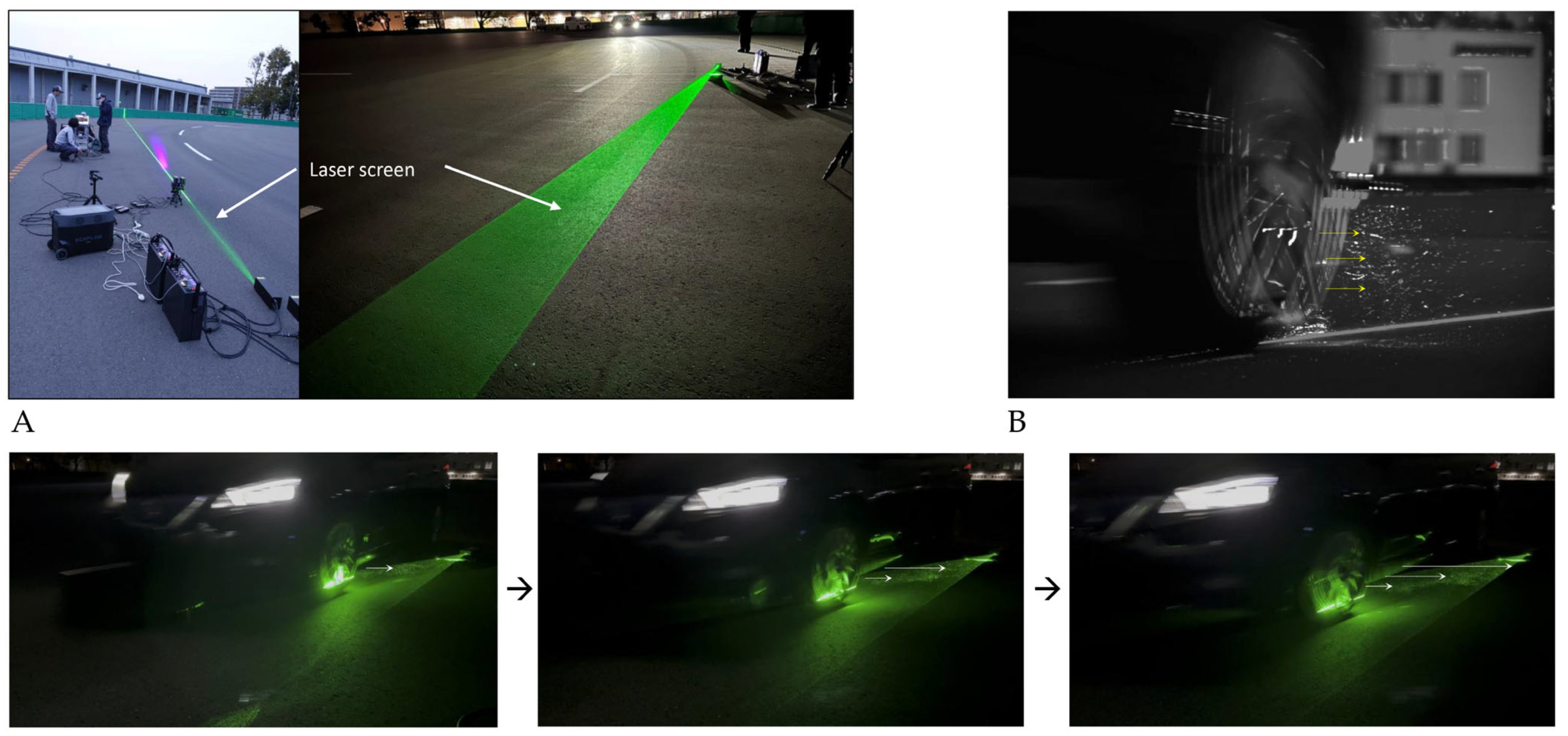
A visualization experiment was conducted to observe the distribution behavior of TRWPs around a rotating tire under realistic driving conditions. The near-field distribution of the TRWPs was visualized using a high-sensitivity optical scattering method implemented using the Visualization of Emitted Surface Transport system. A thin illuminated field, generated by a laser or LED light sheet, intersected the wheelhouse and tire–road contact region, allowing elastically scattered light from suspended particles to be captured by an ultrasensitive camera. Proprietary image processing was applied to isolate weak particle-scattered signals from background reflections and maintain a high dynamic range, enabling visualization and semiquantitative assessment based on particle counts and intensity indices under outdoor daylight conditions.
The visualization experiment employed a laser light source (VL2502G), LED lighting (ParallelEye D), and a high-sensitivity camera (ParticleEye EX, 40 fps) to observe particle motion around the tire while the vehicle was in motion. The visualization system was configured with the camera positioned at a fixed distance from the tire centerline and oriented toward the tire–road interaction region, while the LED light sheet was arranged laterally to illuminate the distribution field. Two illumination sources were used: an LED light source operating in the short-wavelength range of approximately 400–410 nm and a laser light source with a wavelength of 532 nm. These wavelengths were selected to enhance light scattering from particles within the observable size range. Image acquisition was performed at a frame rate of 40 frames per second, enabling time-resolved qualitative observation of particle trajectories and distribution behavior near the tire–road interface. This configuration, shown in Figure 1, enabled the real-time observation of particle movement during driving. The experiment was conducted in collaboration with SHIN NIPPON AIR TECHNOLOGIES, Co., Ltd. (Tokyo, Japan).
Figure 1.
Visualization of particle distribution using optical instrumentation. (A): Setting up a light source on the test course. (B): Visualizing particles associated with vehicle movement.
The visualization system is primarily sensitive to light-scattering particles with sizes on the order of approximately 10 μm and larger under the applied imaging conditions. Using this visualization approach, particle plume trajectories were qualitatively examined in both the rearward wake and lateral directions around the tire. In the present study, lateral direction refers exclusively to the outer lateral side of the vehicle, namely the direction from the outer side of the tire toward the surrounding road surface. The inner lateral side was not considered due to the geometric constraints of the vehicle, which limit the field of view and restrict optical access in this region. Regarding spatial resolution, the minimum particle size that can be realistically resolved by the visualization system is approximately 10 μm under nighttime observation conditions. This effective resolution limit is governed by the optical configuration, imaging geometry, and the high-sensitivity characteristics of the camera in combination with the proprietary ViEST image processing engine embedded in the analysis software (ParticleEye, SHIN NIPPON AIR TECHNOLOGIES, Co., Ltd.).
It should be noted that the observed scattering signals represent particles present in the near-field region around the tire during vehicle operation. These particles may include freshly generated TRWPs as well as resuspended road dust or mixed particles containing both tire-derived and mineral components. Accordingly, the visualization is intended to provide qualitative insight into particle distribution behavior rather than definitive identification of particle origin or composition. A detailed assessment of particle origin and transport mechanisms would require coupled airflow and particle tracking analyses, such as computational fluid dynamics (CFD) simulations, which are beyond the scope of the present study.
These observations provided spatial information on the distribution behavior of TRWPs near the source and served as the experimental basis for defining the enclosure coverage and collection strategy described in the subsequent section.
2.2. Design and On-Vehicle Collection System
2.2.1. Tire Cover, Funnel Geometry, and Vacuum System
Efficient collection of TRWPs requires a system that ensures stable generation conditions around the tires, prevents particle leakage, and ensures reliable collection. Accordingly, a collection system design concept was developed to satisfy these requirements.
First, an electric vehicle was used as a test vehicle to prevent the inclusion of external particles, such as exhaust gases, in the collection of TRWPs. This approach reduces the contribution of external emission sources and enables the collection of TRWPs with improved source specificity. The test was conducted on a circular track with a radius of 50 m on a flat, dense-graded asphalt surface. An electric vehicle (Nissan Leaf, model ZAA-ZE1, manufactured by Nissan Motor Co., Ltd., Yokohama, Japan was used as the test platform. To minimize contamination from brake wear particles, the experiments were designed such that mechanical braking was not applied during the test runs. Vehicle speed was controlled exclusively through regenerative braking, thereby avoiding frictional brake engagement and associated particle emissions.
Next, a structure was designed to cover the tire using a conductive, transparent polyethylene terephthalate (PET) film to suppress the distribution of particles generated around the tire. An antistatic-treated PET film was used to reduce electrostatic charge accumulation and particle adhesion on the enclosure surfaces. Specifically, a commercially available electrostatic discharge (ESD) control film (ST-PET, Achilles Corporation, Tokyo, Japan) was employed. This film incorporates a conductive coating designed to suppress electrostatic charge accumulation on the surface, thereby reducing particle adhesion and promoting more stable particle transport within the enclosure during vehicle operation. The transparency of the film enabled particle visualization while supporting effective particle transport toward the collection system.
A vacuum collection system was used to collect the particles. This high-power suction device efficiently collected the particles that floated or accumulated around the tire. The suction device was mounted on the vehicle, and the particles were collected in real time while driving. Regarding particle deposits, losses, and potential segregation within the sampling lines, the inner surfaces of the funnel and downstream tubing were visually inspected after each test. No significant particle accumulation or location-dependent deposition patterns were observed. However, subtle particle losses or size-dependent segregation effects cannot be completely excluded, particularly with respect to detailed particle size distribution analysis.
Furthermore, the vehicle was equipped with an autonomous driving function to stabilize TRWP generation conditions. This function enabled the precise regulation of driving parameters, such as speed, acceleration, and steering angle, which improved the reproducibility of the test conditions and reduced variability in particle generation. By combining these design elements, the TRWP collection system used in this study was configured to deliver high performance in terms of particle purity, collection efficiency, and test reproducibility.
2.2.2. External Structural Design Around the Tire House
To efficiently collect the TRWPs generated during vehicle operation, an external structural enclosure was designed around the tire house to suppress particle leakage and guide particles toward the collection system. As TRWPs are generated at the tire–road interface and distribute into the surrounding space during driving, a physically enclosed structure is required to maintain particle containment under realistic operating conditions.
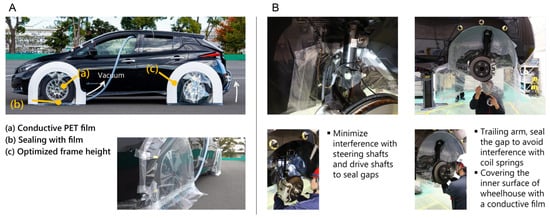
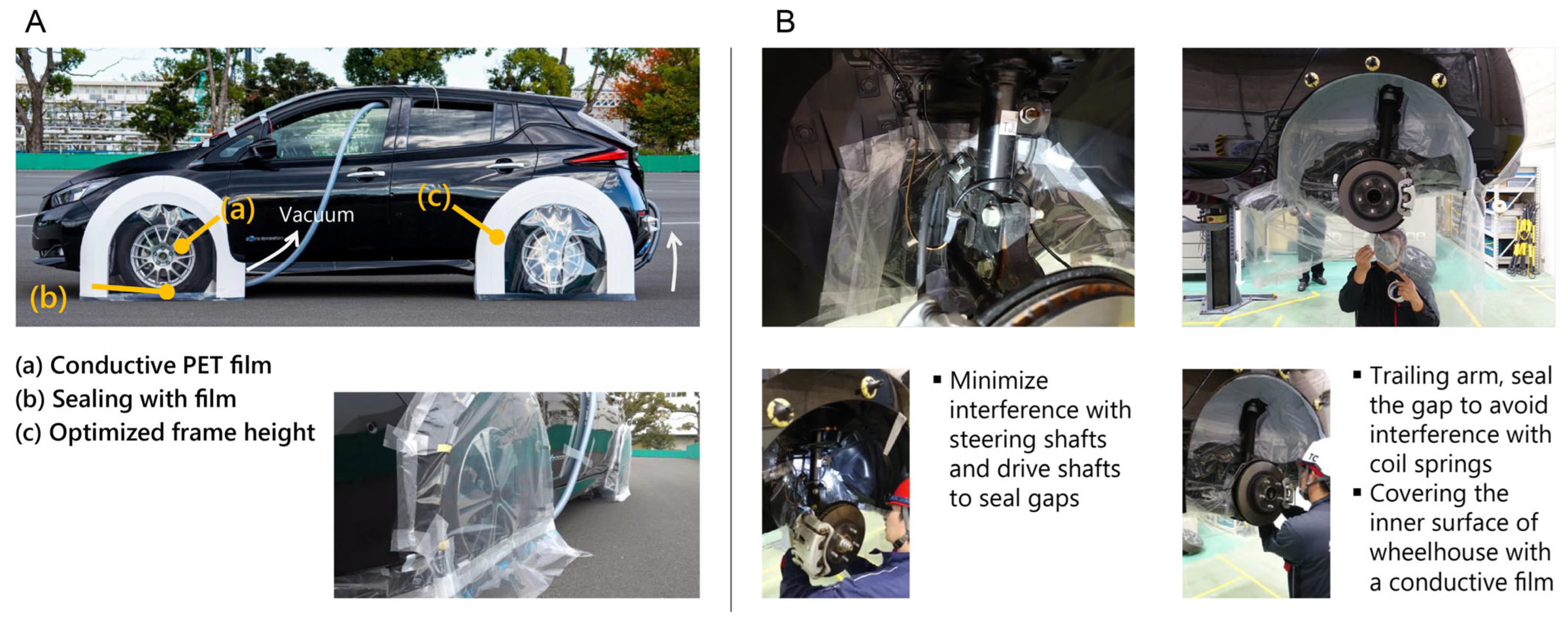
The space surrounding the tire was covered with a conductive, transparent PET film. The transparency of the film allowed visual confirmation of tire motion and particle behavior, while its conductive properties reduced electrostatic charge accumulation and particle adhesion to the enclosure surface. This configuration contributed to improved particle transport toward the collection inlet.
The PET film enclosure was supported by custom-designed connecting components that conformed to the external geometry of the vehicle. These components ensured a tight seal along the tire house while maintaining compatibility with the vehicle structure. Particular attention was paid to optimizing the height and placement of the enclosure frame to avoid mechanical interference with moving components, such as the steering shaft, drive shaft, trailing arm, and coil spring.
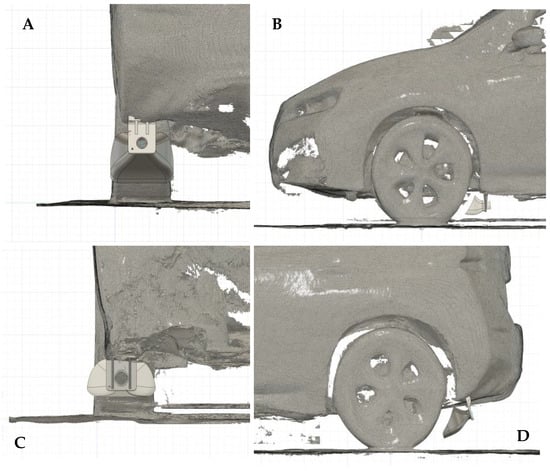
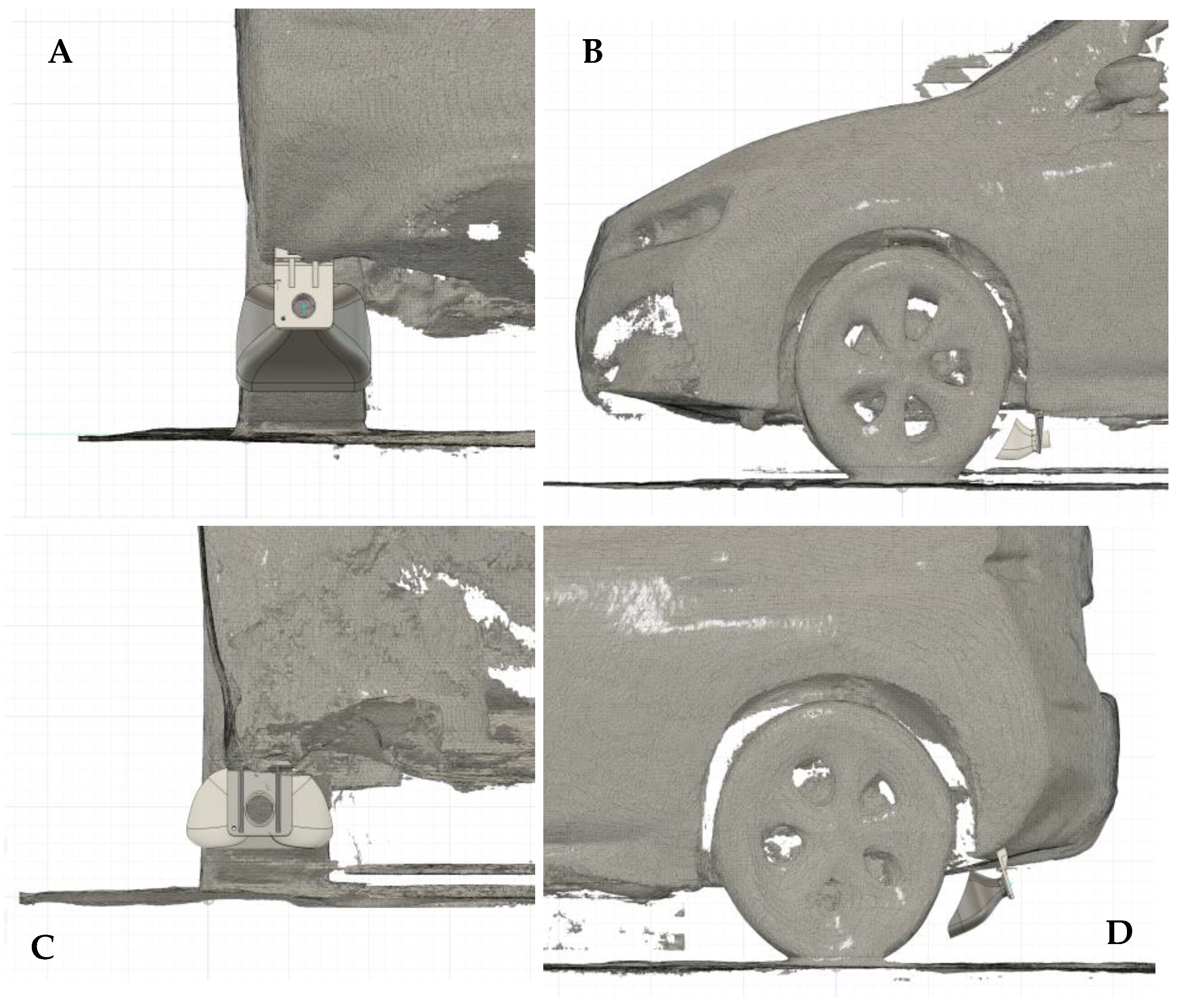
In addition, the enclosure incorporated a funnel-shaped geometry around the wheel to guide particles toward the collection region. The funnel dimensions were defined based on the test tire size and vehicle-specific spatial constraints. The funnel width was set to match the tire width (205 mm), ensuring full lateral coverage of the tire tread. Because the tire was fully enclosed by surrounding panels, this width was sufficient to suppress particle distribution caused by driving-induced airflow and to prevent lateral escape of particles. The lowest point of the funnel was positioned 50 mm above the ground surface to provide clearance under road undulation, suspension movement, and vehicle roll. Furthermore, the funnel edge was offset by 50 mm from the nominal outer tire diameter to prevent mechanical interference during suspension compression and rebound. The geometry was determined using three-dimensional scanning of the vehicle exterior, which enabled verification of spatial constraints and informed the final enclosure design (Figure 2).
Figure 2.
Three-dimensional scanning of the vehicle exterior. (A): Represents funnel position of the left rear wheel (viewed from the rear of the vehicle). (B): Represents funnel position of the left front wheel (viewed from the side of the vehicle). (C): Represents funnel position of the left front wheel (viewed from the rear of the vehicle). (D): Represents funnel position of the left rear wheel (viewed from the side of the vehicle).
To further minimize particle leakage, the gaps around the movable suspension and drivetrain components were sealed using an additional conductive film. A conductive film was also applied to the interior surfaces of the tire well to control particle adhesion and static behavior within the enclosure. These measures collectively contributed to stabilizing particle behavior within the enclosed region during driving. Avoiding particle deposition on the inner surfaces of the wheel compartment and on the wheel itself was an intentional design feature of the present study. This approach was adopted to facilitate recovery of a larger fraction of particles associated with the wear of the instrumented test tire, thereby enabling systematic comparison with measured tire wear loss. As a result, the collected particles include fractions that may not directly contribute to atmospheric emissions under real-world conditions. Accordingly, the measurements should be interpreted as representing an enclosure-influenced particle population for controlled investigation of tire wear, rather than direct exposure-relevant emissions.
The external structural design, shown in Figure 3, incorporated three primary features: (i) sealing the area surrounding the tire using a conductive transparent PET film, (ii) sealing gaps around movable components to prevent particle escape, and (iii) optimizing the enclosure geometry to conform to the vehicle shape. These features enabled the effective containment of TRWPs near the generation region and provided a controlled environment for subsequent particle collection during vehicle operation.
Figure 3.
External structural design around the tire housing. PET, polyethylene terephthalate. (A): Outside of the tire. (B): Inside of the tire.
In the context of this design, the enclosed wheel configuration employed in this study was intentionally designed to prioritize selective recovery of particles associated with the instrumented test tire, rather than to reproduce undisturbed real-world emission conditions. The primary objective of this approach is to enable recovery of a sufficiently large fraction of particles relative to the measured tire wear loss, which is essential for linking particle characteristics to their source.
In many previous on-road and laboratory studies, collected particles may include substantial contributions from non-test-tire sources, such as pre-existing road surface materials, previously deposited wear particles, or emissions from other vehicle components. In addition, reported collection efficiencies are often limited to a relatively small fraction of the total tire wear mass. Under such conditions, the collected samples may represent only a partial subset of the particle population generated by the tire.
The enclosure of the wheel housing in the present study represents a deliberate methodological trade-off. While the enclosed configuration modifies the local airflow and particle transport behavior, it enables improved containment and recovery of particles in the near-field region of the tire. This facilitates systematic comparison between tire wear mass loss and recovered particle mass under controlled conditions.
Accordingly, the collected particles should be interpreted as an enclosure-influenced near-field particle population, rather than as direct representations of real-world TRWP emissions. Potential artifacts associated with enclosure effects, including altered airflow, particle resuspension, and interactions with surrounding surfaces, are acknowledged.
2.2.3. Vehicle Internal Configuration and Autonomous Driving Control
The test vehicle was equipped with an internal vacuum-based collection system and autonomous driving control to enable stable generation and efficient collection of TRWPs. This configuration was designed to ensure consistent operating conditions during testing and minimize the variability associated with manual vehicle operation.
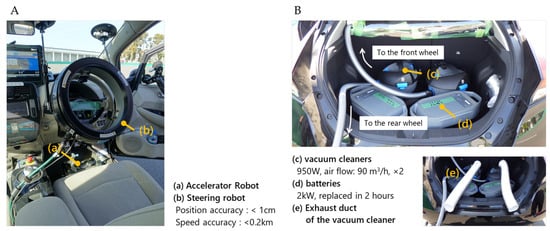
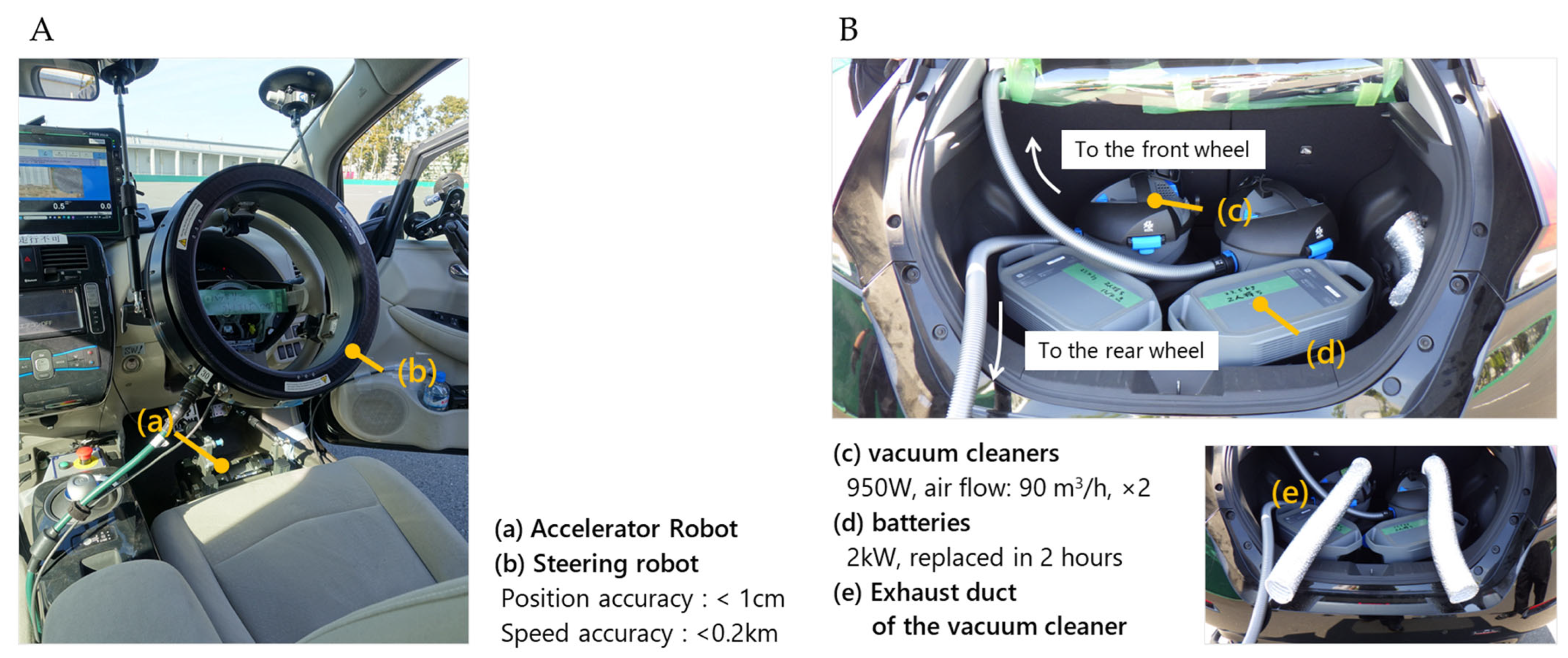
Two vacuum collection units with replaceable filters were installed in the vehicle trunk. Each unit had a rated power output of 950 W and a suction airflow of 90 m3/h, allowing efficient real-time collection of particles generated around the tires during driving. The selected airflow rate of 90 m3/h per unit was determined based on practical and operational considerations rather than optimization of emission representativeness. The primary purpose of suction was to reduce particle residence time within the enclosed wheel compartment and to limit particle deposition on internal surfaces, thereby enabling reproducible recovery of particles in proximity to the tire. In addition to these considerations, functional verification of airflow within wheel housing was conducted during system operation. Upon vacuum activation, inward deformation of the flexible wheel-house cover was visually observed, indicating the presence of negative pressure and confirming that air within the wheel compartment was effectively drawn toward the collection system.
Electrical power was supplied by a 2 kWh onboard battery system, which could be replaced approximately every two hours to support continuous long-duration testing.
The inlet of each suction duct was positioned at an approximate distance of 50 mm from the tire surface. This distance was selected as a compromise between proximity to the particle generation region and avoidance of mechanical interference with the tire under suspension motion and dynamic deformation. The suction duct was oriented such that the inlet face was parallel to the local tangential direction of the tire surface at the point of closest approach. In other words, the inlet plane of the suction duct was aligned parallel to the tire surface tangent, rather than along the radial or vertical axis. This orientation was chosen to facilitate efficient entrainment of particles emitted along the near-surface tangential flow generated by tire rotation and slip.
The vacuum ducts of the collection units were oriented toward the front and rear tires to efficiently guide airflow from the tire enclosure to the collection filters while avoiding interference with tire wear behavior. The collection lines connecting the wheel enclosure to the vacuum units consisted of smooth, flexible polyvinyl chloride (PVC) hoses reinforced with polyester fibers, selected for mechanical durability, flexibility, and resistance to deformation under suction. In this study, commercially available reinforced PVC hoses (TR-32, Toyox Co., Ltd., Kurobe, Japan) were used. The hoses had an inner diameter of 32 mm and an outer diameter of 41 mm. The total hose length depended on the wheel position, being approximately 3.7 m for the left front tire and 1.7 m for the left rear tire, measured from the wheel enclosure outlet to the collection unit. Relatively short duct lengths and sufficiently large inner diameters were selected to reduce pressure losses and limit particle residence time within the lines. In addition, high suction flow rates were maintained to minimize gravitational settling of super-micron particles during transport. Nevertheless, particle losses due to deposition on duct surfaces or electrostatic interactions cannot be completely excluded and are considered as part of the overall system performance.
Potential particle deposition within the sampling ducts may contribute to uncertainty in the overall collection efficiency. These effects were not independently quantified in the present study and are therefore considered part of the system-level uncertainty associated with the reported recovery values.
This configuration allowed particles to be suspended or accumulated near the tire and transported to the collection system during vehicle motion.
To improve test reproducibility and stabilize TRWP generation conditions, the vehicle was equipped with autonomous driving control functions, including accelerator and steering robots. These systems provided high-precision control of vehicle operation, with a positional accuracy of less than 1 cm and a speed control accuracy better than 0.2 km/h. By maintaining consistent speed, acceleration, and steering inputs, the autonomous driving configuration reduced the variability caused by human driving behavior. The use of an autonomous driving system in this study was intended to provide controlled and repeatable driving conditions for systematic investigation of TRWP generation and collection. While this approach reduces variability associated with human driving behavior, it may result in driving dynamics that differ from those encountered in heterogeneous real-world traffic conditions. Accordingly, the experimental conditions should be interpreted as a controlled configuration rather than a direct representation of real-world driving. The measured tire mass loss and associated particle recovery therefore reflect behavior under repeatable conditions and are not intended to directly represent real-world emission factors or exposure-relevant particle distributions. In this context, the mass balance between tire wear loss and recovered particles serves as an internal consistency measure within the experimental system, rather than a direct validation of real-world emission strength.
The combined use of an internal vacuum collection system and autonomous driving control (Figure 4) enabled the stable and reproducible generation and collection of TRWPs under controlled and well-defined driving conditions. While these conditions do not fully represent the complexity of real-world traffic scenarios, the proposed system provides a controlled experimental framework for comparative evaluation of TRWP collection and distribution characteristics under defined test conditions. This served as the basis for the external test procedures described in the following section.
Figure 4.
Internal configuration and autonomous driving control. (A): Autonomous driving. (B): Trunk room: Vacuum cleaner and battery.
2.3. TRWP Generation and Collection Test Procedures
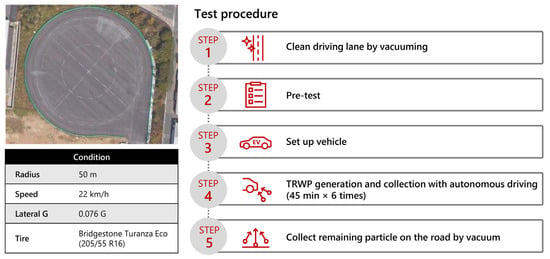
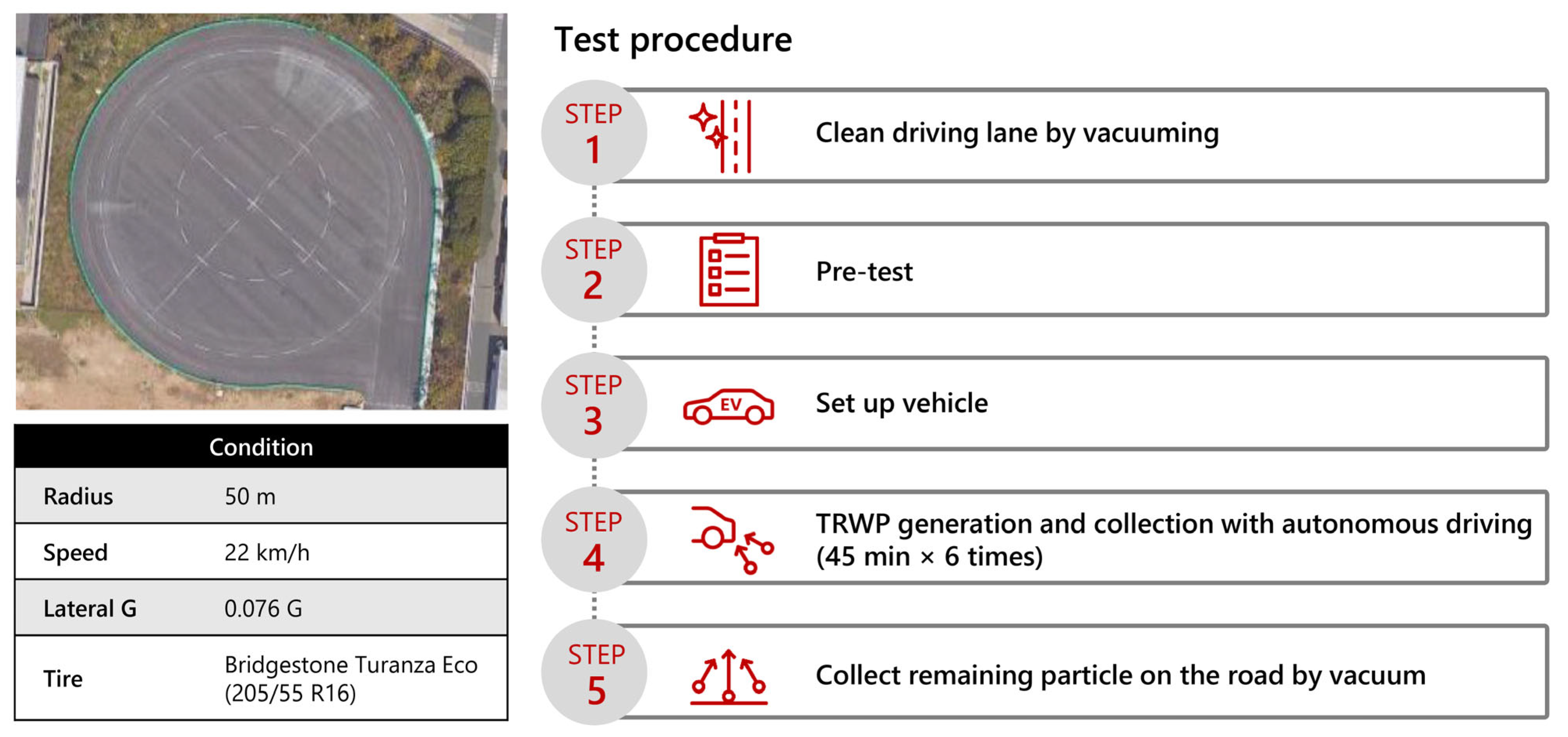
A full-scale vehicle-based test was designed and conducted to generate and collect TRWPs under controlled and reproducible conditions. The test procedure (Figure 5) aimed to minimize contamination from external particle sources while enabling stable TRWP generation and collection during vehicle operation.
Figure 5.
Test conditions and procedures.
The experiment was conducted on an outdoor circular test track with a radius of 50 m. During testing, the vehicle was driven at a constant speed of 22 km/h, corresponding to a lateral acceleration of 0.75 m/s2 (=0.076 G). These driving conditions were selected to ensure stable vehicle motion and consistent TRWP generation.
All experiments were conducted using commercially available Bridgestone Turanza Eco tires (size: 205/55 R16), representative of typical passenger vehicle tires, unless otherwise specified. For particle identification purposes, a custom tire tread compound containing 20 phr (Parts Per Hundred Rubber) of titanium dioxide (TiO2) was used. TiO2 was incorporated as a tracer material to enable selective detection of tire-derived particles during distribution analysis. The spatial distribution of Ti was evaluated using Vanta Element X-ray fluorescence analyzer (Evident Corporation, Tokyo, Japan). This TiO2-marked prototype tire (size: 205/55 R16) was used exclusively for the spatial distribution experiment of TRWPs around the driving lane.
The driving test was conducted twice, and the environmental conditions during each test were recorded in detail for each trial. In the first test, the air temperature on the driving track was 32.4 °C, the relative humidity was 40.5%, the wind speed was 1.5 m/s, and the road surface temperature was 35.1 °C. In the second test, the air temperature was 38.9 °C, the relative humidity was 28.6%, the wind speed was 0.9 m/s, and the road surface temperature was 47.0 °C. These environmental conditions may affect TRWP generation [11,24,25] and were therefore recorded as important indicators for test reproducibility and comparative analysis.
The vehicle traveled 114.3 km in the first test and 104.6 km in the second test, both distances being sufficient to reliably evaluate the generation of wear particles. Two sets of tires were used, and the mass loss due to wear was measured for each test, yielding losses of 76.1 g and 66.6 g in the first and second tests, respectively. The reported wear loss corresponds to the combined mass loss of the left front and left rear tires, which were selected as the primary test tires. These two tires follow nearly identical trajectories during circular driving conditions. In addition to collection by the onboard system, TRWPs deposited along the trajectories of the left front and left rear tires were recovered through post-test road surface cleaning, allowing comprehensive quantification of generated particles.
The measured tire wear losses were as follows: in the first trial, 11.2 g and 64.9 g were recorded for the left front and left rear tires, respectively, resulting in a combined mass loss of 76.1 g. In the second trial, the wear losses were 10.3 g (left front) and 56.3 g (left rear), yielding a total of 66.6 g.
A clear difference in wear between the front and rear tires was observed. This is attributed to the driving configuration used in this study. Under steady circular motion, the rear tire experiences higher slip angles and sustained lateral loading, resulting in increased wear compared to the front tire. This non-uniform wear distribution reflects the specific driving conditions and vehicle dynamics rather than homogeneous wear across all tire positions.
The driving conditions and tire mass loss for both trials are summarized in Table 1.
Table 1.
Driving conditions and tire mass loss in TRWP generation tests.
The environmental conditions differed between the two test runs, particularly with respect to ambient and road surface temperature, relative humidity, and wind speed. Previous studies have reported that temperature and road surface conditions can influence tire wear rates and particle generation mechanisms, while humidity and wind may affect particle distribution and deposition behavior [10,11,26].
However, under the present experimental conditions, the observed tire wear rates showed relatively small variation between the two tests. This suggests that, within the range of environmental parameters examined, the overall amount of generated wear particles was not strongly dominated by these factors. Similarly, no major qualitative differences in particle size distribution or compositional characteristics were observed that could be directly attributed to the reported environmental variations.
Nevertheless, it is recognized that broader ranges of temperature, humidity, road surface texture, and driving dynamics may lead to more pronounced effects on TRWP generation, particle size distribution, and chemical composition. Systematic investigation of environmental parameter dependencies remains an important topic for future work.
Also, prior to each test, the entire road surface along the test track was vacuum-cleaned to remove background particles and reduce contamination from previously deposited materials. After preparing the vehicle and installing the TRWP collection system, a driving test was conducted. Each test consisted of six continuous driving runs, each lasting 45 min, to generate and collect a sufficient number of TRWPs for the subsequent analyses.
During vehicle operation, the TRWPs generated at the tire–road interface were collected in real time using the on-vehicle vacuum collection system described in the previous section. Following the completion of the driving runs, the road surface was vacuum-cleaned again to recover particles remaining on the track and to evaluate particle distribution beyond the collection enclosure.
This combination of pre-test cleaning, controlled driving conditions, real-time on-vehicle collection, and post-test road surface cleaning enabled clear differentiation of particle generation sources and provided samples suitable for quantitative evaluation in subsequent analyses.
2.4. TRWP Sample Processing and Characterization
The collected TRWP samples were processed and characterized to determine their compositional and physical properties. The analytical methods were selected to enable quantitative evaluation of the organic and inorganic fractions of the particles, as well as their size distributions.
2.4.1. Thermogravimetric Analysis
Thermogravimetric analysis (TGA) was performed to quantify the organic (rubber-related) and inorganic fractions of the collected TRWP samples. The measurements were conducted using a HITACHI STA200RV instrument (Hitachi High-Tech Corporation, Tokyo, Japan) under programmed temperature and gas flow profiles.
The heating sequence consisted of multiple stages under controlled nitrogen and air atmospheres to enable the sequential mass loss associated with moisture removal, organic material decomposition, and oxidation of the remaining components. Nitrogen gas was supplied at a flow rate of 0.2 L/min during the inert heating stages, while air was introduced during the oxidation steps to facilitate combustion of carbonaceous material. The heating sequence was as follows:
Step 1: 40 °C to 100 °C at 10 °C/min, hold for 15 min, N2 0.2 L/min
Step 2: 100 °C to 300 °C at 70 °C/min, N2 0.2 L/min
Step 3: 300 °C to 520 °C at 30 °C/min, N2 0.2 L/min
Step 4: 520 °C to 460 °C at 30 °C/min, N2 0.2 L/min
Step 5: 460 °C (isothermal), hold for 2 min, Air 0.2 L/min
Step 6: 460 °C to 400 °C at 30 °C/min, N2 0.2 L/min
Step 7: 400 °C to 600 °C at 70 °C/min, Air 0.2 L/min
Step 8: 600 °C to 750 °C at 30 °C/min, hold for 10 min, Air 0.2 L/min
This stepwise heating protocol enabled clear differentiation between rubber-derived components and inorganic residues in the TRWP samples.
2.4.2. Particle Size Distribution Analysis
Particle size distribution of the collected particles was measured over a size range of 1.25–1000 µm using a DW 3000 Dry & Wet Distribution Particle Image Analyzer (Jasco International) operated in dry mode. In this configuration, the collected samples, which may include tire-derived particles as well as non-tire materials such as road dust or other environmental particulates, were distributed onto a glass plate using vacuum suction. The particles were illuminated using a 440 nm LED light source through a telecentric optical system, and particle projections were captured by a built-in 10-megapixel color camera. Dedicated image processing software was used to automatically detect the particles and calculate their size distributions based on the projected particle dimensions. Accordingly, the reported particle size distributions represent the overall characteristics of the collected particle mixture, rather than exclusively tire and road wear particles. These characterization methods provided quantitative information on the compositional and size characteristics of the collected samples and served as the basis for subsequent data analysis.
3. Results and Discussion
3.1. Evaluation of Generated TRWPs and Wear Rate
Based on the experimental procedures and conditions described in Section 2, the number of TRWPs generated during circular driving was quantitatively evaluated using tire mass loss measurements. Tire wear rates were calculated by normalizing the measured mass loss to the total driving distance for each test.
The calculated wear rate per tire, obtained under accelerated condition due to steady circular rotation, was 332.9 mg/km in the first test and 318.4 mg/km in the second test. These values indicate that comparable amounts of TRWPs were generated under the two test conditions, despite differences in environmental parameters. The close agreement between the wear rates obtained in the repeated tests demonstrates the stability of TRWP generation under steady circular driving conditions. This confirms that the autonomous vehicle-based circular driving test is a reproducible and reliable method for evaluating TRWP generation. This further supports its applicability in subsequent particle collection and characterization studies. While the results demonstrate high repeatability under controlled conditions, the observed wear rates differ from those typically reported under real-world driving. The wear rate per driven distance in this study was approximately 12 times higher than values reported for real traffic conditions [8]. This difference can be attributed to the steady-state circular driving configuration, which introduces continuous lateral loading and slip, in contrast to the transient and variable conditions encountered in real-world driving. Although the lateral acceleration (0.076 G) was selected to be representative of typical driving, the absence of straight-line segments and load variability likely contributes to elevated wear rates. This has implications for both the magnitude and characteristics of emitted particles, as increased wear may influence particle size distribution and physicochemical properties. Therefore, the results of this study should be interpreted as representative of controlled, near-field generation conditions rather than direct real-world emission levels.
3.2. Evaluation of TRWP Collection Efficiency
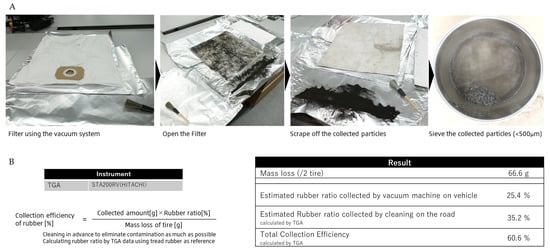
The collection efficiency of the TRWPs was quantitatively evaluated using a vehicle-mounted collection system with road sweeping. Tire mass loss measurements were conducted using repeated gravimetric weighing with a calibrated balance. The observed differences between pre- and post-test measurements were substantially larger than the instrumental weighing uncertainty. The experiment uses KIWAMI-HEPA commercial vacuum cleaner manufactured by Daiichi Sangyo Co., Ltd., (Kobe, Japan) and captures particles using the synthetic fiber filter bag that comes standard with this vacuum cleaner. The KIWAMI-HEPA commercial vacuum cleaner employs a three-stage filtration system. The mass of the first-stage filter bag was measured before and after each test, and the mass difference was used to quantify the collected particle mass. The second- and third-stage downstream filters were also weighed before and after the tests, and no measurable mass increase was detected, confirming that particle breakthrough beyond the first stage was negligible. After each test, the first-stage filter bag was carefully opened using scissors, and the collected particles were gently recovered using an antistatic-treated brush to minimize particle loss during extraction.
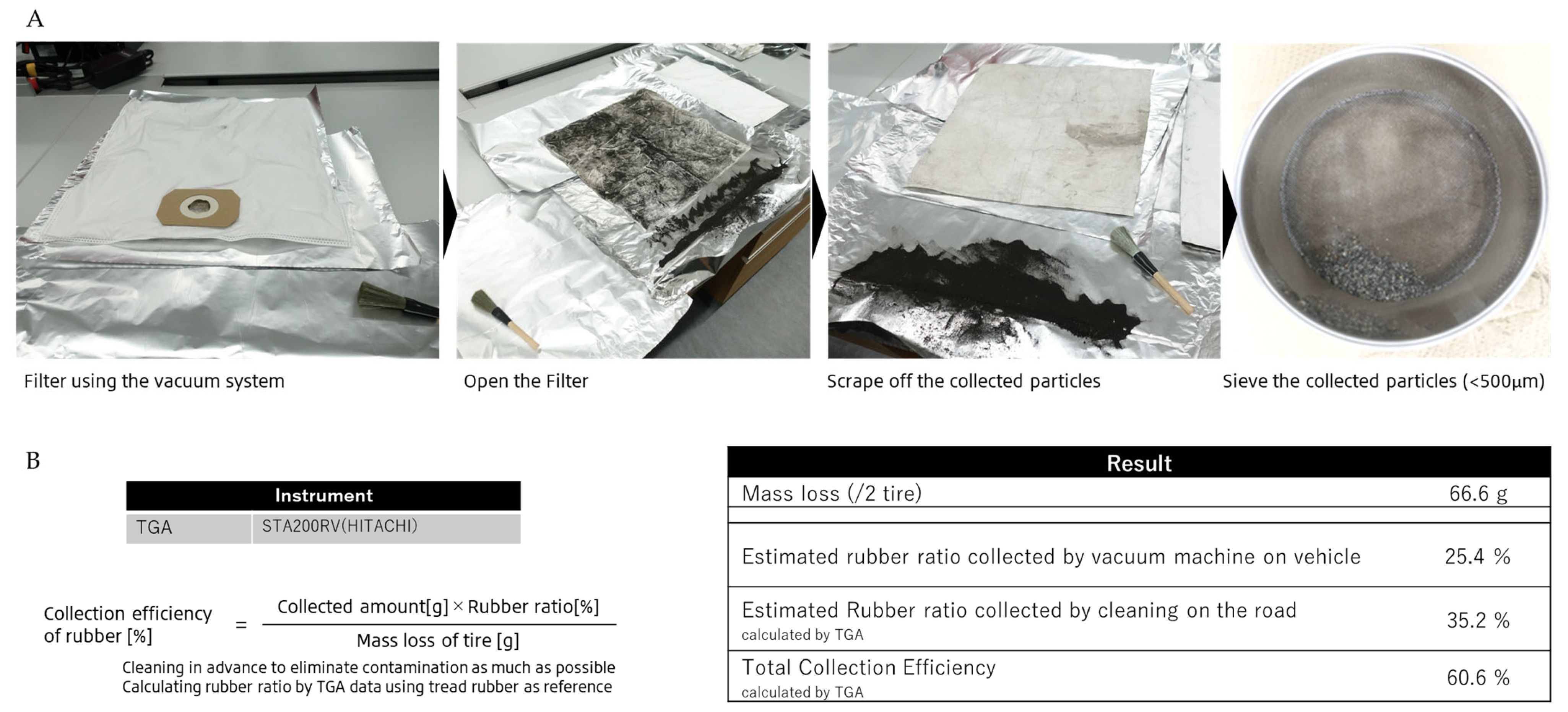
Collection efficiency (Figure 6) was calculated as the ratio of recovered rubber components to the total loss of tire mass measured during the driving tests. The detailed calculation of collection efficiency and the comparison between TGA analysis and py-GC/MS are provided in the Supplementary Materials (File S1). The road surface was cleaned prior to testing to minimize contamination from background particles. After completion of the driving tests, the particles collected by the vehicle-mounted vacuum system and residual particles recovered by road sweeping were analyzed separately to quantify their respective contributions to overall TRWP recovery.
Figure 6.
Evaluation of TRWP collection efficiency. TGA, thermogravimetric analysis. (A): represents preprocessing; (B): represents calculation of collection efficiency.
The rubber content of the collected particles was quantified via TGA. A Hitachi STA200RV instrument was used to determine the organic (rubber-derived) fraction of the collected material, with tire tread rubber as the reference sample for rubber component identification.
The results showed that the rubber particles collected by the vehicle-mounted vacuum system accounted for 25.4% of total tire mass loss. In contrast, the rubber particles recovered through road sweeping accounted for 35.2% of the total. When both collection pathways were combined, the total TRWP collection efficiency relative to tire mass loss reached 60.6%. (To ensure reliable quantification of recovered TRWPs, the collected particles were sieved to 500 μm or smaller and scraped from the collection filters prior to analysis. This pretreatment facilitated consistent particle size selection and improved quantification of rubber components, enhancing the accuracy of the evaluated collection efficiency.)
To address the variability of the collection efficiency, two methodological improvements were implemented to enhance the recovery of tire and road wear particles relative to tire mass loss. First, after each collection test, particles remaining inside the tire housing and on the wheel surfaces were thoroughly recovered. Adhered particles on the inner surfaces of the tire cover and wheel were collected using an onboard vacuum device operated manually. The recovered particles were included as part of the total collected TRWP mass associated with the vehicle-based collection. Second, the road surface cleaning width after each test was expanded from the conventional 60 cm to 120 cm. This modification was guided by prior tracer experiments using a Ti marker, which visually demonstrated that particles generated from the test tire were distributed beyond the immediate wheel track. By extending the cleaning width, particles deposited around the driving lane were more effectively recovered and included in the collection. As a result of these improvements, the total collection efficiency increased in the three tests, reaching an average value of 81%. The observed range of collection efficiency (maximum to minimum) was 91% to 73%, indicating a substantial reduction in uncertainties related to incomplete particle recovery. These results demonstrate that the implemented refinements effectively improved the representativeness of the collected TRWP samples with respect to the generated tire wear under the applied test conditions. Although the applied setup does not aim to directly represent average real-world emission factors, the implemented improvements to particle recovery substantially reduce collection-related uncertainties, allowing the collected TRWPs to be interpreted as representative of the generated particles under the defined high-load and controlled test conditions.
Previous vehicle- and laboratory-based studies have reported collection efficiencies that are typically limited to a relatively small fraction of the total generated wear mass, often on the order of several percent to approximately 10–20%, depending on sampling location and methodology [17,19,21]. These approaches generally focus on representative airborne or near-field particles and exclude particles depositing on the wheel, wheel housing, or road surface [17,19]. Within this context, the collection efficiency observed in this study (81%) is higher than values reported in previous studies [19,26]. This reflects the combined use of on-vehicle particle collection and road surface recovery, as well as differences in system configuration and efficiency definition.
These differences primarily reflect variations in experimental objectives and system configurations. In many previous studies, collection efficiency is defined with respect to airborne or distributed particles and is intentionally limited to avoid disturbance of the tire–road interface or alteration of emission pathways. In contrast, the present study defines collection efficiency as the fraction of the measured wear mass of the test tires that is recovered through the combined on-vehicle collection system and subsequent road surface recovery. The enclosed wheel configuration, active suction, and post-test surface sweeping were deliberately employed to suppress particle escape and recover a larger fraction of particles associated with the test tires. This design prioritizes selective and extensive recovery over strict preservation of undisturbed emission pathways.
Accordingly, the collection efficiency reported in this study should be interpreted with caution when compared to values from studies targeting airborne emissions. The higher recovery fraction primarily reflects differences in collection definition, enclosure geometry, airflow control, and inclusion of deposited particle fractions.
In addition, the use of TGA-based chemical analysis provides a robust approach for quantifying the rubber-derived fraction of collected particles and assessing TRWP collection efficiency.
3.3. Morphological Observation and Component Analysis of TRWPs
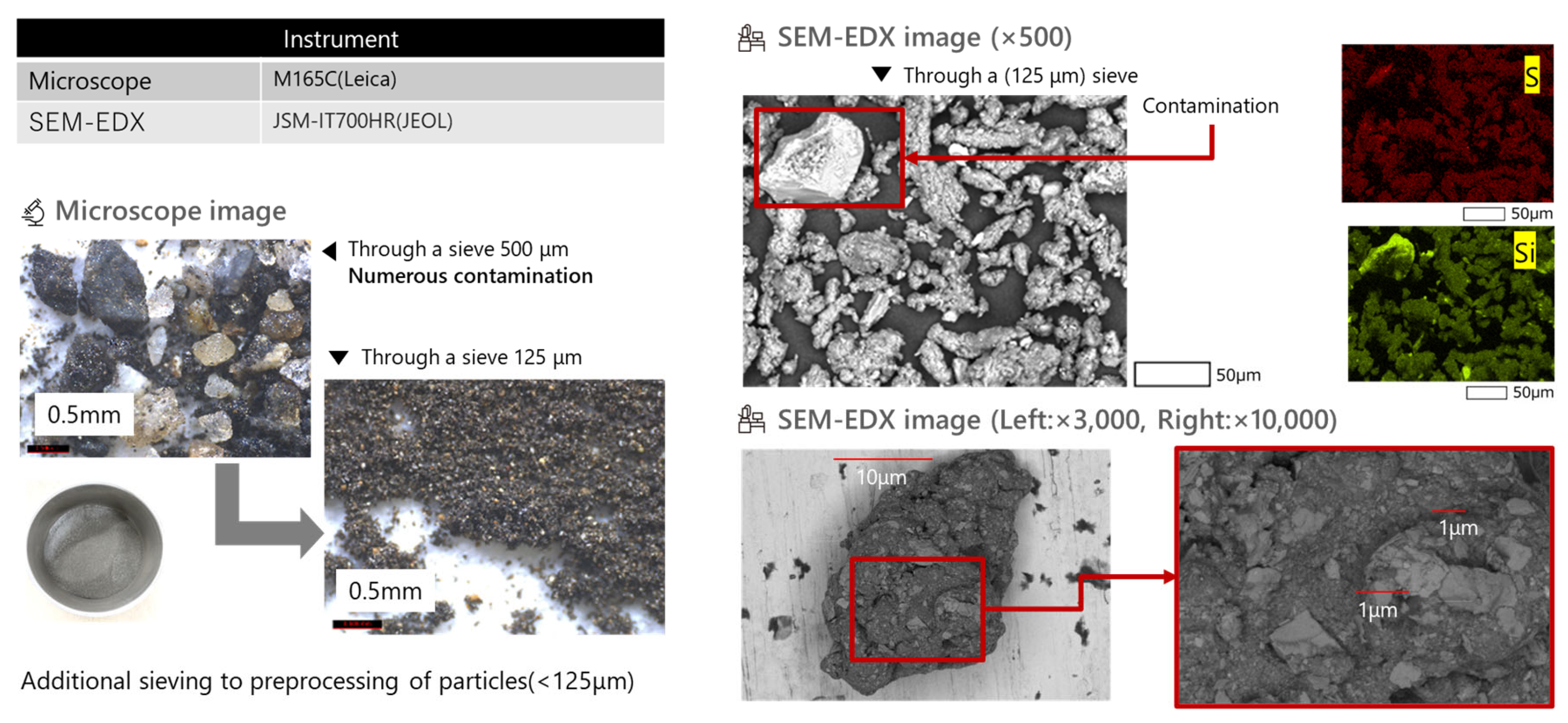
The morphological characteristics and chemical compositions of the collected tires and road wear particles were investigated using optical microscopy, scanning electron microscopy (SEM), and energy-dispersive X-ray spectroscopy (EDX). These complementary techniques were employed to characterize particle appearance, surface structure, and elemental composition. Optical microscopy was conducted using a Leica M165C microscope (Leica Microsystems, Wetzlar, Germany), and detailed surface and compositional analyses were performed using a JEOL JSM-IT700HR SEM-EDX system. Together, these instruments enabled the visualization of particle morphology across multiple size scales and the identification of key elemental constituents.
Prior to observation, the collected particles were sieved to 500 μm or smaller and examined using optical microscopy. These observations revealed that the samples consisted of a heterogeneous mixture of black, transparent, and white particles. The black particles may include tire-derived rubber components; however, contributions from other sources, such as bitumen fragments, brake wear particles, or previously deposited materials, cannot be excluded based on visual observation alone. The transparent or white particles are likely to be associated with mineral materials originating from road surfaces or other environmental sources. Therefore, classification based solely on optical appearance is indicative but not definitive, and further compositional analysis is required for reliable source identification.
To further investigate the finer particles, the samples were additionally sieved to 125 μm or smaller and subjected to SEM-EDX analysis. The SEM images obtained at magnifications of 500×, 3000×, and 10,000× revealed the irregular surface textures and rough morphologies characteristic of wear-generated particles. These images provided detailed insights into the microstructural features of the TRWPs.
EDX analysis detected elements such as sulfur (S) and silicon (Si) in the black particles. The presence of sulfur, which is commonly associated with vulcanized rubber, may indicate contributions from tire-derived materials. However, sulfur is also present in other sources, such as bitumen and brake wear particles, and therefore is not uniquely diagnostic of tire tread. The simultaneous detection of Si may reflect the presence of mineral components or silica fillers used in tire formulations, but it can also originate from road surface materials. Accordingly, the detected elemental composition suggests a mixed-origin particle population, and EDX results should be interpreted as indicative rather than definitive evidence of tire-derived TRWPs.
Titanium (Ti), used as a tracer element (Section 2.3), was not analyzed by EDX. Instead, Ti distribution was evaluated using handheld XRF measurements, which are more suitable for spatial mapping.
In addition to TRWPs, various contaminant particles were observed in the collected samples. These contaminants are attributed to the driving environment and road surface conditions and may influence the transport, deposition, and environmental behavior of TRWPs. Their presence highlights the importance of considering particle heterogeneity when evaluating TRWP characteristics.
The results, shown in Figure 7, demonstrate that the collected particles exhibit substantial morphological and compositional diversity. The combined use of particle size separation, microscopic observations, and elemental analysis provides useful insights into particle characteristics; however, these methods alone are not sufficient for definitive identification of TRWPs from other particle types. The morphological and compositional insights obtained in this study should therefore be interpreted as indicative of mixed-origin particles, rather than conclusive identification of tire-derived TRWPs. These findings provide a preliminary basis for TRWP classification and characterization, supporting future potential environmental impact assessments and highlighting the need for more specific identification techniques.
Figure 7.
Morphology and compositional analysis of TRWPs.
3.4. Evaluation of Particle Size Distribution of TRWPs
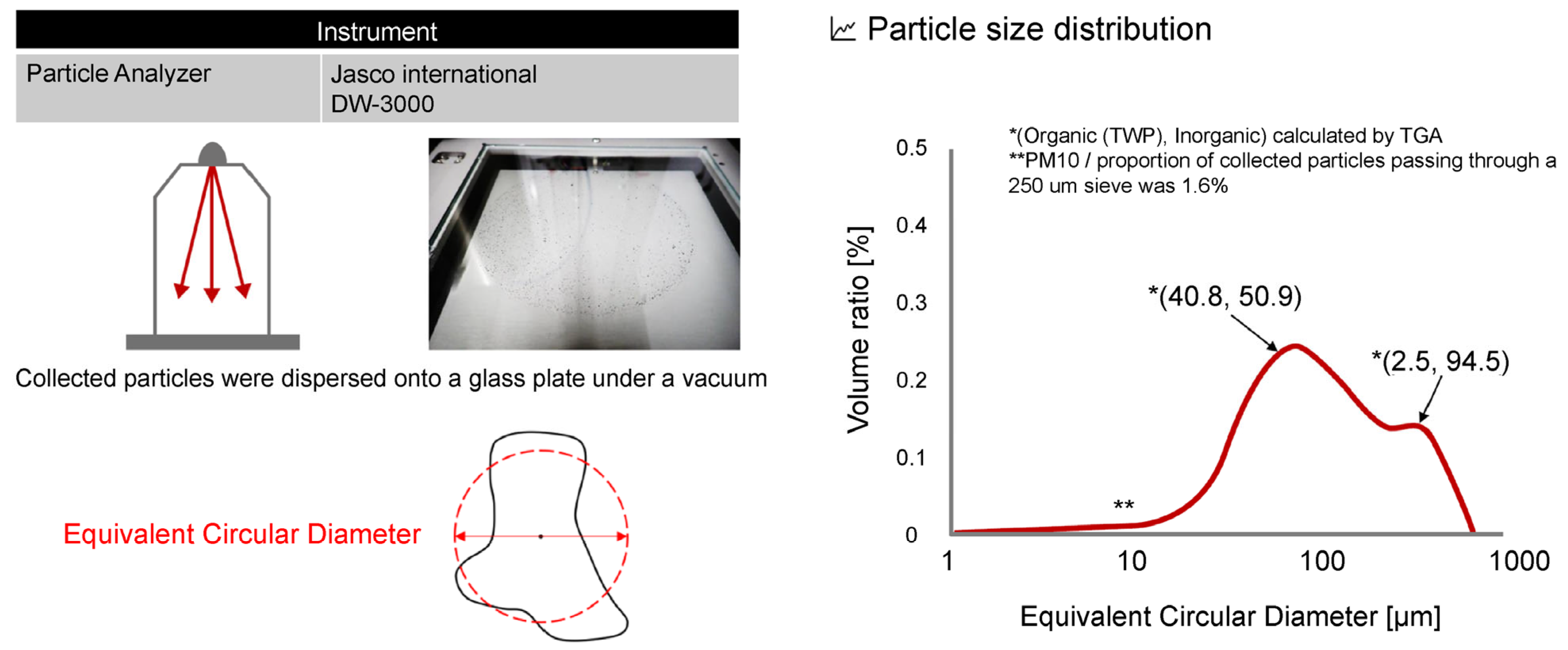
A particle analyzer was used to evaluate the particle size distribution of collected TRWPs. Measurements were performed using a DW-3000 particle image analyzer (Jasco International Co., Ltd., Hachioji, Japan), with particles distributed on a glass plate under vacuum.
Particle size was quantified as the equivalent circular diameter, and particle volume ratio distributions were obtained. The results revealed a bimodal size distribution with two distinct peaks, the first of which occurred in the 10–100 μm size range. TGA confirmed that particles within this range consisted of an approximately 50:50 ratio of organic (tire-derived rubber) and inorganic (road-derived mineral matter) components. Based on this compositional balance, this particle group was identified as TRWPs.
The second peak was observed in the larger particle size range and was primarily composed of inorganic components. This peak was attributed to the presence of sand and coarse mineral particles originating from the road surface.
In samples sieved to remove particles larger than 250 μm, the proportion of particles corresponding to PM10 (fine particles with diameters of 10 μm or smaller) was determined to be 1.6% (Figure 8). Because this particle fraction is particularly susceptible to becoming airborne and poses potential respiratory health concerns, it represents an important indicator for environmental impact assessments.
Figure 8.
Particle size distribution of TRWPs measured using the DW-3000 particle image analyzer.
These results indicate that the collected TRWPs exhibited a characteristic bimodal particle size distribution, demonstrating that classification based on both particle size and composition is feasible. This information provides a fundamental basis for TRWP source identification, prediction of environmental behavior, and the development of particle removal and control technologies. Specifically, the combined information on particle morphology, elemental composition, and size distribution obtained under controlled test conditions can support operational source identification by distinguishing particle populations consistent with mixed tire–road wear from other non-exhaust sources, while acknowledging that definitive attribution requires complementary analytical methods.
In addition, the observed size-dependent compositional characteristics and the near-field spatial distribution of particles provide input parameters relevant for predicting environmental behavior, such as deposition, resuspension, and transport pathways, particularly in the immediate vicinity of the driving lane.
From a technological perspective, the characterization of particle size ranges, recovery efficiencies, and enclosure-induced effects offers practical insight for the conceptual design of particle removal and control strategies. While the present results are system- and condition-dependent, they can inform the selection of target particle size ranges and the evaluation of trade-offs between containment efficiency and representativeness in future mitigation technologies.
3.5. TRWP Distribution Evaluation Around the Driving Lane
The generation and collection of TRWPs, as well as their spatial distribution on the road surface after driving, were quantitatively evaluated. Understanding this distribution is essential for elucidating the distribution ranges and deposition patterns of TRWPs in the environment. The tires used in the experiment were Bridgestone experimental tires (size: 205/55 R16) with a custom tread rubber containing 20 phr of titanium dioxide (TiO2) for particle identification.
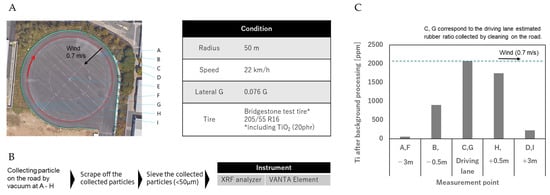
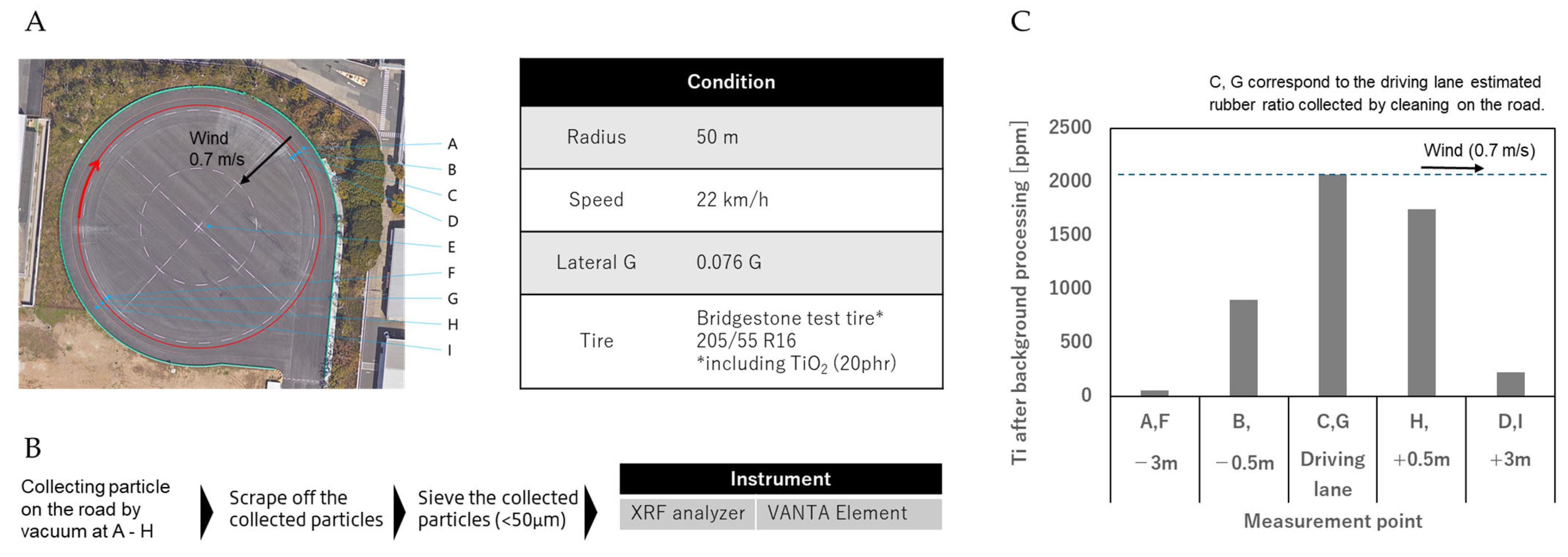
The spatial distribution was evaluated using an Vanta Element X-ray fluorescence analyzer (Evident Corporation, Tokyo, Japan). Multiple measurement points (A–I) were established at lateral distances of ±0.5 m and ±3 m from the center of the driving lane. Particles were collected at each point using a vacuum collection system, sieved to 250 μm or smaller, and quantitatively evaluated based on Ti concentration as an index.
The results showed that Ti concentration was highest near the center of the driving lane and remained relatively elevated within ±0.5 m of the lane center. In contrast, Ti concentration significantly decreased at distances of ±3 m, indicating that TRWPs were primarily concentrated within approximately ±1 m of the driving lane center.
The wind speed during the test was relatively low (0.7 m/s), limiting external influences on particle distribution. Therefore, the observed particle distribution is likely attributable primarily to direct release from tire wear.
Elevated rubber content was also detected in particles collected by road sweeping at measurement points C and G (Figure 9). This indicates that these locations serve as primary accumulation areas for TRWPs. It should be noted that the X-ray fluorescence measurements were used to detect the presence of titanium (Ti) as a tracer element, with a limit of detection (LOD) of approximately 25 ppm; however, quantitative TRWP concentration was not directly measured. These findings provide insights into the spatial behavior of TRWPs on road surfaces and offer useful information for designing particle collection strategies and conducting environmental impact assessments. Furthermore, the observed deposits primarily represent readily deposited particles on the road surface, whereas finer airborne particles may remain suspended and be transported over longer distances beyond the measurement region.
Figure 9.
Spatial distribution of TRWPs around the driving lane. (A): Measurement point and Test condition. (B): Preprocessing. (C): Ti concentration around driving lane.
4. Conclusions
In this study, experimental investigations using an autonomous driving vehicle were conducted to examine TRWP generation behavior and to develop a vehicle-based particle collection methodology. The study focuses on a controlled experimental configuration designed to enable systematic observation and repeatable particle recovery, rather than direct representation of real-world driving conditions. Because TRWPs are widely distributed into the environment during vehicle operation, quantitative evaluation and systematic characterization of these particles remain important for understanding their environmental behavior.
Visualization of near-field TRWP distribution clarified particle emission trajectories and local distribution behavior around the tire–road interface. Based on the observations, a vehicle-mounted collection system integrating an airtight enclosure using a conductive PET film, a high-power vacuum collection system, and autonomous driving control was developed. This configuration enabled stable operation and improved particle recovery within the defined experimental setup; however, the enclosure and suction system may alter local airflow, particle transport, and deposition behavior.
The collected particles were characterized by optical microscopy and SEM. The results revealed a heterogeneous mixture of tire-derived rubber particles and road-derived contaminants. Particle identification based on morphology and elemental composition remains indicative rather than definitive, and the collected samples should be interpreted as mixed-origin particle populations. Particle size distribution analysis further demonstrated characteristic size-dependent compositional differences, providing insight into the environmental behavior and transport potential of TRWPs. However, this distribution may be influenced by the controlled driving configuration, including repeated circular motion, localized wear, and thermal effects at the contact interface.
Quantitatively, the tire wear rates were 332.9 mg/km and 318.4 mg/km, indicating stable and reproducible particle generation under controlled driving conditions. The combined TRWP collection efficiency reached 60.6%, with contributions of 25.4% from on-vehicle collection and 35.2% from road surface recovery. Additional tests with an expanded recovery protocol indicated that collection efficiency can increase to ~81% (range: 73–91%), highlighting the influence of collection coverage. These values represent bounded, system-dependent recovery indicators rather than precise emission estimates, and reflect the performance of the recovery system under the specific experimental constraints applied. Particle size analysis revealed a bimodal distribution with a dominant fraction in the 10–100 μm range and a PM10 fraction of 1.6%, while spatial distribution analysis showed that TRWPs were primarily confined within approximately ±1 m of the driving lane. These results reflect system-level behavior under controlled conditions and should be interpreted accordingly.
In addition, spatial analysis of particles remaining on the road surface revealed that uncollected material was predominantly distributed within a limited range around the driving lane, clarifying accumulation patterns under the present test configuration. Together, these results demonstrate that the proposed experimental framework enables repeatable and comparative recovery of tire-associated particles under identical conditions, rather than comprehensive characterization of emissions under real-world traffic scenarios.
The findings of this study have several implications for experimental approaches and environmental evaluation of TRWPs. First, visualization of near-field TRWP distribution suggests that particle release occurred not only in the rearward direction but also laterally along the vehicle. This indicates that collection strategies focused solely on the rear wake may overlook laterally distributed particle fractions under certain conditions. However, this observation is limited to deposited particles and does not capture finer airborne fractions, which may remain suspended and be transported over longer distances.
Second, the particle purity, collection efficiency, and reproducibility achieved through the integrated enclosure, vacuum collection, and autonomous driving control suggest that the proposed system can provide consistent performance under controlled conditions. However, the enclosed configuration and active suction may exaggerate contributions from resuspended or interfering particle sources, and therefore the recovered samples should not be interpreted as representative of ambient emission exposure. This interpretation is consistent with observations reported in previous studies [10,18,21,26].
Third, while the reproducibility of tire mass loss under circular driving conditions demonstrates experimental stability, such conditions differ substantially from real-world driving, particularly due to continuous lateral loading and repeated contact over the same road section. Consequently, both wear rates and particle characteristics observed in this study are likely elevated relative to typical traffic conditions, and their representativeness should be interpreted with caution.
Fourth, the observed morphological diversity and bimodal particle size distribution suggest that TRWPs cannot be treated as a uniform particle class. The coexistence of rubber-derived and mineral-rich particles across different size ranges indicates that TRWP classification and environmental assessments should consider both particle size and composition, while recognizing that particle origin cannot be unambiguously determined based on the applied analytical techniques alone.
While this study provides a vehicle-based methodology for the controlled recovery and characterization of tire-associated particle mixtures, several limitations must be emphasized. The experiments were conducted under constrained conditions on a circular test track using a single vehicle type and tire specification. Residual background particles, resuspension effects, enclosure-induced airflow modification, electrostatic interactions, and exclusion of ultrafine particles all contribute to uncertainty in source attribution and quantitative interpretation. Furthermore, the reported recovery efficiencies are specific to the applied combination of enclosure, vacuum collection, and road sweeping, and alternative system configurations may yield different outcomes.
Building on this experimental framework, future research should focus on extending controlled recovery approaches to a broader range of driving scenarios, vehicle types, tire formulations, and road surfaces, while explicitly quantifying uncertainty sources such as resuspension, electrostatic losses, and particle transport. Integration of flow-field modeling and complementary analytical techniques would be required to better resolve particle origin and transport mechanisms. The present study should therefore be viewed as a technical step toward controlled experimental recovery of tire-associated particles, rather than as a definitive tool for emission quantification or mechanistic analysis.
Supplementary Materials
The following supporting information can be downloaded at: https://www.mdpi.com/article/10.3390/atmos17070625/s1. File S1: Calculation of collection efficiency by TGA and Comparison between TGA and py-GCMS.
Author Contributions
Conceptualization, Y.W., T.K. and Y.S.; Data curation, T.S.; Investigation, Y.W., T.K., K.Y., C.K. and T.S.; Methodology, Y.W., T.K., K.Y. and C.K.; Project administration, R.K. and Y.S.; Resources, Y.S.; Supervision, N.K.; Validation, N.K.; Visualization, K.Y.; Writing—original draft, R.K.; Writing—review and editing, Y.S. All authors have read and agreed to the published version of the manuscript.
Funding
This research received no external funding.
Institutional Review Board Statement
Not applicable.
Informed Consent Statement
Not applicable.
Data Availability Statement
Dataset available on request from the authors.
Acknowledgments
The authors thank SHIN NIPPON AIR TECHNOLOGIES, Co., Ltd. for technical support and field collaboration in the TRWP visualization experiments.
Conflicts of Interest
All authors are employees of Bridgestone Corporation or Bridgestone Europe NV/SA. The company had no role in the design of the study; in the collection, analysis, or interpretation of data; in the writing of the manuscript, or in the decision to publish the article. The paper reflects the views of the scientists and not the company.
References
- Grad, F.P.; Rosenthal, A.J.; Hsia, R.; Munzer, S.R.; Schwarcz, S.L. The Automobile and the Regulation of Some of Its Non-Exhaust Impacts on the Environment. Columbia J. Environ. Law 2019, 1, 187–232. [Google Scholar] [CrossRef]
- Beckman, J.A.; Crane, G.; Kay, E.L.; Laman, J.R. Scrap tire disposal. Rubber Chem. Technol. 1974, 47, 597–624. [Google Scholar] [CrossRef]
- McCarty, K.; Mian, H.R.; Chhipi-Shrestha, G.; Hewage, K.; Sadiq, R. Ecological risk assessment of tire and road wear particles: A preliminary screening for freshwater sources in Canada. Environ. Pollut. 2023, 325, 121354. [Google Scholar] [CrossRef] [PubMed]
- Wik, A.; Dave, G. Occurrence and effects of tire wear particles in the environment—A critical review and an initial risk assessment. Environ. Pollut. 2009, 157, 1–11. [Google Scholar] [CrossRef] [PubMed]
- Thompson, R.C.; Courtene-Jones, W.; Boucher, J.; Pahl, S.; Raubenheimer, K.; Koelmans, A.A. Twenty years of microplastic pollution research-what have we learned? Science 2024, 386, eadl2746. [Google Scholar] [CrossRef] [PubMed]
- Grigoratos, T.; Martini, G. Non-Exhaust Traffic Related Emissions: Brake and Tyre Wear PM; Publications Office of the European Union: Luxembourg, 2014. [CrossRef] [PubMed]
- Müller, K.; Unice, K.; Panko, J.; Ferrari, B.J.D.; Breider, F.; Wagner, S. Risk assessment of tire wear in the environment—A literature review. Environ. Sci. Process. Impacts 2025, 27, 2212–2232. [Google Scholar] [CrossRef] [PubMed]
- Giechaskiel, B.; Grigoratos, T.; Mathissen, M.; Quik, J.; Tromp, P.; Gustafsson, M.; Franco, V.; Dilara, P.; Dilara, P. Contribution of road vehicle tyre wear to microplastics and ambient air pollution. Sustainability 2024, 16, 522. [Google Scholar] [CrossRef]
- Gieré, R.; Dietze, V. Tire-abrasion particles in the environment. In Degradation of Elastomers in Practice, Experiments and Modeling; Heinrich, G., Kipscholl, R., Stoček, R., Eds.; Springer International Publishing: Cham, Switzerland, 2022; pp. 71–101. [Google Scholar] [CrossRef]
- De Oliveira, T.; Muresan, B.; Ricordel, S.; Lumière, L.; Truong, X.T.; Poirier, L.; Gasperi, J. Realistic assessment of tire and road wear particle emissions and their influencing factors on different types of roads. J. Hazard. Mater. 2024, 465, 133301. [Google Scholar] [CrossRef] [PubMed]
- Yan, H.; Zhang, L.; Liu, L.; Wen, S. Investigation of the external conditions and material compositions affecting the formation mechanism and size distribution of tire wear particles. Atmos. Environ. 2021, 244, 118018. [Google Scholar] [CrossRef]
- Wagner, S.; Funk, C.W.; Müller, K.; Raithel, D.J. The chemical composition and sources of road dust, and of tire and road wear particles–A review. Sci. Total Environ. 2024, 926, 171694. [Google Scholar] [CrossRef] [PubMed]
- Kim, G.; Lee, S. Characteristics of tire wear particles generated by a tire simulator under various driving conditions. Environ. Sci. Technol. 2018, 52, 12153–12161. [Google Scholar] [CrossRef] [PubMed]
- Li, K.; Su, H.; Xiu, X.; Liu, C.; Hao, W. Tire wear particles in different water environments: Occurrence, behavior, and biological effects-a review and perspectives. Environ. Sci. Pollut. Res. Int. 2023, 30, 90574–90594. [Google Scholar] [CrossRef] [PubMed]
- Park, I.; Kim, H.; Lee, S. Characteristics of tire wear particles generated in a laboratory simulation of tire/road contact conditions. J. Aerosol Sci. 2018, 124, 30–40. [Google Scholar] [CrossRef]
- Feißel, T.; Kunze, M.; Hesse, D.; Ivanov, V.; Augsburg, K.; Gramstat, S. On-road vehicle measurement of tire wear particle emissions and approach for emission prediction. Tire Sci. Technol. 2024, 52, 2–14. [Google Scholar] [CrossRef]
- Wahlström, J.; Lyu, Y.; Lundberg, J.; Pagels, J.; Hjelm, R. Advancing tyre and road wear particle measurements: Balancing laboratory conditions and real-world relevance. Atmosphere 2025, 16, 588. [Google Scholar] [CrossRef]
- Schubert, L.; Torres, M.A.A.; Bigl, S.; Steiner, G.; Huber, M.; Lex, C. Challenges in quantifying tire wear particle emissions on an outer drum test bed. In Search Technical Papers; SAE International: Warrendale, PA, USA, 2025. [Google Scholar] [CrossRef]
- Truong, X.T.; Muresan, B.; Lumière, L.; Liu, Y.; Cerezo, V. Emission dynamics of tire and road contact particles emitted at the rear of the wheel of a passenger vehicle using on-road experiments on different routes. Transp. Res. Procedia 2023, 72, 2277–2285. [Google Scholar] [CrossRef]
- Hesse, D.; Feißel, T.; Kunze, M.; Bachmann, E.; Bachmann, T.; Gramstat, S. Comparison of methods for sampling particulate emissions from tires under different test environments. Atmosphere 2022, 13, 1262. [Google Scholar] [CrossRef]
- zum Hagen, F.H.F.; Mathissen, M.; Grabiec, T.; Hennicke, T.; Rettig, M.; Grochowicz, J.; Vogt, R.; Benter, T.; Benter, T. On-road vehicle measurements of brake wear particle emissions. Atmos. Environ. 2019, 217, 116943. [Google Scholar] [CrossRef]
- ISO/DIS 18511-2; Tyre Abrasion Rate Measurement Methods, Part 2: Indoor Test Method by Using an Abrasion Tester on External Drum. International Organization for Standardization (ISO): Geneva, Switzerland, 2024. Available online: https://www.iso.org/standard/85302.html (accessed on 5 March 2025).
- ISO 22638:2024; Rubber—Generation and Collection of Tyre and Road Wear Particles (TRWP)—Road Simulator Laboratory Method. International Organization for Standardization (ISO): Geneva, Switzerland, 2024. Available online: https://www.iso.org/standard/84313.html (accessed on 5 March 2025).
- Kang, J.; Liu, X.; Dai, B.; Liu, T.; Haider, F.U.; Zhang, P.; Habiba; Cai, J.; Cai, J. Tyre wear particles in the environment: Sources, toxicity, and remediation approaches. Sustainability 2025, 17, 5433. [Google Scholar] [CrossRef]
- Schläfle, S.; Unrau, H.J.; Gauterin, F. Influence of load condition, tire type, and ambient temperature on the emission of tire–road particulate matter. Atmosphere 2023, 14, 1095. [Google Scholar] [CrossRef]
- Dong, J.; Huang, H.; Pei, J.; Xu, Y.; Cao, J. A methodology for capturing tire wear particles: Computational particle fluid dynamics modelling and experimental verification. Powder Technol. 2021, 384, 176–185. [Google Scholar] [CrossRef]

Disclaimer/Publisher’s Note: The statements, opinions and data contained in all publications are solely those of the individual author(s) and contributor(s) and not of MDPI and/or the editor(s). MDPI and/or the editor(s) disclaim responsibility for any injury to people or property resulting from any ideas, methods, instructions or products referred to in the content. |
© 2026 by the authors. Licensee MDPI, Basel, Switzerland. This article is an open access article distributed under the terms and conditions of the Creative Commons Attribution (CC BY) license.