
Skip to Content

Cardiogenetics

Cardiogenetics is an international, peer-reviewed, open access journal, published quarterly online by MDPI (from Volume 10, Issue 2 - 2020).

Get Alerted

Add your email address to receive forthcoming issues of this journal.

All Articles (227)

Background: Inherited arrhythmic syndromes (IAS) are an important but under-recognized cause of sudden cardiac death (SCD), particularly in younger individuals. Understanding long-term mortality trends is essential to evaluate their public health impact. Objective: To assess temporal trends and demographic disparities of IAS-related sudden cardiac death among individuals aged 5–44 years in the United States using CDC WONDER data. Methods: This retrospective observational study utilized the CDC WONDER Multiple Cause-of-Death database from 1999 to 2024. Deaths were identified using ICD-10 codes for non-ischemic arrhythmogenic conditions (I42, I44, I45, I47, I49) in combination with sudden cardiac arrest or unexplained death (I46, R96). Ischemic heart disease (I20–I25) was excluded to enhance specificity for inherited causes. Crude and age-adjusted mortality rates (AAMRs) per 1,000,000 population were calculated and stratified by age, sex, race/ethnicity, region, urbanization, and place of death. Joinpoint software helped us calculate the average annual percentage change (AAPC)/annual percent change (APC) in AAMRs and the 95% CIs for these changes. Results: A total of 8879 deaths were identified over the study period. The AAMR increased from 1.46 (95% CI: 1.27–1.64) in 1999 to 3.15 (95% CI: 2.89–3.42) in 2024, peaking at 4.54 in 2021, with an overall AAPC of 3.71% (p < 0.000001). Mortality was higher in males; however, females demonstrated a greater relative increase over time. Non-Hispanic Black individuals exhibited the highest mortality rates and fastest rise. The 25–44-year age group accounted for most deaths and showed the steepest increase. Regional and urban–rural disparities were observed, with higher mortality rates in the South and rural areas. Conclusions: It is concluded that mortality related to inherited arrhythmic syndromes and sudden cardiac death is rising among young individuals in the United States. The findings highlight a growing burden of potentially inherited arrhythmogenic conditions and underscore the need for early detection strategies, including genetic screening and targeted public health interventions, to reduce premature cardiovascular mortality.

2 July 2026
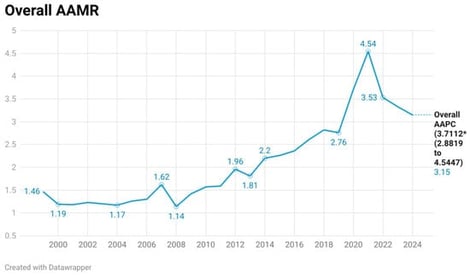
Overall potentially inherited arrhythmic syndromes and sudden cardiac death-related AAMR per 1,000,000 in the United States, 1999 to 2024. * Denotes statistically significant annual percent change (APC) or average annual percent change (AAPC) at p &lt; 0.05, as determined by two-tailed t-test using Joinpoint Regression Analysis.

Congenital heart defects (CHDs) are the most common congenital anomalies, with identifiable genetic etiologies in approximately 5–30% of affected infants, depending on the clinical presentation and comorbidities. This study included 216 children with CHD, predominantly syndromic, to explore the role of genetic variants in their morphological phenotypes. Chromosomal microarray (CMA) and whole-exome sequencing (WES) were performed, revealing clinically significant copy number variations (csCNVs) in 59 (27.3%) patients. The most frequent were 22q11.21 (8/59; 13.6%) and 7q11.23 (5/59; 8.5%) deletions. WES was conducted in 28.0% of cases, achieving a detection rate of 29.5%, primarily identifying variants related to Noonan syndrome. Genetic diagnoses were confirmed in 33.3% of patients, with clinically significant CNVs and SNV/INDELs found exclusively in those with syndromic CHD, leading to a 36.5% diagnosis rate in those patients. The identified variants most frequently affected genes encoding transcription factors (40.4%), followed by genes involved in the RAS signaling pathway and structural proteins (17.0%), and chromatin remodeling proteins (12.8%).

10 June 2026

Background: Heterozygous familial hypercholesterolemia (HeFH) is characterized by elevated low-density lipoprotein cholesterol (LDL-C) and increased cardiovascular risk, making early diagnosis essential; however, the diagnostic performance of pediatric criteria is heterogeneous. This study evaluated the effectiveness of different diagnostic criteria and scoring systems to select children for genetic testing. Materials and methods: A total of 214 pediatric subjects with suspected HeFH were included, recruited from patients followed at a tertiary care center, based on LDL-C levels ≥ 95th age- and sex-specific percentile in both the proband and one biological parent. All subjects underwent genetic analysis of the main FH-associated genes (LDLR, APOB, PCSK9). The following diagnostic criteria and scoring systems were retrospectively evaluated and compared with genetic findings: Simon Broome Register (SBR), Dutch Lipid Clinic Network (DLCN), European Atherosclerosis Society (EAS), American Heart Association (AHA), Familial Hypercholesterolemia Canada Network (FH-CAN), Japanese Atherosclerosis Society (JAS), Lipid TransPort Disorders Italian Genetic Network for Italian pediatric patients (LIPIGEN-FH-PED), and the Familial Hypercholesterolemia Pediatric Diagnostic Score (FH-PeDS). Results: Pathogenic variants were identified in 91.8% of subjects. Approaches using lower LDL-C thresholds minimized the loss of variant-positive individuals (particularly JAS and FH-PeDS, with a missed diagnoses rate of 1.6%), whereas more restrictive definitions excluded a substantial proportion of affected patients (10.5% SBR, 56.3% DLCN, 6.3% EAS, 6.3% AHA, 7.4% FH-CAN, and 6.3% LIPIGEN-FH-PED). The mutation detection rate (MDR) was >91% for all examined criteria. Conclusions: Several current diagnostic criteria may underestimate the true number of children carrying FH-associated variants. Less selective criteria enable the identification of a greater number of FH-positive individuals while maintaining a high MDR, thus supporting the prioritization of identifying as many affected children as possible in the pediatric setting. This cohort reflects a tertiary referral population rather than the general population; therefore, further studies are needed to evaluate the applicability of our findings to broader public health contexts and screening settings.

3 June 2026

Noonan syndrome (NS) is a paradigmatic rare, genetically heterogeneous, multisystem disorder belonging to the RASopathies family, caused by dysregulated RAS/MAPK signaling. It is characterized by distinctive craniofacial features, postnatal short stature, and a high prevalence of congenital cardiac defects, with pulmonary valve stenosis (PS) and hypertrophic cardiomyopathy (HCM) being the hallmark lesions. First described by Dr. Jacqueline Noonan in 1968, the molecular era began with the discovery of PTPN11 mutations in 2001, revolutionizing diagnosis, risk stratification, and understanding of pathogenesis. Strong genotype–phenotype correlations now guide prognosis and personalized management; for instance, RAF1 and RIT1 variants confer a high risk of severe, early-onset HCM, while PTPN11 is strongly linked to dysplastic PS. Cardiac involvement remains the central determinant of long-term outcomes, requiring continuous surveillance from the prenatal period through adulthood. Management is inherently multidisciplinary, addressing endocrine, hematologic, neurodevelopmental, and oncologic aspects. Recent consensus statements emphasize the critical need for structured transition from pediatric to adult care. Novelty arises from the potential of MEK inhibitors as targeted therapies for severe HCM and lymphatic complications. This review provides a comprehensive update on NS, integrating foundational clinical knowledge with contemporary molecular insights, advanced cardiologic management, and emerging frontiers in therapy and diagnostics, underscoring the necessity of a proactive, lifelong, and personalized care approach.

22 May 2026

News & Conferences

Volumes

Latest Issues

Open for Submission

Editor's Choice

XFacebookLinkedIn
Cardiogenetics - ISSN 2035-8148