

- Article

The Effect of Pretreatment Cataract Surgery on Selective Laser Trabeculoplasty Outcomes: A One-Year Follow-Up Study
- Sonja Jandroković,
- Sania Vidas Pauk and
- Ivan Škegro
- + 5 authors
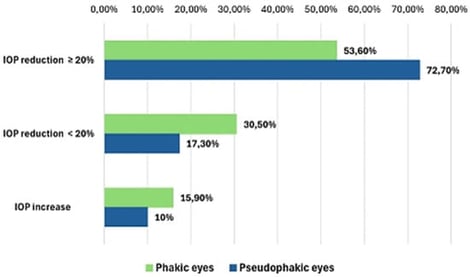
Background/Objectives: We aim to determine whether prior cataract surgery affects the intraocular pressure (IOP)-lowering effect of selective laser trabeculoplasty (SLT) in patients with primary open-angle glaucoma (POAG). Methods: This prospective interventional cohort study initially included 92 patients with POAG who were inadequately controlled or intolerant to topical therapy and were treated with SLT. Of these, 84 patients completed all scheduled visits and constituted the final analyzed dataset. Patients were divided into phakic and pseudophakic groups, with cataract surgery performed at least one year before SLT in all pseudophakic eyes. All patients underwent standardized 360-degree SLT by a single specialist. The primary outcome was IOP reduction at one year. Secondary outcomes included percentage IOP reduction and treatment success, defined as ≥20% IOP reduction. Data were analyzed using StatisticaTM 14.0.1.25 (TIBCO Software Inc., Palo Alto, CA, USA, USA). Results: Before SLT, the median IOP was 20.5 mmHg in phakic eyes and 21 mmHg in pseudophakic eyes. One year after SLT, median IOP decreased insignificantly in phakic eyes (4.0 mmHg; p = 0.262), whereas it decreased significantly in pseudophakic eyes (5.5 mmHg; p = 0.004). At one year post-SLT, an IOP reduction of ≥20% was observed in 53.6% of phakic and 72.7% of pseudophakic eyes. Pseudophakic patients were significantly older than phakic patients, as expected, because age-related senile cataract is more common in older individuals, and the groups also differed by gender distribution. This gender imbalance was coincidental and reflected the non-randomized inclusion of POAG patients according to clinical need for SLT rather than predefined matching. In unadjusted analyses, one-year IOP reduction was positively associated with age (p = 0.048), pretreatment IOP (p < 0.001), and prior cataract surgery (p = 0.047). However, after adjusting for age, gender, and baseline IOP in a multivariate sensitivity analysis, prior cataract surgery was not an independent predictor of success; only pretreatment IOP predicted a significant reduction (p = 0.031) in the analysis of 84 eyes. Conclusion: Although pseudophakic eyes showed greater unadjusted IOP reduction after SLT over one year, lens status was not an independent predictor after adjustment for potential confounders. Therefore, the observed pseudophakic advantage should be interpreted as a hypothesis-generating association warranting further research into the effect of pseudophakia on SLT response.
8 July 2026