
Skip to Content

Epidemiologia

Epidemiologia is an international, peer-reviewed, open access journal on epidemiologic research published bimonthly online by MDPI.
The Italian Society of Environmental Medicine (SIMA) is affiliated with Epidemiologia, and its members receive discounts on article processing charges.
Indexed in PubMed | Quartile Ranking JCR - Q2 (Public, Environmental and Occupational Health)

Get Alerted

Add your email address to receive forthcoming issues of this journal.

All Articles (378)

Background: Urolithiasis is a common condition characterized by a high risk of recurrence, although this risk varies substantially between patients. The present study aimed to quantify incidence, identify determinants, and model recurrence risk between stone composition and recurrence, and to assess the role of selected clinical and behavioral factors in a cohort of patients with confirmed stone clearance. Methods: This retrospective cohort study included adult patients with urolithiasis managed between 2017 and 2021 in a specialized referral center. Only patients with confirmed stone-free status and available follow-up were included. Stone composition was determined using morpho-spectroscopic analysis. Clinical and behavioral variables were collected from medical records. Recurrence was defined as a new stone event during follow-up. Time-to-event analysis was performed using Kaplan–Meier estimates and Cox proportional hazards models. Results: A total of 962 patients were included, with a median follow-up of over three years. During this period, recurrence occurred in approximately one-third of patients. Uric acid stones were associated with a higher risk of recurrence compared with calcium oxalate monohydrate stones, while the effect size was moderate. Previous stone history and low fluid intake were also independently associated with recurrence. Other dietary variables did not retain statistical significance after adjustment. Conclusions: Recurrence in urolithiasis appears to reflect the combined effect of compositional, clinical, and behavioral factors. While certain variables are associated with increased risk, no single determinant fully explains recurrence patterns. These findings support a more individualized approach to risk assessment and follow-up.

3 July 2026
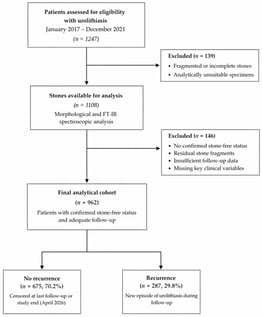
Flow diagram of patient selection and study cohort formation.

Mumps remains a public health challenge worldwide despite being a vaccine-preventable disease. This review outlines the historical development and contrasting mumps vaccination policies in the United States and Japan and their epidemiological consequences. In the United States, where the two-dose measles, mumps, and rubella (MMR) vaccine is routinely administered, the incidence of mumps has markedly decreased. Recently, however, sporadic outbreaks have emerged, driven by breakthrough infections among vaccinated individuals. These resurgences are driven largely by waning immunity, coupled with antigenic divergence between the vaccine strain and circulating wild-type viruses. In contrast, Japan vaccination the MMR vaccine was licensed in 2026 after being suspended in 1993 owing to concerns over aseptic meningitis as an adverse event following immunization but mumps vaccination remains voluntary. This has resulted in low vaccination coverage, a lack of herd immunity, and recurrent epidemics. This review also highlights the disease-modifying effect of mumps vaccination, including a reduced risk of complications such as meningitis and orchitis, even in cases of breakthrough infection. In Japan, irreversible sensorineural hearing loss (mumps deafness), continues to occur even following subclinical infection. To prevent these complications, continuous molecular surveillance, improved vaccine safety, and reintroduction of routine two-dose mumps vaccination in Japan are essential.

7 July 2026

Beyond 42 Days: A National Cohort Study of Maternal and Late Maternal Deaths in Brazil from 2010 to 2023

  • Gustavo Gonçalves dos Santos,
  • Elizabeth Mollard and
  • Katucha Rocha de Almeida Farias
  • + 15 authors

Maternal mortality is a serious public health problem and reflects social, ethnic, racial, and regional inequalities in access to and quality of obstetric care. Despite advances in the surveillance and investigation of maternal deaths in Brazil, late maternal deaths (occurring between 43 days and 1 year after birth) are still underestimated and underexplored. Therefore, the objective of this study was to analyze the distribution and factors associated with maternal deaths and late maternal deaths in Brazil between 2010 and 2023. This was a population-based, retrospective cohort study with a quantitative approach, using secondary data from the Mortality Information System. All maternal deaths (Chapter XV of ICD-10) and late deaths recorded during the period were included. Sociodemographic, clinical, and administrative variables were analyzed. Statistical tests of association (chi-square, test of proportions, and 95% CI) were used, with a significance level of 5%. A total of 26,953 deaths were identified, of which 24,387 were maternal and 2566 were late deaths. Most deaths occurred among single, mixed-race women with 8 to 11 years of schooling, and residing in the Southeast region. Late deaths were more frequent in the South and among women aged 40 to 49. The main causes were direct obstetric conditions. A statistically significant association was observed between the type of death and sociodemographic variables. The results highlight structural inequalities in maternal mortality in Brazil and reinforce the importance of expanding postpartum surveillance beyond 42 days, with a focus on equity and continuity of care.

7 July 2026

Background: European health systems face growing pressure from population ageing, post-pandemic service backlogs, and fiscal constraints. Yet substantial cross-country differences in health outcomes persist despite comparable levels of healthcare expenditure. This study evaluated the relative efficiency of European health systems using a multidimensional framework that integrates expenditure, prevention, and population health outcomes. Methods: A cross-sectional analysis was conducted on 25 European countries using 2022 data or the nearest available year. An output-oriented constant returns to scale Data Envelopment Analysis (DEA) model was estimated with two inputs, public and private healthcare expenditure per capita, and five outputs, life expectancy at birth, inverse infant mortality, healthy life years at birth, breast cancer screening coverage, and poliomyelitis vaccination coverage. A robustness specification added physician density as an additional input. Bootstrap bias correction with 1000 replications was applied to the baseline model. A second-stage Simar–Wilson truncated regression with 2000 bootstrap replications examined the association between inefficiency and selected contextual variables, including GDP per capita, population ageing, obesity prevalence, and tobacco use prevalence. Results: In the baseline DEA model, 8 of 25 countries were located on the technical efficiency frontier (Croatia, Czechia, Estonia, Greece, Hungary, Latvia, Lithuania, and Poland; output-oriented DEA inefficiency score = 1.000 for each country), while inefficiency scores among the remaining countries ranged from 1.042 to 2.617. The highest inefficiency scores were observed for Germany (2.617), Austria (2.283), Belgium (2.230), Ireland (2.219), and France (2.167). When physician density was added as an additional input, 12 countries were located on the estimated frontier. Bootstrap correction of the baseline model increased the estimated output-oriented inefficiency scores, with bias-corrected values ranging from 1.100 to 2.941. In the second-stage analysis, higher log GDP per capita was positively associated with bias-corrected inefficiency (coefficient 1.993; 95% bootstrap CI 0.219 to 4.197), whereas population ageing, adult obesity prevalence, and tobacco use prevalence were not statistically associated with bias-corrected inefficiency. Conclusions: In this cross-sectional sample of 25 European countries, higher healthcare expenditure was not consistently associated with frontier performance when health outcomes and preventive coverage were considered jointly. The results were sensitive to the inclusion of physician density and to bootstrap correction, supporting the interpretation of Data Envelopment Analysis as an exploratory benchmarking tool rather than a definitive ranking of health systems. These findings highlight the importance of assessing how financial and workforce resources are converted into measurable health and prevention-related outputs.

2 July 2026

News & Conferences

Volumes

Latest Issues

Open for Submission

Editor's Choice

XFacebookLinkedIn
Epidemiologia - ISSN 2673-3986