Skip to Content

Journal of Cardiovascular Development and Disease

Journal of Cardiovascular Development and Disease (JCDD) is an international, peer-reviewed, open access journal on cardiovascular medicine, published monthly online by MDPI.

Indexed in PubMed | Quartile Ranking JCR - Q2 (Cardiac and Cardiovascular Systems)

Get Alerted

Add your email address to receive forthcoming issues of this journal.

All Articles (2,642)

Minimally Invasive Cardiac Surgery (MICS) has traditionally been defined according to the extent of surgical access, primarily focusing on the avoidance of full sternotomy and the reduction in incision size. However, the rapid evolution of cardiac surgery, including technological innovation, robotic platforms, hybrid procedures, and enhanced perioperative management, has progressively challenged the adequacy of purely anatomical definitions of invasiveness. Contemporary surgical practice suggests that the overall impact of a procedure on the patient extends beyond the surgical incision itself and includes several physiological and patient-centered dimensions. This narrative review discusses the contemporary meaning of invasiveness in cardiac surgery and examines the limitations of conventional definitions of MICS based exclusively on surgical exposure. This narrative review is based on a non-systematic literature search of PubMed, Scopus, and Web of Science, and uses a thematic synthesis approach to explore the multidimensional concept of surgical invasiveness in cardiac surgery. Particular attention is given to the growing role of patient-centered outcomes and perioperative burden in defining procedural invasiveness. Building upon emerging conceptual perspectives in the literature, this review highlights a multidimensional interpretation of MICS, in which technical, physiological, and recovery-related factors collectively contribute to the assessment of surgical invasiveness.

8 July 2026
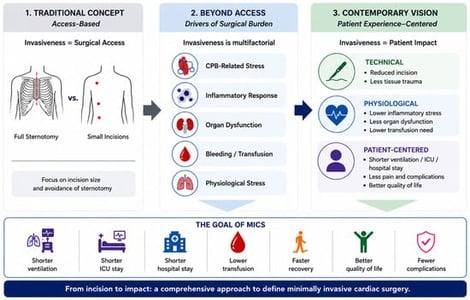
Paradigm shift in the definition of minimally invasive cardiac surgery. CPB: Cardiopulmonary Bypass; ICU: Intensive Care Unit.

Cardiovascular disease (CVD) remains the leading cause of death among women worldwide and accounts for a substantial proportion of global morbidity, mortality, and disability, as well as healthcare expenditure [...]

8 July 2026

Nutritional Status and Obesity Paradox in Acute Coronary Syndrome Patients

  • Alberto Cordero,
  • Vicente Arrarte and
  • Emilio Flores
  • + 2 authors

The worse nutritional status of patients without obesity after an acute coronary syndrome (ACS) could explain their worse prognosis and the so-called obesity paradox. We performed a retrospective study of all consecutive patients admitted to a hospital for ACS between 2009 and 2020. Nutritional status was analyzed using the CONUT scale, and values > 4 were categorized as moderate-severe malnutrition. We included 2789 patients with a mean BMI of 28.0 (4.6) kg/m2 and 26.4% with obesity. The mean CONUT index was 2.4 (2.2), and 24.3% had moderate-severe malnutrition. Obese patients had a lower prevalence of moderate-severe malnutrition: 20.0% vs. 25.9% (p = 0.003). The median follow-up was 3 years. A significant interaction between BMI and the CONUT for mortality was verified, and both variables behaved in the opposite way in relation to risk. BMI was associated with lower all-cause (HR: 0.93, 95% CI 0.89–0.98) and cardiovascular (HR: 0.93, 95% CI 0.87–0.98) mortality risk only in patients with CONUT > 4; however, in patients without malnutrition, BMI obesity was not associated with increased mortality or major cardiovascular events. In conclusion, CONUT-defined nutritional-inflammatory status may partly contribute to the observed obesity paradox in ACS patients.

8 July 2026

Background: The non-high-density lipoprotein cholesterol (non-HDL-C) / high-density lipoprotein cholesterol (HDL-C) ratio has emerged as a marker of residual vascular risk; however, its role in patent foramen ovale (PFO)-associated cryptogenic stroke (CS) remains unclear. We investigated the association between the non-HDL-C/HDL-C ratio and CS in patients with PFO and evaluated its incremental predictive value beyond the Risk of Paradoxical Embolism (ROPE) score. Methods: This retrospective study included 316 patients with confirmed PFO, including 56 patients with CS. Multivariable logistic regression, restricted cubic spline analysis, ROC analysis, net reclassification improvement (NRI), integrated discrimination improvement (IDI), decision curve analysis, and bootstrap internal validation were performed. Results: Patients with CS had significantly higher non-HDL-C/HDL-C ratio levels than those without CS (p < 0.001). In multivariable analysis, the non-HDL-C/HDL-C ratio remained independently associated with CS (OR: 1.881, 95% CI: 1.310–2.700, p < 0.001). Restricted cubic spline analysis demonstrated a significant nonlinear association between the non-HDL-C/HDL-C ratio and CS risk (overall p = 0.001; nonlinear p = 0.015). Addition of the non-HDL-C/HDL-C ratio to the ROPE score improved discrimination, increasing the AUC from 0.781 to 0.819 (DeLong p = 0.010), and significantly improved risk reclassification (continuous NRI: 0.555, p = 0.002; IDI: 0.057, p = 0.002). Internal validation demonstrated stable model performance with minimal optimism. Conclusions: The non-HDL-C/HDL-C ratio was independently associated with CS and demonstrated potential incremental predictive value beyond the ROPE score in patients with PFO. These findings suggest that metabolic lipid burden may contribute to thromboembolic susceptibility and may improve individualized risk stratification in PFO-related stroke.

8 July 2026

News & Conferences

Volumes

Latest Issues

Open for Submission

Editor's Choice

Reprints of Collections

Echocardiography in Cardiovascular Disease
Reprint

Echocardiography in Cardiovascular Disease

Editors: Kenya Kusunose
Minimal Access Cardiac Surgery
Reprint

Minimal Access Cardiac Surgery

State of the Art and Future Perspectives
Editors: Jason Ali
XFacebookLinkedIn
J. Cardiovasc. Dev. Dis. - ISSN 2308-3425