Skip to Content

Marine Drugs

Marine Drugs is an international, peer-reviewed, open access journal on the research, development, and production of biologically and therapeutically active compounds from the sea, published monthly online by MDPI.
The Australia New Zealand Marine Biotechnology Society (ANZMBS) is affiliated with Marine Drugs and its members receive discounts on the article processing charges.
Indexed in PubMed | Quartile Ranking JCR - Q1 (Pharmacology and Pharmacy | Chemistry, Medicinal)

Get Alerted

Add your email address to receive forthcoming issues of this journal.

All Articles (7,696)

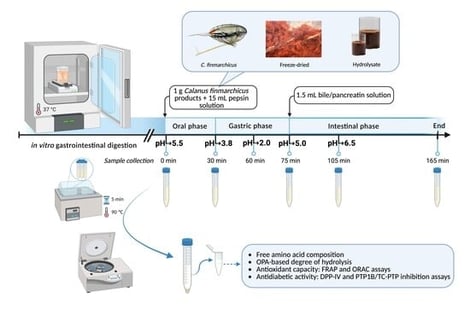
Marine rest raw materials are often undervalued or wasted despite their nutrient and bioactive composition. Calanus finmarchicus, harvested primarily for its omega-3-rich oil, yields a side-stream protein hydrolysate, C. finmarchicus hydrolysate (CFH), during commercial enzyme-assisted extraction. Although currently used as a feed ingredient, CFH contains low-molecular-weight peptides and free amino acids with potential for human health applications. This study evaluated the gastrointestinal stability of CFH and the impact of digestion on bioactivity using a static in vitro gastrointestinal digestion model. Fresh-frozen and freeze-dried C. finmarchicus were included to provide comparative data. Antioxidant capacity was measured by ferric reducing antioxidant power (FRAP) and oxygen radical absorbance capacity (ORAC) assays, and antidiabetic activity by dipeptidyl peptidase-IV (DPP-IV) and protein tyrosine phosphatase 1B (PTP1B) inhibition assays. The hydrolysate maintained its antioxidant capacity throughout digestion (at 165 min: FRAP: 27.5 ± 0.6 µmol TE/g dry weight (DW); ORAC: 411 ± 37 µmol TE/g DW). Digestion increased its DPP-IV inhibitory activity, with the inhibitory concentration (IC50) decreased from 3.73 to 1.96 mg/mL (p ≥ 0.05). PTP1B inhibitors were nonselective and detected only at 0 and 30 min. These findings support our hypothesis that CFH may serve as a nutraceutical for humans and provide a rationale for subsequent in vivo studies. However, further identification of bioactive components and in vivo validation are warranted.

7 July 2026
Relative degree of hydrolysis (DH, %) during in vitro gastrointestinal digestion of (a) fresh-frozen C. finmarchicus, (b) freeze-dried C. finmarchicus, and (c) C. finmarchicus hydrolysate measured at 0, 30, 75, 105, and 165 min. Results are the mean ± SD from three independent digestions (n = 3) and were baseline corrected by subtracting the 0 min enzyme control. Within each material, different letters indicate significant differences across time points (one-way ANOVA with Tukey’s post hoc test, p < 0.05).

Marine by-products, including fishery discards, seafood-processing residues, aquaculture wastes, crustacean shells, and seaweed-derived side streams, are heterogeneous feedstocks rich in proteins, lipids, minerals, chitinous materials, polysaccharides, and bioactive compounds. This review examines insect-mediated bioconversion as a controlled biorefinery strategy for transforming these unstable marine residues into functional aquafeed ingredients and value-added bioproducts. We compare major marine feedstock classes and industrially relevant insects, with emphasis on substrate–insect matching, moisture control, salinity, lipid and ash load, texture, spoilage risk, and safety. Particular attention is given to how marine substrates can tailor insect meal, insect oil, chitinous fractions, hydrolysates, frass, and functional feed additives. The review further summarizes aquafeed applications of insect-derived products, including fishmeal and fish-oil replacement, protein and amino acid quality, lipid enrichment, gut health, immunity, and disease resistance in aquatic animals. Microbiome-assisted strategies, such as fermentation, enzymatic pretreatment, and gut or substrate microbial management, are discussed as tools to improve substrate stability, digestibility, and product quality. Finally, safety, regulation, scale-up, life cycle assessment, and techno-economic issues are considered. Overall, marine insect biorefineries should be optimized not only for biomass yield, but also for product quality, traceability, and application-specific safety.

7 July 2026

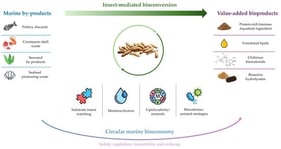
Overall framework of insect-mediated bioconversion of marine by-products into functional aquafeed ingredients and value-added bioproducts. Major marine feedstock classes include fish-processing residues, aquaculture residues, crustacean shell waste, seaweed residues, and other marine side streams. Through insect larval rearing combined with pretreatment and formulation strategies, such as moisture control, particle-size reduction, fermentation, and co-substrate blending, these heterogeneous substrates can be converted into insect meal/protein fractions, insect oil/lipid fractions, chitin- and chitosan-containing fractions, bioactive hydrolysates, and frass. These product streams can support aquafeed formulation, functional feed additives, biomaterials, and agricultural nutrient recovery.

Direct Capture Methods Reveal Extensive Organohalide Chemical Space in Marine Environments

  • Alexander Bogdanov,
  • Douglas Sweeney and
  • Paul R. Jensen
  • + 3 authors

The vast majority of the ocean’s microbial natural product biosynthetic potential remains undescribed. To access this chemical diversity, we employed Small Molecule In Situ Resin Capture (SMIRC) across three ecologically distinct sites in San Diego, California. Using high-resolution LC-MS/MS, we detected spatial and temporal variability in the metabolomes captured. Low annotation rates and evidence of extensive halogenation supported the chemical novelty of the compounds captured. We detected rare chlorinated polyketides in the pinnaic acid class, previously known only from filter-feeding invertebrates. We also report the first detection of chlorosulfolipids in the Eastern Pacific Ocean including one that contained 11 chlorine atoms. We linked compound abundances to weekly phytoplankton counts to identify candidate producers and found evidence that different taxa produce chlorosulfolipids of different carbon chain lengths. This study provides evidence of the chemical novelty that can be captured directly from the environment and a framework for integrating environmental metabolomics with phytoplankton counts as a method to identify candidate compound producers.

4 July 2026

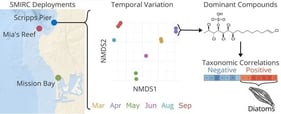
SMIRC deployment sites and metabolome similarities. (A) San Diego deployment locations (colored circles). (B) NMDS plot of metabolome Bray–Curtis dissimilarities (stress: 0.155) colored by site. Shape defines deployment year. Within shapes: × indicates used HP-20 resin, + indicates HP-20 agar, no symbol indicates new HP-20 resin. Plot created using combined positive and negative-mode LCMS data. Circles indicate 95% confidence intervals.

Tuberculosis therapy is prolonged partly because dormant subpopulations of Mycobacterium tuberculosis show reduced susceptibility to first-line drugs. Therefore, agents active against both replicating and non-replicating mycobacteria remain important to explore. Here, we investigated secondary metabolites from the Indonesian marine-derived fungus Aspergillus ostianus for activity against Mycobacterium smegmatis, a BSL-1 mycobacterial model, under aerobic and hypoxia-induced non-replicating conditions, and examined the underlying mechanism. Bioassay-guided fractionation and spectroscopic analysis identified three hydroxamate pyrazinones: neohydroxyaspergillic acid (NHAA), hydroxyaspergillic acid (HAA), and neoaspergillic acid (NAA). The MIC values were 1.56 µg/mL for NHAA and 3.13 µg/mL for HAA and NAA under both aerobic and hypoxic atmospheres. Time-kill kinetics showed ≥3-log10 CFU reductions within 24–72 h at 4–8× MIC under aerobic conditions and within 48–96 h at 4–8× MIC under hypoxia, with no regrowth at the final sampling point. Scanning electron microscopy and release of UV-absorbing intracellular material at OD260/OD280 were consistent with envelope disruption in both atmospheres. Antimycobacterial activity was attenuated in a concentration-dependent manner by exogenous Fe3+ and was reversed at 100 µM FeCl3, whereas isoniazid activity was unaffected, supporting iron-reversible and pyrazinone-specific killing. Together with the established Fe3+-binding hydroxamate pharmacophore shared by this compound class, these findings support iron sequestration as a plausible mechanism and identify fungal hydroxamate pyrazinones as scaffolds that retain bactericidal activity against hypoxia-adapted non-replicating mycobacteria, warranting further evaluation in M. tuberculosis models.

3 July 2026

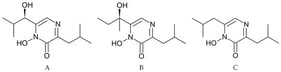
The chemical structures of neohydroxyaspergillic acid (A), hydroxyaspergillic acid (B), and neoaspergillic acid (C).

News & Conferences

Volumes

Latest Issues

Open for Submission

Editor's Choice

Reprints of Collections

The Extraction and Application of Functional Components in Algae
Reprint

The Extraction and Application of Functional Components in Algae

Editors: Aurora Silva, Miguel Ángel Prieto Lage, Clara Grosso, Maria Fátima Sá Barroso
Commemorating the Launch of the Section "Marine Toxins"
Reprint

Commemorating the Launch of the Section "Marine Toxins"

Editors: Andrew Turner, Panagiota Katikou
XFacebookLinkedIn
Mar. Drugs - ISSN 1660-3397