

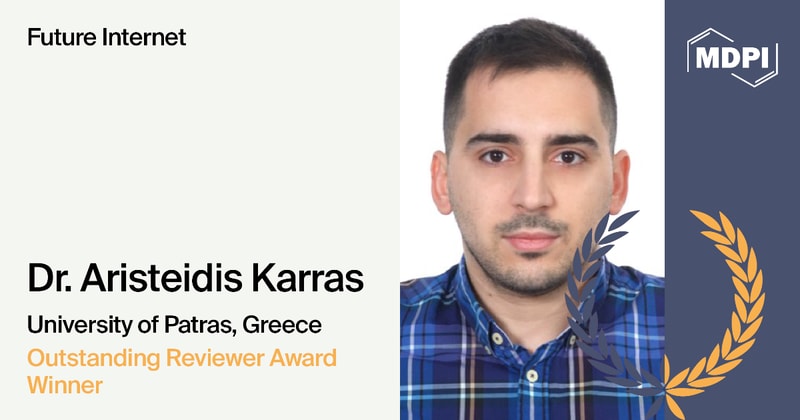
Interview with Dr. Aristeidis Karras—Winner of the Future Internet Outstanding Reviewer Award
Name: Dr. Aristeidis Karras
Affiliation: Computer Engineering and Informatics Department, University of Patras, 26504 Patras, Greece
Research interests: internet of things; edge AI; IoT data engineering; data management; big data; distributed systems
1. Can you briefly introduce yourself to our readers and tell us a little bit about your fields of interest?
I am Dr. Aristeidis Karras, and my research interests focus on big data, artificial intelligence, cybersecurity, IoT systems, and intelligent data management. My research in particular focuses on how emerging technology can be used in facilitating secure, scalable, and efficient digital systems.
2. How has your experience as a reviewer with Future Internet been? What kind of support would you like to see from the journal?
My experience with Future Internet has been very positive and pleasant. The review process is clear, well-organized, and respectful of the reviewer’s time. I also appreciate the journal’s broad scope, which allows reviewers to engage with interesting work in areas such as artificial intelligence, IoT, cybersecurity, data management, and emerging digital technologies. In terms of support, it would be useful to have more structured reviewer guidance, especially for interdisciplinary papers, and perhaps clearer criteria for evaluating methodological quality, novelty, and practical impact.
3. How has serving as a reviewer shaped your perspective on manuscript quality and improved your own writing or research practices?
As a reviewer, I have gained more insight into what constitutes a strong manuscript in terms of being coherent, novel, methodologically sound, and actually applicable. It has also helped me to become more precise, structured, and critical in my writing and research practices because it motivates me to be more exact in the way I present my work.
4. Based on your reviewing experience, what are some common problems that authors face?
In my reviewing experience, some common challenges authors face include unclear research motivation, limited methodological detail, weak discussion of results, and insufficient positioning of their contribution within the existing literature. In many cases, improving structure and clarity can greatly strengthen a manuscript.
5. As an exceptional reviewer for MDPI, do you have any tips or experiences to share that could help other reviewers improve the quality of their reviews?
One suggestion that reviewers might have is to strive to make constructive, balanced, and specific reviews. It is essential not just to find some weaknesses, but also to give some practical recommendations which may assist the authors to enhance their work. An effective review ought to not only aid in quality assurance, but also academic growth.
6. How do you see the role of reviewers evolving with advancements in artificial intelligence and automated tools in research publishing?
I believe the role of reviewers will remain essential, but it will also become more focused. AI tools can help with technical checks, language quality, similarity screening, formatting, and even the first identification of possible issues. But they cannot fully judge the originality, scientific value, reasoning, and real contribution of a manuscript. These still need human expertise. So, I see reviewers working more alongside these tools, using them to save time, but still providing the critical thinking and academic judgment that publishing needs.
7. Future Internet is an open access journal; what is your opinion of the open access model of publication?
I strongly support the open access model when it is applied with strong editorial standards and rigorous peer review. Open access makes research more visible and more useful, especially for researchers, students, and institutions that may not have access to expensive subscription-based journals. It also helps knowledge move faster across countries, disciplines, and communities. At the same time, maintaining quality, transparency, and fairness in the publication process is very important.
I would like to sincerely thank the editorial team of Future Internet for this recognition. Receiving the Future Internet Outstanding Reviewer Award 2025 is a real honor for me. I also want to thank the academic community around the journal, since reviewing is not only about evaluation but also about helping authors improve their work and supporting the quality of published research. I am grateful for the opportunity to contribute to this process.