


Abstract
Cryptomeria japonica (Japanese cedar) is extensively planted as windbreaks in Jeju, Korea, producing highly allergenic pollen that significantly affects local populations. This study analyzed 10-year trends of airborne C. japonica pollen concentrations and their relationship with meteorological factors in Jeju to provide essential data for allergy management and climate adaptation strategies. Daily airborne pollen sampling was conducted using Burkard traps from 2015 to 2024 at a monitoring site in Jeju. Meteorological data, including temperature, wind speed, relative humidity, precipitation, solar radiation, and cloud amount, were obtained from the Korea Meteorological Administration. Temporal trends were analyzed using linear regression and the Mann–Kendall test, while correlations between pollen parameters and meteorological variables were calculated using Spearman’s correlation coefficients. Over the 10-year period, annual pollen integral (APIn) and peak concentrations showed statistically significant increasing trends. Pollen season start dates demonstrated a tendency toward earlier occurrence. Season onset was strongly negatively correlated with pre-season temperatures in January and February. January solar radiation showed positive correlations with both season end and period duration. C. japonica pollen concentrations in Jeju demonstrate significant increasing trends with earlier seasonal onset, primarily driven by pre-season warming in January and February. These changes may lead to prolonged allergen exposure periods, necessitating enhanced public health preparedness and adaptation of clinical management strategies for allergic populations.
1. Introduction
Climate change significantly affects airborne pollen concentrations, seasonality, and allergenicity, with direct implications for respiratory health worldwide [1,2,3,4,5,6]. Cryptomeria japonica (Japanese cedar) pollen is recognized as a major cause of seasonal allergic diseases throughout East Asia [7].
On an international scale, comprehensive aerobiological monitoring has increasingly emphasized the dynamic interconnection between localized meteorological parameters and airborne bioaerosols, extending to large-scale spatiotemporal modeling of allergenic taxa [8,9]. While some environmental health frameworks have focused on biological allergens and respiratory symptoms in contrasting environments like arid urbanized areas [10], establishing long-term baselines in unique ecosystems remains critical for predicting regional allergy burdens. In Korea, Jeju Island represents a unique ecological niche where C. japonica pollen occurs at exceptionally high concentrations due to extensive windbreak plantations established since the early 1920s, which were further expanded through intensive afforestation efforts during the 1970s [11,12]. Unlike other regions of Korea where C. japonica pollen is rarely detected, Jeju Island experiences substantial pollen loads that significantly impact local populations with respiratory allergies [11,13].
The island’s humid subtropical climate creates favorable conditions for C. japonica growth and reproduction [11,14]. As global climate change accelerates, understanding how environmental changes affect pollen production patterns becomes increasingly important for predicting future allergen exposure risks. Previous studies have demonstrated that pollen season characteristics are highly sensitive to meteorological conditions, particularly temperature fluctuations during pre-flowering and flowering periods [15,16].
This study investigates decade-long trends in airborne C. japonica pollen concentrations and examines their relationship with meteorological factors in Jeju. Our findings provide essential baseline data for understanding climate change impacts on allergenic pollen exposure and inform evidence-based strategies for allergy management and public health adaptation.
2. Materials and Methods
2.1. Study Site and Pollen Sampling
Daily airborne pollen sampling was conducted at the standard observational field of the Jeju Regional Office of Meteorology, located on the southernmost island of South Korea (33.51° N, 126.52° E) (see online resource Supplementary Materials Figure S1, which presents a detailed overview of the site). Jeju Island is characterized by diverse vegetation zones and extensive C. japonica windbreak forests in coastal lowland areas. Airborne pollen monitoring was performed using a seven-day recording Burkard trap (Burkard Manufacturing Co., Ltd., Rickmansworth, UK), following internationally accepted protocols for aerobiological sampling in accordance with the European standard EN 16868:2019 [17,18].
Pollen concentrations were calculated as grains per cubic meter of air (grains m−3). Microscopic inspection and pollen identification were performed on specimens stained with Calberla fuchsin using light microscopy. Pollen classification was conducted with reference to relevant literature [19]. The annual pollen integral (APIn) represents the sum of daily mean pollen concentrations throughout the entire pollen season, providing a measure of total seasonal exposure [20,21,22]. The pollen season parameters (start, end, and duration) were determined using a percentage-based season definition. Specifically, the pollen season was defined as the period from the day on which the cumulative daily mean pollen concentration reached 2.5% of the total annual sum until the day it reached 97.5% [23,24].
2.2. Meteorological Data
Meteorological data from the automated synoptic observation system near the pollen sampling site were obtained from the Jeju Regional Office of Meteorology, Korea. The recorded meteorological elements were temperatures (mean: Ta, maximum: Tmax, and minimum: Tmin; °C), wind speed (mean: WS and maximum: WSmax; m/s), relative humidity (RH; %), precipitation (PPT; mm), solar radiation (SI; MJ m−2), sunshine duration (SS; h), and cloud amount (CA; %). Monthly averages of these parameters were calculated to examine relationships with seasonal pollen characteristics.
2.3. Statistical Analysis
All statistical analyses were performed using SPSS Statistics 27 software. The correlation coefficients between airborne pollen concentrations and meteorological variables were calculated using Spearman’s correlation coefficient. Temporal trends in pollen season characteristics and meteorological factors were analyzed using linear regression. Additionally, the non-parametric Mann–Kendall test and Sen’s slope estimator for decadal trend analysis were executed using R software (version 4.3.1) with the ‘trend’ package. Statistical significance was defined as p < 0.05 [25,26]. Both daily correlations during pollen seasons and monthly correlations with seasonal parameters were examined.
3. Results
3.1. 10-Year Trends of Airborne Cryptomeria Japonica Pollen in Jeju, Korea
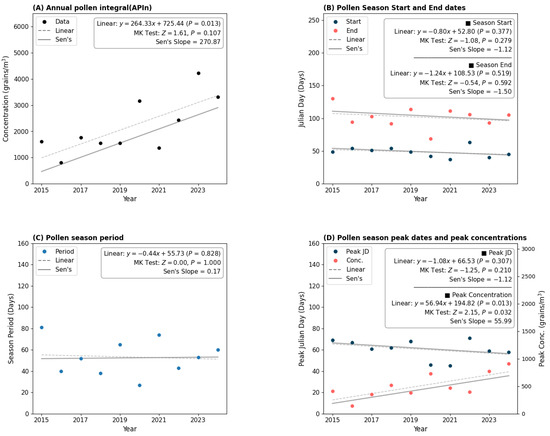
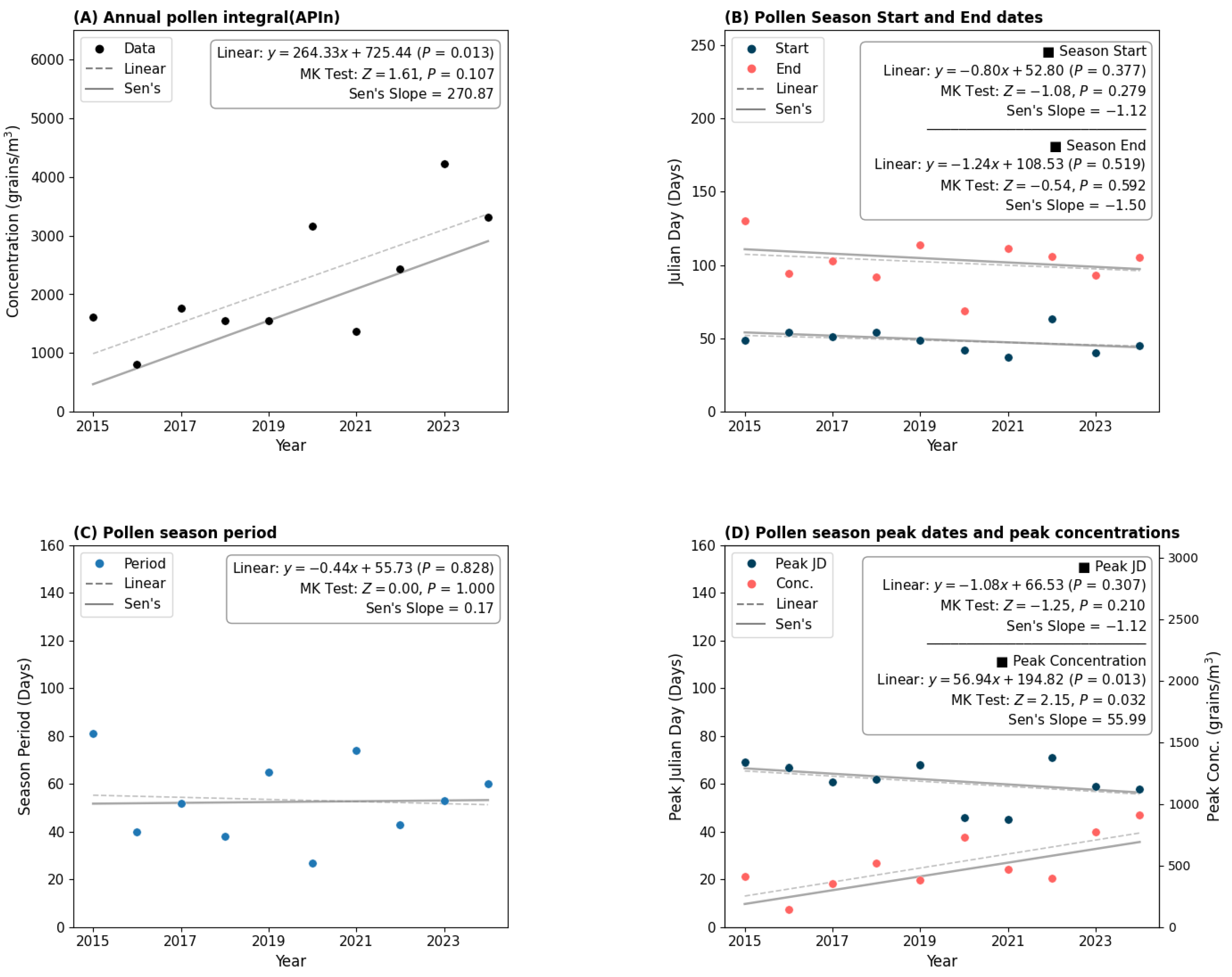
Over the 10-year monitoring period (2015–2024), C. japonica pollen demonstrated marked changes in both intensity and timing (Figure 1). APIn exhibited a significant linear increase (p < 0.05), although its monotonic trend missed the significance threshold in the Mann–Kendall analysis (p = 0.11). The temperature showed a robust upward trend under both linear regression (p < 0.05) and the Mann–Kendall test (p < 0.05) (see online resource Supplementary Materials Figure S2). Peak season concentrations also exhibited significant increases. Temporal analysis revealed that pollen season start dates, end dates, and peak dates all demonstrated a general direction toward earlier occurrence as years progressed. However, it is critical to emphasize that these macro-temporal shifts were statistically non-significant, representing qualitatively observed tendencies rather than statistically supported trends over the 10-year monitoring period.
Figure 1.
Decadal trends in airborne Cryptomeria japonica pollen parameters in Jeju, Korea, over the 10-year study period (2015–2024). (A) Annual pollen integral (APIn); (B) Pollen season start and end dates (expressed in Julian days); (C) Pollen season period (duration in days); (D) Pollen season peak dates and peak concentrations. In each panel, dashed lines represent the linear regression trends, and solid gray lines indicate the non-parametric Sen’s slope estimator trends. Detailed statistical outputs, including the linear equations, Mann–Kendall (MK) test results, and Sen’s slope values, are summarized in the respective inset boxes.
3.2. Interplay Between Meteorological Parameters and Airborne Pollen of Cryptomeria Japonica
Correlation analysis between daily C. japonica pollen concentrations and same-day meteorological conditions during pollen seasons revealed specific environmental drivers of day-to-day variability (Table 1). Daily maximum temperature showed a significant positive correlation with pollen concentrations (r = 0.109, p < 0.01), confirming that warmer days promote higher pollen release and/or atmospheric transport. Conversely, solar radiation demonstrated a significant negative correlation with daily pollen concentrations (r = −0.122, p < 0.01).
Table 1.
Correlation coefficients between daily concentration of pollen and meteorological variables for the 10-year (2015–2024) period of C. japonica pollen seasons in Jeju, Korea.
3.3. Seasonal Timing and Pre-Season Meteorology
Analysis of relationships between monthly meteorological conditions and seasonal pollen characteristics revealed important patterns linking pre-season weather to subsequent pollen season development (Table 2). Season start date showed negative correlations with mean air temperature in both January (r = −0.744, p < 0.05) and February (r = −0.835, p < 0.01). January solar radiation showed positive correlations with both season end (r = 0.758, p < 0.05) and season period (r = 0.697, p < 0.05). Conversely, January cloud amount demonstrated significant negative correlations with both season end (r = −0.794, p < 0.01) and season duration (r = −0.879, p < 0.01).
Table 2.
Correlation between meteorological variables in January, February, March, April, and the C. japonica pollen season’s start and end for the 10-year (2015–2024) period in Jeju.
4. Discussion
This study provides the first comprehensive analysis of decade-long C. japonica pollen trends in Korea, revealing significant increases in both total seasonal exposure and peak concentrations. These findings align with global patterns of increasing allergenic pollen production and advanced seasonality attributed to climate change across the Northern Hemisphere [5,6,27,28]. Similar trends have been reported for other allergenic tree species, including birch pollen in Europe, suggesting a widespread phenomenon affecting multiple taxa worldwide [29,30].
The significant increasing trend in annual pollen integral suggests that total seasonal exposure has intensified substantially over the past decade. This increase likely reflects enhanced pollen production per tree, expanded flowering periods, or improved survival and transport of pollen grains under changing environmental conditions [31,32]. Regarding potential shifts in plantation area, recent survey data from Jeju indicate that the total C. japonica forest coverage slightly decreased to 4307 ha, representing a 40 ha reduction compared to the previous Forest Type Map [33]. This marginal decline suggests that spatial expansion is unlikely to be the primary driver, implying that climate factors, such as pre-season warming, may play a more prominent role in the observed pollen intensification. The observed tendency toward an earlier season onset, although strictly lacking statistical significance in our linear regression analysis, aligns directionally with widespread phenological advances documented for numerous plant species globally [27,29]. The lack of statistical verification for these timing parameters most likely stems from the high interannual variability inherent in a relatively short 10-year dataset, which limits the statistical power for long-term phenological trend detection. Therefore, while our data demonstrate a statistically significant intensification of pollen volume, shifts in seasonal timing parameters must be interpreted with caution as statistically unproven tendencies that require longer-term monitoring to confirm.
The strong relationship between pre-season meteorological factors and C. japonica phenology can be explained by the mechanistic interplay between winter chilling accumulation and spring warming, which is characteristic of almost all tree species. Plant phenology generally requires a specific period of winter chilling to break endodormancy, followed by a subsequent accumulation of heat units to trigger flowering ecodormancy release. On Jeju Island, which features a humid subtropical climate, winter chilling thresholds required for endodormancy release are consistently met. Consequently, the subsequent forcing phase becomes the primary rate-limiting step; rising temperatures in January and February accelerate fulfillment of these heat accumulation requirements, thereby advancing the pollen season start date, a biological mechanism strongly supported by long-term observations of earlier flowering under regional warming trends [34,35].
To accurately interpret the environmental drivers of C. japonica pollen dynamics, it is critical to distinguish between short-term meteorological controls operating on a daily scale and long-term climatic controls influencing annual and seasonal parameters [36]. On a short-term scale, day-to-day fluctuations during the active pollen season are primarily governed by immediate meteorological conditions that modulate physical pollen release and atmospheric transport. This is evidenced by the positive correlation between daily maximum temperature and pollen concentrations, which enhances anther dehiscence and atmospheric dispersion [3,5,31]. Conversely, long-term climatic controls act as biological macro-drivers, dictating regional phenological shifts and overall annual pollen yields over a decadal timeline, representing a dynamic interconnection between multi-decadal environmental shifts and biological outputs [17,37]. Our results show that instead of daily weather, it is the cumulative pre-season climatic context-based rising temperatures in January and February that exert a strong control over seasonal onset, thereby potentially reshaping the macro-temporal exposure window for the population. The long-term warming trends of these specific meteorological variables are documented in Supplementary Figures S2 and S3.
The relationship between solar radiation and pollen dynamics appears to be dual-faceted depending on the timing. This study observed a significant negative correlation between daily pollen concentrations and solar radiation, which stands in contrast to the positive influence of temperature. However, it is critical to note that the underlying physical or biological mechanisms behind this negative association remain speculative, as direct physiological impacts were not monitored in this study. One hypothetical pathway based on previous literature is that intense solar radiation, particularly within the UV-B spectrum, might potentially induce cellular degradation in pollen grains or lower their release viability. Prior experimental studies in other plant taxa, including members of the Cupressaceae family, have demonstrated that enhanced UV-B radiation can negatively affect pollen morphology, germination capacity, and pollen tube growth [38,39,40,41,42,43]. Since direct measurements of UV-B irradiance or pollen structural integrity were not conducted in this regional study, this specific destructive mechanism remains a plausible hypothesis that requires further direct experimental validation in future aerobiological research. Conversely, pre-season solar radiation in January showed a strong positive correlation with the season duration and season end. This indicates that while excessive sunlight during the dispersion period may be detrimental, sufficient accumulation of photosynthetically active radiation during the winter dormancy period is crucial for reproductive development [44,45,46,47]. Enhanced solar exposure prior to flowering likely boosts carbohydrate reserves, enabling the trees to sustain a longer flowering period.
In addition to thermal phenology, the physical persistence of airborne pollen is highly modulated by atmospheric transport mechanisms and moisture status [37]. Although daily relative humidity and precipitation showed no correlations in our daily dataset, meteorological factors fundamentally alter pollen aerodynamics. Higher relative humidity typically induces pollen grain hydration, increasing their weight and promoting rapid dry deposition, while precipitation exerts a ‘wash-out’ effect that effectively clears biological particulates from the planetary boundary layer [35,37]. Conversely, mechanical wind factors facilitate initial detachment and long-range transport. The complex behaviors of these parameters highlight the importance of multi-faceted meteorological modeling for reliable seasonal forecasting.
The documented increasing trends in C. japonica pollen concentrations have direct and quantifiable implications for respiratory health management in Jeju. Lee et al. [11] demonstrated a significant rise in C. japonica pollinosis and sensitization among symptomatic patients in Jeju over recent decades, driven by the unique environmental abundance of these windbreak forests. Furthermore, longitudinal observations by Suh et al. [13] quantified this risk, revealing that the number of seasonal exposures to C. japonica pollen directly and cumulatively increases the risk of sensitization among local adults. As our 10-year dataset demonstrates an intensification of both total seasonal exposure and daily peak levels, the clinical threshold for symptom triggering is likely to be reached earlier and sustained longer each year, necessitating proactive, patient-specific therapeutic interventions prior to the pollen season onset [3,48].
The significant correlations between pre-season meteorological conditions and pollen season characteristics offer valuable opportunities for seasonal forecasting. Winter temperature and solar radiation data could inform predictive models for season onset timing, similar to successful forecasting systems developed for other allergenic species in Europe [36,49]. Such forecasting capabilities would allow better preparation by both healthcare systems and sensitive individuals, potentially reducing the burden of allergic disease through improved preventive care timing.
5. Conclusions
This decade-long analysis demonstrates that C. japonica pollen concentrations in Jeju are increasing significantly, with season onset occurring earlier and being strongly influenced by pre-season temperature conditions. These trends reflect the growing impact of climate change on allergenic pollen exposure and highlight the need for adaptive management strategies. The strong relationships between pre-season meteorological conditions and subsequent pollen season characteristics provide valuable insights for seasonal forecasting and clinical preparation. Continued monitoring and research are essential for developing effective adaptation strategies and maintaining public health in the face of changing environmental conditions.
Supplementary Materials
The following supporting information can be downloaded at https://www.mdpi.com/article/10.3390/atmos17060618/s1, Figure S1: Location of the airborne pollen sampling and meteorological parameter survey site at the standard observational field of the Jeju Regional Office of Meteorology (33.51411 °N; 126.52969 °E; elevation: 20.79 m above sea level); Figure S2. Decadal trend analysis of the annual mean temperature in Jeju over the 10-year period (2015–2024). The dashed lines represent the linear regression trends, and solid gray lines indicate the non-parametric Sen’s slope estimator trends. Detailed statistical outputs, including the linear equations, Mann–Kendall (MK) test results, and Sen’s slope values, are summarized in the respective inset boxes; Figure S3. Monthly average temperature trends for January (navy), February (coral), and March (orange) from 2015 to 2024. The dashed lines represent the linear regression trends, and solid gray lines indicate the non-parametric Sen’s slope estimator trends. Detailed statistical outputs, including the linear equations, Mann–Kendall (MK) test results, and Sen’s slope values, are summarized in the respective inset boxes.
Author Contributions
Conceived the original screening and research plans and performed all the experiments, Y.J.H.; provided pollen data, M.J.H.; conceived and supervised the research, S.K., K.R.K. and J.-W.O. All authors have read and agreed to the published version of the manuscript.
Funding
This study was funded by the Korea Meteorological Administration Research and Development Program “Advanced Research on Bio- and Agricultural Meteorology” under grant number KMA2018-00626.
Institutional Review Board Statement
This article does not contain any studies with human participants or animals performed by any of the authors.
Informed Consent Statement
Not applicable.
Data Availability Statement
Restrictions apply to the datasets due to an ongoing study. Requests to access the datasets should be directed to the corresponding author.
Conflicts of Interest
The authors declare that they have no conflicts of interest.
References
- Di Menno di Bucchianico, A.; Gaddi, R.; Brighetti, M.; De Franco, D.; Miraglia, A.; Travaglini, A. Status and trend of the main allergenic pollen grains and Alternaria spores in the city of Rome (2003–2019). Sustainability 2023, 15, 6150. [Google Scholar] [CrossRef]
- Kim, K.R.; Han, M.J.; Han, Y.J.; Lee, Y.H.; Oh, J.W. Prediction model for annual variation in total pollen by allergenic trees in Korean cities. Allergy Asthma Immunol. Res. 2024, 16, 109–122. [Google Scholar] [CrossRef] [PubMed]
- Schramm, P.J.; Brown, C.L.; Saha, S.; Conlon, K.C.; Manangan, A.P.; Bell, J.E.; Hess, J.J. A systematic review of the effects of temperature and precipitation on pollen concentrations and season timing, and implications for human health. Int. J. Biometeorol. 2021, 65, 1615–1628. [Google Scholar] [CrossRef] [PubMed]
- Lake, I.R.; Jones, N.R.; Agnew, M.; Goodess, C.M.; Giorgi, F.; Hamaoui-Laguel, L.; Semenov, M.A.; Solomon, F.; Storkey, J.; Vautard, R.; et al. Climate Change and Future Pollen Allergy in Europe. Environ. Health Perspect. 2017, 125, 385–391. [Google Scholar] [CrossRef] [PubMed]
- Ziska, L.H.; Makra, L.; Harry, S.K.; Bruffaerts, N.; Hendrickx, M.; Coates, F.; Saarto, A.; Thibaudon, M.; Oliver, G.; Damialis, A.; et al. Temperature-related changes in airborne allergenic pollen abundance and seasonality across the northern hemisphere: A retrospective data analysis. Lancet Planet. Health 2019, 3, e124–e131. [Google Scholar] [CrossRef] [PubMed]
- Anderegg, W.R.L.; Abatzoglou, J.T.; Anderegg, L.D.L.; Bielory, L.; Kinney, P.L.; Ziska, L. Anthropogenic climate change is worsening North American pollen seasons. Proc. Natl. Acad. Sci. USA 2021, 118, e2013284118. [Google Scholar] [CrossRef] [PubMed]
- Osada, T.; Okano, M. Japanese cedar and cypress pollinosis updated: New allergens, cross-reactivity, and treatment. Allergol. Int. 2021, 70, 281–290. [Google Scholar] [CrossRef] [PubMed]
- Naseer, S.; Noor, M.J.; Iftikhar, S. Airborne pollen and spore monitoring for seasonal trends and dynamic interconnection with meteorological parameters in Rawalpindi city, Pakistan. Atmos. Environ. 2024, 336, 120755. [Google Scholar] [CrossRef]
- Ren, X.; Cai, T.; Mi, Z.; Bielory, L.; Nolte, C.G.; Georgopoulos, P.G. Modeling past and future spatiotemporal distributions of airborne allergenic pollen across the contiguous United States. Front. Allergy 2022, 3, 959594. [Google Scholar] [CrossRef] [PubMed]
- Ortega-Rosas, C.I.; Meza-Figueroa, D.; Vidal-Solano, J.R. Association of airborne particulate matter with pollen, fungal spores, and allergic symptoms in an arid urbanized area. Environ. Geochem. Health 2021, 43, 1761–1782. [Google Scholar] [PubMed]
- Lee, J.; Lee, K.H.; Lee, H.S.; Hong, S.C.; Kang, J.H. Japanese Cedar (Cryptomeria japonica) pollinosis in Jeju, Korea: Is it increasing? Allergy Asthma Immunol. Res. 2015, 7, 295–300. [Google Scholar] [CrossRef] [PubMed]
- Lumbers, R.I.C.; Seo, Y.O.; Joo, S.H.; Jung, S.C. Evaluation of stem taper models fitted for Japanese cedar (Cryptomeria japonica) in the subtropical forests of Jeju Island, Korea. For. Sci. Technol. 2017, 13, 181–186. [Google Scholar]
- Suh, M.J.; Yi, H.J.; Kim, J.H.; Lee, K.H.; Hong, S.C.; Kang, J.W. Number of seasonal exposures to Japanese cedar pollen increases the risk of sensitization: Observational study in Korean adults. Sci. Rep. 2019, 9, 10496. [Google Scholar] [CrossRef] [PubMed]
- Park, J.; Shin, Y.H.; Byrne, R. Late-Holocene vegetation and climate change in Jeju Island, Korea and its implications for ENSO influences. Quat. Sci. Rev. 2016, 153, 40–50. [Google Scholar] [CrossRef]
- Cleland, E.E.; Chuine, I.; Menzel, A.; Mooney, H.A.; Schwartz, M.D. Shifting plant phenology in response to global change. Trends Ecol. Evol. 2007, 22, 357–365. [Google Scholar] [CrossRef] [PubMed]
- García-Mozo, H.; Oteros, J.; Galán, C. Phenological changes in olive (Olea europaea L.) reproductive cycle in southern Spain due to climate change. Ann. Agric. Environ. Med. 2015, 22, 421–428. [Google Scholar] [CrossRef] [PubMed]
- Rantio-Lehtimäki, A. Sampling airborne pollen and pollen antigens. In Allergenic Pollen and Pollinosis in Europe; D’Amato, G., Spieksma, F.T., Bonini, S., Eds.; Blackwell Scientific: Hoboken, NJ, USA, 1991; pp. 18–23. [Google Scholar]
- EN 16868:2019; Ambient Air-Sampling and Analysis of Airborne Pollen Grains and Fungal Spores for Allergy Networks-Volumetric Hirst Method. European Committee for Standardization: Brussels, Belgium, 2019.
- Hong, C.S. Pollen allergy plants in Korea. Allergy Asthma Respir. Dis. 2015, 3, 239–254. [Google Scholar] [CrossRef]
- Galán, C.; Ariatti, A.; Bonini, M.; Clot, B.; Crouzy, B.; Fernandez-González, D.; Frenguelli, G.; Gehrig, R.; Isard, S.; Levetin, E.; et al. Recommended terminology for aerobiological studies. Aerobiologia 2017, 33, 293–295. [Google Scholar] [CrossRef]
- Bastl, K.; Kmenta, M.; Gerger, U.W. Defining pollen seasons: Background and recommendations. Curr. Allergy Asthma Rep. 2018, 18, 73. [Google Scholar] [CrossRef] [PubMed]
- Nilsson, S.; Persson, S. Tree pollen spectra in the Stockholm region (Sweden), 1973–1980. Grana 1981, 20, 179–182. [Google Scholar] [CrossRef]
- Jato, V.; Rodríguez-Rajo, F.J.; Alcázar, P.; De Nuntiis, P.; Galán, C.; Mandrioli, P. May the definition of pollen season influence aerobiological results? Aerobiologia 2006, 22, 13–25. [Google Scholar] [CrossRef]
- Anderson, T.B. A model to predict the beginning of the pollen season. Grana 1991, 30, 269–275. [Google Scholar] [CrossRef]
- Caeiro, E.R.G.; Camacho, R.A.P.; Ferreira, M.B.; Carreiro-Martins, P.; Camacho, I.G.C. Trends in airborne grass pollen in Évora City (Portugal). Aerobiologia 2024, 40, 175–189. [Google Scholar] [CrossRef]
- Da Silva, R.M.; Santos, C.A.G.; Moreira, M.; Corte-Real, J.; Silva, V.C.L.; Medeiros, I.C. Rainfall and river flow trends using Mann-Kendall and Sen’s slope estimator statistical tests in the Cobres River basin. Nat. Hazards 2015, 77, 1205–1221. [Google Scholar] [CrossRef]
- Guada, G.; Fernández-González, M.; Amigo, R.; Dias-Lorenzo, D.A.; Espinosa, K.C.; Rodriguez-Rajo, F.J. Precipitation masks the effect of temperature on Birch airborne pollen start, and previous summer temperature affects pollen intensity; A 31-year study at its southwestern distribution boundary. Agric. For. Meteorol. 2024, 353, 110072. [Google Scholar] [CrossRef]
- Walther, G.R.; Post, E.; Convey, P.; Menzel, A.; Parmesan, C.; Beebee, T.J.C.; Fromentin, J.M.; Hoegh-Guldberg, O.; Bairlein, F. Ecological responses to recent climate change. Nature 2002, 416, 389–395. [Google Scholar] [CrossRef] [PubMed]
- Parmesan, C.; Yohe, G. A globally coherent fingerprint of climate change impacts across natural systems. Nature 2003, 421, 37–42. [Google Scholar] [CrossRef] [PubMed]
- Root, T.L.; Price, J.T.; Hall, K.R.; Schneider, S.H.; Rosenzweig, C.; Pounds, J.A. Fingerprints of global warming on wild animals and plants. Nature 2003, 421, 57–60. [Google Scholar] [CrossRef] [PubMed]
- Bruffaerts, N.; De Smedt, T.; Delcloo, A.; Simons, K.; Hoebeke, L.; Verstraeten, C.; Nieuwenhuyse, A.V.; Packeu, A.; Hendrickx, M. Comparative long-term trend analysis of daily weather conditions with daily pollen concentrations in Brussels, Belgium. Int. J. Biometeorol. 2018, 62, 483–491. [Google Scholar] [PubMed]
- Beggs, P.J.; Šikoparija, B.; Smith, M. Aerobiology in the international journal of biometeorology, 1957-2017. Int. J. Biometeorol. 2017, 61, 51–58. [Google Scholar] [CrossRef] [PubMed]
- Jeju Special Self-Governing Province. Research Survey on Distribution Investigation and Resource Plan Establishment of Cryptomeria japonica Forests in Jeju; Jeju Special Self-Governing Province: Jeju, Republic of Korean, 2022.
- Inoue, S.; Kawashima, S.; Takahashi, Y. Estimating the beginning day of Japanese cedar pollen release under global climate change. Glob. Change Biol. 2002, 8, 1165–1168. [Google Scholar] [CrossRef]
- Taylor, P.E.; Flagan, R.C.; Valenta, R.; Glovsky, M.M. Release of airborne microparticles from grass and tree pollen during thunderstorms. J. Allergy Clin. Immunol. 2002, 109, 61–66. [Google Scholar] [CrossRef] [PubMed]
- Frisk, C.A.; Brobakk, T.E.; Rizzi, J.; Ramfjord, H. Influence of spatiotemporal and meteorological variation on Norwegian atmospheric pollen seasonality. Agric. For. Meteorol. 2024, 353, 110059. [Google Scholar] [CrossRef]
- Recio, M.; Docampo, S.; García-Sánchez, J.J.; Trigo, M.M.; Melgar, M.; Cabezudo, B. Influence of meteorological parameters on airborne Cupressaceae pollen concentrations in Malaga (Spain). Int. J. Biometeorol. 2010, 52, 181–190. [Google Scholar]
- Llorens, L.; Badenes-Pérez, F.R.; Julkunen-Tiitto, R.; Zidorn, C.; Fereres, A.; Jansen, M.A.K. The role of UV-B radiation in plant sexual reproduction. Perspect. Plant Ecol. Evol. Syst. 2015, 17, 243–254. [Google Scholar] [CrossRef]
- Feng, H.; An, L.; Tan, L.; Hou, Z.; Wang, X. Effect of enhanced ultraviolet-B radiation on pollen germination and tube growth of 19 taxa in vitro. Environ. Exp. Bot. 2000, 43, 45–53. [Google Scholar] [CrossRef]
- Koti, S.; Reddy, K.R.; Reddy, V.R.; Kakani, V.G.; Zhao, D. Interactive effects of carbon dioxide, temperature, and ultraviolet-B radiation on soybean (Glycine max L.) flower and pollen morphology, pollen production, germination, and tube lengths. J. Exp. Bot. 2005, 56, 725–736. [Google Scholar] [CrossRef] [PubMed]
- Sampson, B.J.; Cane, J.H. Impact of enhanced ultraviolet-B radiation on flower, pollen, and nectar production. Am. J. Bot. 1999, 86, 108–114. [Google Scholar] [CrossRef]
- Demchik, S.M.; Day, T.A. Effect of enhanced UV-B radiation of pollen quantity, quality, and seed yield in Brassica rapa (Brassicaceae). Am. J. Bot. 1996, 83, 573–579. [Google Scholar] [CrossRef]
- Rojo, J.; Rapp, A.; Lara, B.; Fernández-González, F.; Pérez-Badia, R. Effect of land uses and wind direction on the contribution of local sources to airborne pollen. Sci. Total Environ. 2015, 538, 672–682. [Google Scholar] [CrossRef] [PubMed]
- Gruda, N.; Bisbis, M.; Tanny, J. Influence of climate change on protected cultivation: Impacts and sustainable adaptation strategies—A review. J. Clean. Prod. 2019, 225, 481–495. [Google Scholar] [CrossRef]
- Deng, N.; Ling, X.; Sun, Y.; Zhang, C.; Fahad, S.; Peng, S.; Cui, K.; Nie, L.; Huang, J. Influence of temperature and solar radiation on grain yield and quality in irrigated rice system. Eur. J. Agron. 2015, 64, 37–46. [Google Scholar] [CrossRef]
- Marcelis, L.F.M.; Broekhuijsen, A.G.M.; Meinen, E.; Nijs, E.M.F.M.; Raaphorst, M.G.M. Quantification of the growth response to light quantity of greenhouse grown crops. V Int. Symp. Artif. Light. Hortic. 2005, 711, 97–104. [Google Scholar]
- Gruda, N.; Tanny, J. Protected crops—Recent advances, innovative technologies and future challenges. Acta Hortic. 2015, 1107, 271–278. [Google Scholar] [CrossRef]
- Yang, S.I.; Lee, I.H.; Kim, M.; Ryu, G.; Kang, S.Y.; Kim, M.A.; Lee, S.M.; Kim, H.J.; Park, D.Y.; Lee, Y.J.; et al. KAAACI allergic rhinitis guidelines: Part 1. update in pharmacotherapy. Allergy Asthma Immunol. Res. 2023, 15, 19–31. [Google Scholar] [CrossRef] [PubMed]
- Malkiewicz, M.; Drzeniecka-Osiadacz, A.; Krynicka, J. The dynamics of the Corylus, Alnus, and Betula pollen seasons in the context of climate change (SW Poland). Sci. Total Environ. 2016, 573, 740–750. [Google Scholar] [CrossRef] [PubMed]

Disclaimer/Publisher’s Note: The statements, opinions and data contained in all publications are solely those of the individual author(s) and contributor(s) and not of MDPI and/or the editor(s). MDPI and/or the editor(s) disclaim responsibility for any injury to people or property resulting from any ideas, methods, instructions or products referred to in the content. |
© 2026 by the authors. Licensee MDPI, Basel, Switzerland. This article is an open access article distributed under the terms and conditions of the Creative Commons Attribution (CC BY) license.