


Abstract
Introduction: It is accepted that nano- and micro-plastic (NMP) pollutants threaten ecosystems and human health by their bioaccumulation but, interestingly, their toxicity is shape-dependent. However, a clear definition of irregular NMPs, as the dominant shape in environmental and biological samples, is currently lacking when compared to spherical and fibrous NMPs. Objectives: This study quantifies morphometric descriptors in order to develop a standardized definition for irregular NMPs. Methods: Hyperspectral images of 34 spherical, 50 fibrous, and 45 irregular NMPs were collected from the literature. All shape-related features reported previously were analyzed using a machine learning model. Using five-fold cross-validation, a decision tree-based ensemble classifier with fixed parameters and Gini coefficient was established to screen key morphometric descriptors and their optimal interval ranges. The model was independently validated, enabling the accurate distinction of irregular NMPs from spherical and fibrous NMPs. Results: Three morphometric descriptors, including circularity, roundness, and perimeter-to-area ratio, were identified using five-fold cross-validation as optimal indicators for NMP shape classification. Optimal interval ranges for irregular NMPs were as follows: circularity (0.388 ± 0.004–0.768 ± 0.004), roundness (0.248 ± 0.01–0.752 ± 0.06) and perimeter-to-area ratio (>11.608 ± 1.39). This approach generated a 96.0% macro-averaged accuracy across these NMPs, with 100% precision and 89.0% recall. Conclusions: Irregular NMPs may be characterized using three morphometric descriptors, such as circularity, roundness, and perimeter-to-area ratio. The three-descriptor combination has highly accurate discrimination from spherical and fibrous NMPs.
1. Introduction
Plastics, known for their low cost, light weight, and durability, are extensively used across various sectors. However, high production rates have led to significant waste accumulation and increased microplastic (MP) pollution concerns [1,2]. MPs are typically 100 nm to 5 mm in diameter, and can further break down to nanoplastics (NPs), which are <100 nm in size [3]. The ecological and organismal health hazards posed by these emerging pollutants have attracted considerable research attention. Nano- and micro-plastics (NMPs) are found not only in natural environments such as water [4], soil [5], and air [6], but also in biological samples, such as saphenous vein tissue [7], placenta [8], and human prostate tissue [9]. Recent studies have also reported that NMPs accumulate and elicit toxic effects across various physiological systems, including respiratory, digestive, reproductive, and nervous systems, thereby posing a potentially detrimental impact on human health [10,11,12,13].
Notably, health risks elicited by NMPs are shape-dependent [14], with entities mainly classified as spherical, fibrous, and irregular shapes [15]. Even when polymer composition is identical, significant differences relating to toxic effects are still observed across different shapes [16,17]. Spherical NMPs have “circular shapes” [18], while fibrous NMPs have an “aspect ratio of ≥3” [19]. Thus, both types can be artificially prepared due to their quantifiable morphological descriptors. Currently, spherical NMP standards, particularly polystyrene, have been commercialized and used in toxicological studies [20]. For fibrous NMPs, some research groups [21,22], including us, have successfully prepared fibrous products of varying lengths and diameters. Using these artificial products, a study examining mussels and zebrafish [23,24] showed that fibrous MP exposure generated higher MP accumulation rates in organisms and lower survival rates when compared to spherical MPs. In contrast, although irregular MPs dominate in both natural environments (53.7–73.6%) and human samples (60.37–60.71%) [25,26], no clear definition has been assigned until now. These MPs are vaguely described as “MPs with shapes that are difficult to define” [27] or “when the particle shape is not clear, it is recorded as irregular” [7]. Consequently, this lack of clarity has become a major obstacle with respect to their controlled preparation and risk assessments relating to the majority of NMP pollutants.
Recently, researchers have used different methods to self-prepare irregular NMPs and conduct in vitro and in vivo toxicological experiments. Xu et al. [28] reported that irregular MPs released from baby bottles induced inflammatory responses in human intestinal cells and promoted intestinal inflammation. Similarly, Kim et al. [16] showed that irregular MPs reduced survival rates and inhibited growth in benthic organisms. Additionally, in vitro and in vivo studies indicated that irregular MPs induced stronger pro-inflammatory responses when compared to spherical MPs [29]. Unfortunately, these irregular NMPs were prepared using non-unified standards, leading to reduced comparability across different irregular NMPs. Even if irregular NMPs were generated by the same research team, their reproducibility is low and their subsequent validation in toxicology studies remains challenging. Therefore, establishing criteria defining irregular NMPs has become paramount when assessing their health risks.
To characterize morphometric descriptors for irregular NMP shapes, researchers developed several parameters that quantified irregularity across a wide range of materials. Saito-Koyama et al. [30] used aspect ratio, circularity, roundness, and solidity parameters to characterize cell nucleus irregularity in histopathological images when investigating relationships between nucleus shape irregularity and Programmed cell death-ligand 1 (PD-L1) expression in lung squamous cell carcinoma. In the geotechnical engineering field, Zhang et al. [31] used aspect ratio and convexity to describe irregular sandy soil particles simulated using a 2-dimensional (2D) discrete element method, and analyzed the influence of particle shape on ground responses during tunnel excavation in sandy formations. In the NMP field, researchers have also examined methods and criteria that classify different shapes; e.g., Lorenzo-Navarro et al. proposed MP classification into fragments, lines, and pellets [32]. Unfortunately, these authors did not establish precise, critical morphometric descriptor interval ranges, thus a clear irregularity definition remains lacking. Therefore, a more comprehensive irregular NMP definition and a more accurate assessment of the irregularity degree is required.
To investigate morphometric descriptors, artificial intelligence (AI) methods, such as decision tree (DT), random forest, and other machine learning approaches, have increased automated identification, quantification, classification, and prediction outputs due to their ability to model complex data relationships [33], and have yielded more precise and comprehensive characterization parameters when compared to traditional visual inspection or optical microscopy techniques [34,35]. Of these algorithms, DT constructs a hierarchical tree structure by recursively partitioning data based on descriptor interval ranges, thereby extracting logical rules from data characteristics to achieve precise classification or prediction [36,37]. Meyers et al. [38] used a DT model to distinguish plastics from non-plastics and achieved 95.8% accuracy, and also identified MP composition achieving 88.1% accuracy. Vadivel et al. [39] used the C5.0 DT to categorize irregular breast lumps and achieved an accuracy of up to 92.7%. This evidence suggests that the DT approach can generate irregular NMP morphometric descriptors.
In this study, we retrieved irregular NMP images from the literature to build a DT model that could be used to analyze irregular NMP morphometric features. Morphometric descriptors were generated after the model was evaluated using three assessment metrics, and related interval ranges established to define irregular NMPs. We believe these findings could provide an anchor point for the controlled preparation of irregular NMP standards in the future.
2. Materials and Methods
2.1. Sample Collection and Image Acquisition
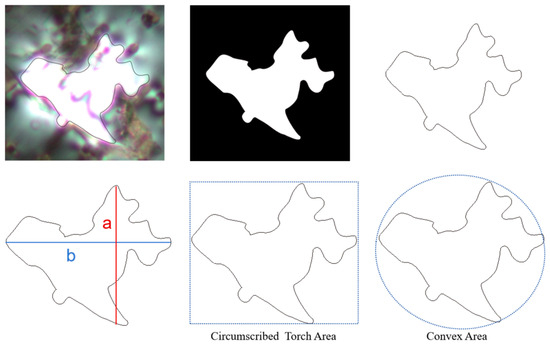
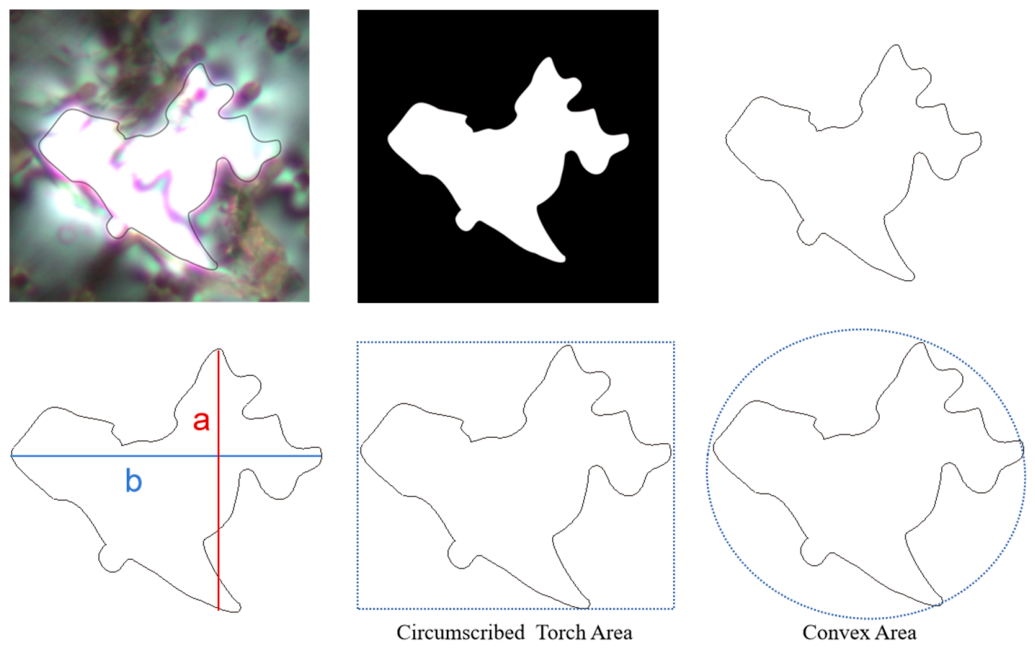
Two databases, PubMed and Scopus, were used to conduct an extensive literature search. Three distinct search strings were used: (1) “microplastics” AND “fiber”; (2) “irregular microplastics”; and (3) “microplastics” AND “spherical”. The following criteria were also used: pictures with descriptions or annotations that explicitly mentioned “spherical”, “fiber”, and “irregular” shapes. All 2D hyperspectral irregular MP images in the established dataset were sourced from the relevant literature, focusing on fragments and films. In total, 320 images were retrieved, including 52 spherical MP images, 144 fibrous MP images, and 124 irregular MP images. To ensure quality control during contour extraction, strict inclusion and exclusion criteria were applied: images where MPs were obscured by markers (arrows, circles, etc.) were excluded, as such occlusion compromised image integrity and interfered with identification and analysis. Ultimately, 129 hyperspectral images were selected for shape analysis. A 2D image of irregular MP morphology is shown (Figure 1).
Figure 1.
A 2D image showing irregular microplastic morphology a. short diameter and b. long diameter.
2.2. Data Processing, Extraction, and Evaluating Irregularity Descriptors
2.2.1. Dataset Creation and Feature Extraction
The dataset primarily encompassed 34 spherical shapes, 50 fibrous forms, and 45 irregularly-shaped entities. The Segment Anything Model (SAM) is an image segmentation model released by Meta AI Research in 2023, which segments every object in an image [40]. To extract contour information from this diverse data array, we leveraged a Multi-modal Medical AI Platform that was inherently equipped with the SAM2 model. This platform facilitated contour extraction with exceptional precision, guided by standardized user-defined minimal enclosing bounding boxes slightly larger than the target objects as prompts. Clear rules were established to standardize box-drawing, with a double-check mechanism implemented by reviewers to ensure annotation consistency. No additional image cleanup was performed, though minor manual corrections were applied to samples affected by lighting and shadows, ensuring comprehensive and reproducible analysis of the intricate contours in the dataset.
We used several features, such as long diameter, short diameter, aspect ratio, circularity, roundness, solidity, rectangularity, perimeter-to-area ratio, vertex count, and the Boyce-Clark index [41]. These features were established from previous studies and are widely used in computer vision and pattern recognition for feature analysis and comparisons [41,42,43,44,45,46,47]. The formulae for these features are shown (Table 1).
Table 1.
Morphological characteristic features of microplastics.
2.2.2. DT Modeling
We partitioned our dataset into training and test sets in a fixed ratio of 80.0% to 20.0%, respectively. The training set was utilized for model construction, feature selection, and parameter tuning, while the testing set was reserved for the independent validation of the final model’s classification performance. Throughout the process, a strict non-overlap principle between training and test sets was consistently enforced to preclude data leakage and ensure the validity of the experimental results.
In the model training phase, five-fold cross-validation was adopted to mitigate the risk of overfitting, fully exploit the utility of the available training data, and enhance the stability of parameter estimation. Meanwhile, the splitting mechanism for DT nodes was leveraged to assess the discriminative capacity of each feature. The core objective here was to determine the optimal threshold for each descriptor, thereby enabling effective and accurate differentiation among the three target categories.
To ensure accurate threshold determination and experimental reproducibility, the key parameters for DT classifiers were fixed in advance: the maximum depth (max depth) was set to 2, the splitter was specified as “best,” and the Gini coefficient was adopted as a criterion for node splitting. Using these fixed parameter settings, 10 DT classifiers were constructed in each fold of the five-fold cross-validation, corresponding to the 10 descriptors extracted (Table 1). Each classifier was constructed using a single feature as the sole input for node splitting. By analyzing key indicators such as classification accuracy and splitting performance in the training set in each fold, the discriminative ability and contribution of each feature were quantitatively evaluated.
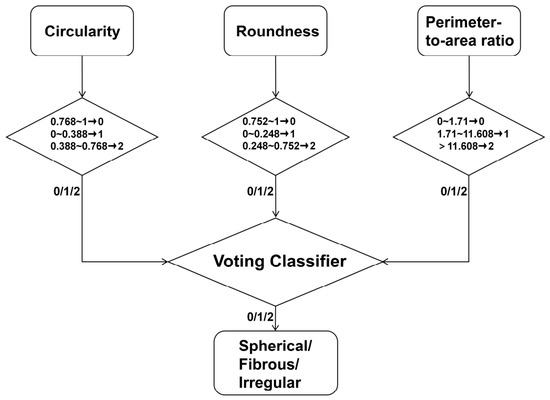
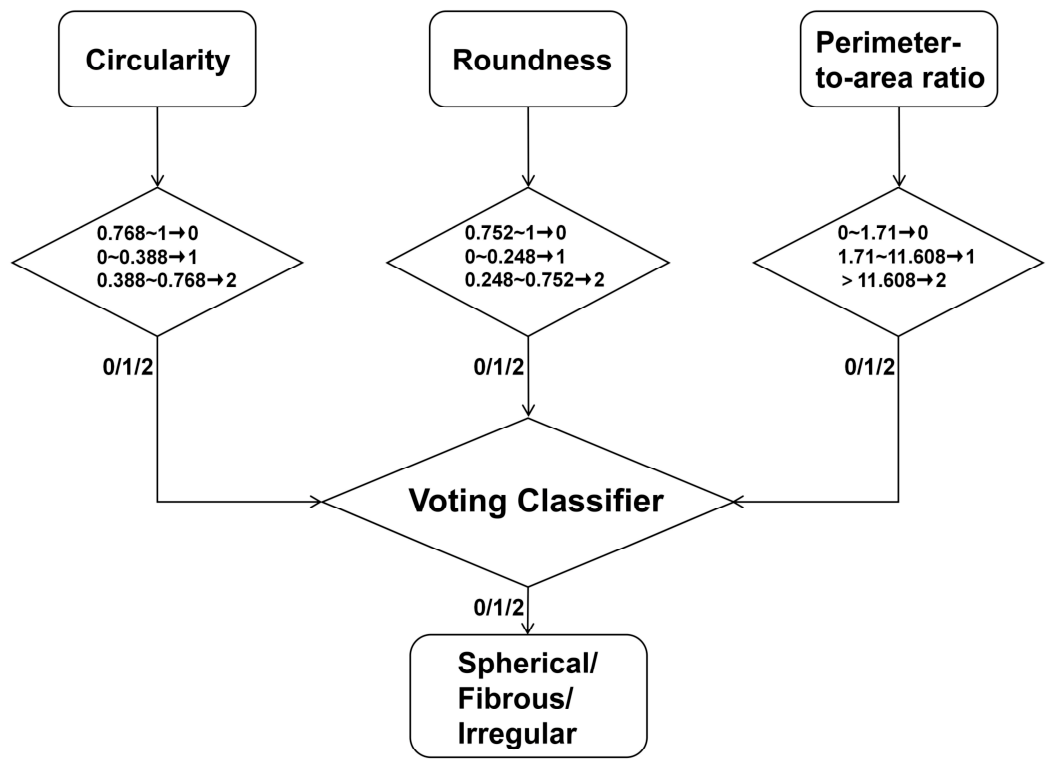
Subsequently, an ensemble classifier was constructed using the Voting Classifier module from the scikit-learn library, where classifier predictions were combined through majority voting. A schematic diagram (Figure 2) illustrated the data flow: three shape features (circularity, roundness, perimeter-to-area ratio) were input to independent decision tree classifiers, whose outputs were aggregated to classify samples as spherical, fibrous, or irregular. To optimize ensemble performance, a stepwise selection strategy was adopted: the top N optimal features (N = 1, 2, …, 10) and their corresponding DTs were iteratively selected as base classifiers. By comparing the classification performance of the ensemble classifiers corresponding to different N values under five-fold cross-validation, the optimal number of features N was finally determined—specifically, the scale of feature combination that enabled the ensemble classifier to achieve the optimal performance and the strongest generalization ability.
Figure 2.
Schematic of the voting classifier for microplastic morphology classification.
During the model validation phase, optimal feature combination and ensemble configuration was applied to the independent test set. For each sample in this set, N independent classification results were generated using the N selected features, where each feature corresponded to the prediction output of its associated single-feature DT. These results were then combined through majority voting to determine the final predicted class for that sample. To comprehensively and rigorously evaluate the effectiveness of the assessment method and the ensemble classifier, a set of standard classification metrics was employed, including Accuracy, Recall, and F1-score [48]. Detailed metric definitions and descriptions are shown (Table 2).
Table 2.
Quality metrics for formulae and descriptions.
3. Results
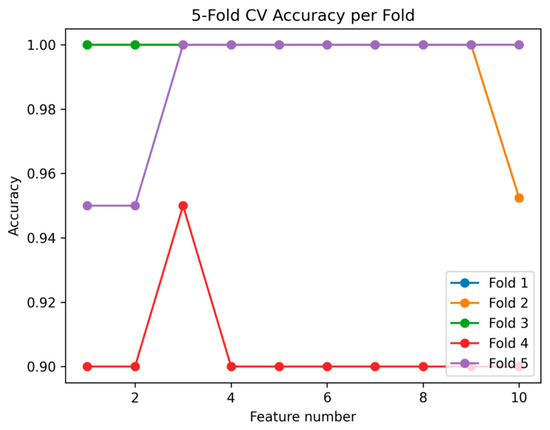
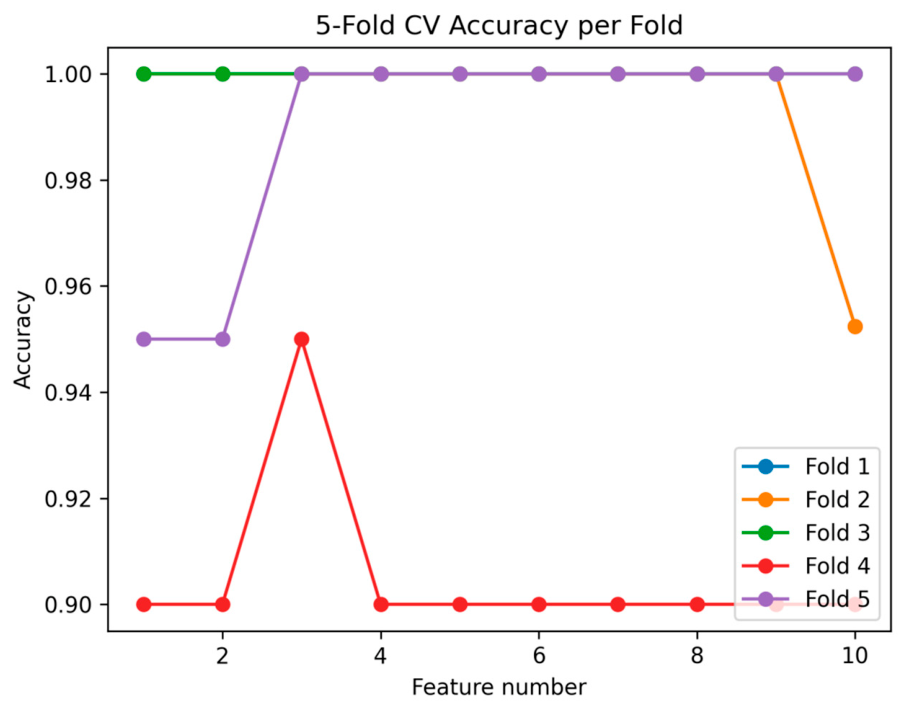
In five-fold cross-validation, we constructed multiple ensemble classifiers by traversing N features (where N increments went from 1 to a higher number) and then compared their optimal performance. Comparison results for each fold are shown as line graphs (Figure 3). Fold 1 completely overlapped with another fold in the plot, rendering it visually indistinguishable. This overlap was purely visual and did not impact the interpretation of the cross-validation results or the final conclusions. As indicated, the classification accuracy for the three types of target peak when three categories of features are used. Furthermore, in five-fold experiments, the best-performing ensemble classifiers included three features: circularity, roundness, and perimeter-to-area ratio. Accordingly, we adopted these three features as characterization parameters to classify the surface irregularity of plastic products.
Figure 3.
Five-fold cross-validation accuracy across different feature numbers.
To precisely define irregular descriptor ranges, we present the five-fold cross-validation intervals for these five descriptors. We established corresponding range values for each feature in the three categories and documented feature performance in assessing categories in the training set (Table 3).
Table 3.
Feature ranges and training accuracy for different categories.
In the test set that included 7 spherical, 10 fibrous, and 9 irregular entities, the evaluation performance for irregular descriptors is shown (Table 4). For spherical particles and fibrous particles demonstrated optimal classification performance with maximum values across all metrics (precision = 1.00, recall = 1.00, and F1 = 1.00). Irregular particles showed 100% precision with slightly reduced recall (0.89), yielding a robust F1-score of 0.94. Macro-averaged accuracy across these three categories was 0.96, confirming the model’s diagnostic consistency.
Table 4.
Evaluating decision tree model performance across three microplastic shapes.
Given the small size of our test set, even a single misclassification could significantly skew our precision and recall metrics. We therefore included a confusion matrix (Table 5) to explicitly demonstrate the magnitude of changes in performance that could arise from minor data variations. As shown, all 7 spherical and 10 fibrous entities were correctly classified with no mispredictions. Of the 9 irregular entities, 8 were accurately identified, while only 1 was misclassified as spherical, which aligns with the slight reduction in recall observed for the irregular class. This matrix confirmed the model’s strong capacity to distinguish spherical, fibrous, and irregular microplastic morphologies, with minimal misclassification in the irregular category.
Table 5.
Confusion matrix of microplastic morphology classification.
4. Discussion
Irregular NMPs are the dominant morphological type in natural environments. As previously reported, 93.9% of the NMPs detected in marine samples were irregular, including 88.6% fragments and 5.3% films [49], while the proportion of irregular NMPs in river sediments reached 96.2% (95.5% fragments and 0.7% films) [50]. In this study, we generated precise morphological features using SAM [51], and used a DT-based ensemble model with five-fold cross-validation to evaluate irregular NMPs by comparing them with spherical and fibrous NMPs. Three optimal morphometric descriptors were identified, and their interval ranges established to define irregular NMPs: circularity (0.388 ± 0.004–0.768 ± 0.004), roundness (0.248 ± 0.01–0.752 ± 0.06), and perimeter-to-area ratio (>11.608 ± 1.39), thereby generating a macro-averaged accuracy of 96.0% across spherical, fibrous, and irregular NMPs.
Our results demonstrated that a multi-descriptor combined threshold, identified via five-fold cross-validation, significantly enhanced the identification specificity of irregular NMPs, thereby achieving precision, recall, and F1-score of 1.00, 0.89, and 0.94, respectively. Notably, spherical and fibrous NMPs achieved perfect classification performances (precision = 1.00, recall = 1.00, F1-score = 1.00), which further confirmed the reliability of the three-descriptor combination. Crucially, these descriptors functioned as an interdependent system. Importantly, relying solely on single features may result in erroneous morphological categorization, a limitation addressed by the cross-validated feature selection strategy in this study. Mukhanov et al. [52] suggested that combining two shape features could enhance analytical shape characterization, as it provides additional information on MP properties. However, the features used in their study, including circularity and Feret’s diameter, showed low specificity. As Sinkhonde et al.’s study revealed, the synergistic combination of roundness, solidity, and circularity, which is a recognized features set, enabled a more precise discrimination among folded particles, true spheres, and elongated fibers [53]. In contrast to their study, we identified three optimal morphometric descriptors (circularity, roundness, and perimeter-to-area ratio) using five-fold cross-validation. We excluded solidity and long diameter, two features previously evaluated in preliminary analyses, because cross-validation results demonstrated that these features did not enhance classification accuracy and instead introduced additional model redundancy. This well-selected three-descriptor combination still achieved higher precision, recall, and F1-score in distinguishing irregular NMPs from spherical and fibrous NMPs, highlighting the requirement for a compact, non-redundant set of multiple shape features to avoid morphological misinterpretation.
Furthermore, apart from enhancing accuracy by using the optimized three-feature combination, descriptor interval ranges (instead of single thresholds) are vital for shape definition, which directly affect the reliability of classification results. We systematically optimized the interval ranges for the three morphometric descriptors under stringent criteria via five-fold cross-validation, achieving a macro-averaged accuracy up to 96.0%. In comparison, Chen et al. [54] used a deep residual neural network (ResNet-50) to classify MP morphological types, and achieved an accuracy of 92.7%. In terms of precise interval ranges, they identified four morphometric descriptors, but only for MP pellets: circularity (0.50–1.00), aspect ratio (1.00–2.50), roundness (0.40–1.00), and solidity (0.70–1.00) [54]. In our study, interval ranges for all spherical, fibrous, and irregular NMPs were established by combining three morphometric descriptors. For spherical NMPs, two out of five descriptors (circularity, roundness) were the same as those reported by Chen et al., but our interval ranges were quite different for circularity (0.768 ± 0.004–1.00) and roundness (0.752 ± 0.06–1.00). For spherical NMPs, we established stricter interval ranges while achieving higher accuracy when compared to Chen et al., which suggested that our DT-based ensemble model generated critical morphometric descriptor interval ranges for the controllable preparation of irregular NMPs.
Our study had some limitations. First, only 129 hyperspectral images were included in our dataset, which may have confined polymer composition diversity and degradation status. More images encompassing different states are required to enhance the environmental representation of irregular NMPs. Second, all morphometric descriptors were extracted from 2D images (first attempt), and the thresholds determined in this study were based on existing published images, which might need minor adjustment when different image processing approaches are used. In comparison to 3D images, our approach may have underestimated structural complexity. Further 3D characterization studies are required to improve irregular definition precision, while its validation in real environments remains to be explored in future work.
5. Conclusions
In the MP research field, the lack of standardized criteria for defining irregular NMPs remains a key challenge. This study established a robust classification framework using a DT-based ensemble model with five-fold cross-validation to identify the core morphometric descriptors of irregular NMPs. The combination of circularity (interval range: 0.388 ± 0.004–0.768 ± 0.004), roundness (interval range: 0.248 ± 0.01–0.752 ± 0.06) and perimeter-to-area ratio (interval range: >11.608 ± 1.39) was revealed to identify irregular NMPs from spherical and fibrous entities with 96.0% accuracy. Our findings may provide a reference for irregular MP definition. But these criteria might be improved after integrating 3D morphometric features and performing validation using real environmental samples.
Author Contributions
Conceptualization, X.Y., L.Y., W.S. and G.P.; Investigation, X.Y., Y.J., P.Z., C.L., Y.S. and J.Z.; Writing—original draft, X.Y., P.Z. and C.L.; Methodology, X.Y., Y.J., P.Z., C.L., Y.S., J.Z., W.S. and G.P.; Data analysis, Y.J.; Project administration, L.Y.; Writing—review & editing, L.Y., W.S. and G.P.; Supervision, L.Y., W.S. and G.P. All authors have read and agreed to the published version of the manuscript.
Funding
This research was supported by the National Natural Science Foundation of China [grant number: U21A20399] and the Science and Technology Innovation Team Project of China Medical University 2022 (grant number CXTD2022006). The funders had no role in study design, data collection and analysis, decision to publish, or preparation of the manuscript.
Institutional Review Board Statement
Not applicable.
Data Availability Statement
The raw data supporting the conclusions of this article will be made available by the authors on request.
Conflicts of Interest
Author Yi Jing was employed by the company (Neusoft Research of Intelligent Healthcare Technology, Co., Ltd.). The remaining declare that the research was conducted in the absence of any commercial or financial relationships that could be construed as a potential conflict of interest.
References
- Liu, Z.; You, X.Y. Recent progress of microplastic toxicity on human exposure base on in vitro and in vivo studies. Sci. Total Environ. 2023, 903, 166766. [Google Scholar] [CrossRef] [PubMed]
- Geyer, R.; Jambeck, J.R.; Law, K.L. Production, use, and fate of all plastics ever made. Sci. Adv. 2017, 3, e1700782. [Google Scholar] [CrossRef]
- Koelmans, A.A.; Besseling, E.; Shim, W.J. Nanoplastics in the Aquatic Environment. Critical Review. In Marine Anthropogenic Litter; Bergmann, M., Gutow, L., Klages, M., Eds.; Springer International Publishing: Cham, Switzerland, 2015; pp. 325–340. [Google Scholar]
- Lofty, J.; Ouro, P.; Wilson, C. Microplastics in the riverine environment: Meta-analysis and quality criteria for developing robust field sampling procedures. Sci. Total Environ. 2023, 863, 160893. [Google Scholar] [CrossRef]
- Miao, H.; Zhang, S.; Gao, W.; Zhou, J.; Cai, H.; Wu, L.; Liu, J.; Wang, Z.; Liu, T. Microplastics occurrence and distribution characteristics in mulched agricultural soils of Guizhou province. Sci. Rep. 2024, 14, 21505. [Google Scholar] [CrossRef]
- Goßmann, I.; Herzke, D.; Held, A.; Schulz, J.; Nikiforov, V.; Georgi, C.; Evangeliou, N.; Eckhardt, S.; Gerdts, G.; Wurl, O.; et al. Occurrence and backtracking of microplastic mass loads including tire wear particles in northern Atlantic air. Nat. Commun. 2023, 14, 3707. [Google Scholar] [CrossRef]
- Rotchell, J.M.; Jenner, L.C.; Chapman, E.; Bennett, R.T.; Bolanle, I.O.; Loubani, M.; Sadofsky, L.; Hobkirk, J.; Palmer, T.M. Detection of microplastics in human saphenous vein tissue using μFTIR: A pilot study. PLoS ONE 2023, 18, e0280594. [Google Scholar] [CrossRef] [PubMed]
- Liu, S.; Liu, X.; Guo, J.; Yang, R.; Wang, H.; Sun, Y.; Chen, B.; Dong, R. The Association Between Microplastics and Microbiota in Placentas and Meconium: The First Evidence in Humans. Environ. Sci. Technol. 2023, 57, 17774–17785. [Google Scholar] [CrossRef]
- Deng, C.; Zhu, J.; Fang, Z.; Yang, Y.; Zhao, Q.; Zhang, Z.; Jin, Z.; Jiang, H. Identification and analysis of microplastics in para-tumor and tumor of human prostate. eBioMedicine 2024, 108, 105360. [Google Scholar] [CrossRef]
- Shan, S.; Zhang, Y.; Zhao, H.; Zeng, T.; Zhao, X. Polystyrene nanoplastics penetrate across the blood-brain barrier and induce activation of microglia in the brain of mice. Chemosphere 2022, 298, 134261. [Google Scholar] [CrossRef] [PubMed]
- Qin, X.; Cao, M.; Peng, T.; Shan, H.; Lian, W.; Yu, Y.; Shui, G.; Li, R. Features, Potential Invasion Pathways, and Reproductive Health Risks of Microplastics Detected in Human Uterus. Environ. Sci. Technol. 2024, 58, 10482–10493. [Google Scholar] [CrossRef]
- Woo, J.H.; Seo, H.J.; Lee, J.Y.; Lee, I.; Jeon, K.; Kim, B.; Lee, K. Polypropylene nanoplastic exposure leads to lung inflammation through p38-mediated NF-κB pathway due to mitochondrial damage. Part. Fibre Toxicol. 2023, 20, 2. [Google Scholar] [CrossRef]
- Jia, R.; Han, J.; Liu, X.; Li, K.; Lai, W.; Bian, L.; Yan, J.; Xi, Z. Exposure to Polypropylene Microplastics via Oral Ingestion Induces Colonic Apoptosis and Intestinal Barrier Damage through Oxidative Stress and Inflammation in Mice. Toxics 2023, 11, 127. [Google Scholar] [CrossRef]
- Park, J.S.; Yoo, J.W.; Lee, Y.H.; Park, C.; Lee, Y.M. Size- and shape-dependent ingestion and acute toxicity of fragmented and spherical microplastics in the absence and presence of prey on two marine zooplankton. Mar. Pollut. Bull. 2024, 206, 116768. [Google Scholar] [CrossRef]
- Nitzberg, E.J.; Parmar, S.; Arbuckle-Keil, G.; Saba, G.K.; Chant, R.J.; Fahrenfeld, N.L. Microplastic concentration, characterization, and size distribution in the Delaware Bay estuary. Chemosphere 2024, 361, 142523. [Google Scholar] [CrossRef]
- Kim, L.; Kim, H.; Song, Y.; An, Y.J. Chronic effects of irregular and fibril microplastics on Artemia franciscana in a benthic environment: Size and shape-dependent toxicity. Mar. Pollut. Bull. 2024, 209, 117270. [Google Scholar] [CrossRef]
- Schwarzer, M.; Brehm, J.; Vollmer, M.; Jasinski, J.; Xu, C.; Zainuddin, S.; Fröhlich, T.; Schott, M.; Greiner, A.; Scheibel, T.; et al. Shape, size, and polymer dependent effects of microplastics on Daphnia magna. J. Hazard. Mater. 2022, 426, 128136. [Google Scholar] [CrossRef] [PubMed]
- Liu, P.; Shao, L.; Li, Y.; Jones, T.; Cao, Y.; Yang, C.X.; Zhang, M.; Santosh, M.; Feng, X.; BéruBé, K. Microplastic atmospheric dustfall pollution in urban environment: Evidence from the types, distribution, and probable sources in Beijing, China. Sci. Total Environ. 2022, 838, 155989. [Google Scholar] [CrossRef] [PubMed]
- Wang, S.; Lu, W.; Cao, Q.; Tu, C.; Zhong, C.; Qiu, L.; Li, S.; Zhang, H.; Lan, M.; Qiu, L.; et al. Microplastics in the Lung Tissues Associated with Blood Test Index. Toxics 2023, 11, 759. [Google Scholar] [CrossRef]
- Souza-Silva, T.G.; Oliveira, I.A.; Silva, G.G.D.; Giusti, F.C.V.; Novaes, R.D.; Paula, H.A.A. Impact of microplastics on the intestinal microbiota: A systematic review of preclinical evidence. Life Sci. 2022, 294, 120366. [Google Scholar] [CrossRef]
- Galvão, L.S.; Ferreira, R.R.; Fernandes, E.M.S.; Correia, C.A.; Valera, T.S.; Dos Santos Rosa, D.; Wiebeck, H. Analysis of selective fluorescence for the characterization of microplastic fibers: Use of a Nile Red-based analytical method to compare between natural and synthetic fibers. J. Hazard. Mater. 2023, 443, 130217. [Google Scholar] [CrossRef] [PubMed]
- Zhao, Y.; Qiao, R.; Zhang, S.; Wang, G. Metabolomic profiling reveals the intestinal toxicity of different length of microplastic fibers on zebrafish (Danio rerio). J. Hazard. Mater. 2021, 403, 123663. [Google Scholar] [CrossRef]
- Qiao, R.; Deng, Y.; Zhang, S.; Wolosker, M.B.; Zhu, Q.; Ren, H.; Zhang, Y. Accumulation of different shapes of microplastics initiates intestinal injury and gut microbiota dysbiosis in the gut of zebrafish. Chemosphere 2019, 236, 124334. [Google Scholar] [CrossRef] [PubMed]
- Park, K.; Kim, W.S.; Park, J.W.; Kim, T.H.; Kwak, I.S. Bioaccumulation, microbiome composition and immunity, and epigenetic signatures associated with exposure to spherical, fibrous, and fragmented microplastics in the mussel Mytilus galloprovincialis. J. Hazard. Mater. 2024, 462, 132691. [Google Scholar] [CrossRef]
- Jian, M.; Zhang, Y.; Yang, W.; Zhou, L.; Liu, S.; Xu, E.G. Occurrence and distribution of microplastics in China’s largest freshwater lake system. Chemosphere 2020, 261, 128186. [Google Scholar] [CrossRef]
- Zhu, L.; Wu, Z.; Dong, J.; Zhao, S.; Zhu, J.; Wang, W.; Ma, F.; An, L. Unveiling Small-Sized Plastic Particles Hidden behind Large-Sized Ones in Human Excretion and Their Potential Sources. Environ. Sci. Technol. 2024, 58, 11901–11911. [Google Scholar] [CrossRef] [PubMed]
- Yao, Y.; Glamoclija, M.; Murphy, A.; Gao, Y. Characterization of microplastics in indoor and ambient air in northern New Jersey. Environ. Res. 2022, 207, 112142. [Google Scholar] [CrossRef]
- Xu, Z.; Shen, J.; Lin, L.; Chen, J.; Wang, L.; Deng, X.; Wu, X.; Lin, Z.; Zhang, Y.; Yu, R.; et al. Exposure to irregular microplastic shed from baby bottles activates the ROS/NLRP3/Caspase-1 signaling pathway, causing intestinal inflammation. Environ. Int. 2023, 181, 108296. [Google Scholar] [CrossRef]
- Weber, A.; Schwiebs, A.; Solhaug, H.; Stenvik, J.; Nilsen, A.M.; Wagner, M.; Relja, B.; Radeke, H.H. Nanoplastics affect the inflammatory cytokine release by primary human monocytes and dendritic cells. Environ. Int. 2022, 163, 107173. [Google Scholar] [CrossRef]
- Saito-Koyama, R.; Tamai, K.; Yasuda, J.; Okamura, Y.; Yamazaki, Y.; Inoue, C.; Miki, Y.; Abe, J.; Oishi, H.; Sato, I.; et al. Morphometric analysis of nuclear shape irregularity as a novel predictor of programmed death-ligand 1 expression in lung squamous cell carcinoma. Virchows Arch. 2024, 484, 609–620. [Google Scholar] [CrossRef] [PubMed]
- Zhang, Z.; Gao, X.; Wang, S. Role of Particle Shape on Ground Responses to a Circular Tunnel Excavation in Sandy Soil: Consequences from DEM Simulations. Materials 2022, 15, 7088. [Google Scholar] [CrossRef]
- Lorenzo-Navarro, J.; Castrillon-Santana, M.; Santesarti, E.; Marsico, M.D.; Herrera, A. SMACC: A System for Microplastics Automatic Counting and Classification. IEEE Access 2020, 8, 25249–25261. [Google Scholar] [CrossRef]
- Hu, B.; Dai, Y.; Zhou, H.; Sun, Y.; Yu, H.; Dai, Y.; Wang, M.; Ergu, D.; Zhou, P. Using artificial intelligence to rapidly identify microplastics pollution and predict microplastics environmental behaviors. J. Hazard. Mater. 2024, 474, 134865. [Google Scholar] [CrossRef] [PubMed]
- Su, J.; Zhang, F.; Yu, C.; Zhang, Y.; Wang, J.; Wang, C.; Wang, H.; Jiang, H. Machine learning: Next promising trend for microplastics study. J. Environ. Manag. 2023, 344, 118756. [Google Scholar] [CrossRef]
- Yu, F.; Hu, X. Machine learning may accelerate the recognition and control of microplastic pollution: Future prospects. J. Hazard. Mater. 2022, 432, 128730. [Google Scholar] [CrossRef]
- Fazil, A.Z.; Gomes, P.I.A.; Sandamal, R.M.K. Applicability of machine learning techniques to analyze Microplastic transportation in open channels with different hydro-environmental factors. Environ. Pollut. 2024, 357, 124389. [Google Scholar] [CrossRef]
- Madushani, J.P.S.S.; Sandamal, R.M.K.; Meddage, D.P.P.; Pasindu, H.R.; Gomes, P.I.A. Evaluating expressway traffic crash severity by using logistic regression and explainable & supervised machine learning classifiers. Transp. Eng. 2023, 13, 100190. [Google Scholar] [CrossRef]
- Meyers, N.; Catarino, A.I.; Declercq, A.M.; Brenan, A.; Devriese, L.; Vandegehuchte, M.; De Witte, B.; Janssen, C.; Everaert, G. Microplastic detection and identification by Nile red staining: Towards a semi-automated, cost- and time-effective technique. Sci. Total Environ. 2022, 823, 153441. [Google Scholar] [CrossRef]
- Vadivel, A.; Surendiran, B. A fuzzy rule-based approach for characterization of mammogram masses into BI-RADS shape categories. Comput. Biol. Med. 2013, 43, 259–267. [Google Scholar] [CrossRef] [PubMed]
- Kirillov, A.; Mintun, E.; Ravi, N.; Mao, H.; Rolland, C.; Gustafson, L.; Xiao, T.; Whitehead, S.; Berg, A.C.; Lo, W.-Y.; et al. Segment Anything. In Proceedings of the IEEE/CVF International Conference on Computer Vision (ICCV), Paris, France, 1–6 October 2023; pp. 4015–4026. [Google Scholar]
- Boyce, R.R.; Clark, W.A.V. The concept of shape in geography. Geogr. Rev. 1964, 54, 561–572. [Google Scholar] [CrossRef]
- Su, L.; Dong, X.; Peng, J.; Cheng, H.; Craig, N.J.; Hu, B.; Li, J.Y. Segmentation of beach plastic fragments’ contours based on self-organizing map and multi-shape descriptors: A rapid indication of fragmentation and wearing types. J. Hazard. Mater. 2024, 478, 135564. [Google Scholar] [CrossRef]
- Ismayilova, I.; Zeyer, T.; Timpf, S. Identification of Microplastics in Soils Using 2D Geometric Shape Descriptors. AGILE GIScience Ser. 2021, 2, 32. [Google Scholar] [CrossRef]
- Zandonadi, R.S.; Luck, J.D.; Stombaugh, T.S.; Shearer, S.A. Evaluating field shape descriptors for estimating off-target application area in agricultural fields. Comput. Electron. Agric. 2013, 96, 217–226. [Google Scholar] [CrossRef]
- Hejduk, A.; Czajka, S.; Lulek, J. Impact of co-processed excipient particles solidity and circularity on critical quality attributes of orodispersible minitablets. Powder Technol. 2021, 387, 494–508. [Google Scholar] [CrossRef]
- Maganga, G.D.; Bourgarel, M.; Vallo, P.; Dallo, T.D.; Ngoagouni, C.; Drexler, J.F.; Drosten, C.; Nakouné, E.R.; Leroy, E.M.; Morand, S. Bat distribution size or shape as determinant of viral richness in African bats. PLoS ONE 2014, 9, e100172. [Google Scholar] [CrossRef] [PubMed]
- Schnepf, U.; Von Moers-Memer, M.A.L.; Brümmer, F. A practical primer for image-based particle measurements in microplastic research. Microplast. Nanoplast. 2023, 3, 16. [Google Scholar] [CrossRef]
- Phan, S.; Torrejon, D.; Furseth, J.; Mee, E.; Luscombe, C. Exploiting weak supervision to facilitate segmentation, classification, and analysis of microplastics (<100 μm) using Raman microspectroscopy images. Sci. Total Environ. 2023, 886, 163786. [Google Scholar] [CrossRef] [PubMed]
- Andersen, R.; Harsaae, A.L.; Kellner, A.; Smyth, A.; Westermann, T.A.R.; Green, M.; Vollertsen, J.; Syberg, K.; Lorenz, C. Abundance, distribution and characteristics of microplastics in the North and South Atlantic Ocean. Mar. Pollut. Bull. 2024, 209, 117217. [Google Scholar] [CrossRef]
- Wang, T.T.; Tang, W.Q.; Wu, D.H.; Yu, X.R.; Wang, G.Y.; Cai, X.W.; Shao, S.; Wang, S.; Mo, L.; Liu, Y.S.; et al. Abundance and characteristics of microplastics in the Wanquan River estuary, Hainan Island. Mar. Pollut. Bull. 2023, 189, 114810. [Google Scholar] [CrossRef]
- Li, Y.; Zhang, J.; Teng, X.; Zhang, H.; Liu, X.; Lan, L. RefSAM: Efficiently adapting segmenting anything model for referring video object segmentation. Neural Netw. 2025, 193, 108000. [Google Scholar] [CrossRef]
- Mukhanov, V.; Daria, L.; Sakhon, Y.; Bagaev, A.; Veerasingam, S.; Venkatachalapathy, R. A new method for analyzing microplastic particle size distribution in marine environmental samples. Ecol. Montenegrina 2019, 23, 77–86. [Google Scholar] [CrossRef]
- Sinkhonde, D. Identification of 2-d shape parameters for waste brick powders from varying milling methods: A discussion of quantitative image analysis. Heliyon 2024, 10, e26666. [Google Scholar] [CrossRef] [PubMed]
- Chen, Q.; Yang, Y.; Qi, H.; Su, L.; Zuo, C.; Shen, X.; Chu, W.; Li, F.; Shi, H. Rapid Mass Conversion for Environmental Microplastics of Diverse Shapes. Environ. Sci. Technol. 2024, 58, 10776–10785. [Google Scholar] [CrossRef] [PubMed]

Disclaimer/Publisher’s Note: The statements, opinions and data contained in all publications are solely those of the individual author(s) and contributor(s) and not of MDPI and/or the editor(s). MDPI and/or the editor(s) disclaim responsibility for any injury to people or property resulting from any ideas, methods, instructions or products referred to in the content. |
© 2026 by the authors. Licensee MDPI, Basel, Switzerland. This article is an open access article distributed under the terms and conditions of the Creative Commons Attribution (CC BY) license.