


Abstract
Microplastic (MP) pollution is an emerging environmental stressor in marine ecosystems, yet its relationship with trophic ecology remains poorly understood in deep-sea environments. This study investigated MP ingestion in relation to trophic ecology in three deep-sea fish species (Chlorophthalmus agassizi, Hoplostethus mediterraneus, and Coelorinchus caelorhincus) from the central Tyrrhenian Sea (Western Mediterranean). Stable isotope analysis (δ13C and δ15N) was combined with detailed characterisation of ingested MPs to assess trophic niches, trophic position, and species-specific ingestion patterns. The three species showed distinct isotopic signatures, with C. agassizi occupying a lower trophic position, while H. mediterraneus and C. caelorhincus overlapped at higher trophic levels. MPs were detected in all species, with an overall frequency of occurrence of 34.4%, and no significant interspecific differences in occurrence or abundance were observed. However, significant differences emerged in MP characteristics. C. caelorhincus, which exhibited the widest isotopic niche, ingested larger and more diverse particles, whereas C. agassizi showed lower occurrence but higher particle loads in affected individuals. These results suggest that trophic ecology is not clearly associated with MP ingestion rates but may influence the size and diversity of ingested particles, highlighting ecological drivers of exposure in deep-sea ecosystems.
1. Introduction
Since 1950, an estimated 6.3 billion tons of plastic waste have been produced, with 79% either discarded or buried, raising concerns about the environment and particularly the ocean, which represents the ultimate long-term sink for plastic materials [1]. Consequently, the increasing accumulation of plastics in marine ecosystems represents a growing environmental issue [2,3], posing the risk of multiple and interactive disturbances that may alter biodiversity and ecosystem functioning [4]. According to the European Food Safety Authority (EFSA), microplastics (MPs) are defined as a heterogeneous mixture of differently shaped plastic materials, including fragments, fibres, spheroids, granules, pellets, flakes, or beads, ranging from 0.1 to 5000 μm in size [5]. Despite the low toxicity associated with most plastic polymers, MPs pose significant environmental concerns due to their interactions with marine organisms through ingestion [6]. When marine organisms ingest MPs, these particles can lead to various physiological effects, such as obstruction of the digestive system and false satiety [7,8]. Additionally, MPs can act as carriers for plastic additives and persistent pollutants, which may enter the food web, exacerbating marine pollution effects [7,9,10,11]. However, despite the growing concern about MPs in marine ecosystems, little is known about the influence of feeding habits and trophic position on MP ingestion in deep-sea fish. Previous studies suggested a link between trophic niches and MP ingestion patterns [9,12], but no investigation has addressed this topic in the deep-sea ecosystems of the central Tyrrhenian Sea.
This study investigates the link between MP ingestion and trophic ecology in the deep-sea environment of the Tyrrhenian Sea (Western Mediterranean Sea), using three representative fish species: the Shortnose greeneye Chlorophthalmus agassizi (Bonaparte, 1840), the Mediterranean slimehead Hoplostethus mediterraneus (Cuvier, 1829), and the Hollowsnout grenadier Coelorinchus caelorhincus (Risso, 1810). Although these species coexist in the same area, they exhibit different habitat use patterns and depth ranges. Specifically, C. agassizi is a bathydemersal species found between 500 and 1000 m, H. mediterraneus is benthopelagic and occurs from 90 to 1485 m [13], and C. caelorhincus is a generalist predator that inhabits a broad depth range overlapping those of C. agassizi and H. mediterraneus [13,14]. This ecological differentiation within the same environment provides an ideal framework to investigate how trophic ecology may influence species-specific interactions with environmental stressors such as MP pollution in the deep-sea.
In contrast to coastal and epipelagic environments, deep-sea ecosystems are characterised by the absence of primary production, reduced light availability, and a strong dependence on sinking organic matter from surface water [15,16]. These features profoundly influence food-web structure, trophic pathways, and feeding strategies of resident species. Consequently, MP distribution and bioavailability in deep-sea environments may follow different dynamics compared to shallower systems, where direct plastic inputs, visual predation, and short food chains play a major role. In deep waters, MPs are expected to be mainly transported through vertical fluxes, incorporated into detrital pathways, and transferred through trophic interactions rather than being directly ingested from the water column [3,17,18].
Based on these ecological differences and on previous observations from shallower marine environments [12], it was hypothesised that trophic ecology could be more strongly associated with the characteristics of ingested MPs, such as particle size and diversity, rather than with overall ingestion rates. In particular, species characterised by broader trophic niches and more generalist feeding strategies were expected to exhibit greater diversity and variability in ingested MPs. Accordingly, the study aimed to distinguish between the potential influence of trophic ecology on overall MP ingestion rates and its relationship with the characteristics of ingested MPs.
The specific goals of this study are to: (i) define and compare trophic niches and trophic position of three deep-sea fish species using stable isotope analysis; (ii) detect differences in the occurrence, abundance, and characteristics of ingested MPs among the three species; and (iii) integrate ecological information with data on MP ingestion to improve our understanding of their interactions within the deep-sea ecosystem.
2. Materials and Methods
2.1. Study Area
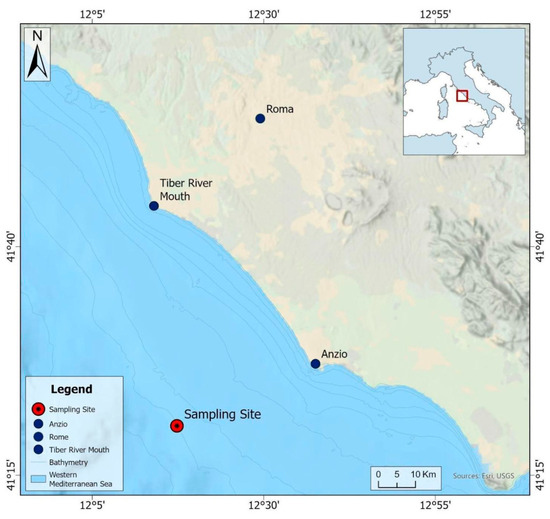
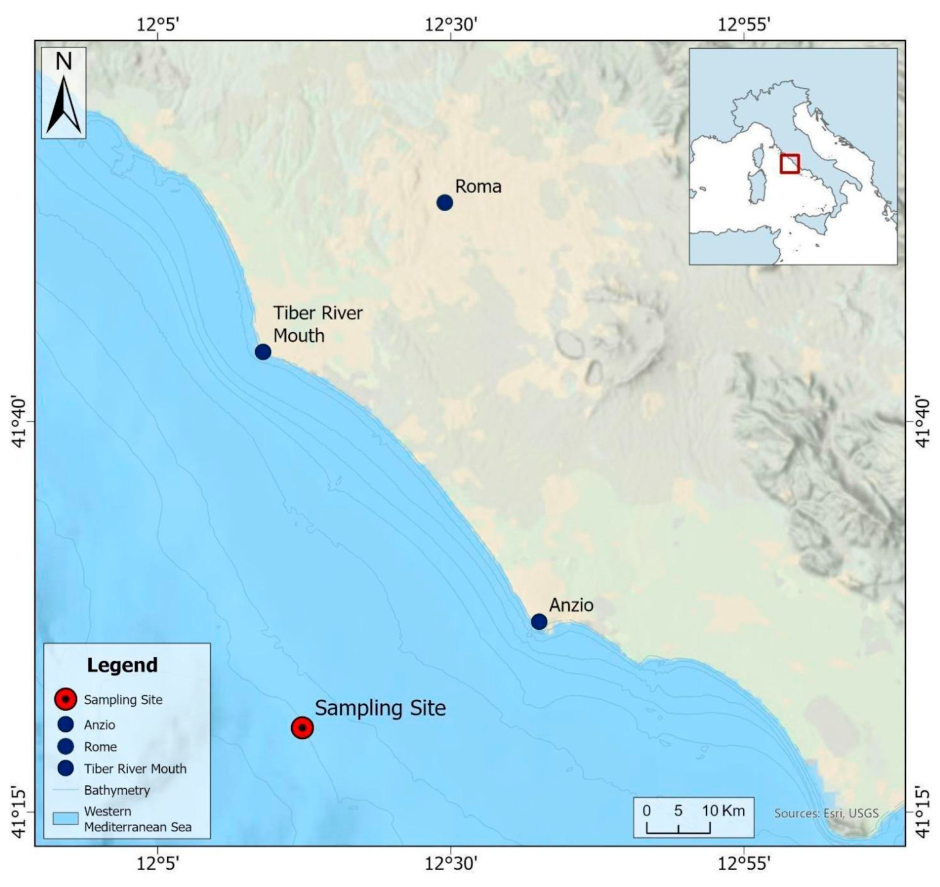
The study area is located in the central Tyrrhenian Sea, 50 km south of the Tiber River mouth, approximately 30 km off the coast of Anzio (41°20′24.5″ N; 012°17′20.6″ E), at 500 m depth (Figure 1).
Figure 1.
Map of the study area in the central Tyrrhenian Sea, off the coast of Anzio (41°20′24.5″ N; 12°17′20.6″ E). The map highlights the Tiber River mouth, which flows through the Metropolitan City of Rome. The city of Anzio is located approximately 50 km south of the Tiber River mouth. The sampling site, marked by a red dot on the map, is located at approximately 500 m depth. This location is considered a potential hotspot for microplastic accumulation, influenced by the Tiber River discharge, intense coastal urbanisation, and peculiar current patterns.
This area is influenced by human activities, primarily due to the discharge of the Tiber River, the third-longest river of the Italian peninsula that serves as the primary source of pollution—including plastic waste—entering the Tyrrhenian Sea [19,20]. The Tiber River has a drainage basin of 17,375 km2 and a flow rate that ranges from 60 to 2700 m3/s, with an annual average of 232 m3/s [21,22,23]. It flows through the metropolitan city of Roma, with approximately 2.7 million inhabitants. These factors create unique conditions for the accumulation of waste from local inputs, making it an ideal pilot zone for MP ingestion studies [12,20].
2.2. Sample Processing
A total of 90 fish specimens were analysed, comprising 30 individuals from each of three species. The sample size per species was defined according to the protocol proposed by [24], which identifies 30 individuals as a feasible standard number to balance analytical effort and statistical robustness in MP ingestion studies. The collection was carried out using a professional fishing vessel equipped with bottom trawl nets. Sampling was conducted in April 2021, following the seasonal rainy period, when increased river discharge and runoff from the Tiber River are expected to enhance the transport of land-based pollutants, including plastic debris, toward the central Tyrrhenian Sea [12,20]. The samples were immediately preserved on ice at −20 °C. Biometric data were recorded for each specimen, ensuring accurate representation of the individuals sampled for subsequent analysis.
2.3. Stable Isotope Analysis
Stable isotope analysis of carbon and nitrogen was conducted on 10 individuals from each species, representing a subset of the specimens analysed for MP ingestion. Samples of dorsal white muscle tissue were freeze-dried for 24 h and ground into a fine powder using a pestle and mortar. From this powdered tissue, aliquots of 0.5 ± 0.10 mg were carefully weighed and placed in tin capsules for analysis. The isotopic composition of each sample was determined in duplicate using an elemental analyser coupled with a continuous-flow mass spectrometer, providing accurate and precise measurements of the carbon and nitrogen isotopic ratios. The carbon and nitrogen values are expressed in delta (δ) units per thousand (‰), indicating deviations from international standards (Vienna Pee Dee Belemnite for carbon and atmospheric N2 for nitrogen). Isotopic ratios were calculated using the following equation:
where X represents the carbon or nitrogen isotope, and R represents the ratio of the abundances of the heavy and light isotopes (13C/12C; 15N/14N).
Isotopic measurements were calibrated using certified reference materials provided by the International Atomic Energy Agency (IAEA-CH-3, IAEACH-6 and USGS24 for δ13C; IAEA-N-1, IAEA-N-2and USGS25 for δ15N). Analytical precision was defined as a measurement error below 0.05‰, and the standard deviation of repeated measurements of laboratory standards (one replicate every 10 samples) remained within ±0.05‰ for δ13C and ±0.07‰ for δ15N.
2.4. Microplastics Analysis
The analysis of MPs was conducted in accordance with the European Guidelines for Monitoring Marine Litter in European Seas and the following specific protocol for analysing MP ingestion by marine fish [24]. Following dissection, the gastrointestinal tracts were weighed and placed in individual glass beakers. A 10% potassium hydroxide (KOH) solution was added to each beaker to digest the biological component. Previous experimental studies reported that KOH digestion under controlled conditions generally preserves most polymer types, although alterations may occur in more sensitive polymers such as PET, particularly at elevated temperature [25]. The digestion process was carried out over seven days at room temperature (≈25 °C). Subsequently, micro-items larger than 100 μm (pre-filtered) were isolated on glass microfibre membranes (Whatman GF/B ™, pore size: 2.7 μm) using a vacuum pump system. Accordingly, the adopted protocol was limited to the analysis of particles larger than 100 μm. Suspected particles were then identified and photographed under a dissecting microscope equipped with a camera (ZEISS Stemi 2000-C with Axiocam 208 colour, Carl Zeiss Microscopy GmbH, Jena, Germany). The chemical composition of all suspected particles was investigated through FT-IR spectroscopy with attenuated total reflection (ATR-FTIR) for particles ≥ 330 μm (Nicolet iS10 ATR FT-IR, Thermo Fisher Scientific, Madison, WI, USA) and through μFT-IR spectroscopy in reflection mode for particles <330 μm (Nicolet iN5 FT-IR Microscope, Thermo Fisher Scientific, Madison, WI, USA). Prior to μFT-IR analysis, suspected particles were manually transferred from glass microfibre membranes onto aluminium supports to allow spectral acquisition in reflection mode. Polymer identification was performed by comparing the acquired spectra with reference spectral libraries available in the OMNIC 9.13.1229 and OMNIC Specta 2.2.155 software packages (Thermo Fisher Scientific Inc.), considering only matches with a similarity percentage ≥ 70%.
All MPs were categorised based on their shape (e.g., fibre, filament, film, fragment, foam, granule, and pellet), size class (S1: 100–330 μm; S2: 330 μm–1 mm; S3: 1–5 mm), and colour (black, blue, red, green, white). Using the image analysis protocol described by [26], the MP images were processed with the open-source software ImageJ (version 1.54s; https://imagej.nih.gov/ij/, accessed on 16 April 2026)) to calculate five shape descriptors: surface area (total pixel count within the particle), perimeter (boundary pixel count), aspect ratio (ratio of the major axis to the minor axis), solidity (proportion of the particle’s area to its convex hull area), and circularity (4π multiplied by the particle’s area divided by the square of its perimeter) [27].
Surface area measurements were used to quantify both the amount and size of ingested MPs, while the additional shape descriptors provided insights into the geometric features of each particle.
2.5. Quality Assurance/Quality Control MPs
To minimise the risk of secondary contamination, all analyses were performed in a controlled laboratory environment with purified air and under a laminar flow hood. Access to the laboratory was limited to a maximum of two people at a time, who were required to wear only 100% cotton clothing and lab coats. Dissecting tools were thoroughly cleaned with ethanol and ultrapure water before each use. To prevent airborne contamination, laboratory equipment was covered with aluminium foil, and membranes were stored in sealed Petri dishes. As a quality control measure, a blank sample was processed every five samples to assess potential contamination. Procedural blanks contained exclusively cellulosic fibres, which were not included among the target materials of this study and were therefore excluded from the final dataset. Moreover, only particles chemically confirmed by μFT-IR analysis were considered as MPs in subsequent analyses; therefore, no blank correction was applied.
2.6. Statistical Analysis
All statistical analyses were conducted using R version 4.4.2 (R Core Team, 2024, Vienna, Austria). The following packages were used: dplyr [28], pscl [29], SIBER [4], ggplot2 [30] and tidyr [31] for graphical outputs. A significance level of p < 0.05 was applied to all statistical tests.
Differences among species for δ15N and δ13C were investigated separately by performing the analysis of variance (ANOVA). Normality was tested using the Shapiro–Wilk test, while homoscedasticity was assessed with Bartlett test. Post hoc comparisons between species were conducted using Tukey HSD test. Subsequently, the trophic position (TP) of the three species was calculated using the following formula [32]:
where δ15Ni is the nitrogen isotopic value of the individual, and δ15Nβ represents the mean δ15N value of the prey taxa identified in the stomach contents of the three species and was used as the isotopic baseline, δ15N is the trophic enrichment factor (TEF = 3.4 ‰; [32]), and λ is the trophic level assigned to the baseline, which is generally assumed to be 2 for zooplankton Trophic position (TP) was derived as a linear transformation of δ15N values under fixed baseline and trophic enrichment factor assumptions. Therefore, comparisons among species based on TP are mathematically equivalent to those based on δ15N, and TP is reported primarily to facilitate ecological interpretation. To further explore species dynamics, selected Bayesian Layman’s metrics were computed and visualised in δ-space scatterplots [4]. These metrics included: (1) δ15N range (NR) of each species indicates its degree of omnivory, that is the extent to which it exploits prey at different trophic levels [32,33]; (2) δ13C range (CR), providing insight into the diversity of food web sources; a broader CR suggests the exploitation of the food web; (3) Total Area (TA) defined as the total area of the convex hull encompassing all individuals in δ13C–δ15N space [32]. TA represents a measure of the overall isotopic niche width of a species. To enhance the comparability of isotopic niches among different species, Bayesian standard ellipse areas corrected for small sample sizes (SEAc) were also calculated. Layman’s metrics and Bayesian standard ellipse areas (SEAc) were used to describe isotopic niche width and structure, and comparisons among species are interpreted in a descriptive rather than inferential framework. All isotopic niche metrics (including SEAc) were calculated on the subset of individuals used for stable isotope analysis (n = 10 per species).
Regarding MP ingestion analysis, the frequency of occurrence (FO%) was calculated as the percentage of individuals that had ingested MPs relative to the total number of individuals examined. MPs abundance was expressed as the mean (±sd) number of particles per individual, considering only those individuals that had ingested MPs.
Three generalised linear models (GLMs) were fitted to assess differences in MP occurrence and abundance among species. A binomial GLM with a logit link was used to test differences in the occurrence of MP ingestion based on the presence or absence of MPs in each individual. A quasi-Poisson GLM with a log link was applied to the full dataset, including individuals with zero MPs, to test differences in the number of ingested MPs. Finally, a quasi-Poisson GLM with a log link was fitted considering only individuals with ingested MPs, to compare MP counts among individuals with at least one ingested particle. This approach does not represent a formal zero-truncated model but provides a complementary comparison restricted to individuals with MP ingestion. Quasi-Poisson models were used to account for overdispersion in count data; however, inference is based on quasi-likelihood approximations. Overdispersion was assessed by examining the ratio of residual deviance to degrees of freedom, which indicated deviation from Poisson assumptions.
To explore potential differences in the types of ingested MPs, the percentages of MPs by shape, polymer, colour, and size class were calculated. Associations between categorical variables (species vs. shape, colour, size class, or polymer type) were tested using Chi-square tests. Since some contingency tables included low expected cell frequencies, p-values were estimated using Monte Carlo simulation as a permutation-based alternative to the asymptotic Chi-square approximation. Differences in the size of ingested particles among species were assessed using the Kruskal–Wallis test [34] on surface area values, followed by Dunn’s post hoc test for multiple pairwise comparisons with Bonferroni correction. Analyses of MP characteristics were conducted at the particle level, with each ingested item treated as an individual observation. To evaluate the diversity of ingested MPs within each species, the Shannon–Wiener diversity index (H′) [35] was calculated based on combinations of MP categorical variables, including shape, size class, colour, and polymer type. The index was used as a descriptive measure of diversity and was not subjected to inferential statistical comparison.
3. Results
3.1. Stable Isotope Analysis
Species showed clearly distinct isotopic signatures, reflecting differences in trophic ecology. These patterns were supported by one-way ANOVA, which revealed significant differences among species for both δ15N (F (2,27) = 83.25, p < 0.001) and δ13C (F (2,27) = 34.22, p < 0.001). Pairwise comparisons revealed significant differences among all species pairs for δ13C. In contrast, for δ15N significant differences were observed between C. agassizi and both C. caelorhincus and H. mediterraneus, whereas no significant difference was detected between H. mediterraneus and C. caelorhincus. The mean ± SD values of δ15N and δ13C and isotopic niche metrics were reported in Table 1. Detailed results from post hoc tests were reported in Table 2.
Table 1.
Layman metrics calculated from δ13C (‰) and δ15N (‰) values for the three species C. agassizi, H. mediterraneus and C. caelorhincus, reported as mean ± standard deviation (n = 10 individuals per species). TP: trophic position; NR: nitrogen range; CR: carbon range; TA: total area; SEAc: standard ellipse areas corrected for small sample size.
Table 2.
Pairwise comparisons of δ13C and δ15N values between the three fish species (C. caelorhincus, H. mediterraneus, and C. agassizi). The table reports, for each pairwise comparison, the mean difference, 95% confidence interval (CI), p, and level of statistical significance for both δ13C and δ15N. Tukey’s post hoc test revealed significant differences in δ13C for all species pairs. Regarding δ15N, significant differences were found between C. caelorhincus and C. agassizi, and between H. mediterraneus and C. agassizi, while no significant difference was detected between H. mediterraneus and C. caelorhincus (p = 0.2851).
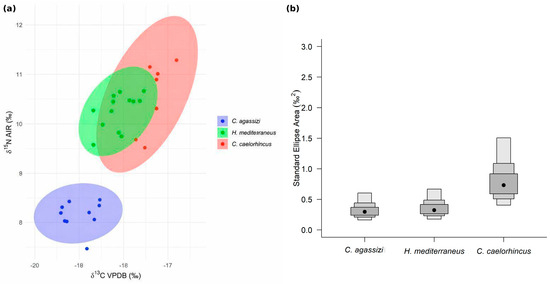
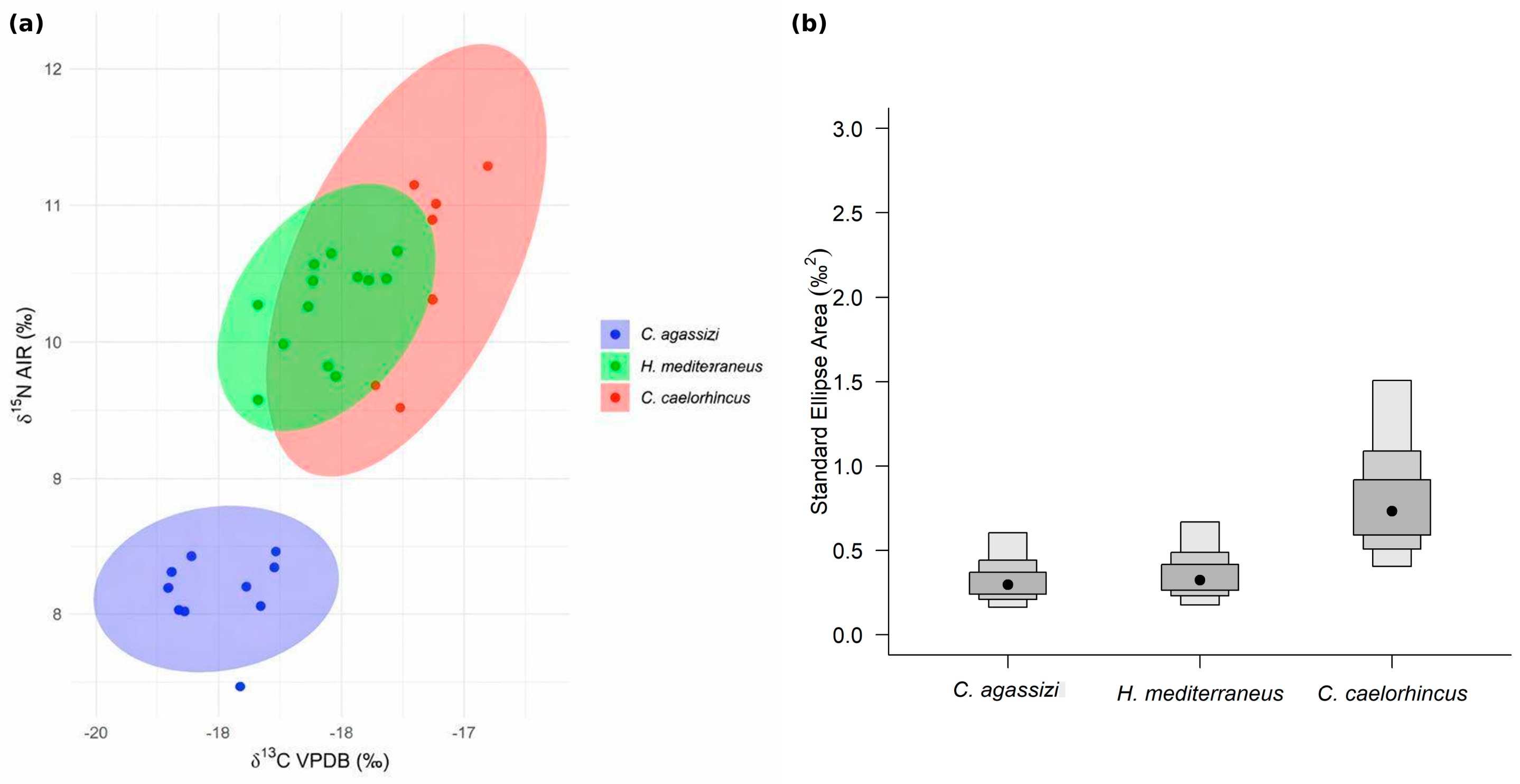
The isotopic niches of H. mediterraneus and C. caelorhincus showed a wide overlap, and both appeared distinct from that of C. agassizi (Figure 2a). Carbon range (CR) values increased from C. agassizi (0.88) to H. mediterraneus (1.05) and were higher in C. caelorhincus (1.66). Nitrogen range (NR) values were similar in C. agassizi and H. mediterraneus (0.99) and higher in C. caelorhincus (1.77). Based on SEAc estimates and their associated uncertainty, C. agassizi and H. mediterraneus showed similar niche widths, both smaller than that of C. caelorhincus (Figure 2b).
Figure 2.
(a) Isotopic niche biplot for C. agassizi, H. mediterraneus, and C. caelorhincus based on δ13C and δ15N values. Ellipses represent the standard ellipse area corrected for sample size (SEAc, 95%). (b) Posterior Bayesian estimates of standard ellipse areas corrected for sample size (SEAb) for each species. Black dots indicate mean values, while boxes represent credible intervals (50%, 75%, 95%).
The estimated trophic position (TP), derived from δ15N values, ranged from 3.19 ± 0.08 in C. agassizi to 3.80 ± 0.10 in H. mediterraneus and 3.89 ± 0.18 in C. caelorhincus.
3.2. Microplastic Ingestion
Overall, 368 suspected particles were isolated and analysed, of which 52 were chemically confirmed as synthetic MPs and included in subsequent analyses. MP ingestion was detected in all three species, with an overall occurrence of 34.4%. Specifically, FOs were 26.7% in C. agassizi, 40% in H. mediterraneus, and 36.7% in C. caelorhincus. The mean ± se number of MPs per individual was calculated both for all individuals (C. agassizi: 0.53 ± 1.20, H. mediterraneus: 0.70 ± 1.09, C. caelorhincus: 0.50 ± 0.78) and only for those that had ingested MPs (C. agassizi: 2.00 ± 1.60, H. mediterraneus: 1.75 ± 1.06, C. caelorhincus: 1.36 ± 0.67). GLMs did not show significant differences in MP ingestion rates between species (all p-values > 0.05; Table 3), and effect sizes were associated with wide confidence intervals, indicating substantial uncertainty. Overdispersion was detected in count data including zero observations (dispersion parameter = 1.86), supporting the use of quasi-Poisson models.
Table 3.
Results of generalised linear models (GLMs) used to assess differences in microplastic (MP) occurrence and abundance among the three studied species. For the binomial model, MP presence/absence was used as the response variable and species as the predictor. For count-based models, the number of MPs ingested by each individual was used as the response variable and species as the predictor. Effect sizes are reported as odds ratios (OR) for the binomial model and count ratios for quasi-Poisson models, with 95% confidence intervals (CI). C. agassizi was used as the reference category. (a) Binomial GLM testing differences in the frequency of occurrence (FO%) of MPs based on presence/absence data. (b) Quasi-Poisson GLM applied to the full dataset, including individuals with zero MPs, testing differences in MP counts. (c) Quasi-Poisson GLM fitted to the subset of individuals with at least one ingested MP, comparing MP counts among individuals with positive ingestion. Overdispersion was detected in count data including zero observations (dispersion parameter = 1.86), supporting the use of quasi-Poisson models.
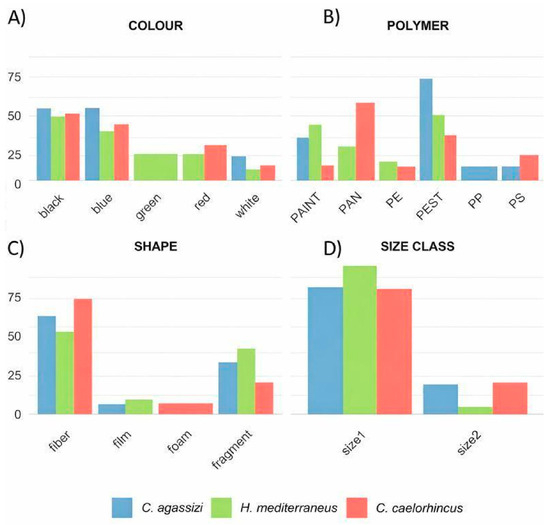
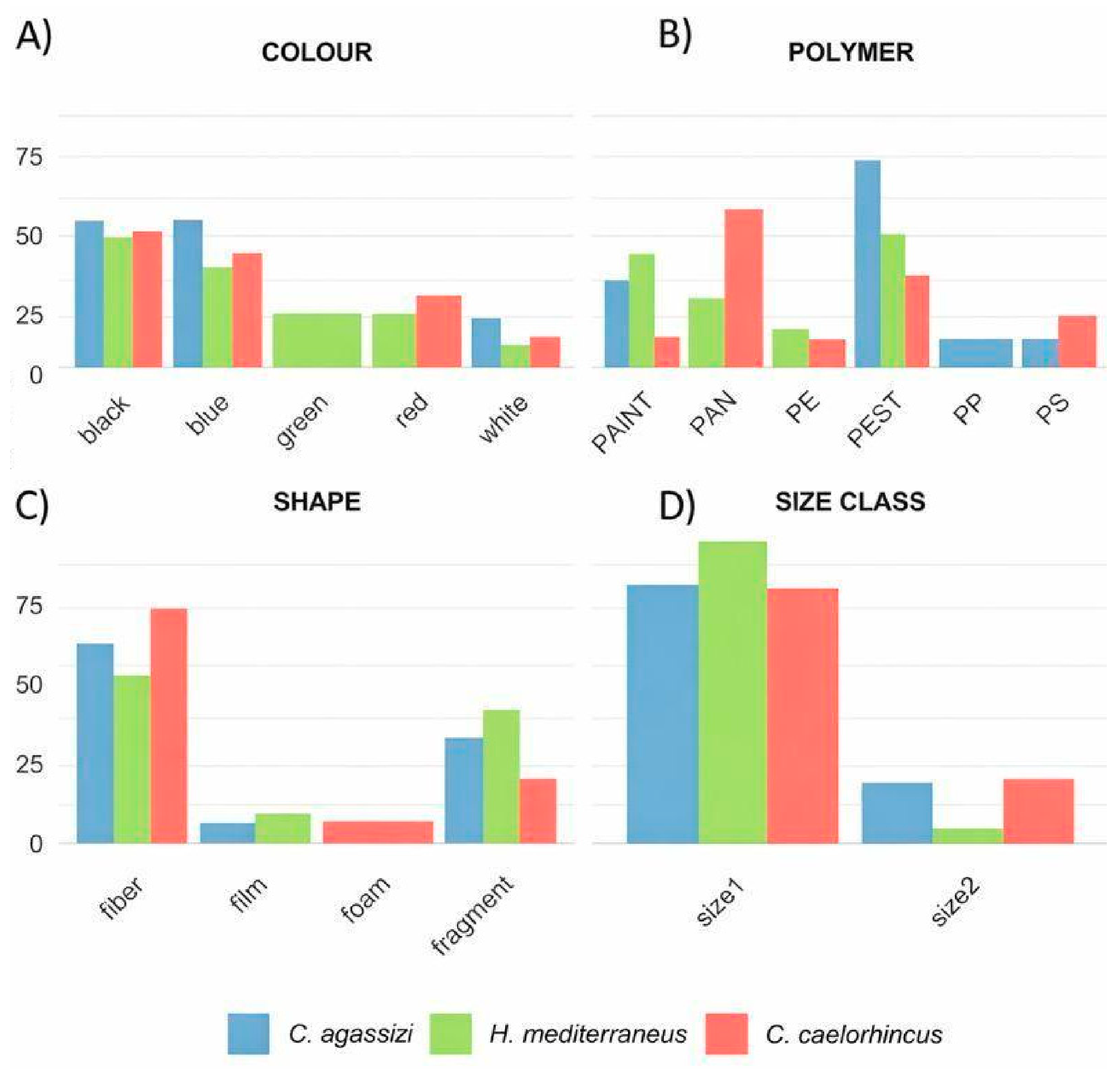
Concerning MP characteristics, the percentages of ingested MPs by shape, colour, size class, and polymer type across species are reported in Figure 3. Among shape categories, fibres were the most frequently ingested MPs (61.5%). The most common size class was S1 (84.6%), while the remaining 15.4% of MPs belonged to size class S2; no particles in size class S3 were detected. The predominant colours were black (44.2%) and blue (28.8%).
Figure 3.
Characteristics of ingested microplastics (MPs) in C. agassizi, H. mediterraneus, and C. caelorhincus. Bar charts show the percentage distribution of MPs according to (A) colour, (B) polymer type, (C) shape, and (D) size class.
Regarding polymer composition, a total of six polymers were identified (polyester, PEST; polyacrylonitrile, PAN; polyethylene, PE; paint particles, PAINT; polypropylene, PP; polystyrene, PS), with PEST (42.3%), PAINT (19.2%), and PAN (19.2%) being the most represented. Representative μFT-IR spectra of the most abundant particle types detect are available in Supplementary Materials (Figure S1). No significant associations were detected between species and MP shape (χ2 = 5.41, p = 0.528), colour (χ2 = 8.77, p = 0.382), or size class (χ2 = 2.30, p = 0.388) (Chi-square tests with simulated p-values; Figure 3A,C,D).
A significant association was observed between species and polymer type (Figure 3B; χ2 = 19.69, df = 10, p = 0.032; Chi-square test with simulated p-value). Species-specific patterns emerged in polymer composition: C. agassizi ingested proportionally more PEST particles but showed no ingestion of PAN or PE, H. mediterraneus ingested mainly PEST with no occurrence of PP or PS, whereas C. caelorhincus ingested predominantly PAN, with no PP detected.
The mean size of ingested particles, expressed as particle surface area [12], differed among species (Kruskal–Wallis test, χ2 = 6.90, df = 2, p = 0.0318). C. caelorhincus ingested significantly larger particles (0.106 ± 0.192 mm) than H. mediterraneus (0.035 ± 0.070 mm; Z = 2.61, p = 0.027, Bonferroni-adjusted), whereas differences with C. agassizi (0.085 ± 0.183 mm) were not significant (p > 0.05), as revealed by Dunn’s post hoc test.
Based on Shannon–Wiener indices (H′), calculated on combinations of MP categorical variables (shape, size class, colour, and polymer composition), diversity values were similar among species, with C. caelorhincus (H′ = 2.27) and H. mediterraneus (H′ = 2.23) showing comparable values, and slightly lower values observed in C. agassizi (H′ = 1.75).
4. Discussion
The present study provides the first investigation of the relationship between trophic ecology and microplastic ingestion in deep-sea fish species from the Western Mediterranean Sea. Despite the growing interest in marine pollution and deep-sea food webs, studies explicitly addressing the link between feeding ecology and MPs exposure remain limited [14,36,37]. This study represents a valuable contribution to the still limited understanding of feeding ecology and MP exposure pathways in deep-sea environments, which remain among the least explored marine ecosystems [38,39].
By combining SIA with the characterisation of ingested MPs, this study adopts an integrated ecological approach that has so far been applied in only a limited number of field-based studies worldwide (e.g., [40]) and only rarely in the Western Mediterranean Sea [12,41], where it has been restricted to the epipelagic zone.
4.1. Differences in Isotopic Niches and Feeding Strategies
The results reveal significant interspecific variations in both δ15N and δ13C, indicating differences in the trophic niches of the three species. Variability in δ13C values suggests differences in carbon source utilisation among the investigated species, likely reflecting various species-specific feeding strategies and habitat use rather than analytical variability [32] or differences in isotopic fractionation [42]. In contrast, no significant differences in δ15N are detected between H. mediterraneus and C. caelorhincus, determining similar trophic positioning in terms of nitrogen assimilation [32].
Considering isotopic niche metrics, carbon range (CR), nitrogen range (NR), and standard ellipse area corrected for sample size (SEAc) indicate that C.agassizi occupies a distinct isotopic space, whereas the niches of H. mediterraneus and C. caelorhincus partially overlap.
Within this framework, C. caelorhincus appears to have a broader isotopic niche compared to the other species, suggesting a more generalist trophic behaviour compared to the other two species.
These patterns are consistent with available information on the feeding habits and habitat use of the three species.
The distinct isotopic space occupied by C. agassizi, together with its significantly lower trophic position, is consistent with its bathydemersal habits and feeding strategy.
This species mainly feeds on bottom-living invertebrates and often ingests large prey fragments along with substantial amounts of detritus, reflecting opportunistic and scavenging behaviours [43,44,45].
In contrast, H. mediterraneus and C. caelorhincus exhibit higher and comparable trophic positions, in agreement with their benthopelagic habits and reliance on prey from both benthic and pelagic compartments, and consistently occupy an isotopic niche clearly separated from that of C. agassizi.
The more extended isotopic niche of C. caelorhincus can be explained by its active predatory lifestyle and its ability to feed also on fish and cephalopods, whereas the diet of H. mediterraneus is mainly restricted to small invertebrates such as amphipods, polychaetes, and natantian decapods.
Overall, these results provide novel insights into the trophic ecology of the three species in the Western Mediterranean Sea, complementing and refining the current understanding for this area [46].
Such evidence contributes to clarifying interspecific trophic differences and enhances our understanding of the ecological complexity characterising bathyal environments of the Central Tyrrhenian Sea.
4.2. Microplastic Ingestion in Deep-Sea Species
No significant differences in MP ingestion rates are observed among the three species, suggesting widespread MP exposure among resident species within the study area [12,35]. In this regard, the overall FO is similar to those reported for C. caelorhincus from the adjacent Central Tyrrhenian area off Eastern Sardinia (48%; [47]). These values are markedly higher than MP ingestion rates detected for deep-water species from the Southern Tyrrhenian, that are about 3.3% [36].
In line with this, the characteristics of ingested MPs are consistent with the hypothesis of diffuse and largely non-selective exposure. Available studies indicate recurrent patterns in the characteristics of ingested MPs, with a predominance of blue and black items and fibres. Similar patterns were also observed in juvenile pelagic fishes from the Southern Tyrrhenian Sea, where MPs were predominantly represented by fibres and included polymers such as polyester, polypropylene, polyethylene, polyamide, nylon, and rayon [48]. Although no significant associations between species and MPs categorical variables such as colour, size class, or shape were detected in the present study, this pattern suggests that these features largely reflect environmental availability rather than a clear selective ingestion mechanism [12]. The association observed for polymer composition was evaluated using a Chi-square test with simulated p-value, providing a more robust inference in the presence of low expected counts. However, given the relatively small number of ingested particles, these results should be interpreted with caution.
For deep-sea fish species in the Mediterranean, comparable information remains scarce. However, studies conducted in other regions provide useful insights. In the South China Sea, for instance, extremely high ingestion frequencies (90.3%) were reported for several deep-sea species, including C. agassizi. This marked difference may reflect the role of the South China Sea as a major sink of MPs [49]. Conversely, markedly lower values have been observed in the North-East Atlantic: in the Azores archipelago, [50] reported an FO of 3.7% for bathyal fish species inhabiting depth ranges similar to those investigated in this study, consistent with the lower frequencies observed in parts of the Mediterranean. However, exploratory studies conducted in other North Atlantic deep-sea systems have reported intermediate occurrence values. For example, Soliño et al. [51] observed MP occurrence frequencies of 28% in bathyal fish species from the Porcupine Bank. Additional variability is reported by [52] in the Southwestern Tropical Atlantic, who documented frequency of occurrence (FO) values ranging from 45% to 93% among different deep-sea species and sampling locations. This wide range further supports the presence of pronounced spatial heterogeneity in MP contamination across deep-sea environments. Differences also emerge when comparing the average number of MPs ingested per individual across studies. Considering only individuals that ingested at least one particle, the values observed in this study are higher than those reported by [36] for the same three species sampled in the Southern Tyrrhenian Sea, specifically in the Gulf of Patti (1.0 for C. agassizi, 1.25 for H. mediterraneus, and 1.0 for C. caelorhincus). Such differences likely reflect spatial and temporal variability in MP distribution and bioavailability, as well as local differences in prey availability and feeding behaviour [53,54,55]. In this context, integrating isotopic analyses provides additional insight by allowing MP ingestion patterns to be interpreted in light of species-specific trophic ecology, rather than as a simple function of environmental contamination alone. This combined approach provides additional context for interpreting both interspecific and spatial variability in MP ingestion within deep-sea environments. To further facilitate the contextualisation of the present findings, a summary comparison with previous studies conducted in Mediterranean and other marine regions is provided in Supplementary Table S1.
4.3. Impact of Feeding Habits on Microplastic Ingestion Patterns
The integration of SIA and MP ingestion data allows an in-depth investigation on the effect of trophic ecology on MP exposure. Although differences in isotopic niches could suggest differential exposure of the three species based on their foraging strategies, the observed data do not clearly indicate a direct relationship between trophic ecology and overall MP ingestion rates. Considering trophic position, the results of the present study suggest that trophic level alone may not be a reliable predictor of overall MP ingestion rates, as previously claimed by [56]. However, trophic ecology appears to play a role in shaping the characteristics of ingested MPs. In particular, relationships emerge when trophic niche width and trophic position are examined in relation to the size and diversity of ingested MPs.
Results suggest that C. agassizi has a more specialised diet and potentially less varied exposure to MPs, exhibiting a lower overall frequency of ingestion, yet individuals that ingest MPs carry a higher particle burden per capita, indicating that exposure, when it occurs, results in relatively large ingestion events. This pattern may reflect variability in feeding behaviour and MP availability rather than a consistently higher exposure to MPs [57].
Indeed C. caelorhincus displays the widest isotopic niche and tends to ingest larger MP particles. This tendency could be associated with its active predatory behaviour, preference for larger prey items, or a larger gape size [13,14,58], as also reflected by the higher trophic position estimated for this species. At interpretational level, the presence of larger MPs, expressed as the surface area of the particles [12], in the gastrointestinal contents of apical predators such as C. caelorhincus may be linked to active ingestion events driven by the similarity of large MPs with natural prey [12].
Nevertheless, the observed increase in trophic level corresponds to a higher diversity (Shannon H′) of ingested MPs, likely reflecting both a broader prey spectrum [59] and more varied exposure pathways. These may also reflect indirect exposure pathways potentially associated with trophic transfer, with particles consumed by prey being subsequently transferred to higher-level predators, although this mechanism could not be directly assessed in the present study [18,60,61]. Moreover, environmental MP availability was not directly quantified in the present study and may also contribute to the observed interspecific patterns. Together, these contrasting patterns —characterised by higher particle loads per affected individual in C. agassizi and by a broader isotopic niche associated with the ingestion of larger and more diverse MPs in C. caelorhincus—may reflect the multiple ecological pathways through which deep-sea fish interact with MPs.
This pattern mirrors observations from pelagic–neritic food web studies, where trophic position does not significantly influence MP ingestion rates but is strongly associated with the characteristics of ingested particles. In pelagic fishes from the Tyrrhenian Sea, Ref. [12] reported that species occupying higher trophic positions did not ingest a greater number of MPs but exhibited a higher diversity of MP types and ingested significantly larger particles, expressed as particle surface area. Similar to our findings, this pattern was interpreted as the result of differences in feeding strategies and prey selection mechanisms, with predatory species being more exposed to the ingestion of larger and more heterogeneous particles, either through active ingestion or trophic transfer. The consistency between pelagic and deep-sea environments provides further support for the ecological interpretation of these patterns and highlights the central role of trophic ecology—rather than ingestion rate alone—in shaping MPs exposure pathways across marine food webs [12].
From a methodological perspective, it is worth noting that trophic position (TP) estimates were calculated using a fixed trophic enrichment factor (TEF) and a single baseline value. This approach is widely adopted in comparative stable isotope studies investigating MP exposure within the same environmental context [9,12], particularly when the objective is to evaluate relative interspecific trophic differences rather than absolute trophic positions. Accordingly, TP estimates primarily reflect variability in δ15N values among sampled individuals. In addition, stable isotope analyses were conducted on a subset of individuals relative to MP ingestion analyses, which may limit the strength of the integrated ecological interpretation. Similarly, the methodological approach adopted in this study targeted only particles larger than 100 μm, potentially underestimating the contribution of smaller MPs, which are increasingly recognised as an important fraction in marine organisms. However, most studies investigating MP ingestion in marine organisms are currently based on analytical protocols targeting particles > 100 μm [56]. It should also be noted that the relatively limited number of ingested particles and the particle-based analytical approach may introduce some dependence among observations, as multiple particles originating from the same individual fish cannot be considered fully independent observations. Therefore, MP-related patterns should be interpreted cautiously. Moreover, the restriction of sampling to a single geographic area and season may not fully capture the spatial and temporal variability of MP availability and ingestion dynamics in deep-sea environments.
Future studies should include seasonal sampling and expand the range of investigated species, incorporating organisms with different anatomical, physiological, and feeding traits. This would allow a better identification of consistent patterns in microplastic ingestion and help to disentangle the relative role of ecological and functional drivers.
5. Conclusions
This study provides the first integrated assessment of trophic ecology and MP ingestion in deep-sea fish species from the central Tyrrhenian Sea. By combining stable isotope analysis with detailed characterisation of ingested MPs, the results suggest that trophic ecology is not clearly associated with overall MP ingestion rates in deep-sea fishes. Instead, trophic traits appear to be more closely related to the characteristics of ingested MPs, including their size and diversity.
The three species exhibited distinct trophic niches, reflecting differences in feeding behaviour and habitat use. Chlorophthalmus agassizi—characterised by a more specialised, bathydemersal feeding strategy—showed lower MP occurrence but relatively higher particle loads in affected individuals, suggesting exposure through occasional intake events rather than continuous ingestion. In contrast, Caelorinchus caelorhincus, an active predator with the widest isotopic niche, tended to ingest larger and more diverse MPs, consistent with its broader prey spectrum and the potential contribution of dietary pathways, including trophic transfer.
These patterns suggest the presence of multiple ecological pathways of MP exposure in deep-sea ecosystems, potentially linked to species-specific feeding strategies rather than trophic position alone. Overall, within the limits of the present dataset, trophic ecology appears to provide a useful framework for interpreting MP ingestion patterns in deep-sea fishes, particularly with respect to particle size and diversity rather than overall ingestion rates.
Supplementary Materials
The following supporting information can be downloaded at: https://www.mdpi.com/article/10.3390/microplastics5020114/s1, Figure S1: Representative FTIR spectra of the most abundant polymers identified in the present study, including (a) polyester (PEST), (b) paint particles (PAINT), and (c) polyacrylonitrile (PAN). Polymer identification was performed through com-parison with reference spectral libraries available in the OMNIC 9.13.1229 and OMNIC Specta 2.2.155 software packag-es (Thermo Fisher Scientific Inc.), considering only matches with a similarity percentage ≥70%; Table S1: Comparative overview of microplastic (MP) ingestion patterns reported in the present study and in previous investiga-tions conducted in Mediterranean and deep-sea marine environments. The table summarizes MP occurrence/frequency values, dominant particle characteristics (shape, colour, size class, and polymer composition), and the main ecological patterns described across studies in order to contextualize the findings of the present work.
Author Contributions
Conceptualisation, E.M., T.V., L.C. and M.M.; Methodology, E.M., M.S., M.R. and T.V.; Formal Analysis, E.M., G.C., D.B. and F.R.; Investigation, E.M. and T.V.; Data Curation, E.M., G.J.L., G.C., D.B., F.R. and T.V.; Writing—Original Draft Preparation, E.M.; Writing—Review and Editing, M.L.C., E.M., L.C., T.V., G.C., D.B., F.R., G.P., M.S., M.R., C.S., G.J.L. and M.M.; Visualisation, E.M.; Supervision, M.L.C., C.S. and M.M.; Project Administration, M.M. All authors have read and agreed to the published version of the manuscript.
Funding
This research received no external funding.
Institutional Review Board Statement
Ethical review and approval were waived for this study due to the use of commercially obtained fish samples and the absence of experimental procedures on live animals.
Informed Consent Statement
Not applicable.
Data Availability Statement
The data presented in this study are available on request from the corresponding author.
Acknowledgments
The authors would like to thank the technical staff of ISPRA (Necton Lab) for their support during laboratory analyses, and the crew of the professional fishing vessel, Raimondo Sferlazzo, and Tommaso Sferlazzo, for assistance during sampling activities. The authors also thank all students of the Necton Lab for their contribution to sample processing and specifically acknowledge Luca Ruscito and Marco Ragnini for their support.
Conflicts of Interest
The authors declare no conflicts of interest.
Abbreviations
The following abbreviations are used in this manuscript:
| ANOVA | Analysis of variance |
| CI | Confidence interval |
| CR | Carbon range |
| FO | Frequency of occurrence |
| FTIR | Fourier-transform infrared spectroscopy |
| GLM | Generalised linear model |
| IAEA | International Atomic Energy Agency |
| KOH | Potassium hydroxide |
| MP | Microplastic |
| MPs | Microplastics |
| NR | Nitrogen range |
| OR | Odds ratio |
| PAINT | Paint particles |
| PAN | Polyacrylonitrile |
| PE | Polyethylene |
| PEST | Polyester |
| PP | Polypropylene |
| PS | Polystyrene |
| QC | Quality control |
| SEAb | Bayesian standard ellipse area |
| SEAc | Standard ellipse area corrected for small sample size |
| SIA | Stable isotope analysis |
| TA | Total area |
| TEF | Trophic enrichment factor |
| TP | Trophic position |
| USGS | United States Geological Survey |
References
- Geyer, R.; Jambeck, J.R.; Law, K.L. Production, use, and fate of all plastics ever made. Sci. Adv. 2017, 3, e1700782. [Google Scholar] [CrossRef]
- Zheng, X.; Sun, R.; Dai, Z.; He, L.; Li, C. Distribution and risk assessment of microplastics in typical ecosystems in the South China Sea. Sci. Total Environ. 2023, 883, 163678. [Google Scholar] [CrossRef]
- Bergmann, M.; Wirzberger, V.; Krumpen, T.; Lorenz, C.; Primpke, S.; Tekman, M.B.; Gerdts, G. High Quantities of Microplastic in Arctic Deep-Sea Sediments from the HAUSGARTEN Observatory. Environ. Sci. Technol. 2017, 51, 11000–11010. [Google Scholar] [CrossRef]
- Jackson, A.L.; Inger, R.; Parnell, A.C.; Bearhop, S. Comparing isotopic niche widths among and within communities: SIBER—Stable Isotope Bayesian Ellipses in R: Bayesian isotopic niche metrics. J. Anim. Ecol. 2011, 80, 595–602. [Google Scholar] [CrossRef]
- EFSA Panel on Contaminants in the Food Chain (CONTAM). Presence of microplastics and nanoplastics in food, with par-ticular focus on seafood. Efsa J. 2016, 14, e04501. [Google Scholar] [CrossRef]
- Gouin, T. Toward an Improved Understanding of the Ingestion and Trophic Transfer of Microplastic Particles: Critical Review and Implications for Future Research. Environ. Toxicol. Chem. 2020, 39, 1119–1137. [Google Scholar] [CrossRef] [PubMed]
- Rochman, C.M.; Hoh, E.; Kurobe, T.; Teh, S.J. Ingested plastic transfers hazardous chemicals to fish and induces hepatic stress. Sci. Rep. 2013, 3, 3263. [Google Scholar] [CrossRef] [PubMed]
- Cole, M.; Lindeque, P.; Halsband, C.; Galloway, T.S. Microplastics as contaminants in the marine environment: A review. Mar. Pollut. Bull. 2011, 62, 2588–2597. [Google Scholar] [CrossRef]
- Ciaralli, L.; Valente, T.; Monfardini, E.; Libralato, G.; Manfra, L.; Berto, D.; Rampazzo, F.; Gioacchini, G.; Chemello, G.; Piermarini, R.; et al. Rose or Red, but Still under Threat: Comparing Microplastics Ingestion between Two Sympatric Marine Crustacean Species (Aristaeomorpha foliacea and Parapenaeus longirostris). Animals 2024, 14, 2212. [Google Scholar] [CrossRef]
- Alberghini, L.; Truant, A.; Santonicola, S.; Colavita, G.; Giaccone, V. Microplastics in Fish and Fishery Products and Risks for Human Health: A Review. Int. J. Environ. Res. Public Health 2022, 20, 789. [Google Scholar] [CrossRef]
- Rai, P.K.; Sonne, C.; Brown, R.J.C.; Younis, S.A.; Kim, K.H. Adsorption of environmental contaminants on micro- and nano-scale plastic polymers and the influence of weathering processes on their adsorptive attributes. J. Hazard. Mater. 2022, 427, 127903. [Google Scholar] [CrossRef]
- Valente, T.; Costantini, M.L.; Careddu, G.; Berto, D.; Piermarini, R.; Rampazzo, F.; Sbrana, A.; Silvestri, C.; Ventura, D.; Matiddi, M. Tracing the route: Using stable isotope analysis to understand microplastic pathways through the pelagic-neritic food web of the Tyrrhenian Sea (Western Mediterranean). Sci. Total Environ. 2023, 885, 163875. [Google Scholar] [CrossRef] [PubMed]
- Scacco, U.; Tiralongo, F.; Mancini, E. Feeding in Deep Waters: Temporal and Size-Related Plasticity in the Diet of the Slope Predator Fish Coelorinchus caelorhincus (Risso, 1810) in the Central Tyrrhenian Sea. J. Mar. Sci. Eng. 2022, 10, 1235. [Google Scholar] [CrossRef]
- Scacco, U.; Mancini, E.; Marcucci, F.; Tiralongo, F. Microplastics in the Deep: Comparing Dietary and Plastic Ingestion Data between Two Mediterranean Bathyal Opportunistic Feeder Species, Galeus melastomus, Rafinesque, 1810 and Coelorinchus caelorhincus (Risso, 1810), through Stomach Content Analysis. J. Mar. Sci. Eng. 2022, 10, 624. [Google Scholar] [CrossRef]
- Danovaro, R.; Company, J.B.; Corinaldesi, C.; D’Onghia, G.; Galil, B.; Gambi, C.; Gooday, A.J.; Lampadariou, N.; Luna, G.M.; Morigi, C.; et al. Deep-Sea Biodiversity in the Mediterranean Sea: The Known, the Unknown, and the Unknowable. Gratwicke B, curatore. PLoS ONE 2010, 5, e11832. [Google Scholar] [CrossRef]
- Smith, K.L.; Ruhl, H.A.; Bett, B.J.; Billett, D.S.M.; Lampitt, R.S.; Kaufmann, R.S. Climate, carbon cycling, and deep-ocean ecosystems. Proc. Natl. Acad. Sci. USA 2009, 106, 19211–19218. [Google Scholar] [CrossRef]
- Kane, I.A.; Clare, M.A.; Miramontes, E.; Wogelius, R.; Rothwell, J.J.; Garreau, P.; Pohl, F. Seafloor microplastic hotspots controlled by deep-sea circulation. Science 2020, 368, 1140–1145. [Google Scholar] [CrossRef]
- Nelms, S.E.; Galloway, T.S.; Godley, B.J.; Jarvis, D.S.; Lindeque, P.K. Investigating microplastic trophic transfer in marine top predators. Environ. Pollut. 2018, 238, 999–1007. [Google Scholar] [CrossRef]
- Sandil, S.; Tserendorj, D.; Károly, Á.; Grenni, P.; Rolando, L.; Dobosy, P.; Dömölki, B.; Záray, G. Microplastic and microfiber contamination in the Tiber River, Italy: Insights into their presence and chemical differentiation. Mar. Pollut. Bull. 2025, 212, 117598. [Google Scholar] [CrossRef] [PubMed]
- Inghilesi, R.; Ottolenghi, L.; Orasi, A.; Pizzi, C.; Bignami, F.; Santoleri, R. Fate of river Tiber discharge investigated through numerical simulation and satellite monitoring. Ocean. Sci. 2012, 8, 773–786. [Google Scholar] [CrossRef]
- Cesarini, G.; Crosti, R.; Secco, S.; Gallitelli, L.; Scalici, M. From city to sea: Spatiotemporal dynamics of floating macrolitter in the Tiber River. Sci. Total Environ. 2023, 857, 159713. [Google Scholar] [CrossRef]
- Crosti, R.; Arcangeli, A.; Campana, I.; Paraboschi, M.; González-Fernández, D. ‘Down to the river’: Amount, composition, and economic sector of litter entering the marine compartment, through the Tiber river in the Western Mediterranean Sea. Rend. Lincei. Sci. Fis. E Nat. 2018, 29, 859–866. [Google Scholar] [CrossRef]
- Patrolecco, L.; Capri, S.; Angelis, S.D.; Pagnotta, R.; Polesello, S.; Valsecchi, S. Partition of Nonylphenol and Related Compounds Among Different Aquatic Compartments in Tiber River (Central Italy). Water Air Soil. Pollut. 2006, 172, 151–166. [Google Scholar] [CrossRef]
- European Commission; Joint Research Centre; MSFD Technical Group on Marine Litter. Guidance on the Monitoring of Marine Litter in European Seas: An Update to Improve the Harmonised Monitoring of Marine Litter Under the Marine Strategy Framework Directive; The Publications Office of the European Union: Luxembourg, 2023; Available online: https://data.europa.eu/doi/10.2760/59137 (accessed on 7 April 2026).
- Valente, T.; Ventura, D.; Matiddi, M.; Sbrana, A.; Silvestri, C.; Piermarini, R.; Jacomini, C.; Costantini, M.L. Image processing tools in the study of environmental contamination by microplastics: Reliability and perspectives. Environ. Sci. Pollut. Res. 2023, 30, 298–309. [Google Scholar] [CrossRef]
- Valente, T.; Pelamatti, T.; Avio, C.G.; Camedda, A.; Costantini, M.L.; de Lucia, G.A.; Jacomini, C.; Piermarini, R.; Regoli, F.; Sbrana, A.; et al. One is not enough: Monitoring microplastic in-gestion by fish needs a multispecies approach. Mar. Pollut. Bull. 2022, 184, 114133. [Google Scholar] [CrossRef]
- Panunzi, G.; Valente, T.; Matiddi, M.; Lasinio, G.J. A preliminary study on shape descriptors for the char acterization of microplastics ingested by fish. In Book of the Short Papers; Pearson: London, UK, 2023; pp. 1015–1020. [Google Scholar]
- Wickham, H.; François, R.; Henry, L.; Müller, K.; Vaughan, D. dplyr: A Grammar of Data Manipulation, version 1.2.1; CRAN: Vienna, Austria, 2014. Available online: https://CRAN.R-project.org/package=dplyr (accessed on 7 April 2026).
- Zeileis, A.; Kleiber, C.; Jackman, S. Regression Models for Count Data in R. J. Stat. Softw. 2008, 27, 1–25. [Google Scholar] [CrossRef]
- Wickham, H. Data Analysis. In Ggplot2; Springer International Publishing: Cham, Switzerland, 2016; pp. 189–201. Available online: http://link.springer.com/10.1007/978-3-319-24277-4_9 (accessed on 7 April 2026).
- Wickham, H.; Averick, M.; Bryan, J.; Chang, W.; McGowan, L.D.A.; François, R.; Grolemund, G.; Hayes, A.; Henry, L.; Hester, J.; et al. Welcome to the Tidyverse. J. Open Source Softw. 2019, 4, 1686. [Google Scholar] [CrossRef]
- Post, D.M. Using stable isotopes to estimate trophic position: Models, methods, and assumptions. Ecology 2002, 83, 703–718. [Google Scholar] [CrossRef]
- Layman, C.A.; Arrington, D.A.; Montaña, C.G.; Post, D.M. Can stable isotope ratios provide for community-wide measures of trophic structure? Ecology 2007, 88, 42–48. [Google Scholar] [CrossRef]
- Kruskal, W.H.; Wallis, W.A. Use of Ranks in One-Criterion Variance Analysis. J. Am. Stat. Assoc. 1952, 47, 583–621. [Google Scholar] [CrossRef]
- Valente, T.; Sbrana, A.; Scacco, U.; Jacomini, C.; Bianchi, J.; Palazzo, L.; de Lucia, G.A.; Silvestri, C.; Matiddi, M. Exploring microplastic ingestion by three deep-water elas-mobranch species: A case study from the Tyrrhenian Sea. Environ. Pollut. 2019, 253, 342–350. [Google Scholar] [CrossRef]
- Sciutteri, V.; Pedà, C.; Longo, F.; Calogero, R.; Cangemi, G.; Pagano, L.; Battaglia, P.; Nannini, M.; Romeo, T.; Consoli, P. Integrated approach for marine litter pollution assessment in the southern Tyrrhenian Sea: Information from bottom-trawl fishing and plastic ingestion in deep-sea fish. Mar. Pollut. Bull. 2023, 188, 114661. [Google Scholar] [CrossRef]
- Deudero, S.; Alomar, C. Mediterranean marine biodiversity under threat: Reviewing influence of marine litter on species. Mar. Pollut. Bull. 2015, 98, 58–68. [Google Scholar] [CrossRef]
- Feng, J.C.; Liang, J.; Cai, Y.; Zhang, S.; Xue, J.; Yang, Z. Deep-sea organisms research oriented by deep-sea technologies development. Sci. Bull. 2022, 67, 1802–1816. [Google Scholar] [CrossRef]
- Fanelli, E.; Bianchelli, S.; Foglini, F.; Canals, M.; Castellan, G.; Güell-Bujons, Q.; Galil, B.; Goren, M.; Evans, J.; Fabri, M.-C.; et al. Identifying Priorities for the Protection of Deep Med-iterranean Sea Ecosystems Through an Integrated Approach. Front. Mar. Sci. 2021, 8, 698890. [Google Scholar] [CrossRef]
- Gao, S.; Zhang, S.; Feng, Z.; Lu, J.; Fu, G.; Yu, W. The bio–accumulation and –magnification of microplastics under predator–prey isotopic relationships. J. Hazard. Mater. 2024, 480, 135896. [Google Scholar] [CrossRef]
- Sbrana, A.; Valente, T.; Scacco, U.; Bianchi, J.; Silvestri, C.; Palazzo, L.; de Lucia, G.A.; Valerani, C.; Ardizzone, G.; Matiddi, M. Spatial variability and influence of biological parameters on microplastic ingestion by Boops boops (L.) along the Italian coasts (Western Mediterranean Sea). Environ. Pollut. 2020, 263, 114429. [Google Scholar] [CrossRef]
- Barnes, C.; Sweeting, C.J.; Jennings, S.; Barry, J.T.; Polunin, N.V.C. Effect of temperature and ration size on carbon and nitrogen stable isotope trophic fractionation. Funct. Ecol. 2007, 21, 356–362. [Google Scholar] [CrossRef]
- Sever, T.M.; Bayhan, B.; Filiz, H.; Taşkavak, E.; Bilge, G. Diet composition of the five deep sea fish from the Aegean Sea. Ege J. Fish. Aquat. Sci. 2013, 30, 61–67. [Google Scholar] [CrossRef]
- Anastasopoulou, A.; Yiannopoulos, C.; Megalofonou, P.; Papaconstantinou, C. Distribution and population structure of the Chlorophthalmus agassizi (Bonaparte, 1840) on an unexploited fishing ground in the Greek Ionian Sea. J. Appl. Ichthyol. 2006, 22, 521–529. [Google Scholar] [CrossRef]
- D’Onghia, G.; Sion, L.; Maiorano, P.; Mytilineou, C.; Dalessandro, S.; Carlucci, R.; Desantis, S. Population biology and life strategies of Chlo-rophthalmus agassizii Bonaparte, 1840 (Pisces: Osteichthyes) in the Mediterranean Sea. Mar. Biol. 2006, 149, 435–446. [Google Scholar] [CrossRef]
- Cicala, D.; Sbrana, A.; Valente, T.; Berto, D.; Rampazzo, F.; Gravina, M.F.; Maiello, G.; Russo, T. Trophic niche overlap of deep-sea fish species revealed by the combined approach of stomach contents and stable isotopes analysis in the Central Tyrrhenian Sea. Deep. Sea Res. Part. Oceanogr. Res. Pap. 2024, 206, 104281. [Google Scholar] [CrossRef]
- Esposito, G.; Prearo, M.; Renzi, M.; Anselmi, S.; Cesarani, A.; Barcelò, D.; Dondo, A.; Pastorino, P. Occurrence of microplastics in the gastrointestinal tract of benthic by–catches from an eastern Mediterranean deep–sea environment. Mar. Pollut. Bull. 2022, 174, 113231. [Google Scholar] [CrossRef]
- Savoca, S.; Bottari, T.; Fazio, E.; Bonsignore, M.; Mancuso, M.; Luna, G.M.; Romeo, T.; D’Urso, L.; Capillo, G.; Panarello, G.; et al. Plastics occurrence in juveniles of Engraulis encrasicolus and Sardina pilchardus in the Southern Tyrrhenian Sea. Sci. Total Environ. 2020, 718, 137457. [Google Scholar] [CrossRef]
- Zhu, L.; Wang, H.; Chen, B.; Sun, X.; Qu, K.; Xia, B. Microplastic ingestion in deep-sea fish from the South China Sea. Sci. Total Environ. 2019, 677, 493–501. [Google Scholar] [CrossRef]
- Pereira, J.M.; Rodríguez, Y.; Blasco-Monleon, S.; Porter, A.; Lewis, C.; Pham, C.K. Microplastic in the stomachs of open-ocean and deep-sea fishes of the North-East Atlantic. Environ. Pollut. 2020, 265, 115060. [Google Scholar] [CrossRef]
- Soliño, L.; Vidal-Liñán, L.; Pérez, P.; García-Barcelona, S.; Baldó, F.; Gago, J. Microplastic occurrence in deep-sea fish species Alepocephalus bairdii and Coryphaenoides rupestris from the Porcupine Bank (North Atlantic). Sci. Total Environ. 2022, 834, 155150. [Google Scholar] [CrossRef]
- Justino, A.K.S.; Ferreira, G.V.B.; Schmidt, N.; Eduardo, L.N.; Fauvelle, V.; Lenoble, V.; Sempéré, R.; Panagiotopoulos, C.; Mincarone, M.M.; Frédou, T.; et al. The role of mesopelagic fishes as microplastics vectors across the deep-sea layers from the Southwestern Tropical Atlantic. Environ. Pollut. 2022, 300, 118988. [Google Scholar] [CrossRef]
- Lo, H.S.; Wong, L.C.; Lai, K.P.; Cheung, S.G. The influences of spatial-temporal variability and ecological drivers on microplastic in marine fish in Hong Kong. Environ. Pollut. 2023, 327, 121527. [Google Scholar] [CrossRef]
- Giani, D.; Andolina, C.; Baini, M.; Panti, C.; Sciandra, M.; Vizzini, S.; Fossi, M.C. Trophic niche influences ingestion of micro- and mesoplastics in pelagic and demersal fish from the Western Mediterranean Sea. Environ. Pollut. 2023, 328, 121632. [Google Scholar] [CrossRef]
- Lopes, C.; Raimundo, J.; Caetano, M.; Garrido, S. Microplastic ingestion and diet composition of planktivorous fish. Limnol. Oceanogr. Lett. 2020, 5, 103–112. [Google Scholar] [CrossRef]
- Covernton, G.A.; Cox, K.D.; Fleming, W.L.; Buirs, B.M.; Davies, H.L.; Juanes, F.; Dudas, S.E.; Dower, J.F. Large size (>100-μm) microplastics are not biomagnifying in coastal marine food webs of British Columbia, Canada. Ecol. Appl. 2022, 32, e2654. [Google Scholar] [CrossRef]
- Courtene-Jones, W.; Quinn, B.; Gary, S.F.; Mogg, A.O.M.; Narayanaswamy, B.E. Microplastic pollution identified in deep-sea water and ingested by benthic invertebrates in the Rockall Trough, North Atlantic Ocean. Environ. Pollut. 2017, 231, 271–280. [Google Scholar] [CrossRef]
- Madurell, T.; Cartes, J.E. Trophic relationships and food consumption of slope dwelling macrourids from the bathyal Ionian Sea (eastern Mediterranean). Mar. Biol. 2006, 148, 1325–1338. [Google Scholar] [CrossRef]
- Bearhop, S.; Adams, C.E.; Waldron, S.; Fuller, R.A.; Macleod, H. Determining trophic niche width: A novel approach using stable isotope analysis. J. Anim. Ecol. 2004, 73, 1007–1012. [Google Scholar] [CrossRef]
- Setälä, O.; Fleming-Lehtinen, V.; Lehtiniemi, M. Ingestion and transfer of microplastics in the planktonic food web. Environ. Pollut. 2014, 185, 77–83. [Google Scholar] [CrossRef]
- Farrell, P.; Nelson, K. Trophic level transfer of microplastic: Mytilus edulis (L.) to Carcinus maenas (L.). Environ. Pollut. 2013, 177, 1–3. [Google Scholar] [CrossRef]

Disclaimer/Publisher’s Note: The statements, opinions and data contained in all publications are solely those of the individual author(s) and contributor(s) and not of MDPI and/or the editor(s). MDPI and/or the editor(s) disclaim responsibility for any injury to people or property resulting from any ideas, methods, instructions or products referred to in the content. |
© 2026 by the authors. Licensee MDPI, Basel, Switzerland. This article is an open access article distributed under the terms and conditions of the Creative Commons Attribution (CC BY) license.