


Abstract
Background: Soil mulching is a widely adopted agricultural practice known to regulate soil microclimate and enhance crop productivity; yet the biochemical mechanisms by which intact plastic and biodegradable mulch films influence soil nitrogen (N) cycling at the metabolic pathway level remain largely unexplored. Understanding these nitrogen transformation pathways is critical for assessing the long-term impacts of mulching materials on soil microbial communities, soil health, and sustainable agricultural management. This study focuses on the biochemical effects of intact mulch film application on soil N metabolism. Methods: N cycle-related soil metabolites were profiled using GC–MS/MS and MALDI TOF/TOF MS and then integrated with multivariate statistical modelling and pathway-level metabolic network perturbation analysis to compare conventional plastic and biodegradable plastic mulch film application against unmulched controls. Results: A panel of 62 KEGG-annotated N-cycle metabolites was profiled, and material-dependent metabolome separation was confirmed by OPLS-DA (R2Y 0.893–0.956; Q2 0.546–0.786). Both mulching materials significantly perturbed soil N-metabolite pools but differed in terms of pathway identity, magnitude, and directionality. Conventional plastic mulching caused the greatest disruption—near-complete suppression of N-storage and stress-adaptation pools (NES of −1.16; impact score of 10.01) and severe impairment of aspartate-centred metabolism—with L-aspartate identified as a critical stoichiometric hub. Biodegradable mulching material imposed a distinct profile dominated by inhibition of branched-chain amino acid catabolism and lysine degradation, with L-pipecolate as a treatment-specific critical impact node. Conclusions: These findings support that mulching material choice is a primary determinant of soil N-cycling biochemistry. The observed metabolite-level perturbations are suggestive of potential consequences for nitrogen retention. Though this inference is based on metabolite pool size differences and network topology metrics rather than directly measured process rates, it should therefore be interpreted with appropriate caution.
1. Introduction
Mulching is among the most widely deployed soil management practices in modern agriculture. Mulching materials—ranging from conventional polyethylene films [1] and biodegradable polymer blends [2] to organic residue-based covers [3]—are applied across diverse cropping systems to modulate soil temperature, conserve moisture, suppress weed emergence, and increase crop productivity [4].
Plastic mulch films, typically composed of low-density polyethylene (LDPE), are widely used to modify soil thermal regimes, reduce evapotranspiration, and increase crop yields under water-limited conditions [5]. However, long-term use leads to fragmentation into microplastics that persist in soil and disrupt nitrogen (N) cycling [6]. Accumulated microplastics alter soil structure by increasing porosity and reducing bulk density, thereby modifying the redox microenvironments that govern microbial N transformations [7]. They also create plastisphere niches that restructure microbial communities and their N-cycling functions, potentially through effects on amoA- and nirS-bearing taxa [8,9].
These structural and biological changes alter all major N transformation pathways. Mineralization and ammonification are often stimulated [10]; in some cases, soil ammonium (NH4+) is increased by more than 200% [11], likely driven by increased activities of enzymes such as urease and leucine aminopeptidase, which accelerate organic N turnover [12]. In contrast, nitrification is frequently inhibited, with microplastics linked to an approximately 7.9% decrease in soil nitrate (NO3−) [10], reflecting suppressed ammonia-oxidizing activity [13]. Denitrification responses are plastic-type dependent, whereas some studies report inhibition [9], while others report substantial stimulation [14], with the increase in nitrous oxide (N2O) emissions by up to 140% in polyurethane microplastics [15]. Microplastics can also increase ammonia volatilization, adding another pathway of reactive N loss from soil and to the atmosphere [10]. Collectively, these findings suggest that microplastic accumulation does not uniformly suppress or stimulate soil N cycling but rather induces complex, process-specific reorganization of N transformation activity.
In response to these environmental concerns, biodegradable mulch films have been proposed as sustainable alternatives to conventional mulches [2]. Unlike LDPE, they are designed to undergo microbial and enzymatic degradation in soil, yielding low-molecular-weight intermediates and ultimately CO2, H2O, and biomass [4]. Their degradation releases labile carbon that can transiently stimulate microbial activity and reshape N cycling dynamics, which often differs from those of conventional plastics. Conventional mulches commonly increase topsoil NO3− and apparent N availability by reducing leaching [16]. In contrast, biodegradable mulches are frequently associated with lower residual nitrate levels, possibly because of greater plant uptake or altered microbial pathways [17]. They can more strongly stimulate gross N mineralization and, at higher concentrations, gross N immobilization [10]. Some studies report up to 63% lower crop N uptake under biodegradable mulches than under conventional mulches, likely because faster in-season breakdown diminishes their moisture- and temperature-buffering functions [5]. Overall, biodegradable mulches and conventional mulches exert distinct, nonequivalent control on soil N transformation.
There are critical gaps in knowledge regarding the biochemical mechanisms through which mulching materials reshape soil N cycling at the metabolic pathway level. Existing studies have predominantly assessed mulching impacts through the use of bulk soil chemical indicators—total nitrogen, ammonium, nitrate, and microbial biomass nitrogen [18]—or through the use of enzyme activity proxies such as urease, protease, and nitrate reductase [7,12]. While informative, these approaches lack the resolution to delineate the coordinated, pathway-level reorganisation of N-metabolite pools that underlies observed changes in soil N availability and transformation rates.
To address these gaps, the present study integrated targeted soil metabolomics with stoichiometric metabolic network reconstruction to characterize and compare the effects of conventional plastic and biodegradable mulching materials on soil nitrogen cycle-related metabolites. Specifically, we aimed to (i) identify the N-cycle metabolites and metabolic pathways most strongly perturbed by each mulching material relative to unmulched control soils; (ii) resolve the directionality and magnitude of pathway-level N-metabolome reprogramming across all pairwise contrasts; and (iii) delineate the stoichiometric network topology and activity-stress architecture underlying mulching-driven perturbations of soil nitrogen cycling, with the objective of providing a mechanistic basis for resolving how mulching material may shape pathway-level outcomes in agricultural soils.
2. Materials and Methods
2.1. Experimental Site Description and Soil Sampling
Field trials were conducted in three spatially adjacent plots cultivated with pea (Pisum sativum L.) within a single experimental site, selected to ensure uniformity in soil type, texture, topography, and agronomic management history (45°58′37″ N, 21°19′20″ E). The site is characterized by a temperate continental climate, with an annual mean temperature of 11.7 °C and annual mean precipitation of 783 mm. The soil at the experimental site is classified as a chernozem with a clay loam texture, exhibiting a slightly alkaline reaction (pH 7.8) and the following baseline chemical properties: total nitrogen 1.83 g·kg−1, available phosphorus 23.3 mg·kg−1, available potassium 202 mg·kg−1, Na+ 58 mg·kg−1, Ca2+ 86 mg·kg−1, and Mg2+ 105 mg·kg−1. Three case study conditions were defined according to the mulching material used: (1) an unmulched control (C); (2) conventional polyethylene (P) plastic mulch; and (3) a soil-biodegradable plastic (B) mulch film. As each mulching treatment was applied to a single unreplicated plot; the study is therefore framed as an exploratory case study, and between-treatment comparisons are interpreted accordingly (see Section 4.3). The P mulch consisted of a black, UV-stabilized agricultural film (25 µm nominal thickness) characterized by low vapour permeability and high mechanical durability. The B mulch was a commercially available, black-colored certified soil-biodegradable plastic film (25 µm nominal thickness) composed of biodegradable polyester blends (poly(butylene adipate-coterephthalate, PBAT)). The experiment was conducted using intact mulch films applied as continuous surface covers throughout the cropping cycle. To minimize the risk of cross-contamination between treatments—including potential microplastic drift and leachate movement—a buffer zone of 2.5 m was maintained between adjacent plots. Within each treatment plot, two subplots were designated as within-plot spatial sampling unit to capture within-field variability. In each subplot, soil samples were collected from five randomly positioned 1 m × 1 m quadrats using stratified random sampling, yielding total of ten quadrat-level observations per treatment across both subplots. With an interrow spacing of 0.5 m and an intrarow of 0.3 m, bulk soil samples were collected from the interrow space. Sampling was conducted in September over two consecutive growing seasons to standardize the sampling phenology and capture end-of-season soil conditions, a period during which cumulative treatment effects on soil microbial activity, organic residue inputs, and soil nitrogen cycling processes are expected to be most pronounced.
2.2. Metabolite Extraction
Soil metabolite profiles were characterized using targeted metabolomics, focusing on nitrogen cycle-related metabolites, including TCA-linked organic acids, proteinogenic amino acids and derivatives, polyamines, urea cycle intermediates, and nucleotide bases and nucleosides. These metabolites were extracted from 1 g of lyophilized soil using a cold biphasic chloroform–methanol–water protocol as previously described by Kovacs et al. [19]. The samples were homogenized for 5 min in 750 µL of ice-cold chloroform:methanol (1:2, v/v), followed by the addition of 250 µL of ice-cold chloroform and further homogenization for 5 min. Subsequently, 250 µL of ice-cold deionized water was added, and the samples were homogenized again for 5 min. The mixture was incubated on ice for 30 min and centrifuged at 2000 rpm for 15 min. Phase separation was performed on ice, and the polar phase was collected for analysis while the lower organic phase was discarded. The residual fraction was re-extracted twice with 450 µL of ice-cold chloroform:methanol (1:2, v/v), 150 µL of ice-cold chloroform, and 150 µL of ice-cold deionized water; the three upper phases were pooled together.
2.3. Mass Spectrometric Assessment of the Soil Metabolome Profile
The pooled extract was split into two aliquots for targeted MS-based assessment of nitrogen cycle-associated metabolites. For GC–MS/MS analysis, the sample aliquot was derivatized by methoximation and silylation by adding 100 µL methoxyamine hydrochloride (0.02 g·mL−1 in pyridine; 60 min at 30 °C) followed by 100 µL MSTFA (30 min at 50 °C). Two microliters were injected into a Trace 1310 GC coupled to a TSQ 9000 triple quadrupole MS (Thermo Scientific, Waltham, MA, USA) using an SSL injector at 250 °C. Separation was performed on an HP-5MS column (30 m × 0.25 mm × 0.25 µm) with helium at 1 mL·min−1. The oven program was 40 °C (7 min), ramped at 5 °C·min−1 to 285 °C, and held for 7 min; the solvent delay was 3.5 min. The ion source was operated at 230 °C in EI mode (70 eV). Data acquisition and targeted peak integration were performed in Xcalibur 4.0 and/or MS-DIAL v4.9 [20]. Process blanks were included, and features present in blanks at >20% of the mean sample intensity were removed. Targeted metabolites identification confidence followed the Metabolomics Standard Initiative [21]: Level 1 identifications (highest confidence) were assigned when retention time and EI spectra matched authentic chemical standards from MSMLS Metabolites standard library (Sigma Aldrich, Munich, Germany) analysed under identical conditions; and Level 2 (putative annotation) required a spectral match score ≥80% against the NIST 14 library without an available standard. Abundances were reported as relative peak areas normalized to each sample chromatogram.
For MALDI–TOF/TOF MS, the second aliquot was dried under N2 and reconstituted in 25 µL of 0.05% trifluoroacetic acid (TFA) in water containing 2% ammonium hydroxide. A 2.5 µL sample was mixed with 2.5 µL 9-aminoacridine matrix (10 mg·mL−1 in 0.1% trifluoroacetic acid (TFA) in acetone), and 1 µL was spotted onto an MTP 384 polished steel target (Bruker Daltonics, Bremen, Germany) and air-dried. Spectra were acquired on an Autoflex maX MALDI TOF/TOF (Bruker Daltonics, Bremen, Germany) with a 355 nm Nd:YAG laser. Data were collected in linear negative-ion mode (laser intensity 35%, 500 Hz, ~2000 shots per raster position). The spectra were processed in flexAnalysis v3.4 (centroid detection; TopHat baseline subtraction), and targeted annotation/assignment was performed using R-MetaboList 2 [22] and rMSIfragment [23]. Calibration was ensured using a MSMLS Metabolites standard library (Sigma Aldrich, Munich, Germany). Assignments were accepted as MSI Level 2 when the accurate-mass error was <10 ppm and the in-source fragmentation pattern matched the reference, and as Level 1 when additionally confirmed against an authentic standard from the MSMLS library.
2.4. Data Normalization
Raw mass spectrometric data underwent sequential quality control and normalization prior to multivariate analysis. First, metabolite features with more than 20% missing values across all samples were removed. The remaining missing values were imputed using the k-nearest neighbours (KNN) algorithm (k = 5) implemented in the impute R package, which is appropriate for low-to-moderate missingness in metabolomics datasets. Data quality was then evaluated by calculating the coefficient of variation (CV) for each metabolite across biological replicates within each experimental group. Metabolites with CV > 50% were flagged as potentially unstable measurements and retained in the dataset by default, but subjected to an explicit sensitivity workflow. Specifically, all primary analysis were conducted on the full dataset, and key results (significant metabolites, pathway-level significance, and pathway rankings) were re-evaluated after excluding flagged metabolites to confirm that findings were not driven by highly variable features. Flagged metabolites were also manually inspected at the level of feature intensity distributions across replicates to identify obvious technical artifacts. Signal intensities were log10-transformed to stabilize variance and improve approximate normality, followed by samplewise probabilistic quotient normalization (PQN) to correct for dilution effects and intersample intensity differences. For multivariate analyses, unit variance (UV) scaling was applied prior to PCA to give all the variables equal weight, whereas Pareto scaling was used before OPLS-DA to reduce the dominance of high-variance features while preserving the underlying data structure. All preprocessing was performed in R using base functions and the ropls package.
2.5. Pathway Integration
Metabolic pathway enrichment and network/pathway perturbation analysis were used to identify nitrogen cycle-related metabolic routes whose metabolite profiles were significantly affected by mulching material type. Differential metabolites were defined as those meeting both criteria: VIP > 1.0 from OPLS-DA and FDR-adjusted p < 0.05 from ANOVA. These metabolites, together with the set of all confidently detected metabolites, were mapped to KEGG (Kyoto Encyclopedia of Genes and Genomes) compound identifiers and then linked to KEGG pathway identifiers. Pathway-level effects were quantified with the MEMPIS (Metabolite Enrichment and Pathway Impact Scoring) algorithm, as a reproducible two-layer workflow that combines overrepresentation testing with network/topology-weighted perturbation scoring. In brief, MEMPIS consist of: (1) Background universe and over-representation: The pathway background universe was defined as the set of all metabolites detected after QC and preprocessing (i.e., the metabolites that passed the missingness filter and were carried into statistical testing). For each KEGG pathway, the number of differential metabolites mapped to that pathway was compared against the expected count under random sampling from this detected-metabolite universe. Statistical significance was evaluated using hypergeometric tests with Benjamini–Hochberg FDR correction. (2) Topology-weighted pathway perturbation/impact: To capture pathway-level perturbation beyond membership counts, an impact score that weights differential metabolites by their topological importance within the KEGG pathway graph (e.g., centrality/betweenness within the pathway network representation) was computed. This provides a network-aware score that prioritizes pathways where changes occur at highly connected or influential nodes. Mapping was performed using curated metabolite identifiers. Ambiguous mappings were handled conservatively—if a metabolite matched multiple KEGG compounds, it was excluded from pathway testing unless a single KEGG ID could be justified by the annotation evidence, to avoid inflating pathway hit counts. To mitigate over-interpretation, enrichment results are reported alongside directional summaries (counts of increased versus decreased metabolites per pathway) and interpreted as evidence of coordinated perturbation rather than uniform directional regulation. Analyses were performed separately for three pairwise contrasts (C vs. P, C vs. B, P vs. B). Pathways with FDR-adjusted p < 0.05 and impact scores > 0.1 were considered significantly affected, and normalized enrichment scores (NES) were calculated to allow comparisons across pathways of differing sizes. Pathway analysis was implemented in R (version 4.3.3. R Core Team) using custom scripts and the KEGG pathway database, with a specific focus on nitrogen cycle-related pathways.
2.6. Network Modelling
A constraint-based metabolic reaction network was constructed from the soil metabolomic profiles obtained under each experimental condition. The network comprised stoichiometrically balanced reactions distributed across metabolic nodes, with each reaction defined by a substrate–product pair. Reaction directionality was encoded as unidirectional (irreversible) activity constraints, consistent with the physiological operating conditions of the represented pathways. Constraint-based network analysis was performed under a steady-state assumption, with control reaction activities normalized to 100 arbitrary units. Metabolite log2 fold changes (log2FC) were used as proxies for relative reaction activity under pseudosteady-state conditions. Pathway-level activity perturbation was estimated as the mean log2FC of all metabolites within each pathway, weighted by stoichiometric coefficients where applicable, and net differences in inferred pathway activity were calculated as the difference between mulching types and control. Activity directionality was assigned from the sign and magnitude of mean log2FC values (0.5, directional change; 0.5, stable). Treatment-induced perturbations were further expressed as absolute and percentage activity deviations, and a stress score was computed for each reaction and used to classify reactions as low (<40), moderate (40–60), high (60–80), or severe (>80) stress. Pathway-level stress was summarized as the mean and maximum stress scores, with an overall classification based on the dominant category. The stoichiometric roles of metabolites were defined on the basis of their net consumption–production balance and combined with correlation-based metabolomics network modelling to characterize treatment-specific rewiring of metabolic coregulation across all pairwise comparisons. OPLS-DA model robustness was assessed by 200-iteration permutation testing, and permutation derived p-values were considered for direct evaluation of model validity and to distinguish genuine group separation from overfitting. The complete reaction list, stoichiometric coefficients, directionality constraints, and activity normalization parameters are provided in Supplementary Material Tables S1–S3.
2.7. R Functions Used in Data Analysis
Multivariate statistical analyses were used to characterize metabolic differences among treatment groups. Principal component analysis (PCA) was performed in R (v.4.3.3. R Core Team) using prcomp() on mean-centered, unit-variance-scaled data to visualize global metabolic patterns and detect potential outliers. Score plots for PC1 and PC2 were generated with 95% confidence ellipses computed using the ellipse package. Orthogonal partial least squares discriminant analysis (OPLS-DA) was conducted with the opls() function from the ropls package on Pareto-scaled data to maximize group separation and identify discriminant metabolites. Three pairwise models were constructed considering the experimental conditions (C vs. P, C vs. B, P vs. B). Model quality was evaluated by R2 (fit) and Q2 (predictive ability) from 7-fold cross-validation, and robustness was assessed by 200-iteration permutation testing. Variable importance in projection (VIP) scores was used to rank metabolites, with a VIP > 1.0 indicating relevant discriminants. One-way ANOVA followed by Tukey’s honestly significant difference (HSD) test was used for pairwise comparisons. Benjamini–Hochberg FDR correction was applied, and metabolites with FDR-adjusted p < 0.05 and |log2 fold change| > 1 were considered significantly altered. Graph-theoretic analysis of the stoichiometric network was performed in igraph. The reaction–metabolite bipartite graph was projected onto a metabolite–metabolite graph, and degree, betweenness, and closeness centrality were calculated for each node. A centrality-weighted metabolic impact score integrated log2FC with degree centrality to classify metabolites as critical, important, or peripheral. Correlation-based network analysis uses Pearson correlations (pairwise complete observations) to derive correlation-difference matrices (Δcorr) among treatments, with 0.5 indicating substantial rewiring. Network metrics and visualizations were generated in R using the igraph, dplyr, ggplot2, and related packages.
3. Results
3.1. N Cycle-Related Metabolites
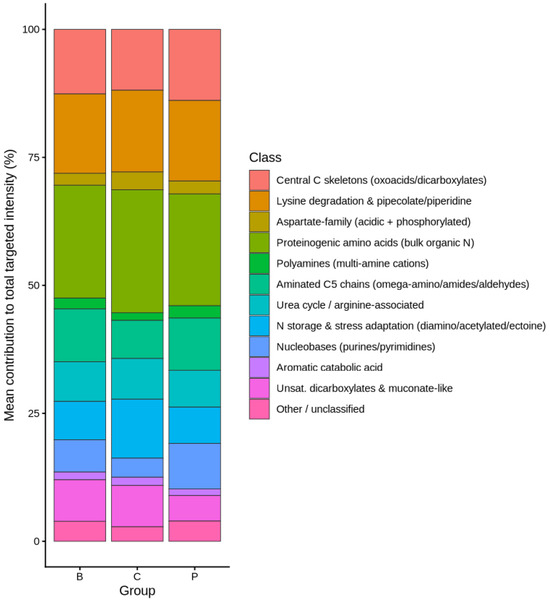
Targeted soil metabolomics yielded 62 KEGG-annotated metabolites, of which 11 metabolites were only weakly associated with N cycling (carbon-only organic acids and aromatic-ring breakdown intermediates). These non-N-specific metabolites accounted for 18.7%, 18.4% and 15% of the total targeted signal in experimental case studies B, C, and P, respectively. Across all the experimental cases (Figure 1), proteinogenic amino acids represented the dominant metabolite class (16.8–32.5%, Supplementary Material Figure S1), followed by lysine-degradation and pipecolate–piperidine pathway metabolites (17.3–35.8). Intermediate contributions were observed for N-storage and stress-adaptation metabolites (3.3–14%), nucleobases/nucleosides/nucleotides (4.7–15.3%), and urea-cycle and arginine-associated metabolites (5.5–10.6%), whereas aromatic catabolic acids (0.2–3.2%) constituted only minor fractions of the total signal.
Figure 1.
Mean percent composition of N cycle-related metabolites.
One-way ANOVA with Benjamini–Hochberg FDR correction (Table 1) revealed significant mulching material-dependent restructuring of the soil N-cycle metabolome. Aspartate-family metabolites (F = 21.3, p < 0.001) and nucleobases/nucleosides/nucleotides (F = 20.95, p < 0.001) had the strongest effects. Aminated C5 chains and N-storage/stress adaptation metabolites differed significantly (p < 0.01). Proteinogenic amino acids, polyamines, urea cycle metabolites, and aromatic catabolic acids did not reach statistical significance after FDR correction.
Table 1.
Among-group ANOVA of soil N-cycle metabolite classes with Benjamini–Hochberg FDR-adjusted significance (q-BH).
3.2. Multivariate Analysis of N-Cycle Metabolite Profiles
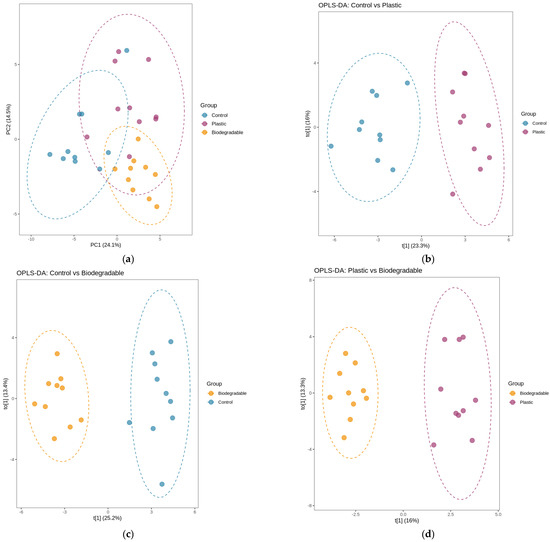
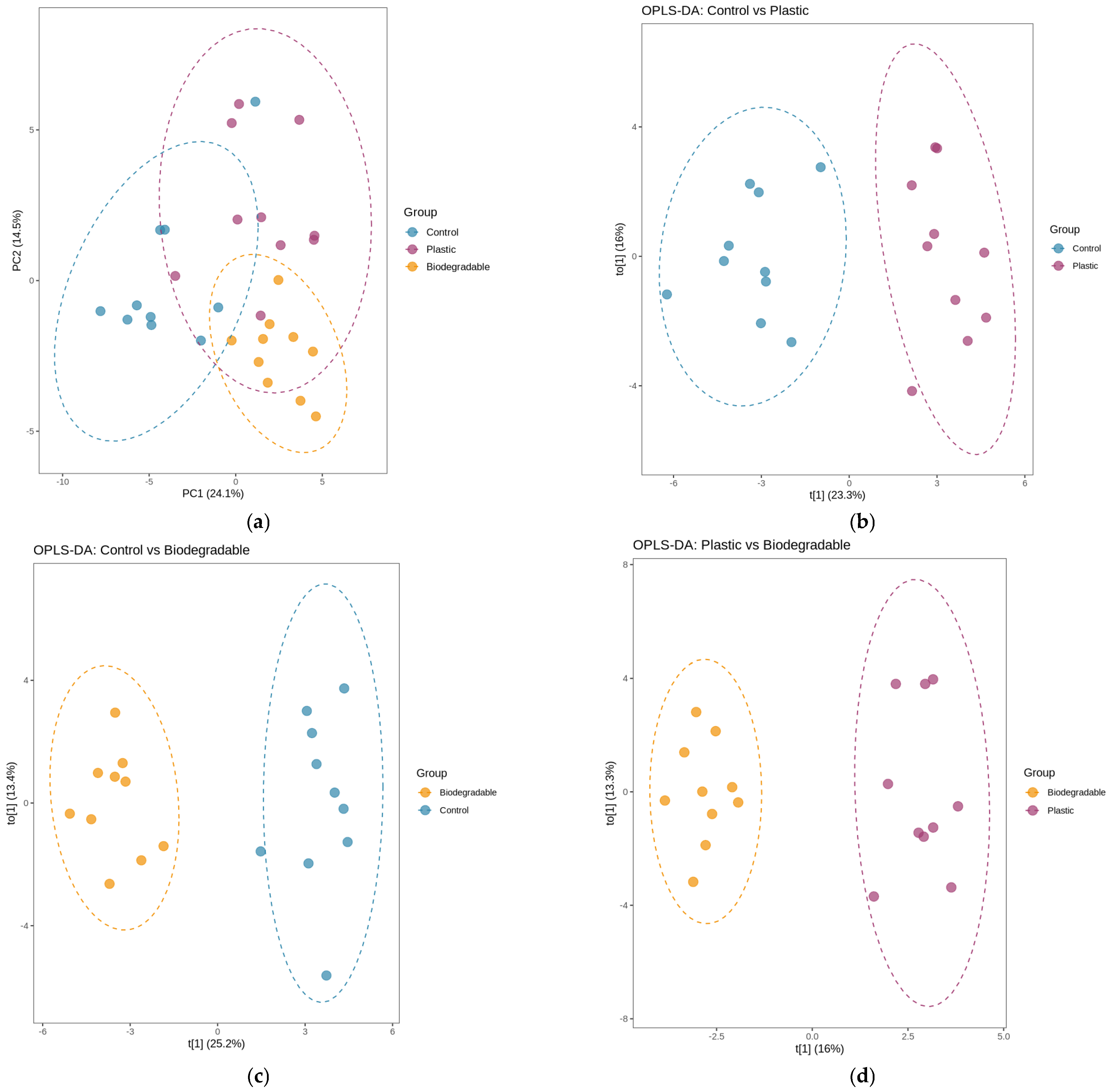
Principal component analysis (Figure 2a) was applied to explore the unsupervised multivariate structure of soil metabolite profiles across experimental case studies. The first two principal components collectively accounted for 38.6% of the total variance (PC1 = 24.1%, PC2 = 14.5%). The ordination revealed a partial mulching material-dependent structuring of the soil metabolome, with C soils clearly displaced along PC1 relative to both mulching material types (P and B), while the two mulched soils exhibited substantial overlap in ordination space, reflecting greater similarity in their multivariate metabolomic composition. The score distribution was characterized by moderate between-group separation and appreciable within-group dispersion.
Figure 2.
Multivariate analysis of the soil metabolome profile between mulching materials: (a) principal component analysis of the soil metabolome profile; (b) OPLS-DA score plot contrasting the C and P soil metabolome profiles; (c) OPLS-DA score plot contrasting the C and B soil metabolome profiles; (d) OPLS-DA score plot contrasting the B and P soil metabolome profiles.
To further delineate mulching material-related variation in the soil metabolome, pairwise OPLS-DA models were constructed for all group comparisons. In the score plot contrasting C and P (Figure 2b), the predictive component t[1] and the orthogonal component t0[1] accounted for 23.3% and 16.0% of the modelled variation, respectively. The two groups were clearly partitioned along t[1] with negligible intercluster overlap. Analogous class separation was observed for the C vs. B (Figure 2c) and P vs. B (Figure 2d) pairwise comparisons, where t[1] accounted for 25.2% and 16.0% of the modelled variation, respectively, and t0[1] accounted for 13.4% and 13.3%, respectively, with both models yielding well-resolved, nonoverlapping group clusters in the reduced-dimensional space.
Across all pairwise models (Table 2), high R2Y values (0.893–0.956) and positive Q2 estimates (0.546–0.786) confirmed that a substantial proportion of between-class response variation was captured, with robust predictive performance under cross-validation. Model fit and predictive ability were strongest for the C vs. B case (R2Y = 0.945, Q2 = 0.786) and P vs. B case (R2Y = 0.956, Q2 = 0.765) comparisons, reflecting more pronounced metabolomic divergence associated with B. The C vs. P model exhibited comparatively moderate predictive performance (Q2 = 0.546, RMSEE = 0.177), indicating a lesser degree of metabolomic differentiation between these groups, which is consistent with the partial overlap observed in the PCA ordination.
Table 2.
OPLS-DA model performance statistics for pairwise group comparisons.
Variable importance in projection (VIP) scores from the pairwise OPLS-DA models were used to identify key metabolic discriminants across experimental case studies (Supplementary Material Figure S2). In the C vs. B contrast, the top contributors were L-isoleucine (VIP = 1.941), 6-amino-2-oxohexanoate (VIP = 1.774), L-aspartate 4-semialdehyde (VIP = 1.715), L-pipecolate (VIP = 1.709), and L-leucine (VIP = 1.689). For C vs. P, discrimination was driven by L-aspartate (VIP = 1.850), N-γ-acetyl-diamino butyrate (VIP = 1.769), ornithine (VIP = 1.754), 6-amino-2-oxohexanoate (VIP = 1.718), and L-aspartate 4-semialdehyde (VIP = 1.714). The P vs. B comparison yielded the highest individual VIP scores overall, with L-pipecolate (VIP = 2.194), L-aspartate (VIP = 2.140), 4-phospho-L-aspartate (VIP = 1.895), N-γ-acetyl-diamino butyrate (VIP = 1.786), and 5-oxopentanoate (VIP = 1.719) as the leading discriminants. The VIP heatmaps show that L-aspartate and L-pipecolate maintained uniformly high VIP scores across all three contrasts, indicating that they were robust pancomparison discriminant metabolites. In contrast, 6-amino-2-oxohexanoate and L-aspartate 4-semialdehyde showed near-zero VIPs in the P vs. B comparison, identifying them as control-driven discriminants. Finally, 4-phospho-L-aspartate was elevated exclusively in the P vs. B contrast, indicating that it was a mulch material-specific metabolic feature.
3.3. Pathway-Level Reprogramming of Nitrogen Metabolism Across Mulching
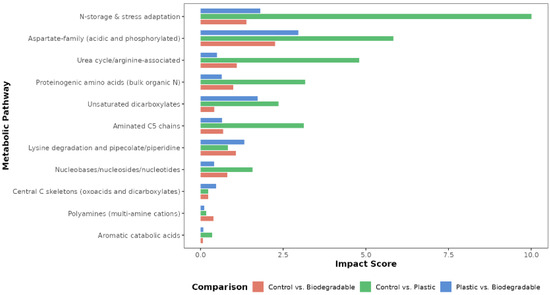
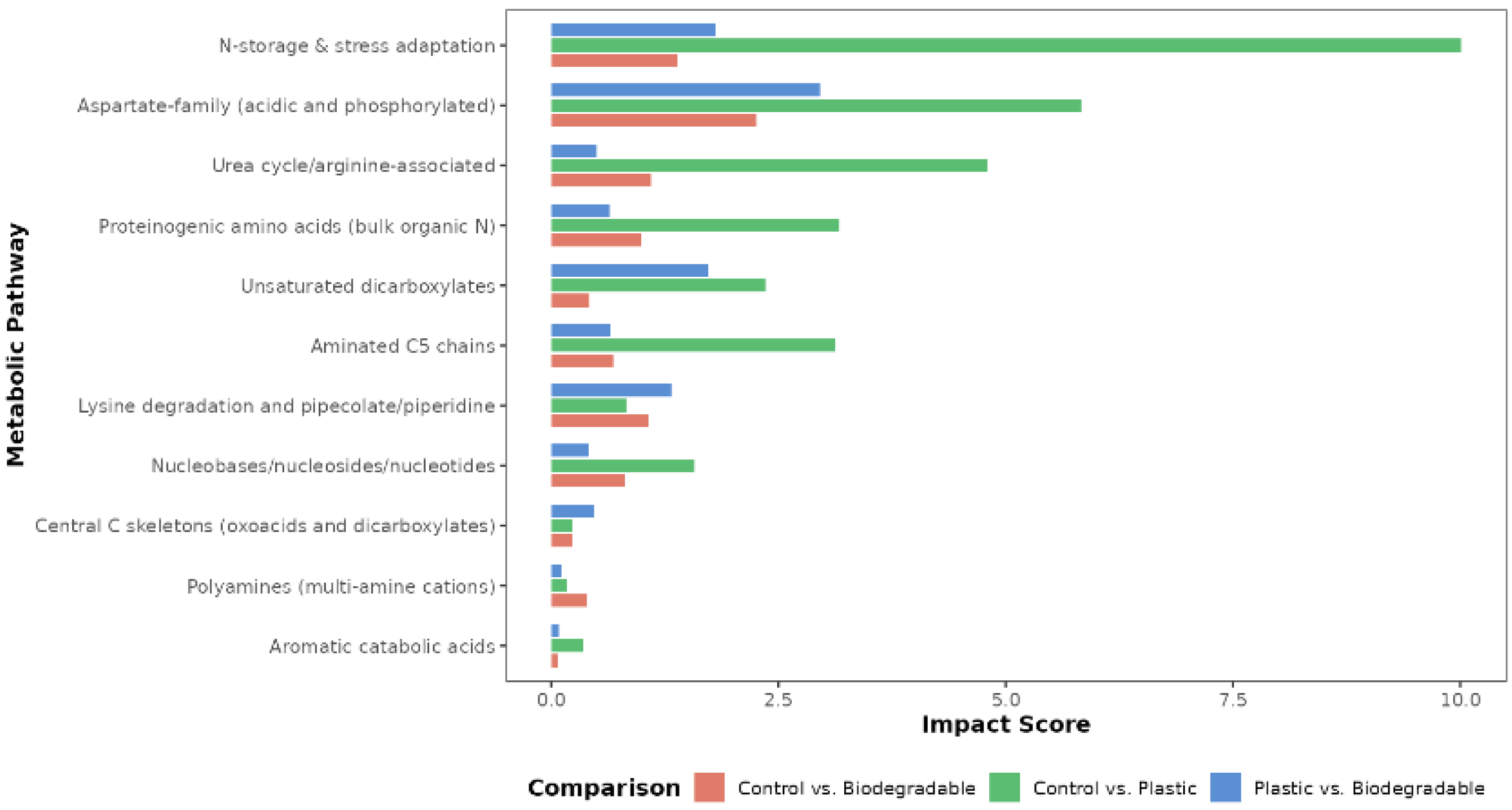
Pathway-level impact analysis (Figure 3) revealed a structured hierarchy of metabolic perturbations across all three pairwise comparisons, with nitrogen-associated pathways consistently ranking among the most strongly affected modules (Supplementary Material Table S1).
Figure 3.
Pathway impact scores across mulching experiments.
In the C vs. B comparison, the aspartate-family pathway (acidic and phosphorylated metabolites) had the highest impact score (2.25; combined p < 0.001), followed by N-storage/stress-adaptation metabolites, urea cycle/arginine-associated metabolism, proteinogenic amino acids, and nucleobases/nucleotides. In the C vs. P contrast, both the magnitude and the breadth of pathway-level perturbations were markedly greater. N-storage/stress-adaptation metabolites exhibited the highest impact score across all comparisons (10.01; combined p < 0.001), followed by the aspartate-family pathway (impact score 5.82; combined p < 0.001), urea cycle/arginine-associated metabolism (impact score 4.80; combined p < 0.001), and proteinogenic amino acids (impact score 3.16; combined p < 0.001). In the P vs. B comparison, the aspartate-family pathway again ranked among the most perturbed modules (impact score 2.96; combined p < 0.001), as did the N-storage/stress-adaptation metabolites (impact score 1.80; combined p < 0.001).
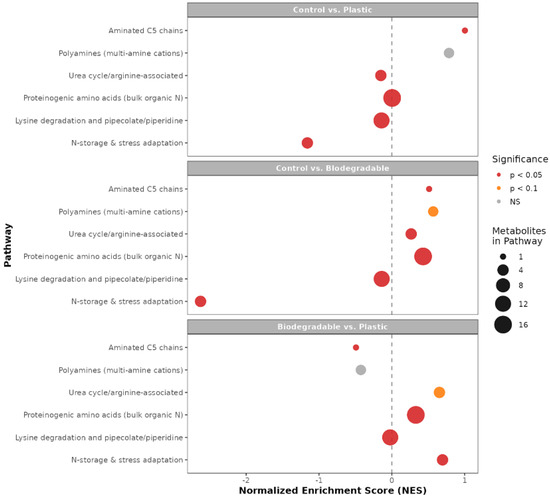
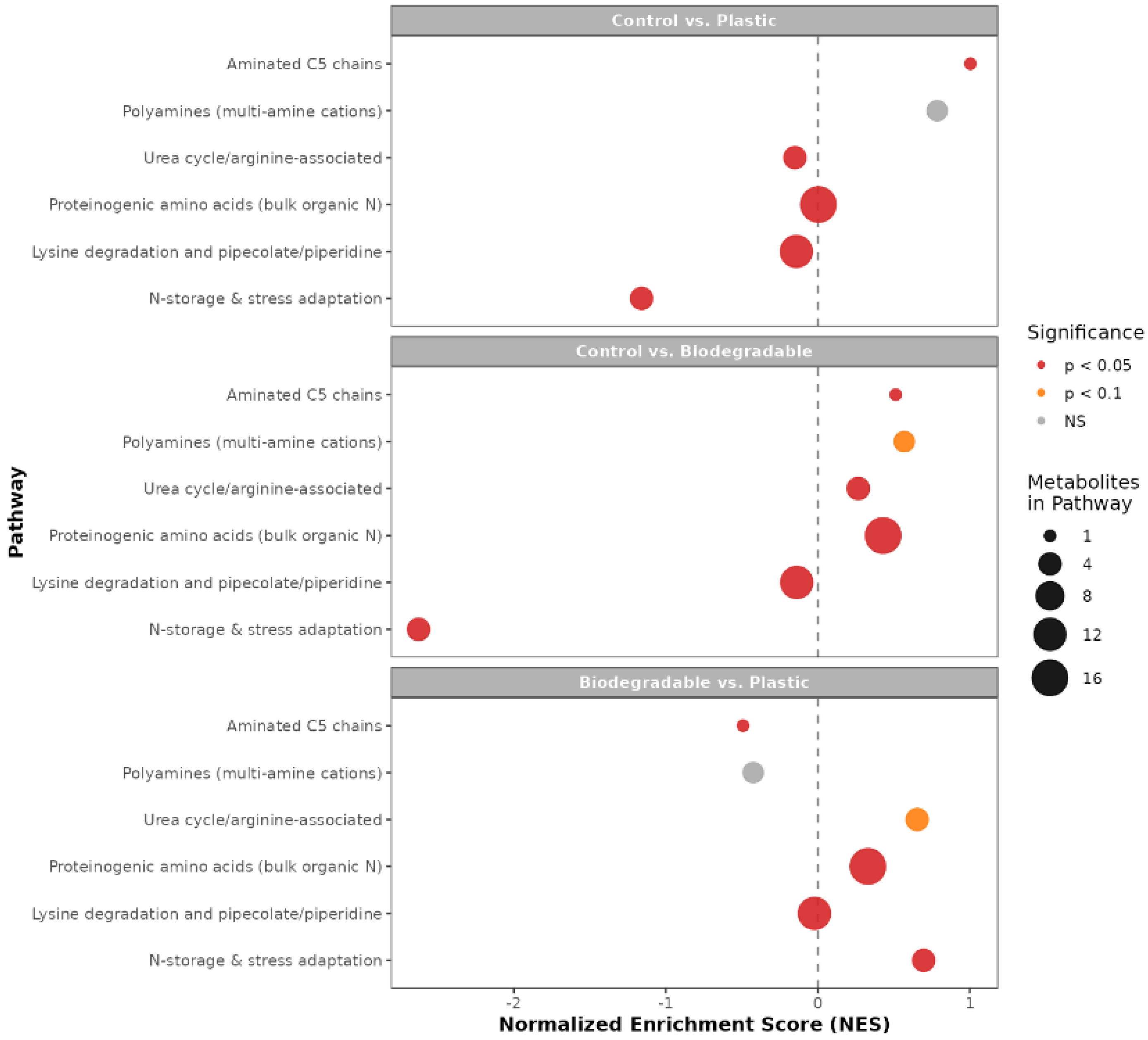
Normalized enrichment score (NES) analysis (Figure 4) yields a direction-resolved, statistically integrated view of coordinated pathway-level regulation across all three pairwise contrasts. In the C vs. B comparison, proteinogenic amino acids (mean log2FC 0.29; NES 0.43; combined p < 0.001), urea cycle/arginine-associated metabolites (mean log2FC 0.21; NES 0.27; combined p < 0.001), and aminated C5 chains (NES 0.51; combined p < 0.001) were positively enriched. In contrast, lysine degradation/pipecolate–piperidine metabolism was significantly negatively enriched (mean log2FC −0.08; NES −0.14; combined p < 0.001). In the C vs. P mulching material comparison, pathway-level regulation was markedly stronger and more directionally coherent. N-storage/stress-adaptation metabolites were strongly depleted under plastic mulching (mean log2FC −1.42; NES −1.16; combined p < 0.001), accompanied by significant negative enrichment of urea cycle/arginine-associated metabolites (mean log2FC −0.21; NES −0.15; combined p < 0.001) and lysine degradation/pipecolate–piperidine metabolism (mean log2FC −0.06; NES −0.14; combined p < 0.001). Aminated C5 chains were positively enriched under plastic mulching (mean log2FC 1.00; NES 1.00; combined p < 0.001), whereas polyamines had a positive but nonsignificant NES (0.79; combined p = 0.72). Proteinogenic amino acids displayed near-zero mean log2FC and NES values but an extremely low combined p value (1.25 × 10⁻¹⁴). In the P vs. B mulching material comparison, the directions of regulation observed in the previous contrasts were largely reversed. N-storage/stress-adaptation metabolites were positively enriched in biodegradable-mulched soils relative to plastic mulching material (mean log2FC 0.75; NES 0.70; combined p < 0.001). Proteinogenic amino acids also showed coordinated positive enrichment (mean log2FC 0.28; NES 0.33; combined p < 0.01), and urea cycle/arginine-associated metabolites tended toward positive enrichment (mean log2FC 0.42; NES 0.65; combined p < 0.05). Aminated C5 chains were negatively enriched in biodegradable plastic material-mulched soils (mean log2FC of −0.49; NES of −0.49; combined p < 0.05), whereas polyamines exhibited a negative but nonsignificant NES of −0.42.
Figure 4.
Normalized enrichment scores (NESs) of metabolic pathways across mulching experiments.
3.4. Constraint-Based Metabolic Reaction Network Analysis
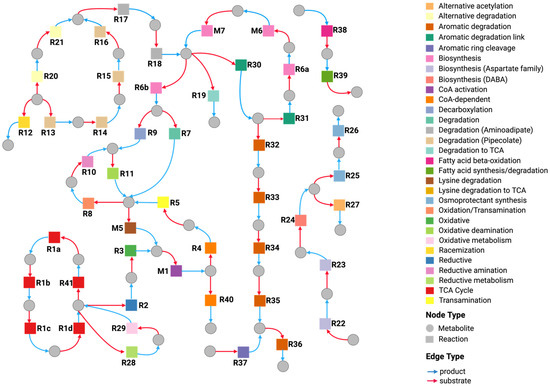
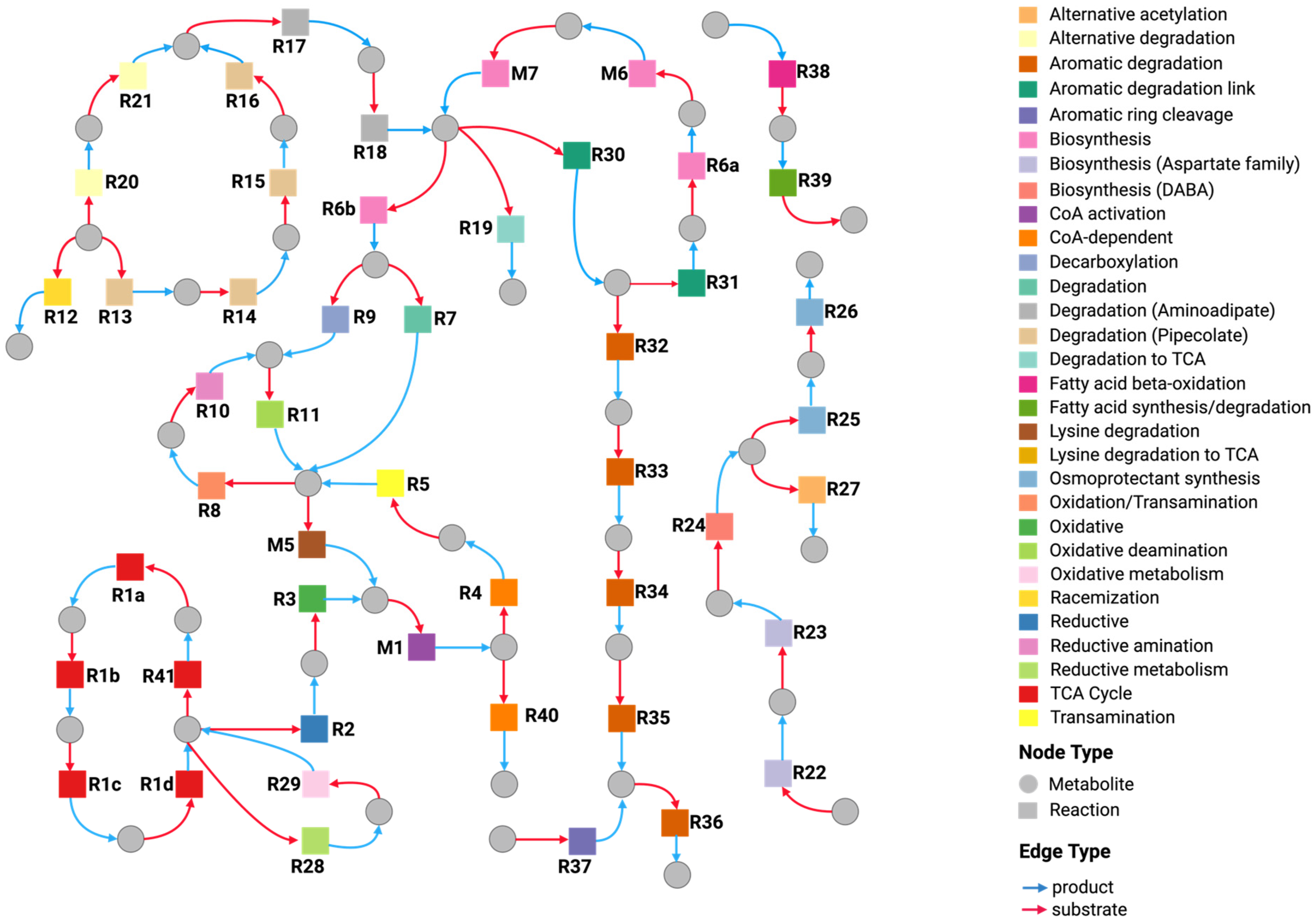
The reconstructed constraint-based metabolic reaction network comprised 49 stoichiometrically balanced reactions distributed across 14 scored metabolic nodes, with graph-theoretic analysis revealing a heterogeneous, hub-dominated topology characterized by a pronounced degree and betweenness heterogeneity (Figure 5, Supplementary Material Table S2).
Figure 5.
Constraint-based metabolic reaction network—nitrogen cycle metabolomics.
L-aspartate emerged as the dominant network hub, exhibiting the highest degree centrality (degree = 6), a betweenness centrality of 8, and a closeness centrality of 0.125 (Table 3), which is consistent with its role as a central metabolite that participates in six distinct reaction steps with a net stoichiometric balance of −2 (four consumption events versus two production events; Supplementary Material Table S3). Secondary hub nodes included L-pipecolate (degree = 2; betweenness = 1; closeness = 0.500) and L-aspartate 4-semialdehyde (degree = 2; betweenness = 0; closeness = 0.0833), with the latter functioning exclusively as a consumed intermediate with no net production activity under any treatment condition (Supplementary Material Table S3).
Table 3.
Network centrality.
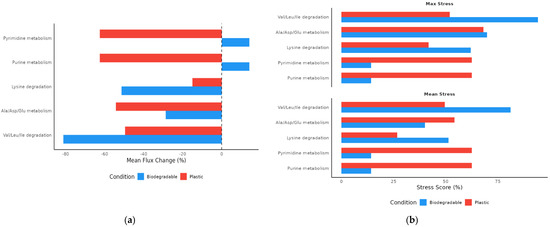
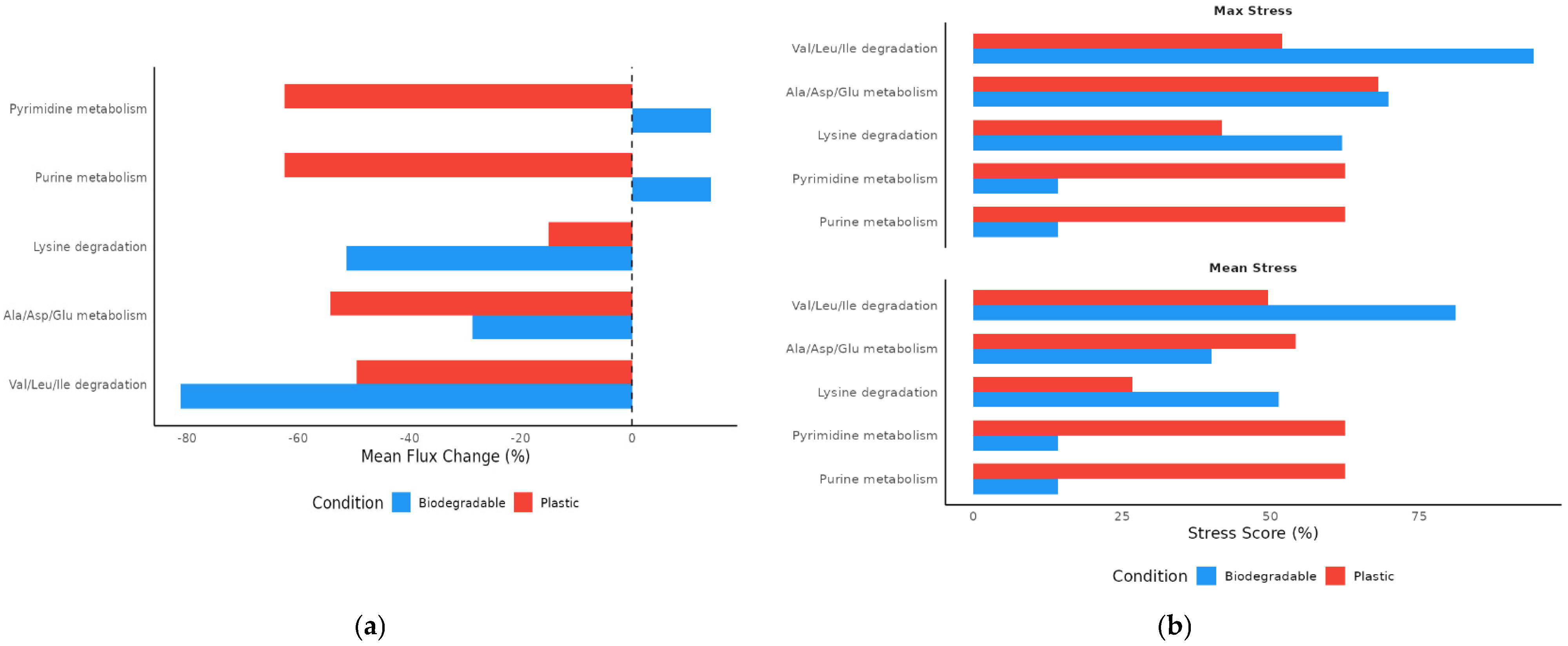
Constraint-based network analysis, normalized to a C baseline of 100 arbitrary activity units, revealed profound and pathway-specific differences in inferred reaction activity under B (Figure 6a). The most severely constrained reactions were the TCA-linked reactions (R1a-R1d; Supplementary Material Table S2), each retaining a residual activity of only 5.8 units—a 94.2% reduction relative to C (stress score = 94.2; Supplementary Material Table S4). Branched-chain amino acid and lysine-associated pathway steps were similarly inhibited, with multiple reactions classified as high or severe stress under B.
Figure 6.
Pathway stress score and activity change. (a) Pathway stress scores by condition; (b) Mean activity change by pathway and condition.
At the pathway level (Figure 6b; Supplementary Material Table S4), inferred activity differences were as follows: alanine, aspartate and glutamate metabolism, with a mean stress of 39.99 (two of five reactions: High Stress); lysine degradation, with a mean stress of 51.31 (max = 61.98; High); and valine, leucine, and isoleucine degradation, with the greatest perturbation (mean = 81.15; max = 94.2; Severe). Purine and pyrimidine metabolism remained minimally affected under B (mean = 14.16; low).
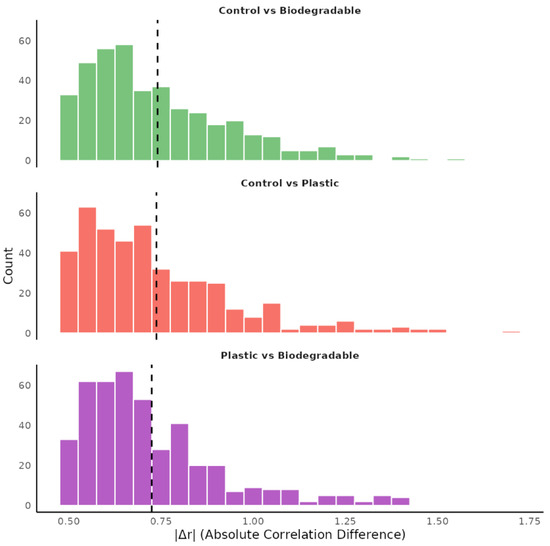
The C vs. B comparison yielded 408 significant metabolite–pair correlation changes (mean = ; max = ; Figure 7). Under P, TCA-linked activity suppression persisted but was attenuated relative to that under B (Δstress ≈ 42 units; Figure 7). Alanine, aspartate, and glutamate metabolism was more impaired under P (mean = 54.18; max = 68.09; high; four of five reactions: high stress) than under B. Conversely, lysine degradation stress was lower under P (mean = 26.74; moderate) than under B (mean = 51.31; high), and purine and pyrimidine metabolism transitioned from low (B) to high stress (P) (Figure 6 and Supplementary Material Table S4). The C vs. P comparison yielded 428 significant correlation changes, with the L-leucine–L-methionine pair showing the greatest shift (Δr = −1.695). The P vs. B contrast produced the greatest number of correlation changes (441 pairs; Figure 7). Centrality-weighted metabolic impact analysis revealed L-aspartate as a critical node under P (log2FC = −1.416) but as important only under B (log2FC = +0.191). L-Pipecolate showed the inverse pattern (critical under B: log2FC = −1.395; important under P: log2FC = +0.160), whereas L-aspartate 4-semialdehyde was consistently suppressed across both treatments (B: log2FC = −1.726; P: log2FC = −1.648; Table 3).
Figure 7.
Absolute difference in Pearson correlation coefficients between the two conditions.
4. Discussion
4.1. Mulching Material Impact on Soil Nitrogen Cycling
The metabolomic profiles obtained in this study reveal that both plastic (P) and biodegradable (B) mulching materials impose substantial, yet mechanistically distinct, reprogramming of soil nitrogen metabolism compared with unmulched control (C) soils. Treatment-dependent separation in multivariate space, corroborated by high OPLS-DA model fidelity (Table 2), suggests that mulching material type may be a relevant driver of soil N-metabolome variation. The most pronounced pathway-level perturbation under P was the near-complete suppression of N-storage and stress-adaptation metabolites (mean log2FC −1.42; NES −1.16; impact score 10.01), a response that was not parallel under biodegradable mulch (Table 2, Figure 3 and Figure 4). This class encompasses compatible solutes and osmoprotectants—including ornithine, N-γ-acetyldiaminobutyrate, and aminated C5 chains—whose depletion under plastic mulch is consistent with, though does not directly demonstrate, a disruption of microbial osmotic adjustment capacity as described by Wu et al. [24]. The observed suppression of osmo-protectant pools is consistent with modified physicochemical soil microenvironment under plastic mulch [25,26], though this remains inferential without direct measurements of soil water potential or osmolyte turnover. The concurrent enrichment of aminated C5 chains under plastic mulching (Figure 4) is tentatively interpreted as a compensatory channelling of nitrogen into noncanonical storage forms [27], suggestive of a reorientation of microbial N-allocation strategy [12]. Although direct quantification of microbial N allocation activity would be required to confirm this mechanism. Under biodegradable mulching material, the dominant perturbations were concentrated in the aspartate family pathway and branched-chain amino acid catabolism. L-pipecolate—a lysine catabolism intermediate and known stress-responsive metabolite—was identified as a critical impact node exclusively under biodegradable conditions (log2FC = −1.395), consistent with broad inhibition of lysine catabolism under mulching, with biodegradable material imposing greater constraints. Biodegradable mulch films, undergo progressive enzymatic and microbial degradation in soil, releasing labile carbon substrates that can stimulate microbial anabolic activity [2,16]. This carbon input may transiently redirect nitrogen activity from catabolic to biosynthetic pathways—an inferred mechanism requiring confirmation through isotope-labelling or enzyme activity assays [28]. L-aspartate functioned as the highest-centrality hub metabolite based on network topology metrics, occupying a critical position at the intersection of amino acid biosynthesis, nucleotide metabolism, and the urea cycle [29]. Its differential perturbation across mulching materials is suggestive of the hypothesis that plastic and biodegradable mulches disrupt soil N cycling through distinct biochemical entry points [2,30]. The uniformly suppressed abundance of L-aspartate 4-semialdehyde across both treatments (Table 3), functioning exclusively as a consumed intermediate (Table S3), further indicates that downstream activity through the aspartate-semialdehyde branch—feeding on lysine, threonine, and methionine biosynthesis—is consistently impaired regardless of mulch type, suggesting a shared constraint at this metabolic node (Figure 5). Whether this reflects reduced enzyme activity, substrate limitation, or altered microbial community composition remains to be established. The urea cycle and arginine-associated metabolism were negatively enriched under plastic mulching and tended toward positive enriched under biodegradable mulch—a divergence indicative of differential effects on soil microbial communities involved in nitrogen mineralization and immobilization [31,32]. This interpretation, however, is based solely on metabolite pool sizes and would require corroboration through direct measurements of urease activity, mineralization rates, or functional gene abundance (e.g., ureC, amoA). The suppression of urea cycle intermediates under plastic mulch is consistent with reports of reduced soil urease activity and impaired ammonium cycling in soils under long-term plastic film application [13,33]. Conversely, the relative preservation or enrichment of urea cycle metabolites under biodegradable mulch is consistent with, but does not confirm, evidence that biodegradable films support greater microbial biomass and enzymatic activity during degradation [34,35]. Network-level analysis revealed 408–441 significant metabolite–pair correlation changes across all pairwise comparisons (mean |Δr| 0.725–0.741), indicating fundamental reorganization of the coregulatory architecture of the soil N metabolome beyond shifts in individual metabolite abundance. The highest number of rewired correlations in the P vs. B comparison (441 pairs) underscores that the two mulching materials impose structurally distinct metabolic network states. The L-leucine–L-methionine pair, (Δr = −1.695), exemplifies decoupling of branched-chain amino acid and sulfur-amino acid metabolism under plastic mulch [36]. This pattern is consistent with disruption of shared transamination and carbon-skeleton recycling reactions, a hypothesis that require transcriptomic or enzymatic validation [37]. Collectively, these findings position plastic mulching as a more disruptive agent of soil N-metabolome architecture than biodegradable mulching material, particularly with respect to N storage, osmoprotection, and central hub connectivity. Biodegradable mulch appears to impose perturbations more localized to specific catabolic modules, partially offset by putative stimulatory effects of film degradation on microbial anabolic activity. It should be noted, however, that all mechanistic interpretations advanced in this section are inferred from metabolite pool size differences and network topology metrics. Therefore, direct validation through process-rate measurements, functional gene quantification, and controlled isotope-tracing experiments is required before these mechanisms can be considered established.
4.2. Consequences for Soil Ecosystem Functions and Services
Soil nitrogen cycling underpins a suite of critical ecosystem functions, including primary productivity support, organic matter decomposition, nutrient retention, and the regulation of reactive nitrogen losses to adjacent terrestrial and aquatic compartments [38]. The pathway-level and network-level disruptions documented in this study therefore, have potential implications for the functional integrity of agricultural soils under mulching regimes. The suppression of N-storage and stress-adaptation metabolite pools under plastic mulching is particularly noteworthy from an ecosystem-services perspective. Microbial osmolytes and compatible solute pools serve not only as intracellular stress buffers but also as labile organic nitrogen reservoirs that are mineralized upon cell lysis, contributing to the soil available-N pool [39,40]. Their depletion under plastic mulch may therefore be hypothesized to reduce the capacity of the soil microbial biomass to act as a short-term nitrogen sink and source, with the potential to increase the vulnerability of the system to nitrogen leaching during precipitation events [41,42]—a hypothesis that would require direct measurement of leaching fluxes and microbial biomass nitrogen turnover to confirm. This metabolite-level pattern is consistent with broader evidence that plastic mulch application can reduce soil microbial biomass nitrogen and alter nitrogen mineralization rates [43]. The differential perturbation of the urea cycle and arginine-associated metabolism across mulch types may be related to soil nitrogen mineralization efficiency. However, as mineralization rates were not directly measured in the present study, the following interpretation is inferential. Arginine is among the most nitrogen-rich proteinogenic amino acids and serves as a primary substrate for microbial nitrogen mineralization through the arginine deiminase and urease pathways [44]. Suppression of urea cycle intermediates under plastic mulch, as indicated by negative NES values, is consistent with a reduced throughput of this mineralization route, suggestive of potential downstream consequences for the plant-available nitrogen supply that remain to be verified through direct process-rate measurement such as urease activity assays or 15N isotope dilution approaches. Conversely, the relative enrichment of these metabolites under biodegradable mulch is consistent with the hypothesis of a more functionally intact mineralization capacity [45], which could partly explain the agronomic performance parity or superiority of biodegradable films reported in some field studies [46]. The severe activity suppression in the valine, leucine and isoleucine degradation module under biodegradable mulch, interpreted as indicative of catabolic inhibition, may paradoxically suggest soil nitrogen retention potential by reducing the rate of amino acid catabolism and associated ammonium release. Whether this represents a net benefit or constraint for soil fertility depends on the temporal dynamics of mulch degradation and the synchrony between nitrogen release and crop demands—a consideration that warrants explicit investigation in future agronomic assessments combining metabolomic profiling with direct measurements of N2O emissions, denitrification rates, and plant N uptake. At the ecosystem scale, network rewiring has been documented across all comparisons—particularly the decoupling of coregulated metabolic modules—may be indicative of a reduction in metabolic redundancy and potential impairment of functional resilience of the soil N-cycling community [47]. Metabolic network connectivity and coregulation are recognized as proxies for microbial community functional stability [48]; their disruption under both mulching treatments, and most markedly under plastic mulch, suggests that sustained mulching application has the potential to progressively erode the buffering capacity of soil nitrogen cycling against environmental perturbations. Such an inference remains to be empirically tested in future studies integrating functional gene quantification (e.g., nirS, nosZ, amoA) with direct process-rate measurements of denitrification, nitrification, and N2O emissions.
4.3. Study Limitations and Further Consideration
Several limitations of the present study warrant explicit acknowledgement. First, metabolomic profiling was conducted at a single time point, precluding assessment of the temporal dynamics of N-metabolome reprogramming across the mulch degradation continuum or in relation to crop phenological stages. Longitudinal sampling designs would be necessary to disentangle transient perturbations from sustained metabolic shifts. Second, the constraint-based metabolic network was constructed from a targeted metabolite panel of 62 KEGG-annotated compounds. Although analytically robust, this panel represents only a subset of the full soil N metabolome. Unmeasured intermediates and alternative pathway branches may have contributed to the observed activity patterns in ways that cannot be resolved from the current dataset. Integration with untargeted metabolomics or metatranscriptomic data would substantially improve network completeness and mechanistic resolution. Third, the study was conducted under specific edaphic, climatic, and agronomic conditions. Therefore, the generalisability of the observed metabolic responses to soils with contrasting texture, pH, organic matter content, or microbial community composition remains to be established. Replication across different soil types and geographic contexts is necessary before broad conclusions can be drawn regarding the effects of mulching on soil N cycling. Fourth, each mulching treatment was applied to a single plot, with two subplots designated as spatial replicates within each plot. As a result, the treatment effect is fully confounded with the plot, constituting a case of unreplicated treatment application. The two within-plot subplots represent spatial pseudo-replication rather than statistically independent experiment units. This substantially limits the inferential power of between-treatment comparisons and precludes formal partitioning of treatment variance from plot-level random effects. Future investigations should employ designs with true independent replication—i.e., multiple spatially separated plots per treatment—to allow robust statistical inference and hypothesis testing. In addition, key characteristics of agricultural production technology were not explicitly incorporated, including crop species, crop rotation history, and fertilization practices. These factors can independently modulate soil N pools and microbial activity and may therefore cofound or modify mulch-associated metabolic responses. Future studies should document and, where possible, standardize or factorially manipulate crop type and fertilizer regime and enable clearer attribution of N-metabolome shifts to mulch degradation. Furthermore, the present study relied exclusively on metabolomic proxies of N-cycling activity and did not include direct process-rate measurements such as net nitrogen mineralisation, nitrification, or denitrification assays. Consequently, the inferred alterations in N-transformation activity remain indirect rather than mechanistically confirmed. Incorporating isotope-based process measurement (e.g., 15N pool dilution or 15N tracing) in parallel with metabolomic profiling would greatly strengthen causal interpretation. Finally, while the metabolomic approach adopted here provides high-resolution biochemical phenotyping, it does not directly resolve the microbial taxonomic or functional gene-level drivers of the observed pathway perturbations. The absence of microbial community composition data and functional gene represents a notable gap, as it precludes attribution of the observed metabolic network shifts to specific microbial guilds or enzymatic capacities involved in nitrogen transformation. Coupling soil metabolomics with amplicon sequencing or shotgun metagenomics would enable the attribution of metabolic network changes to specific microbial guilds involved in nitrogen transformation, thereby substantially advancing understanding of the underlying mechanism.
5. Conclusions
This study indicates that conventional plastic and biodegradable mulching materials are associated with distinct, pathway-level differences is soil nitrogen metabolism, as resolved through targeted metabolomics, multivariate modelling, and constraint-based metabolic network analysis. Relative to unmulched control soils, both mulching material types were associated with significant differences in soil N-metabolite pools, but the affected pathways differed markedly in identity, magnitude, and directionality. Plastic-mulched soils showed the broadest N-metabolome deviation from the unmulched control. This pattern was characterized by strong reduction in N storage- and stress-adaptation-related metabolite pools, together with marked differences in alanine, aspartate, and glutamate metabolism. Within the inferred network structure, L-aspartate was identified as a potentially important stoichiometric hub under plastic mulch conditions. Biodegradable mulching material showed a distinct perturbation profile, characterized primarily by reduced representation of metabolites linked to branched-chain amino acid catabolism and lysine degradation. L-pipecolate emerged as a treatment-associated critical impact node within this network context. Collectively, these findings suggest that mulching material may be an important factor shaping soil N-cycling biochemistry. The observed metabolite-level differences and network-derived features point to potential implications for nitrogen retention, microbial functional resilience, and soil fertility. However, because this study is based exclusively on metabolite pool-size differences and network topology metrics, these functional implications remain inferential and should not be interpreted as hypothesis rather than demonstrated outcomes. Direct confirmation through process-rate measurements, functional gene quantification, and replicated long-term field experiments will be necessary before conclusions regarding nitrogen retention and long-term soil fertility can be substantiated. The constraint-based network framework applied here provides a stoichiometrically explicit, pathway-resolved basis for evaluating potential links between mulching practices and soil nitrogen function, extending beyond conventional bulk-indicator approaches. It further establishes a hypothesis-generating methodological foundation for future comparative assessments across soil types, climatic contexts, and mulching regimes.
Supplementary Materials
The following supporting information can be downloaded at https://www.mdpi.com/article/10.3390/microplastics5020126/s1; Figure S1. Groups of identified metabolites classes; Figure S2. VIP analysis of OPLS-DA models; Table S1. Pathways related to the N cycle; Table S2. List of CBM network reactions; Table S3. Stoichiometric structure; Table S4. Reaction flux and stress.
Author Contributions
Conceptualization, E.D.K.; methodology, M.H.K.; software, E.D.K. and M.H.K.; validation, E.D.K.; formal analysis, E.D.K.; writing—original draft preparation, E.D.K.; writing—review and editing, M.H.K. All authors have read and agreed to the published version of the manuscript.
Funding
This research was funded by the European Union NextGeneration (EU) through the National Recovery and Resilience Plan, Component 9. I8., grant number 760104/23 May 2023, code CF 245/29 November 2022. This work was supported by the project “Sensing, Mapping, Interconnecting: Tools for soil functions and services evaluation” supported by the Romanian Government, Ministry of the Innovation and Digitization through the National Recovery and Resilience Plan (PNRR) PNRR-III-C9-2022-I8, contract no. CF245/29.11.2022.
Data Availability Statement
The original contributions presented in this study are included in the article/Supplementary Material. Further inquiries can be directed to the corresponding author.
Conflicts of Interest
The authors declare that there are no conflicts of interest.
References
- Kader, M.A.; Senge, M.; Mojid, M.A.; Ito, K. Recent advances in mulching materials and methods for modifying soil environment. Soil Tillage Res. 2017, 168, 155–166. [Google Scholar] [CrossRef]
- Campanale, C.; Galafassi, S.; Di Pippo, F.; Pojar, I.; Massarelli, C.; Uricchio, V.F. A critical review of biodegradable plastic mulch films in agriculture: Definitions, scientific background and potential impacts. TrAC Trends Anal. Chem. 2024, 170, 117391. [Google Scholar] [CrossRef]
- Rossi, G.; Beni, C.; Neri, U. Organic mulching: A sustainable technique to improve soil quality. Sustainability 2024, 16, 10261. [Google Scholar] [CrossRef]
- Demo, A.H.; Asefa Bogale, G. Enhancing crop yield and conserving soil moisture through mulching practices in dryland agriculture. Front. Agron. 2024, 6, 1361697. [Google Scholar] [CrossRef]
- Graf, M.; Greenfield, L.M.; Reay, M.K.; Bargiela, R.; Golyshin, P.N.; Evershed, R.P.; Lloyd, C.E.M.; Williams, G.B.; Chadwick, D.R.; Jones, D.L. Field-based assessment of the effect of conventional and biodegradable plastic mulch film on nitrogen partitioning, soil microbial diversity, and maize biomass. Appl. Soil Ecol. 2024, 202, 105595. [Google Scholar] [CrossRef]
- Graf, M.; Greenfield, L.M.; Reay, M.K.; Bargiela, R.; Williams, G.B.; Onyije, C.; Lloyd, C.E.M.; Bull, I.D.; Evershed, R.P.; Golyshin, P.N.; et al. Increasing concentration of pure micro- and macro-LDPE and PP plastic negatively affect crop biomass, nutrient cycling, and microbial biomass. J. Hazard. Mater. 2023, 458, 131932. [Google Scholar] [CrossRef] [PubMed]
- Huang, S.; Guo, T.; Feng, Z.; Li, B.; Cai, Y.; Ouyang, D.; Gustave, W.; Ying, C.; Zhang, H. Polyethylene and polyvinyl chloride microplastics promote soil nitrification and alter the composition of key nitrogen functional bacterial groups. J. Hazard. Mater. 2023, 453, 131391. [Google Scholar] [CrossRef] [PubMed]
- Liu, W.; Wang, Y.; Gu, C.; Wang, J.; Dai, Y.; Maryam, B.; Chen, X.; Yi, X.; Liu, X. Polyethylene microplastics distinctly affect soil microbial community and carbon and nitrogen cycling during plant litter decomposition. J. Environ. Manag. 2025, 373, 123616. [Google Scholar] [CrossRef] [PubMed]
- Ma, X.; Shan, J.; Chai, Y.; Wei, Z.; Li, C.; Jin, K.; Zhou, H.; Yan, X.; Ji, R. Microplastics enhance nitrogen loss from a black paddy soil by shifting nitrate reduction from DNRA to denitrification and Anammox. Sci. Total Environ. 2024, 906, 167869. [Google Scholar] [CrossRef] [PubMed]
- Xiang, Y.; Penuelas, J.; Sardans, J.; Liu, Y.; Yao, B.; Li, Y. Effects of microplastics exposure on soil inorganic nitrogen: A comprehensive synthesis. J. Hazard. Mater. 2023, 460, 132514. [Google Scholar] [CrossRef] [PubMed]
- Zhou, Z.; Hua, J.; Xue, J. Polyethylene microplastic and soil nitrogen dynamics: Unravelling the links between functional genes, microbial communities, and transformation processes. J. Hazard. Mater. 2023, 458, 131857. [Google Scholar] [CrossRef] [PubMed]
- Li, Y.; Shi, X.; Zeng, M.; Qin, P.; Fu, M.; Luo, S.; Tang, C.; Mo, C.; Yu, F. Effect of polyethylene microplastics on antibiotic resistance genes: A comparison based on different soil types and plant types. J. Hazard. Mater. 2024, 472, 134581. [Google Scholar] [CrossRef] [PubMed]
- Sarfraz, U.; Qian, Y.; Yu, Q.; Cao, Y.; Jiang, X.; Mahreen, N.; Tao, R.; Ma, Q.; Zhu, M.; Ding, J.; et al. Microplastic effects on soil nitrogen storage, nitrogen emissions, and ammonia volatilization in relation to soil health and crop productivity: Mechanism and future consideration. Front. Plant Sci. 2025, 16, 1621542. [Google Scholar] [CrossRef] [PubMed]
- Wang, Y.; Yuan, P.; Gao, P. Microplastics accelerate nitrification, shape the microbial community, and alter antibiotic resistance during the nitrifying process. Sci. Total Environ. 2025, 959, 178306. [Google Scholar] [CrossRef] [PubMed]
- Su, P.; Gao, C.; Zhang, X.; Zhang, D.; Liu, X.; Xiang, T.; Luo, Y.; Chu, K.; Zhang, G.; Bu, N.; et al. Microplastics stimulated nitrous oxide emissions primarily through denitrification: A meta-analysis. J. Hazard. Mater. 2023, 445, 130500. [Google Scholar] [CrossRef] [PubMed]
- Liu, L.; Zou, G.; Zuo, Q.; Li, C.; Gu, J.; Kang, L.; Ma, M.; Liang, K.; Liu, D.; Du, L. Soil bacterial community and metabolism showed a more sensitive response to PBAT biodegradable mulch residues than that of LDPE mulch residues. J. Hazard. Mater. 2022, 438, 129507. [Google Scholar] [CrossRef] [PubMed]
- Jia, X.; Li, H.; Tang, D.W.S.; Xue, S.; Liu, E.; Yang, X. Effects of microplastic contamination on soil nitrogen and its bioavailability in soybean–maize rotation system. Soil Tillage Res. 2026, 257, 106925. [Google Scholar] [CrossRef]
- Kumar, S.S.; Wani, O.A.; Prasad, B.; Banuve, A.; Mua, P.; Sharma, A.C.; Prasad, S.; Malik, A.R.; El-Hendawy, S.; Mattar, M.A. Effects of mulching on soil properties and yam production in tropical region. Sustainability 2024, 16, 7787. [Google Scholar] [CrossRef]
- Kovacs, E.D.; Kovacs, M.H. Land use shapes the rhizosphere microbiome and metabolome of naturally growing Barbarea vulgaris. Metabolites 2025, 15, 684. [Google Scholar] [CrossRef] [PubMed]
- Lai, Z.; Tsugawa, H.; Wohlgemuth, G.; Mehta, S.; Mueller, M.; Zheng, Y.; Ogiwara, A.; Meissen, J.; Showalter, M.; Takeuchi, K.; et al. Identifying metabolites by integrating metabolome databases with mass spectrometry cheminformatics. Nat. Methods 2018, 15, 53–56. [Google Scholar] [CrossRef] [PubMed]
- Fiehn, O.; Robertson, D.; Griffin, J.; van der Werf, M.; Nikolau, B.; Morrison, N.; Summer, L.W.; Goodacre, R.; Hardy, N.W.; Taylor, C.; et al. The metabolomics standards initiative (MSI). Metabolomics 2007, 3, 175–178. [Google Scholar] [CrossRef]
- Baquer, G.; Semente, L.; Rafols, P.; Martin-Saiz, L.; Bookmeyer, C.; Fernandez, J.A.; Correig, X.; Garcia-Altares, M. rMSIfragment: Improving MALDI-MSI lipidomics through automated in-source fragment annotation. J. Cheminform. 2023, 15, 80. [Google Scholar] [CrossRef] [PubMed]
- Peris-Diaz, M.D.; Sweeney, S.R.; Rodak, O.; Sentandreu, E.; Tiziani, S. R-MetaboList 2: A flexible tool for metabolite annotation from high-resolution data-independent acquisition mass spectrometry analysis. Metabolites 2019, 9, 187. [Google Scholar] [CrossRef] [PubMed]
- Wu, C.; Zhang, J.; Xu, Y.; Xie, X. Impact of plastic mulch on soil microbial abundance, activity, and diversity in the saline–alkali soils of Xinjiang. Front. Microbiol. 2025, 16, 1691334. [Google Scholar] [CrossRef] [PubMed]
- Wang, K.; Tong, Z.; Shen, Y.; Liu, Y.; Wang, M.; Fang, Q. Field-aged shade nets residues disrupt rhizosphere microbiota and nitrogen metabolism in tea (Camellia sinensis). Environ. Sci. Technol. 2026, 60, 9007–9021. [Google Scholar] [CrossRef] [PubMed]
- Patel, K.F.; Fansler, S.J.; Campbell, T.P.; Bond-Lamberty, B.; Smith, A.P.; Roychowdhury, T.; McCue, L.A.; Varga, T.; Bailey, V.L. Soil texture and environmental conditions influence the biogeochemical responses of soils to drought and flooding. Commun. Earth Environ. 2021, 2, 127. [Google Scholar] [CrossRef]
- Dong, D.; Guo, Z.; Wu, F.; Yang, X.; Li, J. Plastic residues alter soil microbial community compositions and metabolite profiles under realistic conditions. Sci. Total Environ. 2024, 906, 167352. [Google Scholar] [CrossRef] [PubMed]
- Zhao, L.; Zhang, C.; Liang, M.; Chen, P.; Anwar, S.; Fan, M.; Xie, G.; Wang, C. Exploring the influence of planting densities and mulching types on photosynthetic activity, antioxidant enzymes, and chlorophyll content and their relationship to yield of maize. Plants 2024, 13, 3423. [Google Scholar] [CrossRef] [PubMed]
- Jasinska, W.; Dindo, M.; Cordoba, S.M.C.; Serohijos, A.W.R.; Laurino, P.; Brotman, Y.; Bershtein, S. Nonconsecutive enzyme interactions within TCA cycle supramolecular assembly regulate carbon-nitrogen metabolism. Nat. Commun. 2024, 15, 5285. [Google Scholar] [CrossRef] [PubMed]
- Xu, T.; Zheng, S.; Duo, X.; Hou, Z.; Wu, J. Long-term plastic mulching exacerbates the colimitation of carbon and phosphorus in farmland by altering physicochemical properties and microbial interactions. Front. Microbiol. 2026, 16, 1694370. [Google Scholar] [CrossRef] [PubMed]
- Shan, X.; Zhang, W.; Dai, Z.; Li, J.; Mao, W.; Yu, F.; Ma, J.; Wang, S.; Zeng, X. Comparative analysis of the effects of plastic mulch films on soil nutrient, yields and soil microbiome in three vegetable fields. Agronomy 2022, 12, 506. [Google Scholar] [CrossRef]
- Zhang, H.; Wang, K.; Zhang, J.; Muller, C.; Ding, D.; Li, Q.; Tang, H.; Jiang, R. How biodegradable mulching alters soil nitrogen transformations to enhance soil nitrogen supply and influence gas emissions in a maize cropping system. Plant Soil 2026, 520, 323–343. [Google Scholar] [CrossRef]
- Ao, R.; Liu, Z.; Mu, Y.; Chen, J.; Zhao, X. Degradation of biodegradable mulch-derived microplastics and their effects on bacterial communities and radish growth in three vegetable-cultivated purple soils. Agriculture 2025, 15, 1512. [Google Scholar] [CrossRef]
- Shi, J.; Wang, J.; Lv, J.; Wang, Z.; Peng, Y.; Wang, X. Microplastic presence significantly alters soil nitrogen transformation and decreases nitrogen bioavailability under contrasting temperatures. J. Environ. Manag. 2022, 317, 115473. [Google Scholar] [CrossRef] [PubMed]
- Bher, A.; Mayekar, P.C.; Auras, R.A.; Schvezov, C.E. Biodegradation of biodegradable polymers in mesophilic aerobic environments. Int. J. Mol. Sci. 2022, 23, 12165. [Google Scholar] [CrossRef] [PubMed]
- Wang, Q.; Bauke, S.L.; Wang, D.; Zhao, Y.; Reichel, R.; Jones, D.L.; Chadwick, D.R.; Tietema, A.; Bol, R. Amino acid-sulphur decomposition in agricultural soil profile along a long-term recultivation chronosequence. Sci. Total Environ. 2024, 951, 175409. [Google Scholar] [CrossRef] [PubMed]
- Ravanelli, S.; Li, Q.; Annibal, A.; Trifunovic, A.; Antebi, A.; Hoppe, T. Reprograming of proteasomal degradation by branched chain amino acid metabolism. Aging Cell 2022, 21, e13725. [Google Scholar] [CrossRef] [PubMed]
- Pan, H.; Hui, Y.; Wu, W.; Liu, S.; Wei, G.; Jiao, S. Critical thresholds for cobenefits of carbon accumulation and biodiversity conservation under global nitrogen enrichment. Nat. Commun. 2026, 17, 1336. [Google Scholar] [CrossRef] [PubMed]
- Aslam, I.; Bux, N.; Yu, X.; Bi, M.; Guo, H.; Niu, Y.; Ma, Q.; Wang, T. Microplastics in agricultural soils: Impacts on soil microbial communities, nutrient cycling, earthworm health, and soil ecosystem functions. Environ. Chem. Ecotoxicol. 2026, 8, 1157–1175. [Google Scholar] [CrossRef]
- Waren, C.R. Pools and fluxes of osmolytes in moist soil and dry soil that has been rewet. Soil Biol. Biochem. 2020, 150, 108012. [Google Scholar] [CrossRef]
- Zhang, Z.; Peng, W.; Duan, C.; Zhu, X.; Wu, H.; Zhang, X.; Fang, L. Microplastics pollution from different plastic mulching years accentuate soil microbial nutrient limitations. Gondwana Res. 2022, 108, 91–101. [Google Scholar] [CrossRef]
- Kong, M.; Huang, M.J.; Zhang, Z.X.; Long, J.; Siddique, K.H.M.; Zhang, D.M. Effects of plastic film mulching on soil microbial carbon metabolic activity and functional diversity at different maize growth stages in cool, semiarid regions. Front. Microbiol. 2024, 15, 1492149. [Google Scholar] [CrossRef] [PubMed]
- Hai, L.; Li, X.G.; Liu, X.; Jiang, X.J.; Guo, R.Y.; Jing, G.B.; Rengel, Z.; Li, F.M. Plastic mulch stimulates nitrogen mineralization in urea-amended soils in a semiarid environment. Agron. J. 2015, 107, 921–930. [Google Scholar] [CrossRef]
- Fujii, K.; Yamada, T.; Hayakawa, C.; Nakanishi, A.; Funakawa, S. Kinetics of arginine ammonification to estimate microbial activity of N mineralization in forest and cropland soils. Eur. J. Soil Biol. 2019, 92, 1–7. [Google Scholar] [CrossRef]
- Tao, Z.; Flury, M.; Xu, Y.; Yu, Y.; Bol, R.; Du, H.; Wang, J.; Ding, J.; Jones, D.L.; Chadwick, D.R.; et al. Mineralization and transfer of polymer-derived carbon from biodegradable mulch into the soil microbial biomass and organic matter pool. Environ. Sci. Technol. 2025, 59, 25830–25841. [Google Scholar] [CrossRef] [PubMed]
- Song, Z.; Zhao, L.; Bi, J.; Tang, Q.; Wang, G.; Li, Y. Classification of degradable mulch films and their promotional effects and limitations on agricultural production. Agriculture 2024, 14, 1235. [Google Scholar] [CrossRef]
- Fikri, M.; Joulian, C.; Motelica-Heino, M.; Norini, M.P.; Hellal, J. Resistance and resilience of soil nitrogen cycling to drought and heat stress in rehabilitated urban soils. Front. Microbiol. 2021, 12, 727468. [Google Scholar] [CrossRef] [PubMed]
- Cavaco, M.A.; Bhatia, M.P.; Hawley, A.K.; Torres-Beltran, M.; Johnson, W.M.; Longnecker, K.; Konwar, K.; Kujawinski, E.B.; Hallam, S.J. Pathway-centric analysis of microbial metabolic potential and expression along nutrient and energy gradients in the western Atlantic Ocean. Front. Mar. Sci. 2022, 9, 867310. [Google Scholar] [CrossRef]

Disclaimer/Publisher’s Note: The statements, opinions and data contained in all publications are solely those of the individual author(s) and contributor(s) and not of MDPI and/or the editor(s). MDPI and/or the editor(s) disclaim responsibility for any injury to people or property resulting from any ideas, methods, instructions or products referred to in the content. |
© 2026 by the authors. Licensee MDPI, Basel, Switzerland. This article is an open access article distributed under the terms and conditions of the Creative Commons Attribution (CC BY) license.