


Abstract
Plastic waste is estimated to represent 40–80% of the total amount of marine litter, with polyethylene (PE) and polypropylene (PP) being the most abundant polymeric components. The recovery and recycling of marine plastic debris are therefore essential to mitigate environmental pollution and limit the generation of secondary microplastics. In this work, a mechanical recycling strategy was investigated for the valorization of a polyethylene-rich plastic fraction (PE-rf) recovered from the marine environment, characterized by high heterogeneity and persistent inorganic contamination. Different pre-treatment routes, including cryogenic grinding and planetary ball milling, as well as blending approaches with recycled polyethylene and compatibilizing additives, were explored. The effects of composition and processing on the thermal, mechanical, and morphological properties of the resulting materials were systematically analyzed. The results show that intense mechanical homogenization and chemical compatibilization are not sufficient to overcome the intrinsic limitations imposed by contamination and compositional variability. As a proof of concept, selected formulations were processed into filaments and tested in fused filament fabrication, demonstrating basic 3D printability.
1. Introduction
Macro-, meso-, and microplastic pollution in the environment has become a global concern due to its impact on the marine ecosystem. Global plastic production has increased substantially over the years and about 430 million tons were produced in 2024 [1]. Plastics are widely used because of their properties and versatility, making them suitable materials for numerous applications [2]. Improper disposal of plastic waste has resulted in large quantities of these materials entering marine ecosystems [3], and the resulting impacts are becoming increasingly apparent. Due to mismanagement, between 10 and 20 million tons of plastic enter the oceans annually [4], and by 2050, plastic could exceed fish stocks [5]. Plastic waste is estimated to represent 40–80% of the total amount of marine litter [2]. Polyethylene (PE) and polypropylene (PP) represent the most common polymeric fraction found in oceans. When plastic ends up in the ocean, it breaks down into smaller fragments over time due to environmental factors such as abrasion or exposure to sunlight, leading to the formation of microplastics: defined as plastic particles smaller than 5 mm [6] or as any solid plastic particle insoluble in water with a size ranging between 1 µm and 1000 µm (ISO/TR 21960:2020(en)) [7], since the terminology and the different classification of microplastics are still an open debate [8]. These particles appear to be ubiquitous, even in remote marine environments [9], and have significant impacts on ecosystems. Several studies in the literature report the presence of microplastics in a wide variety of animal species [10,11,12,13]. They can be ingested by marine organisms [14], hindering digestion and damaging the stomach [9]. They can also move from one trophic level to the next, leading to food chain contamination [13,15]. Furthermore, microplastics can be toxic for the organisms due to the contaminants either adsorbed from the environment or added during the manufacturing process [16,17]. In fact, to improve the properties of plastics, a mix of additives are usually added during this process such as flame retardants, plasticizers, compatibilizers, pigments and fillers [18]. Recovery and recycling of these materials play fundamental roles in mitigating marine plastic pollution and removing a source of secondary microplastics from the environment, as indicated by the European Commission in EU action against microplastics [19].
A route to contribute to the mitigation of macro- and microplastic pollution in the marine environment consists in the development of recycling technologies to extend the use of marine plastic debris as secondary raw materials in the production of recycled plastics. The recycling of waste plastics is particularly challenging due to the unavoidable presence of organic and inorganic contaminants, large variability in polymer species and grades, and the possible occurrence of chemical and thermo-oxidative degradation [20]. Marine-sourced plastic waste poses an even greater challenge because marine waste contains a considerable amount of sand, salt, shells, algae, and residues of marine organisms, which could hinder plastic recyclability [21]. There are several studies in the literature in which attempts have been made to define an approach aimed at recycling plastic waste with relatively high levels of contamination. Avolio et al. in 2019 investigated the possibility of recycling polyethylene-rich plastic recovered from landfill reclamation [21] by using a melt process, with maleated polyethylene as an additive and a ball milling pre-treatment to homogenize the material. The used approach has proven effective in valorization for landfill-sourced plastics. Capuano et al. in 2021 used a mechano-chemical approach to recycle a polyolefin-rich fraction from household plastic waste collection [22]. The strategy involved a melt process and a ball milling pre-treatment carried out in the presence of an organic peroxide and led to an improvement in mechanical properties of the resulting materials. De Camargo and Saron in 2019 proposed an approach to evaluate the recycling of low-density polyethylene waste in the presence of virgin polypropylene using thermomechanical processing and thermochemical treatment of the material with the incorporation of zeolite ZSM-5 as the catalyst [23], improving properties. However, there are few studies in which recycling approaches are applied to the treatment of plastics recovered from the marine environment. In a previous paper, fishing nets, made of nylon 6,6, were recycled using a cold mixing approach, realizing composite materials with recycled expanded polystyrene or poly (acrylonitrile-butadiene-styrene), thus improving the circular economy of plastics and reducing their ecological, ecosystem service, and social and economic impacts [24]. Ibrahim et al. in 2023 investigated the recycling of marine plastic debris using the solvent extraction method [25], comparing the results with virgin polymers treated with the same procedure. The study concludes that plastics recovered from the marine environment after treatment show properties comparable to those of treated virgin plastics. Pelegrini et al. in 2019 evaluated the recyclability of PE and PP in relation to their state of degradation at sea [26]. The study consists of two steps: in the first step, the degradation state of the plastics recovered from the marine environment was evaluated using Fourier transform infrared spectroscopy (FTIR), and during the second step, the polymers were washed, ground and processed through an extrusion process, with the mechanical and rheological properties of the obtained materials subsequently evaluated. The conclusions demonstrated that the materials used, despite being degraded in the environment, can be subjected to recycling, exhibiting mechanical and rheological properties close to those of virgin materials available on the market.
In the present work, a polyethylene-rich plastic fraction (PE-rf) recovered from the marine environment was investigated as a model system to evaluate the feasibility and limitations of mechanical recycling approaches. Different pre-treatment strategies, including cryogenic grinding and planetary ball milling, as well as blending with recycled polyethylene and compatibilizing additives, were systematically explored. The effects of composition and processing on the thermal, mechanical, and morphological properties of the resulting materials were investigated, and selected formulations were processed into filaments for fused filament fabrication [27]. Through this approach, this study aims to provide a critical and realistic contribution to the valorization of marine plastic waste, highlighting both its potential and its current technological limitations.
2. Materials and Methods
2.1. Materials
Floating and sinking macroplastics were surveyed in the Sinis–Mal di Ventre Marine Protected Area (Sinis MPA) (W Sardinia, Italy) during dedicated monitoring campaigns carried out in spring and summer (March–July). The sampling design combined underwater point surveys and boat-based transects to characterize both seafloor and surface macroplastic litter across representative coastal sectors of the MPA.
Underwater surveys were conducted by pairs of SCUBA divers performing standardized point counts along predefined depth contours on rocky and sandy substrates, at a maximum depth of 10 m. During each dive, operators visually inspected the surrounding seabed, collected all visible plastic items (e.g., bags, sacks, bottles, large fragments) within a fixed search radius, and georeferenced the sampling point using the support vessel’s GPS. Collected items were placed in mesh bags, brought to the surface at the end of the dive, and transferred on board for preliminary sorting and recording.
Complementary boat-based transects targeted floating plastic debris. The research vessel navigated at a constant speed of approximately 5 knots along 20 min visual transects, with observers scanning a fixed strip ahead and to the sides of the bow for floating macroplastic objects such as plastic bags, packaging films, bottles and assorted user items. For each transect, all encountered items were collected using a landing net where feasible, and their position, time and environmental conditions were recorded, allowing subsequent standardization of macroplastic abundance to effort metrics (e.g., items per transect or per Km). At the end of each survey day, all samples were rinsed, classified by item type, and labeled with station metadata (date, GPS coordinates, method, transect or dive ID). A sample of PE-rf was sorted from recovered macroplastics using FTIR spectroscopy as detailed in Section 2.3. The resulting material was mainly composed of polyethylene in the form of either small plastic pieces of various sizes or whole objects.
Maleated linear low-density polyethylene (MAPE), trade name Compoline CO/LL, with a grafted maleic anhydride content of 1.4 wt% was kindly supplied by Auser Polimeri S.r.l. (Lucca, Italy) and used as a compatibilizing agent.
A recycled PE supplied by Skymax S.P.A. (Fonte, Italy), later named “R-PE”, and containing mainly low-density PE (both LDPE and LLDPE) grades was used in this work in combination with PE-rf.
Calcium carbonate was purchased from Sigma Aldrich (St. Louis, MO, USA).
2.2. Processing of PE-rf-Based Materials
Two different pre-treatments were tested to grind and homogenize PE-rf. As a first approach, PE-rf was subjected to cryogenic grinding, immersing the fragments in liquid nitrogen and then using a Retsch ZM 1 centrifugal mill (Retsch GmbH, Haan, Germany), with a sieve with 1 mm openings to obtain a fine powder. Cryo-ground PE-rf was coded as G PE-rf. In a second approach, PE-rf was subjected to a preprocessing step in a PM100 planetary ball mill (Retsch GmbH, Haan, Germany) using a 125 mL steel jar and four 10 mm balls. The rotation speed was 500 rpm for 30 min and 600 rpm for another 30 min. The resulting powder was coded as BM PE-rf.
The obtained materials were then processed in different conditions, as detailed below:
- -
- Direct melt mixing: All samples (neat PE-rf, G PE-rf and BM PE-rf) were melt-processed in a twin-screw extruder Thermo Haake MiniLab (Karlsruhe, Germany) at 190 °C operating in recirculation mode and with a processing time of 5 min. Before processing, the thermal stability of the materials was assessed by performing TGA on selected fragments, revealing that the degradation of the material did not begin until approximately 250 °C. Materials were realized with the following compositions: 100% of neat PE-rf; 100% of G PE-rf; G PE-rf/R-PE 50/50; G PE-rf/MAPE 95/5; and 100% of BM PE-rf. In addition, 100% of R-PE was processed as reference material.
- -
- Cold mixing: In order to investigate the feasibility of a cold mixing approach, i.e., a mixing carried out at room temperature, another composition, with 40% of PE-rf and 60% of R-PE, was prepared by manually homogenizing G PE-rf powder and R-PE pellets before compression molding.
After the mixing steps, the resulting materials were compression-molded using a hydraulic press (Collin P200E, Ebersberg, Germany) at 190 °C for 5 min at 50 bar. Films with 0.5 mm in thickness were obtained.
An advanced filament making machine by 3Devo (Utrecht, The Netherlands) was used to produce a filament for 3D printing. Filament extrusion was carried out using a single-screw filament maker equipped with a circular die, targeting a nominal diameter of 1.75 mm. Multiple extrusion trials were performed to identify processing conditions that allowed continuous extrusion and acceptable dimensional stability. The extrusion temperature profile played a critical role in controlling melt viscosity and filament formation [28]. At low temperatures, unstable flow and filament discontinuities were observed, while excessively high temperatures resulted in poor dimensional control due to excessive melt fluidity [29].
An Original Prusa i3 MK3 3D printer (Prusa Research, Prague, Czech Republic) was used to make an object and test the feasibility of the printing filament made from recycled materials.
The optimized processing parameters adopted for filament production are reported in Table 1.
Table 1.
Filament fabrication parameters.
2.3. Techniques
Marine plastic samples were analyzed by Fourier-transform infrared (FTIR), and spectra were acquired using a Spectrum 100 FTIR spectrometer (PerkinElmer, Waltham, MA, USA), equipped with an attenuated total reflectance accessory (ATR). The scanned wavenumber range was 4000–400 cm−1. All spectra were recorded with a resolution of 4 cm−1, and 4 scans were averaged for each sample.
The following analyses were performed on the films obtained through the processes previously described in Section 2.2.
Tensile tests were performed on dumb-bell specimens (0.5 mm thickness) at a cross-head speed of 5 mm/min by using an Instron 5564 testing machine (ITW Inc. Glenview, IL, USA). Young’s modulus (E), peak stress (σmax), and elongation at break (εR) were calculated as average values over at least 6 tested samples.
Thermogravimetric analysis (TGA) was performed on a Pyris 1 TGA analyzer (PerkinElmer, Waltham, MA, USA) using air as purge gas and a linear heating ramp from 30 to 800 °C at 10 °C/min.
Differential scanning calorimetric analysis (DSC) was carried out on a TA-Q2000 system equipped with an RCS-90 cooling unit (TA Instruments, New Castle, DE, USA). The instrument was calibrated in temperature and energy with pure indium. About 5 mg of each sample was sealed into aluminum pans and analyzed in the thermal range from 20 to 200 °C using a heating/cooling rate of 10 °C/min. Quantification of the degree of crystallinity was not included, since the heterogeneous and contaminated nature of PE-rf prevents reliable conversion of DSC enthalpies to crystallinity values.
The crystallinity of the samples was calculated by dividing the sample melting enthalpy by the melting enthalpy of the fully crystalline polymer, i.e., 293 J/g for PE [30].
Scanning electron microscopy (SEM) was carried out on a Quanta 200 FEG microscope (FEI, Hillsboro, OR, USA) working in high-vacuum mode with an acceleration voltage ranging from 10 to 30 kV and using a secondary electron detector. Before SEM observations, cryo-fractured surfaces were sputter-coated with a Au/Pd alloy by means of an Emitech K575X sputtering device (Quorum Technologies Ltd, West-Sussex, UK).
3. Results and Discussions
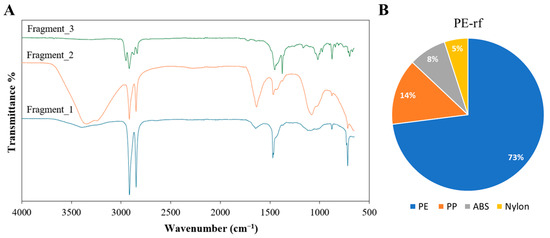
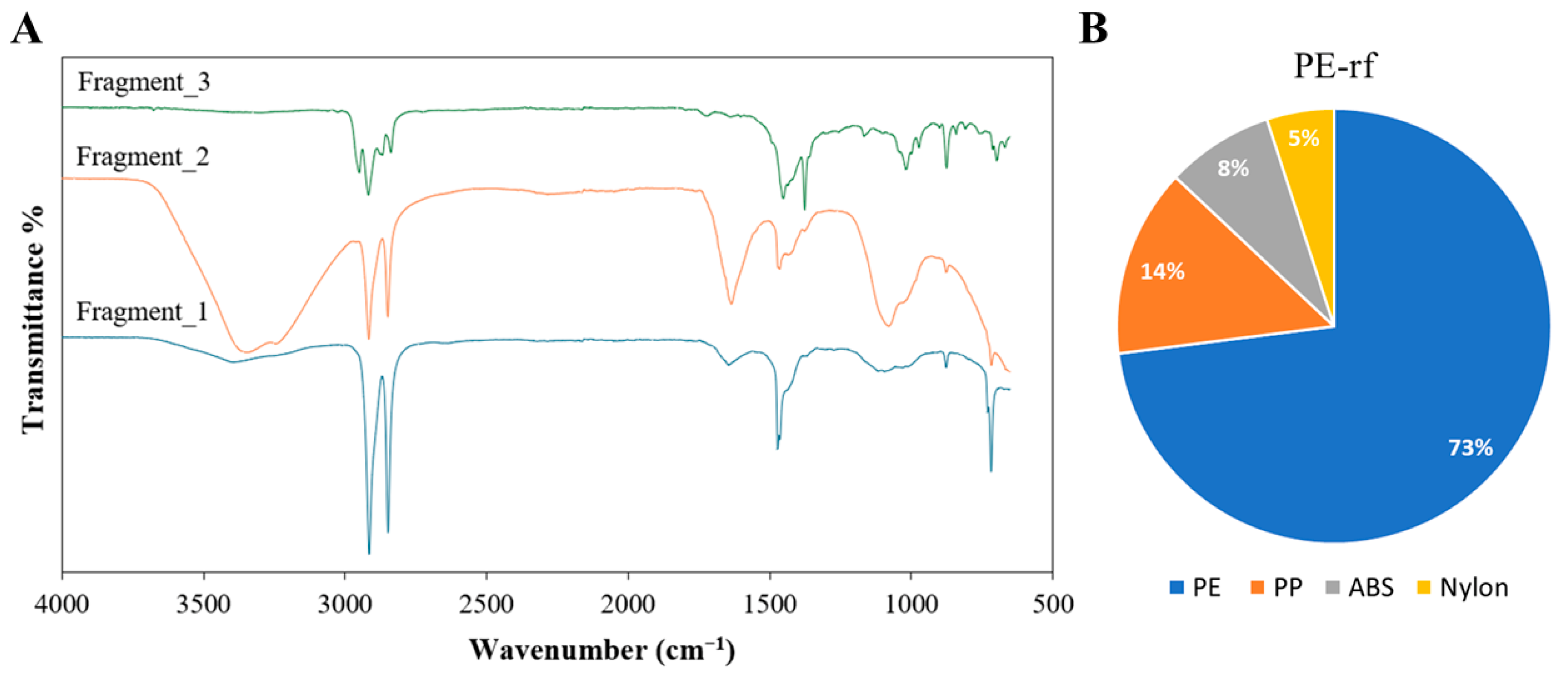
As reported, a PE-rich fraction of plastics recovered from the marine environment was obtained by on-site manual sorting. The collected PE-rf was not washed, to assess the feasibility of processing this material in its native, contaminated state, which reflected realistic marine plastic recovery conditions. The fragments were then further analyzed in laboratory by means of FTIR spectroscopy. FTIR analysis was carried out according to the procedure described in Section 2.3. FTIR analysis (Figure 1A) qualitatively confirmed the large presence of PE fragments (73%) and, in a lower amount, polypropylene (PP) (14%) and other plastics (13%) (Figure 1B). FTIR analysis showed that in most of the PE fragments, the presence of inorganic contamination was evidenced by the broad absorption bands: as an example, in Fragment 2, the broad peak in the range of 1100–1000 cm−1 could be attributed to siliceous materials from sand contamination.
Figure 1.
Compositional analyses. (A) Example of the FTIR spectra; (B) percentage distribution of identified polymers.
The sampling also revealed some minor contamination by other plastics such as polyamide and acrylonitrile butadiene styrene (ABS).
3.1. Mechanical Testing
As summarized in Table 2, tensile testing of neat, molded PE-rf revealed a relatively high elastic modulus compatible with the values usually exhibited by HDPE [31]. However, the high modulus is accompanied by low strength and extremely low elongation at break, around 1%. This behavior can be attributed to the presence of rigid impurities and inorganic materials in PE-rf, as suggested by preliminary FTIR analysis, that hinder the deformation of the polymer matrix and lead to fragile behavior [21]. In order to improve the properties of PE-rf, part of the sample was subjected to cryogenic milling (G PE-rf). Grinding promoted better dispersion of inclusions and contaminants in the sample, making it more homogeneous. The treatment resulted in a slight improvement in mechanical properties, with an increase in all parameters.
Table 2.
Mechanical properties. Results of mechanical testing on PE-rf-based formulations: elastic modulus (E), tensile strength (σmax), and elongation at break (εR).
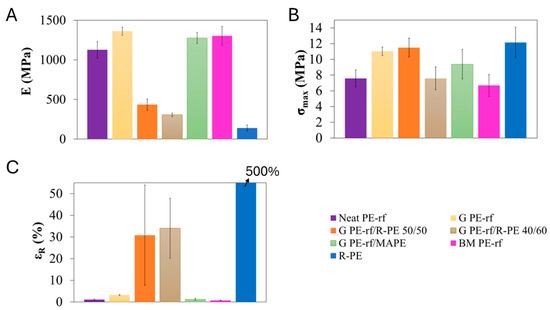
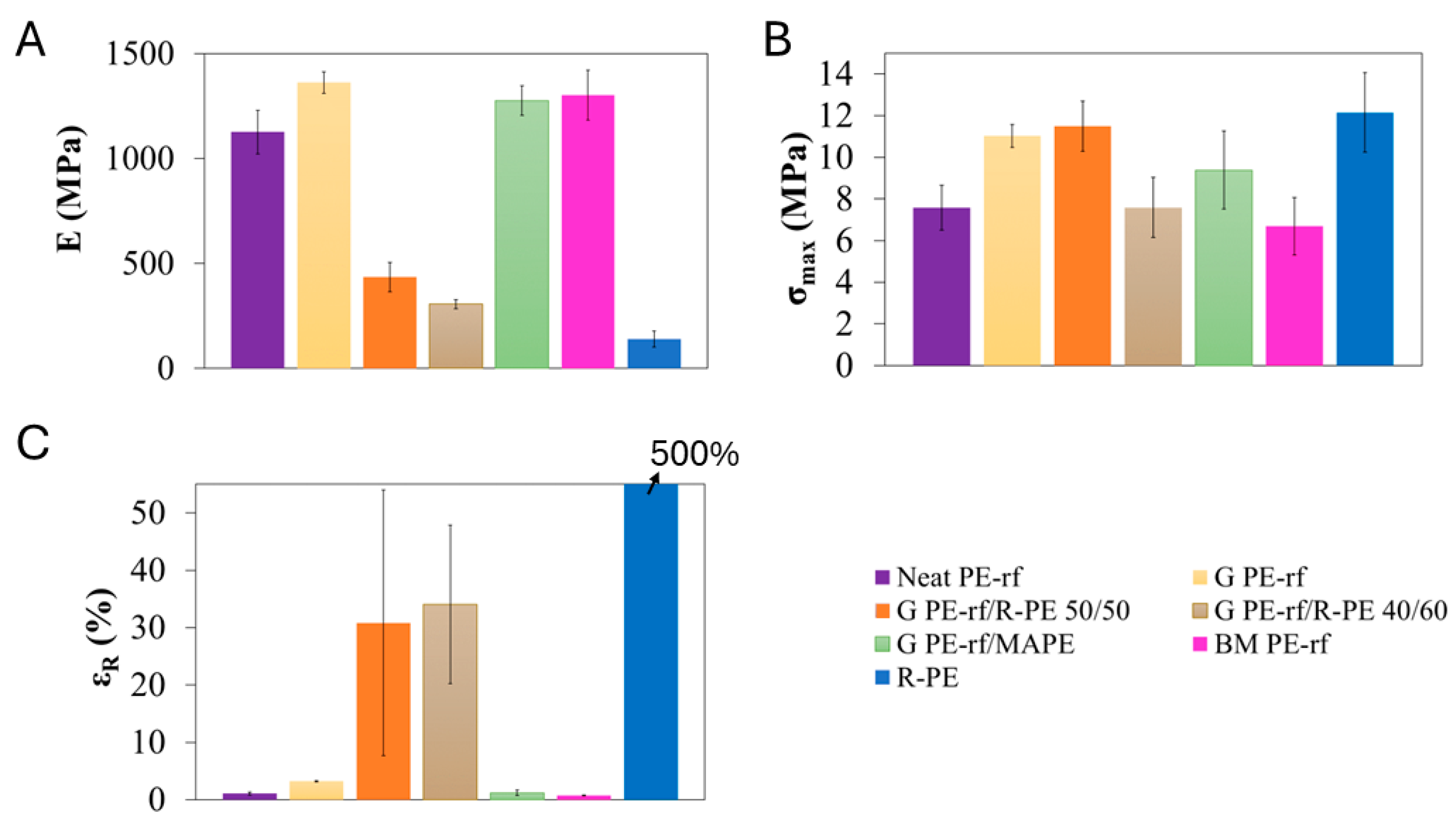
To test the effectiveness of polymeric compatibilizers to improve properties, a material containing 5% maleated polyethylene and 95% ground PE-rf was prepared. However, the use of MAPE did not lead to a significant improvement in the properties compared to ground PE-rf (Table 2). MAPE is widely recognized as an effective compatibilizer for PE-based materials containing inorganic particles [32,33]. However, in our samples, the high concentration of such impurities, combined with the presence of multiple polymer species whose adhesion to the PE-rich matrix cannot be improved by MAPE, resulted in the poor performance observed. The use of ductile R-PE in combination with PE-rf, conversely, led to a significant increase in the elongation (from 3 to 30%) while, at the same time, the elastic modulus decreased by up to 80%, as represented in Figure 2. These findings are rationalized considering that R-PE is a recycled blend mainly containing low-density PE, which exhibits high ductility and very low stiffness. It is interesting to observe that the tensile strength (σmax) of the G PE-rf/R-PE 50/50 sample is almost the same as that of pure R-PE.
Figure 2.
Mechanical properties. Results of mechanical testing on PE-rf-based formulations: (A) elastic modulus (E), (B) tensile strength (σmax), and (C) strain at break (εR).
In the case of the material prepared by cold mixing, the presence of R-PE is still able to increase the ductility of the mixture; however, the strength recorded is much lower, confirming the importance of the melt processing to improve the mixing and homogeneity of these materials. In both materials containing R-PE, the high standard deviation that affects the elongation values recorded can be attributed to the action of solid impurities that are responsible for the premature failure of some specimens.
To test the feasibility of a different approach to homogenization, a planetary ball mill (BM) preprocessing step was applied to neat PE-rf. The intense mixing promoted by BM treatment is, in principle, highly suited for the homogenization of heterogeneous mixtures. The implemented BM treatment was carried out at room temperature and, in the frame of a sustainable approach, no solvents or reagents were added. However, the treatment was not effective in improving the mechanical response of the materials. These findings confirm that the presence and distribution of rigid contaminants are decisive factors governing the mechanical behavior of recycled PE-based materials.
Considering the results of mechanical testing, the better-performing materials were identified in the ones containing R-PE as an additive. For this reason, further analyses were carried out only on those samples.
3.2. Thermal Analysis
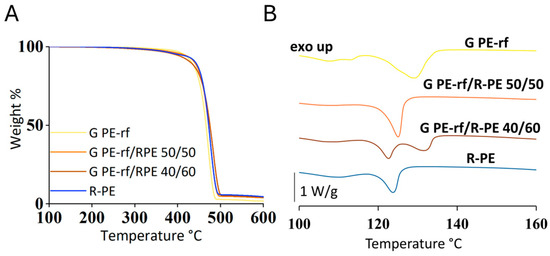
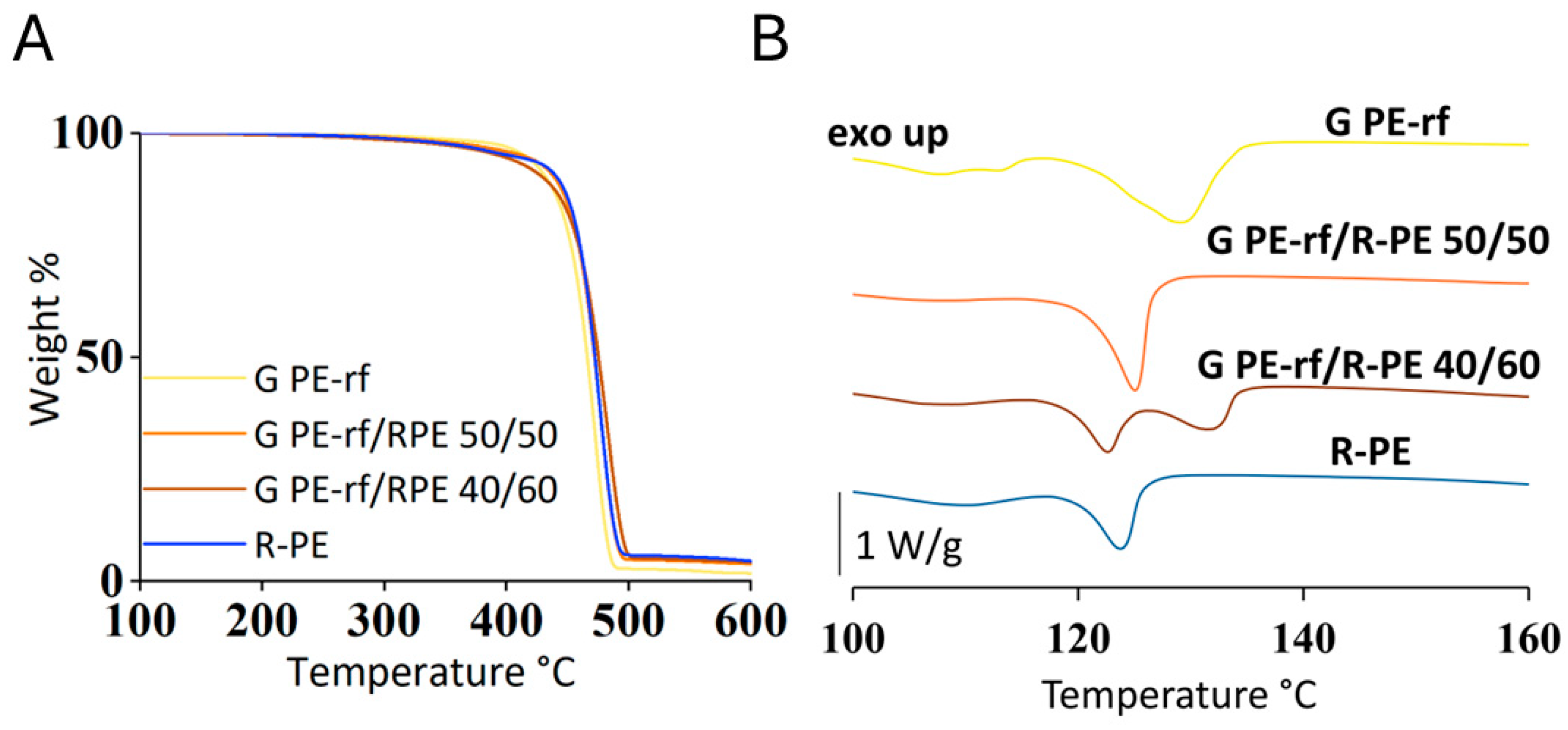
Thermogravimetric and calorimetric analyses were performed on the blends to investigate the effects of adding RPE on the thermal properties. DSC and TGA traces are illustrated in Figure 3.
Figure 3.
Thermal properties. (A) Thermogravimetric analysis (TGA) weight-loss curves and (B) DSC thermograms of selected PE-rf-based formulations.
TGA results indicate that all samples exhibit a single-step thermal degradation process, typical of polyethylene-based materials. The onset of weight loss occurs around 450 °C, and this temperature was determined based on the onset of a 5% weight loss. The thermal stability of the blends (PE-rf/R-PE) is comparable to that of the individual components (PE-rf and R-PE), suggesting that the incorporation of recycled fractions does not significantly compromise the thermal resistance of the material. Slight differences in the onset temperature among the curves may reflect minor variations in composition and crystallinity, but overall, the degradation profiles confirm the compatibility of the recycled and reprocessed polyethylene grades within the blends.
Differential scanning calorimetry revealed the presence of different PE grades inside PE-rf, as highlighted by the multiple melting peaks shown in Figure 3B. The melting peaks at 108–114 °C indicate the presence of LDPE and that at 131 °C indicates HDPE with a probable predominance of the latter [34]. Double melting peaks are observed in the film obtained using the cold mixing approach, one comparable to that of R-PE and the other to that of PE-rf; these are suggestive of incomplete mixing of the two components in the blend. Films with 50% PE-rf and 50% R-PE and prepared by extrusion and compression molding have a melting peak at an intermediate temperature between the melting peaks of the two components. The double melt peaks in the cold-mixed 40/60 film are consistent with incomplete mixing and the persistence of separated domains of different PE grades, while the single melting peak of melt-blended 50/50 materials is consistent with an intimate mixing and partial cocrystallization between PE grades. The occurrence of a melting peak around 123 °C in R-PE-containing samples suggests the presence of LLDPE within the recycled polymer matrix [35]. The presence of LLDPE within the recycled polyethylene fraction appears to play a significant role in improving the homogenization of the blends. This effect can be explained by the structural characteristics of LLDPE, which exhibits a linear backbone with short-chain branching, resulting in intermediate crystallinity and density between LDPE and HDPE. Such features allow LLDPE to act as a physical compatibilizer, reducing interfacial tension and promoting better dispersion of the different polyethylene grades and minor polyolefin components. Consequently, the incorporation of LLDPE contributes to the formation of a more uniform polymer matrix, which is expected to enhance the mechanical performance and thermal stability of the recycled formulations. Evidence from the literature supports this hypothesis. Van Belle et al. (2020) [36] reported that LLDPE/LDPE and LLDPE/HDPE blends exhibit a strong interphase due to the miscibility of their amorphous phases, which leads to mixed-phase interfacial regions and improved phase adhesion. Similarly, in LLDPE/HDPE blends, the linear structure of both polymers facilitates chain alignment, reducing entanglement and contributing to more uniform deformation and strain hardening at intermediate compositions [36].
These findings, combined with the results of mechanical testing, indicate that the presence of LLDPE in recycled polyethylene fractions can significantly improve mechanical performance, supporting its role as a physical compatibilizer in multi-grade polyethylene systems. DSC analysis (Table 3) shows that G PE-rf has a higher degree of crystallinity (42%) than R-PE (23%), in line with the greater content of HDPE.
Table 3.
DSC data. Degree of crystallinity of selected PE-rf-based formulations analyzed by DSC.
Blending with R-PE induces a reduction in the degree of crystallinity (35% and 33% for the 50/50 and 40/60 blends, respectively), in a way that is approximately proportional to the content of R-PE. This finding indicates that, in both the physical mixture (G PE-rf/R-PE 40/60) and the melt-processed blend (G PE-rf/R-PE 50/50), both materials contribute to the overall crystalline content.
3.3. Morphological Analysis
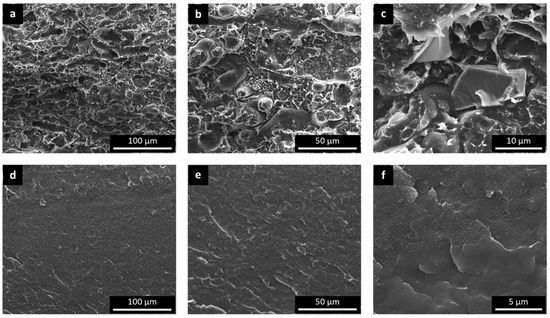
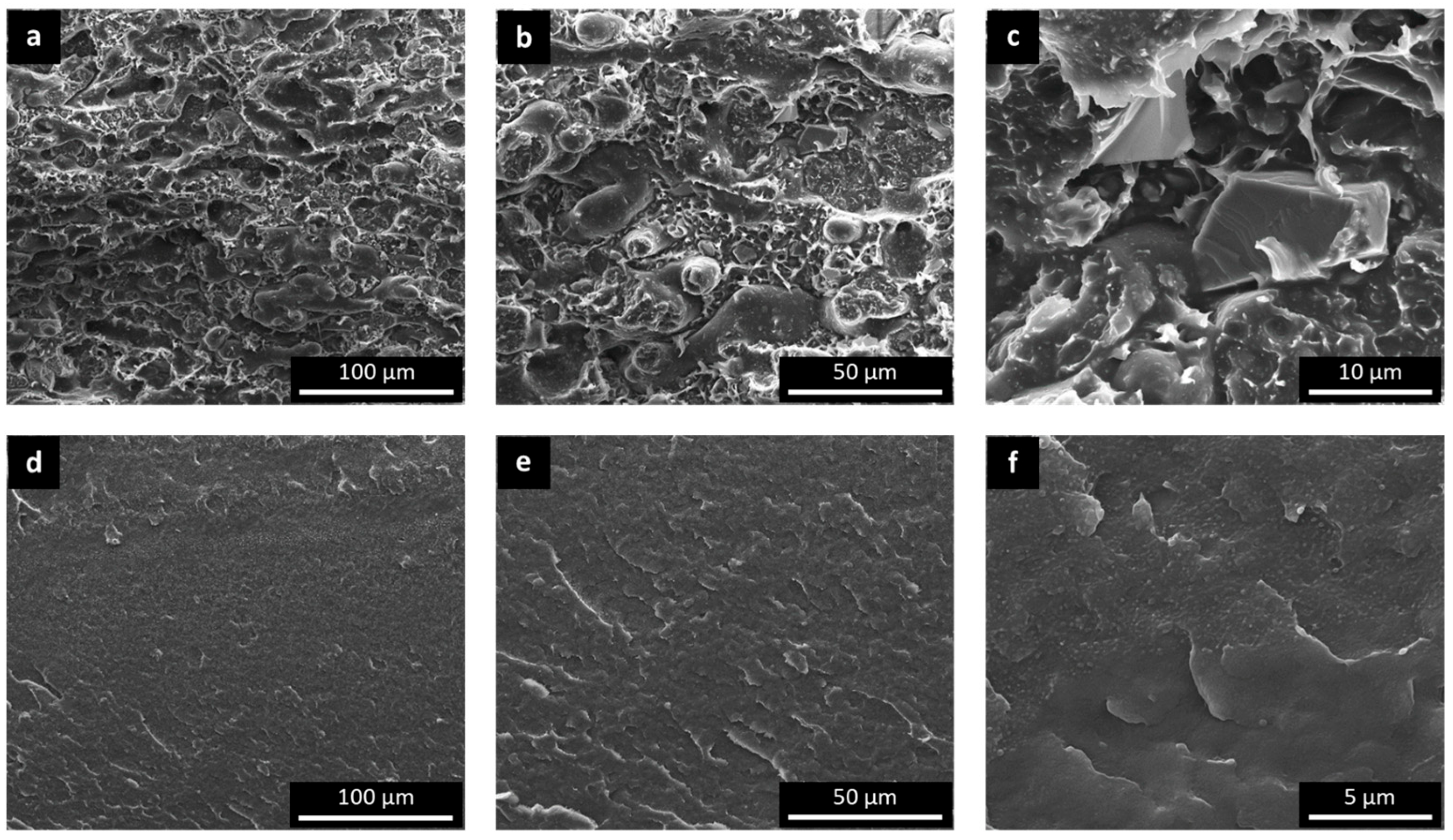
The results of mechanical and thermal analyses highlight the important influence of composition and phase morphology on the properties of complex multi-phase materials. For this reason, analysis of the morphology of the best-performing composition (G PE-rf/R-PE 50/50) in comparison with PE-rf was carried out by SEM. The resulting micrographs are shown in Figure 4.
Figure 4.
Morphological analyses. SEM micrographs of cryo-fractured surfaces of G PE-rf (a–c) and G PE-rf/R-PE 50/50 (d–f).
The SEM micrographs of PE-rf (Figure 4a–c) reveal the presence of micrometric-sized impurities of different nature and shape: inorganic materials, fibers, and particles. These impurities are typical of the contamination resulting from the permanence of plastic items in the marine environment. It can be observed that the inclusions are not well adhered to the matrix; in fact, the mechanical load applied during the cryogenic fracture induced an extended failure of the matrix/inclusion interface (debonding), suggesting a lack of adhesion at the interface. The non-homogeneity of the samples is probably the main reason for the low strain at break observed in tensile tests.
The realization of the blends containing 50% of R-PE seems to cause a better dispersion of the phases, resulting in smoother fracture surfaces with no strong evidence of discontinuities (Figure 4d–f). The better dispersion of the inclusions and the absence of evident phase separations could explain the increase observed in the mechanical properties.
3.4. Suitability of Recycled Formulation for 3D Printing Applications
Filaments based on the G PE-rf/R-PE 50/50 formulation were produced to preliminarily assess the suitability of the recycled blend for fused filament fabrication (FFF). The evaluation was intended as a proof of concept, primarily focused on filament processability and basic printability, rather than on achieving optimized filament quality or high-performance printed parts.
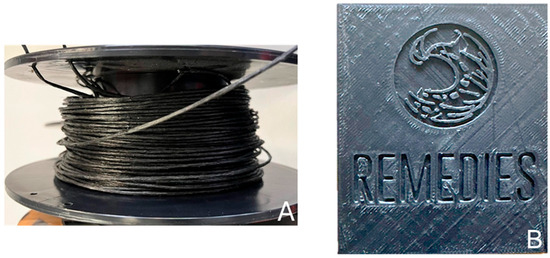
Under the experimental conditions reported in Table 1, a continuous filament could be produced: the obtained filament (Figure 5A) exhibited an overall continuous morphology and a reasonably regular diameter along its length; however, local diameter fluctuations and surface defects were still detectable, even under the optimized processing conditions. These irregularities are attributed to the intrinsic heterogeneity of the recycled formulation and to the presence of residual inorganic contaminants, as well as the complex crystallization behavior of polyethylene-based systems.
Figure 5.
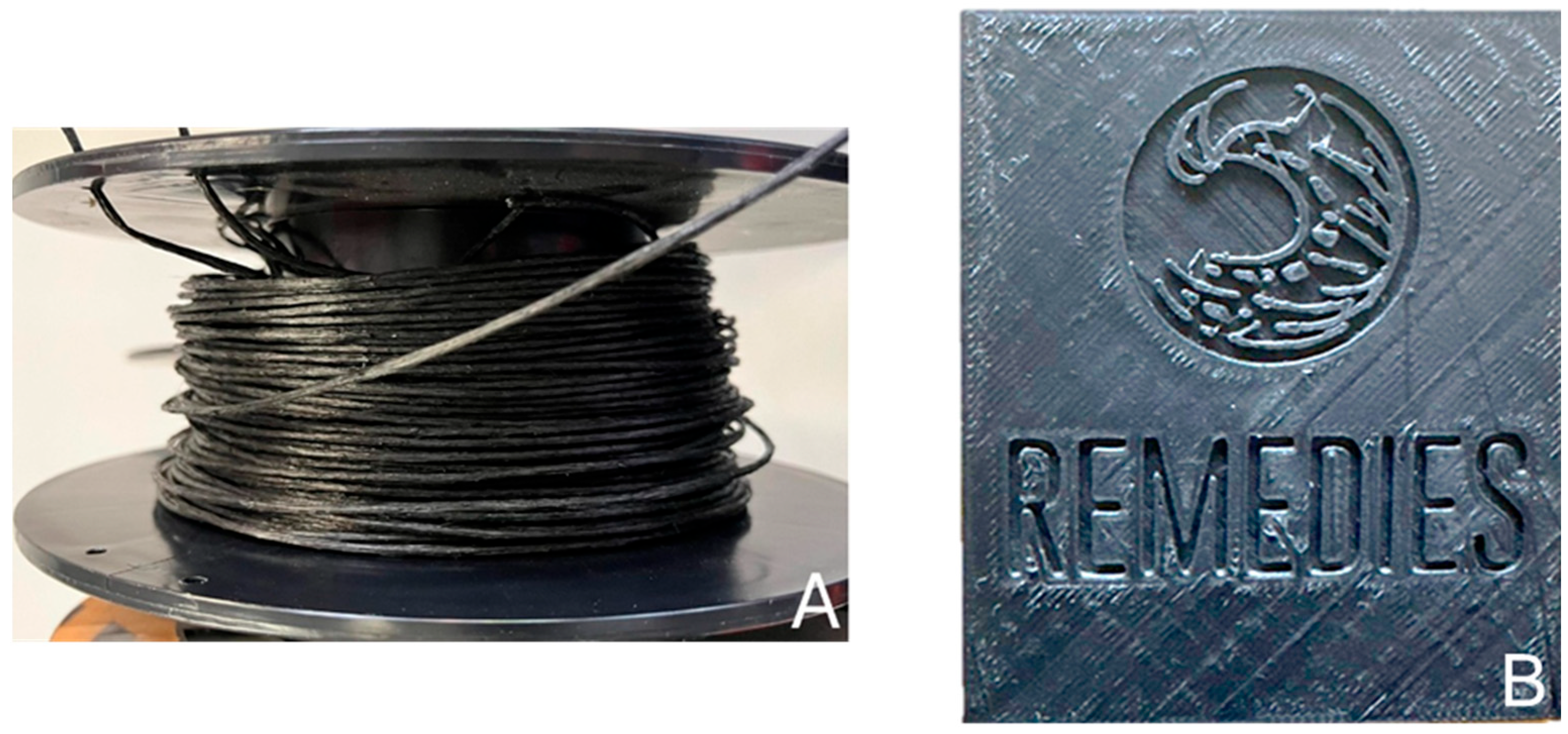
3D printing. (A) Filament obtained from the PE-rf/R-PE 50/50 material for the 3D printing test. (B) An example of printed object: a plate with the project logo.
The filament was subsequently processed by fused filament fabrication. During FFF printing trials, rapid crystallization of the material led to limited interlayer adhesion and a tendency toward warping. To partially mitigate these effects, calcium carbonate was added at 20 wt% to slow down crystallization and improve dimensional stability during deposition. In this case, the printed specimens showed continuous extrusion paths and acceptable adhesion between successive deposited layers, enabling the realization of geometrically stable objects with a homogeneous infill pattern (Figure 5B). Nevertheless, surface roughness, minor voids, and local imperfections at the interlayer interfaces were consistently observed, indicating that while the material is suitable for preliminary 3D printing applications, further optimization of the formulation and processing parameters is required to achieve a print quality comparable to that of commercial filaments. Overall, these results demonstrate the technical feasibility of converting marine-derived polyethylene-rich plastic waste into FFF filaments, while highlighting the current limitations associated with material heterogeneity and crystallization behavior. Future work will focus on improving filament uniformity, surface quality, and mechanical performance of printed parts through formulation optimization and process control.
4. Conclusions
This study evaluated a mechanical recycling strategy for a polyethylene-rich plastic fraction recovered from the marine environment (PE-rf). The material was found to be highly heterogeneous and contaminated, reflecting the complexity of marine debris and its impact on recyclability. Among the tested strategies, blending PE-rf with a ductile recycled polyethylene (R-PE) was the only method that significantly improved ductility without compromising strength, confirming the importance of the addition of a “standardized” polymeric phase over the use of compatibilization additives and strategies in such systems. The selected blends were transformed into filaments and 3D-printed objects, demonstrating their feasibility, while the observed defects and dimensional fluctuations suggest that further formulation and process optimization are needed to improve print quality.
In conclusion, this study demonstrates that polyethylene-rich marine plastic waste can be mechanically recycled and partially valorized through simple blending and melt-processing strategies, enabling its integration into secondary material streams, including additive manufacturing. At the same time, the results clearly point to the current limitations associated with variability, contamination, and property dispersion, emphasizing the need for statistically robust characterization, improved sorting strategies, and targeted formulation design. In this perspective, the proposed approach represents a realistic and scalable pathway toward the circular use of marine plastic waste, contributing to pollution mitigation while outlining the challenges that must be addressed to enable its broader industrial adoption.
Author Contributions
Conceptualization, R.A., M.E.E. and M.C.; Methodology, I.L., R.A., A.C., G.A.d.L. and M.C.; Formal Analysis, I.L., R.A., A.S., A.C., G.A.d.L. and M.E.E.; Investigation, I.L., A.C., G.A.d.L. and M.E.E.; Data Curation, R.C., F.O., G.G. and A.S.; Writing—Original Draft Preparation, I.L., R.A., R.C., F.O., G.G., A.S., A.C., G.A.d.L., M.E.E. and M.C.; Funding Acquisition, G.A.d.L. and M.C. All authors have read and agreed to the published version of the manuscript.
Funding
This research was funded by project REMEDIES “Co-creating strong uptake of REMEDIES for the future of our oceans through deploying plastic litter valorisation and prevention pathways” financed by the European Union’s HORIZON EUROPE Innovation program under grant agreement No. 101093964, and by the Project–Biomonitoraggio di micro e nanoplastiche biodegradabili: dall’ambiente all’uomo in una prospettiva one health (BioPlast4Safe), carried out with the technical and financial support of the Italian Ministry of Health–PNC.
Data Availability Statement
The original contributions presented in this study are included in the article. Further inquiries can be directed towards the corresponding author.
Conflicts of Interest
The authors declare no conflicts of interest.
References
- Plastics Europe. Plastics—The Fast Facts 2025—Plastics Europe. Available online: https://plasticseurope.org/knowledge-hub/plastics-the-fast-facts-2025 (accessed on 1 December 2025).
- Boucher, J.; Friot, D. Primary Microplastics in the Oceans; IUCN: Gland, Switzerland, 2017; Available online: https://portals.iucn.org/library/node/46622 (accessed on 1 December 2025).
- Prata, J.C.; Silva, A.L.P.; Da Costa, J.P.; Mouneyrac, C.; Walker, T.R.; Duarte, A.C.; Rocha-Santos, T. Solutions and Integrated Strategies for the Control and Mitigation of Plastic and Microplastic Pollution. Int. J. Environ. Res. Public Health 2019, 16, 2411. [Google Scholar] [CrossRef]
- Barron, A.; Sparks, T.D. Commercial Marine-Degradable Polymers for Flexible Packaging. iScience 2020, 23, 101353. [Google Scholar] [CrossRef]
- Paul, M.B.; Stock, V.; Cara-Carmona, J.; Lisicki, E.; Shopova, S.; Fessard, V.; Braeuning, A.; Sieg, H.; Böhmert, L. Micro- and nanoplastics—Current state of knowledge with the focus on oral uptake and toxicity. Nanoscale Adv. 2020, 2, 4350–4367. [Google Scholar] [CrossRef]
- Resources|IUCN. Available online: https://iucn.org/resources (accessed on 1 December 2025).
- ISO/TR 21960:2020; Plastics—Environmental Aspects—State of Knowledge and Methodologies. International Organization for Standardization (ISO): Geneva, Switzerland, 2020.
- Federici, S.; Ademovic, Z.; Amorim, M.J.B.; Bigalke, M.; Cocca, M.; Depero, L.E.; Dutta, J.; Fritzsche, W.; Hartmann, N.B.; Kalčikova, G. COST Action PRIORITY: An EU Perspective on Micro- and Nanoplastics as Global Issues. Microplastics 2022, 1, 282–290. [Google Scholar] [CrossRef]
- Taylor, M.L.; Gwinnett, C.; Robinson, L.F.; Woodall, L.C. Plastic microfibre ingestion by deep-sea organisms. Sci. Rep. 2016, 6, 33997. [Google Scholar] [CrossRef]
- Martin, C.; Corona, E.; Mahadik, G.A.; Duarte, C.M. Adhesion to coral surface as a potential sink for marine microplastics. Environ. Pollut. 2019, 255, 113281. [Google Scholar] [CrossRef]
- Palazzo, L.; Coppa, S.; Camedda, A.; Cocca, M.; De Falco, F.; Vianello, A.; Massaro, G.; de Lucia, G.A. A novel approach based on multiple fish species and water column compartments in assessing vertical microlitter distribution and composition. Environ. Pollut. 2021, 272, 116419. [Google Scholar] [CrossRef]
- Vencato, S.; Montano, S.; Saliu, F.; Coppa, S.; Becchi, A.; Liotta, I.; Valente, T.; Cocca, M.; Matiddi, M.; Camedda, A.; et al. Phthalate levels in common sea anemone Actinia equina and Anemonia viridis: A proxy of short-term microplastic interaction? Mar. Pollut. Bull. 2024, 200, 116125. [Google Scholar] [CrossRef] [PubMed]
- Mercogliano, R.; Avio, C.G.; Regoli, F.; Anastasio, A.; Colavita, G.; Santonicola, S. Occurrence of Microplastics in Commercial Seafood under the Perspective of the Human Food Chain. A Review. J. Agric. Food Chem. 2020, 68, 5296–5301. [Google Scholar] [CrossRef] [PubMed]
- Wright, S.L.; Thompson, R.C.; Galloway, T.S. The physical impacts of microplastics on marine organisms: A review. Environ. Pollut. 2013, 178, 483–492. [Google Scholar] [CrossRef] [PubMed]
- Santonicola, S.; Volgare, M.; Di Pace, E.; Cocca, M.; Mercogliano, R.; Colavita, G. Occurrence of potential plastic microfibers in mussels and anchovies sold for human consumption: Preliminary results. Ital. J. Food Saf. 2021, 10, 9962. [Google Scholar] [CrossRef]
- Luís, C.; Algarra, M.; Câmara, J.; Perestrelo, R. Comprehensive Insight from Phthalates Occurrence: From Health Outcomes to Emerging Analytical Approaches. Toxics 2021, 9, 157. [Google Scholar] [CrossRef]
- Amato, A.; Gioia, S.; Liotta, I.; Cocca, M.; Caramiello, D.; Manfra, L.; Libralato, G.; Esposito, R.; Zupo, V.; Costantini, M. Assessing the effect of microplastics on marine invertebrates: The consequence of exposure of sea urchin larvae to polystyrene microplastics. Mar. Pollut. Bull. 2026, 223, 119013. [Google Scholar] [CrossRef]
- Fries, E.; Dekiff, J.H.; Willmeyer, J.; Nuelle, M.T.; Ebert, M.; Remy, D. Identification of polymer types and additives in marine microplastic particles using pyrolysis-GC/MS and scanning electron microscopy. Environ. Sci. Process. Impacts 2013, 15, 1949. [Google Scholar] [CrossRef]
- European Commission, Directorate General for Environment. EU Action Against Microplastics; Publications Office of the European Union: Luxembourg, 2023; Available online: https://data.europa.eu/doi/10.2779/917472 (accessed on 1 December 2025).
- Quaghebeur, M.; Laenen, B.; Geysen, D.; Nielsen, P.; Pontikes, Y.; Van Gerven, T.; Spooren, J. Characterization of landfilled materials: Screening of the enhanced landfill mining potential. J. Clean. Prod. 2013, 55, 72–83. [Google Scholar] [CrossRef]
- Avolio, R.; Spina, F.; Gentile, G.; Cocca, M.; Avella, M.; Carfagna, C.; Tealdo, G.; Errico, M.E. Recycling Polyethylene-Rich Plastic Waste from Landfill Reclamation: Toward an Enhanced Landfill-Mining Approach. Polymers 2019, 11, 208. [Google Scholar] [CrossRef]
- Capuano, R.; Bonadies, I.; Castaldo, R.; Cocca, M.; Gentile, G.; Protopapa, A.; Avolio, R.; Errico, M.E. Valorization and Mechanical Recycling of Heterogeneous Post-Consumer Polymer Waste through a Mechano-Chemical Process. Polymers 2021, 13, 2783. [Google Scholar] [CrossRef] [PubMed]
- De Camargo, R.V.; Saron, C. Mechanical–Chemical Recycling of Low-Density Polyethylene Waste with Polypropylene. J. Polym. Environ. 2020, 28, 794–802. [Google Scholar] [CrossRef]
- Liotta, I.; Avolio, R.; Castaldo, R.; Gentile, G.; Ambrogi, V.; Errico, M.E.; Cocca, M. Mitigation approach of plastic and microplastic pollution through recycling of fishing nets at the end of life. Process Saf. Environ. Prot. 2024, 182, 1143–1152. [Google Scholar] [CrossRef]
- Ibrahim, I.A.; Khoo, K.S.; Rawindran, H.; Lim, J.W.; Ng, H.S.; Shahid, M.K.; Tong, W.-Y.; Hatshan, M.R.; Sun, Y.-M.; Lan, J.C.-W.; et al. Environmental Sustainability of Solvent Extraction Method in Recycling Marine Plastic Waste. Sustainability 2023, 15, 15742. [Google Scholar] [CrossRef]
- Pelegrini, K.; Maraschin, T.G.; Brandalise, R.N.; Piazza, D. Study of the degradation and recyclability of polyethylene and polypropylene present in the marine environment. J. Appl. Polym. Sci. 2019, 136, 48215. [Google Scholar] [CrossRef]
- Djonyabe Habiba, R.; Malça, C.; Branco, R. Exploring the Potential of Recycled Polymers for 3D Printing Applications: A Review. Materials 2024, 17, 2915. [Google Scholar] [CrossRef]
- Gilmer, E.L.; Miller, D.; Chatham, C.A.; Zawaski, C.; Fallon, J.J.; Pekkanen, A.; Long, T.E.; Williams, C.B.; Bortner, M.J. Model analysis of feedstock behavior in fused filament fabrication: Enabling rapid materials screening. Polymer 2018, 152, 51–61. [Google Scholar] [CrossRef]
- Duty, C.; Ajinjeru, C.; Kishore, V.; Compton, B.; Hmeidat, N.; Chen, X.; Liu, P.; Hassen, A.A.; Lindahl, J.; Kunc, V. What makes a material printable? A viscoelastic model for extrusion-based 3D printing of polymers. J. Manuf. Process. 2018, 35, 526–537. [Google Scholar] [CrossRef]
- Li, D.; Zhou, L.; Wang, X.; He, L.; Yang, X. Effect of Crystallinity of Polyethylene with Different Densities on Breakdown Strength and Conductance Property. Materials 2019, 12, 1746. [Google Scholar] [CrossRef] [PubMed] [PubMed Central]
- Tai, C.M.; Li, R.K.Y.; Ng, C.N. Impact behaviour of polypropylene/polyethylene blends. Polym. Test. 2000, 19, 143–154. [Google Scholar] [CrossRef]
- Avolio, R.; Gentile, G.; Avella, M.; Carfagna, C.; Errico, M.E. Polymer–filler interactions in PET/CaCO3 nanocomposites: Chain ordering at the interface and physical properties. Eur. Polym. J. 2013, 49, 419–427. [Google Scholar] [CrossRef]
- Avella, M.; Avolio, R.; Bonadies, I.; Carfagna, C.; Errico, M.E.; Gentile, G. Recycled multilayer cartons as cellulose source in HDPE-based composites: Compatibilization and structure-properties relationships. J. Appl. Polym. Sci. 2009, 114, 2978–2985. [Google Scholar] [CrossRef]
- Turku, I.; Keskisaari, A.; Kärki, T.; Puurtinen, A.; Marttila, P. Characterization of wood plastic composites manufactured from recycled plastic blends. Compos. Struct. 2017, 161, 469–476. [Google Scholar] [CrossRef]
- Charitopoulou, M.A.; Koutroumpi, S.; Achilias, D.S. Thermal Characterization and Recycling of Polymers from Plastic Packaging Waste. Polymers 2025, 17, 1786. [Google Scholar] [CrossRef] [PubMed]
- Van Belle, A.; Demets, R.; Mys, N.; Van Kets, K.; Dewulf, J.; Van Geem, K.; De Meester, S.; Ragaert, K. Microstructural Contributions of Different Polyolefins to the Deformation Mechanisms of Their Binary Blends. Polymers 2020, 12, 1171. [Google Scholar] [CrossRef] [PubMed]

Disclaimer/Publisher’s Note: The statements, opinions and data contained in all publications are solely those of the individual author(s) and contributor(s) and not of MDPI and/or the editor(s). MDPI and/or the editor(s) disclaim responsibility for any injury to people or property resulting from any ideas, methods, instructions or products referred to in the content. |
© 2026 by the authors. Licensee MDPI, Basel, Switzerland. This article is an open access article distributed under the terms and conditions of the Creative Commons Attribution (CC BY) license.