


Abstract
Plastics are now ubiquitous in the environment, in this, the “Plasticene” era. Microplastics (MPs) and Nanoplastics (NPs) are emerging contaminants of global concern. This systematic review, registered on PROSPERO and conducted according to PRISMA guidelines, investigated the presence, distribution, and characteristics of MPs in tap water (TW) worldwide, and estimated the population’s Estimated Daily Intake (EDI) by age group, including pregnant women. A comprehensive search across PubMed, Scopus, Web of Science, and Cochrane identified 22,650 records, of which 8 studies were included. MPs were detected in treated water (TW) in the studies included in this review, although the currently available evidence remains limited. Calculated EDIs were highest in children aged 6 months to 3 years (up to 39 MPs/kg bw/day), followed by pregnant women (up to 14.96 MPs/kg bw/day), reflecting differences in water intake per body weight. These estimates must be interpreted as indicative, estimated by methodological variability among studies. The widespread presence of MPs in TW calls for standardized methods, improved treatments, and thorough monitoring to assess risks and protect public health.
1. Introduction
We are currently living in the Plasticene, an era in Earth’s history within the Anthropocene, commencing in the 1950s and characterised stratigraphically in the depositional record by a new and growing layer of plastic [1]. The presence of plastic-based materials in nature is a unique phenomenon in history, affecting the entire world and is responsible for an ever-increasing human exposure [2,3,4,5,6]. The widespread use of plastics, due to their durability, malleability, and flexibility, has made them essential materials in various sectors, which has also resulted in extensive environmental pollution by microplastics (MPs, particles smaller than 5 mm up to 1 µm). Indeed, several studies have highlighted the spread of MPs across various environmental matrices, including water, soil, and air, as well as in living organisms, such as fish, birds, and algae [7,8,9,10], and in various consumer products including food and cosmetics [11,12,13]. Accurate measurement of MPs in various environments is essential, as it contributes to a deeper understanding of their behaviour and distribution within ecosystems [14].
This growing awareness of the presence of MPs has been driven by evidence of their toxicity and the harmful effects they have on the environment, ecosystems, and public health. The spread of MPs raises global health concerns, as humans can come into direct contact with these particles through ingestion and inhalation [10,15,16,17,18]. To date, scientific evidence confirms the presence of MPs in the human body [6,19,20].
In parallel with the growing attention toward MPs, research has also begun to focus on Nanoplastics (NPs), plastic fragments smaller than 1 µm. Due to their even smaller size, NPs can more easily penetrate biological barriers, with potential toxic effects that are still poorly understood but considered worthy of concern. Their analytical detection is complex, which makes it difficult to produce a solid scientific production; however, recent studies have begun to confirm their presence in various environmental compartments and even in matrices intended for human consumption [21,22].
NPs and MPs have been found in tap water (TW) originating from centralized water treatment systems [23,24]. While numerous studies have been conducted in the marine environment, studies on drinking water have been less frequent [25,26,27]. Studies carried out in different countries, including China, Thailand, and South Africa [26,28,29], highlighted the presence and quantified MPs in TW.
Tap water represents only one of the multiple pathways through which humans may be exposed to microplastics. Therefore, the concentrations reported here should be interpreted as the contribution from tap water alone, not as an estimate of total daily exposure.
The safety and security of TW are the primary goals of public health, as this could constitute one of the main sources of human exposure to emerging contaminants [30]. The consequences of exposure to MPs and NPs through TW also include harmful effects such as endocrine disruption, developmental toxicity, and genetic damage, observed in animal models such as fish, rats, and nematodes [12,17,31,32,33].
The objective of this systematic review is to analyse the presence, distribution, and characteristics of MPs and NPs in TW. In this review, our primary objective is to synthesize current evidence on the occurrence and distribution of microplastics in environmental matrices. This study will also enable us to evaluate the Estimated Daily Intakes (EDIs) of the population (adults, pregnant women, and children) according to data reported in eligible studies.
2. Materials and Methods
2.1. Search Strategy
A Systematic review was carried out according to PRISMA (Preferred Reporting Items for Systematic Reviews and Meta-Analyses) guidelines to ensure a rigorous and transparent methodology [34]. This systematic review has been registered on PROSPERO (an international database for systematic review registrations, 2.0.37 version) with the registration code CRD420250563489.
To identify relevant studies, a comprehensive and systematic search of multiple scientific databases was performed. The databases used for the literature search included PubMed, Scopus, Web of Science, and Cochrane. The searches covered the period from 1 February 2009 to 1 June 2025.
A carefully selected set of keywords was employed to maximize the retrieval of pertinent studies. The keywords used in the search included: Chlorinated water, Disinfection modality, Drinking distribution system, Drinking water, Microplastics, Municipal water, Nanoplastics, Plastic pollution, Plastics, Potable water, Tap water, Water distribution system, Water purification plant (Supplementary Materials). To manage and screen the retrieved articles efficiently, the online tool Rayyan [35,36] was employed. This platform facilitates systematic reviews by allowing researchers to upload, organize, and filter studies collaboratively [37].
2.2. Inclusion and Exclusion Criteria
The studies included in this review had to meet specific eligibility criteria to ensure the relevance and quality of the records. Only original research articles were considered, as they provide primary data and contribute directly to the understanding of MP and NP contamination in TW. The selected studies had to investigate the presence, sources, and distribution of these contaminants in TW, focusing on the pathways through which MPs enter the water supply. Additionally, studies that analysed the potential health risks associated with the ingestion of MPs and NPs were included. The knowledge of these risks is crucial for assessing the impact on public health.
On the other hand, several types of studies were excluded from the review, especially when the analyzed samples were fewer than 30 [38]. Systematic reviews, umbrella reviews, and meta-analyses were not considered, as the focus was on collecting and synthesizing original data rather than secondary analyses. Similarly, reports, editorials, PhD theses, commentaries, and conference abstracts were excluded due to their limited methodological rigor and the potential lack of peer review. Furthermore, studies that examined MP contamination in bottled water or natural water bodies, such as rivers and lakes, without a direct connection to tap water contamination were not included, as they did not align with the scope of the review. Finally, research with significant methodological weaknesses, unreliable detection methods, or insufficient or unreported data on contamination levels was excluded to ensure the reliability of the findings presented in this review.
As a result of this rigorous multi-step screening, only a small number of studies met all inclusion criteria. This limited sample size reflects the current heterogeneity of analytical methods and reporting standards in the field.
2.3. Study Selection and Data Extraction
Three authors (E.P., P.R., G.D.) were responsible for the collection, screening, final selection of eligible studies, and extraction of relevant data, which were organized into the descriptive Table 1. Data synthesis was performed narratively using Microsoft Excel [39] to facilitate a structured analysis. Additionally, the authors of the included eligible studies were contacted whenever clarification or missing information was needed to ensure the completeness of the dataset. Doubt records were discussed and evaluated at the same time independently by two focus groups (G.O.C., M.F., and M.D.; and P.C., M.A.C., G.M., and A.A.) at the first step, and collegially at the final step, to definitively evaluate the inclusion or exclusion of the doubt records in the systematic review. G.O.C and M.D. supervised the entire process to verify its accuracy and consistency.
Table 1.
Comparative analysis of 8 studies on microplastics in drinking water.
2.4. Records Quality and Risk of Bias Assessment
Risk of bias assessment was carried out using the NOS (Newcastle–Ottawa Scale) tool developed by the Cochrane Collaboration for randomized studies, adapted for the context of environmental observational studies investigating the presence of MPs in TW. The tool considers six main domains: (1) randomization process, (2) participant recruitment, (3) deviations from the intended intervention, (4) missing data, (5) outcome measurement, and (6) selection of reported results.
For each domain, judgments were assigned according to the predefined categories (Low risk, Some concerns, High risk), with criteria adapted to the descriptive and non-interventional nature of the studies analysed [46]. The risk of bias assessment was conducted independently by two reviewers (P.R. and E.P.), and any discrepancies in scoring were resolved through discussion or consultation with a third reviewer (G.O.C.) to ensure consistency and reliability in the evaluation process.
2.5. EDIs Calculation
The Estimated Daily Intake (EDI) of MPs through TW, expressed in MPs/kg bw/day, was calculated using the following equation:
where:
EDI = (C × IR)/BW
C is the MP concentration in TW (MPs/L), expressed as the number of particles,
IR is the ingestion rate according to reference values reported by EFSA [46],
Table 2.
Ingestion rate and body weight for the class of age as reported by EFSA.
Although widely used in exposure assessments, the EDI represents a simplified model indicator and should not be interpreted as a direct toxicological benchmark. Its value is strongly influenced by uncertainties in input parameters, including MPs concentration, ingestion rates, body weight, and local consumption habits. In this study, the EDI is employed exclusively as a comparative exposure metric.
The body weight and ingestion rate values adopted in the calculations were selected from standardized international references to ensure methodological consistency and comparability across the diverse geographical contexts represented in the dataset.
An EDI average of minimum and maximum was calculated using a descriptive statistical analysis.
3. Results
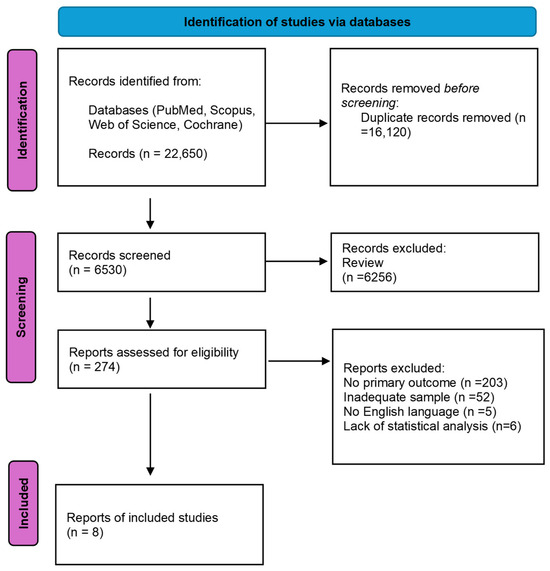
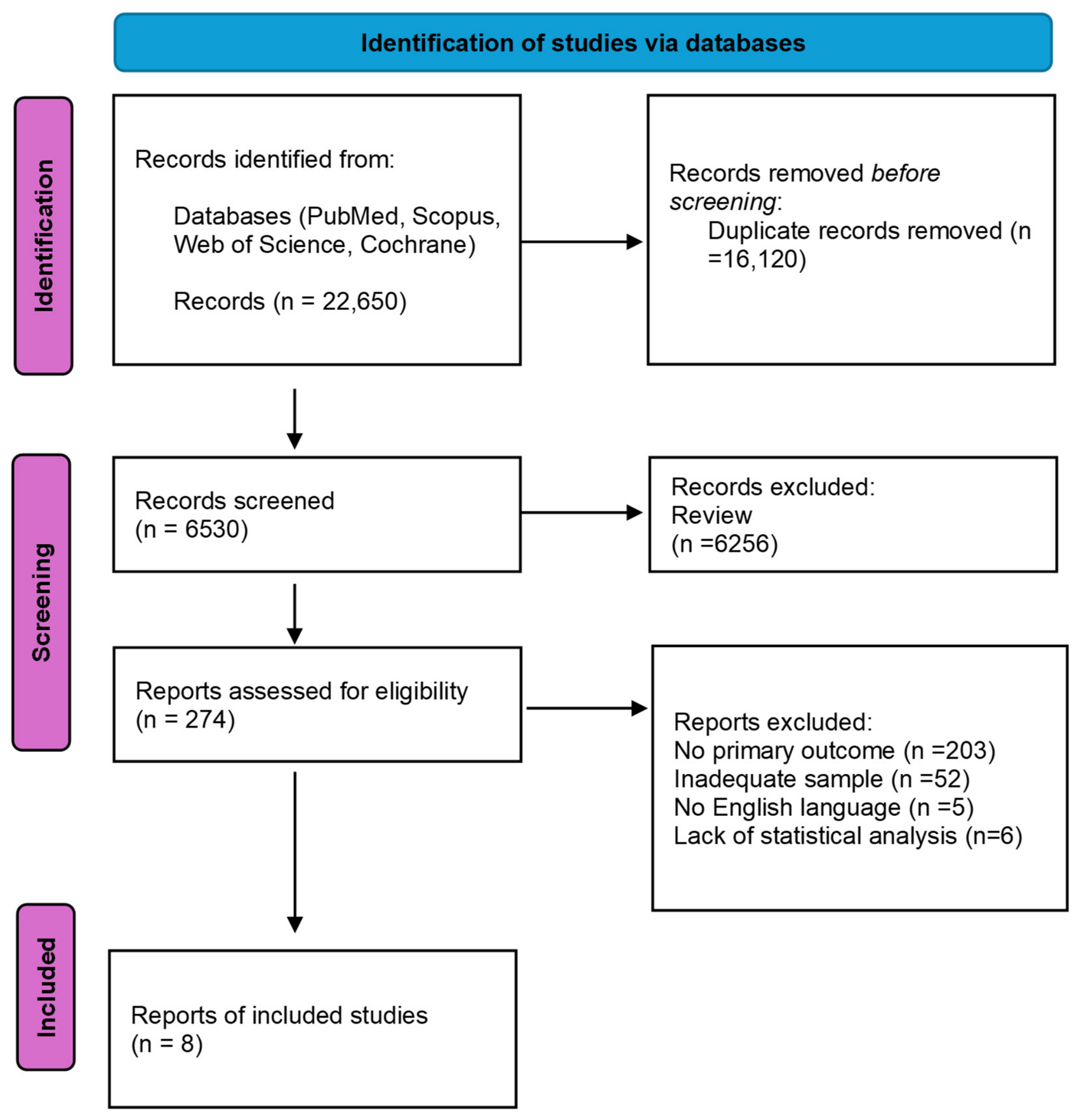
The comprehensive search identified a total of 22,650 articles. After removing duplicates, 6530 articles were collected for screening. During this phase, 99.9% of studies were excluded as they were not relevant due to absence of primary outcome, inadequate samples, not being written in English, and lack of statistical analysis. After a detailed evaluation, only eight studies were deemed eligible and included in the final analysis (Figure 1).
Figure 1.
Prisma flowchart.
Detailed characteristics of the 8 selected articles, including study design, analytical methods, number of samples, and MPs characteristics, are summarized in Table 1. The included studies were carried out in Europe (n = 1), Africa (n = 1), South America (n = 1), the Middle East (n = 2), and Asia (n = 3). All articles employed an observational design, mostly cross-sectional, with sampling carried out on urban water networks. Comparability across studies is limited by the lack of international standards, differences in detection limits, and variation in filters and digestive solutions used. The studies investigate the presence, distribution, and characteristics of MPs, and to a lesser extent, of NPs, in TW.
All studies confirm the presence of MPs in TW, although concentrations varied significantly and synthetic fibers were consistently detected. NPs, on the other hand, were rarely detected, mainly due to technical limitations that hinder their reliable identification. This pattern highlights the current analytical gap between micro- and nanoscale detection capabilities.
The analytical tools used in MP research vary depending on the level of precision required and the type of particles being analyzed. Stereoscopic microscopy, for example, is commonly employed for routine analyses, as seen in studies by Ramaremisa et al. (2024), Sultan et al. (2023), Hossain et al. (2024), and Lam et al. (2020) [27,29,41,42]. For chemical identification, more advanced techniques such as FTIR and Raman spectroscopy are widely used, as demonstrated by researchers like Buyukunal et al. (2023) and Li et al. (2022) [40,44]. In addition, more sophisticated methods like HPLC [45] are applied when molecular traceability or complex analytical protocols are needed.
These methodological differences inherently influence the minimum detectable particle size, the accuracy of polymer identification, and the overall comparability of reported concentrations across studies. For example, microscopy-based approaches tend to underestimate smaller size fractions, whereas FTIR/Raman spectroscopy improves chemical confirmation but remains limited by particle size thresholds. Mass-spectrometry-based methods, while more sensitive, target different analytes and therefore produce results that are not directly comparable to particle-count-based techniques. This heterogeneity must be considered when interpreting concentration ranges and exposure estimates.
Collectively, these studies investigated a total of 586 samples. The number of samples examined varied considerably across studies, ranging from just 30 in Ramaremisa et al. (2024) [29] to 130 in Li et al. (2022) [44]. All studies report the presence of MPs, although the quantities detected vary widely. The average MP concentration ranges from 0 [27] to 390 MPs/L [40].
According to the studies analyzed, the most commonly identified shapes are fibers and fragments. Less frequently, the shapes are films, spheres, or pellets. Particle sizes detected range from 2.7 μm to >5 mm, with a prevalence of MPs between 10–500 μm.
The EDI of MPs was calculated using data reported in the eight eligible studies for various age groups, including healthy pregnant women (Table 3). These estimates varied widely across populations and analytical approaches, reflecting differences in MP concentrations and methodological assumptions. The minimum and maximum calculated EDI values varied widely across studies and population groups, reflecting differences in the concentrations of MPs detected due to the variability in analytical methodologies applied, analytical approaches, and assumed parameters (e.g., daily water consumption and body weight).
Table 3.
Estimated Daily Intake calculated based on MPs through tap water ingestion.
The highest EDI values were assessed for the population of Istanbul according to MPs dosage as estimated by Buyukunal et al. (2023) [40], with a maximum of 39.00 MPs/kg bw/day in children aged 2–3 years and 35.10 MPs/kg bw/day in infants aged 6–12 months. High EDIs across nearly all categories, with a maximum of 15.00 MPs/kg bw/day in 2–3-year-old children and up to 5.75 MPs/kg bw/day in healthy pregnant women, were assessed using MPs concentrations estimated by Vega-Herrera et al. (2022) [45] in Barcelona.
In contrast, EDI resulted in null values across all age groups in Hong Kong, as reported by Lam et al. (2020) [27], who found MP concentrations equal to zero.
Overall, the estimated exposure was generally higher in paediatric groups, particularly in children aged 2–3 years and infants aged 6–12 months, compared with adolescents and adults. This trend aligns with the higher ratio of water intake to body weight in children.
Pregnant women showed lower EDI values than EDIs of children but higher than those of non-pregnant adults, with maximum estimates reaching 14.96 MPs/kg bw/day in Istanbul and 5.75 MPs/kg bw/day in Barcelona.
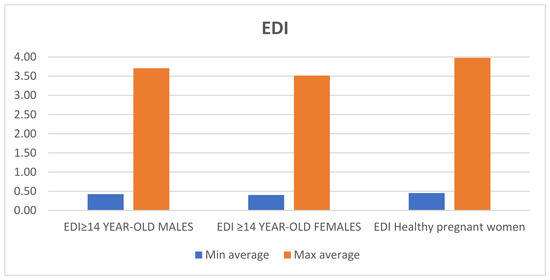
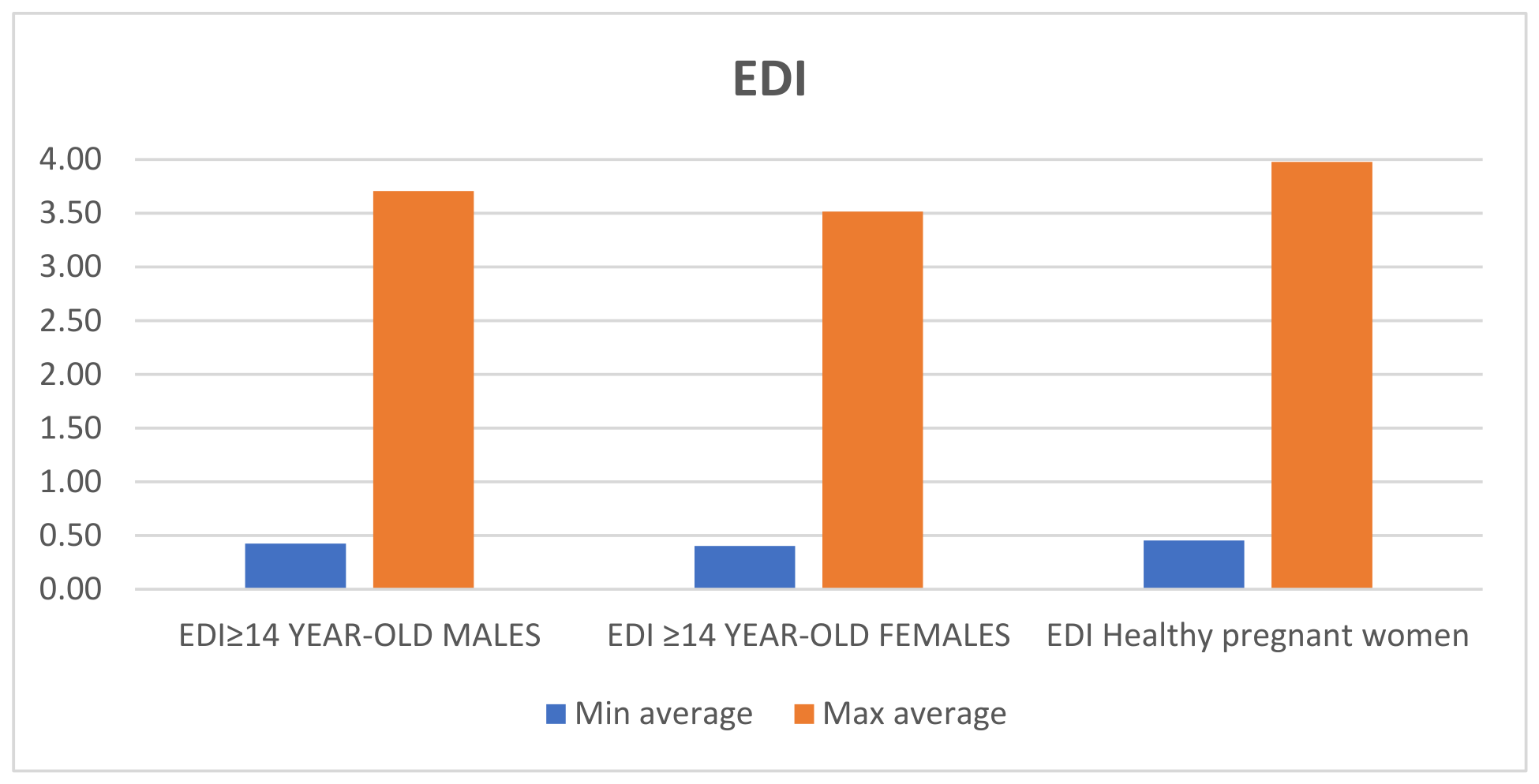
The EDI of microplastics was consistently higher in healthy pregnant women, both in minimum and maximum averages, compared with males and females aged ≥14 years (Figure 2).
Figure 2.
Minimum and maximum average EDI of microplastics (MPs/kg bw/day) in three population groups: males aged ≥14 years, females aged ≥14 years, and healthy pregnant women.
The risk of bias assessment conducted on the eight eligible studies revealed that, although none of them was classified as “low risk” (Table 4), all were classified as having “some concerns” in the overall judgment, mainly due to shortcomings in the transparency of analytical protocols and data management.
Table 4.
Cohort studies included in the review.
The selection of reported results represented another area of uncertainty, with “some concerns” assigned to all studies, often due to the lack of pre-registered protocols or detailed analytical plans. Missing data was generally well managed, with most studies rated as low risk in this domain (Supplementary Materials).
4. Discussion
Our systematic review confirmed the ubiquitous presence of MPs in TW, with concentrations varying across studies, ranging from 0.0008 to 74 MPs/L [41,42,44]. These variations can be attributed to differences in analytical methodologies, sampling volumes, extractions, and processing protocols. For instance, some studies employed advanced determination techniques such as scanning electron microscopy (SEM), Fourier-transform infrared spectroscopy (FTIR), Raman spectroscopy, or chromatography coupled with mass spectrometry [45], whereas others relied on less specific visual or microscopic methods [27,43]. Recognizing these methodological discrepancies is essential for correctly interpreting the variability observed across studies and for avoiding direct comparisons between datasets generated with fundamentally different analytical capabilities. The predominance of fibers and fragments, typically ranging between 10 and 500 μm in size, was consistently observed across the included studies [40,42,44]. MPs smaller than 500 μm were most frequently detected, with particles <1 mm accounting for over 98% of all MPs identified in some studies [42,44]. However, although several authors report that particles of this size are unlikely to translocate across biological barriers [6,10], current toxicological evidence is still limited and does not allow firm conclusions regarding their safety for human health. Larger microplastics may still interact with the gastrointestinal mucosa, potentially inducing local inflammatory responses or acting as carriers of absorbed chemicals. The most prevalent morphology across geographic regions was fibrous shapes, representing 77% to 86% of total MPs [29,43].
The most commonly reported polymers included polyethylene (PE), polypropylene (PP), polyethylene terephthalate (PET), and polystyrene (PS), although other polymers such as ethylene-vinyl acetate (EVA), polyamide (PA), polybutadiene (PBD), and polyimide (PI) were also detected, albeit less frequently [41,44,45]. Polymer type variability is also influenced by contamination sources, which include the degradation of macroplastics, personal care and cleaning products, industrial wastewater, packaging materials, and components of water distribution systems [29,42]. Residual stress in semicrystalline plastics such as PP and PE induces the migration of low-molecular-weight amorphous fractions toward the surface, forming droplets that can be released into water as amorphous polymer micropollutants. This mechanism, driven by thermally activated and stress-dependent flows, is particularly relevant in highly compressed regions (e.g., the neck of bottles) and highlights the need to reconsider processing technologies to reduce residual stress [52]. The presence of MPs in treated water suggests that conventional treatment processes may not be fully effective in removing smaller particles, even though most of the authors do not refer to measures of control against environmental cross-contamination during the sample treatment. Indeed, smaller-sized MPs (<1 μm) are associated with higher concentrations compared with larger particles [3,45]. The latter study detected MPs as small as 0.7 μm in diameter, confirming that standard treatment technologies may not always be capable of eliminating them.
Studies such as Sharma et al. (2023) [53] reported 100% removal efficiency for MPs larger than 5000 μm in TW via ultrafiltration. However, for smaller particles, the removal efficiency decreases and can be affected by membrane fouling. This indicates that advanced technologies could significantly improve water quality [54]. Nevertheless, the variability in treatment protocols and MPs characteristics calls for further research to optimize removal processes. Additionally, the persistence of MPs in treated water supports the hypothesis that conventional treatment systems may not be fully effective at eliminating smaller particles [55].
The calculated EDI values based on doses of MPs reported in the eight analyzed studies show differences that can be attributed to multiple variables, such as the diverse analytical methodologies employed, the particle size ranges considered, sampling protocols, and the parameters used for calculation (e.g., water intake volume and body weight).
This methodological heterogeneity hinders direct comparisons between studies, but it is a widely acknowledged issue in the literature [56,57]. Additionally, only a few studies assessed NPs, which, due to their smaller size, could contribute to a potentially underestimated exposure [58] as reported by several studies [9,10,59].
From a human exposure perspective, children aged 6 months to 3 years are consistently exposed to the highest EDI values. This trend is explained by the higher water intake per unit of body weight in younger age groups, making them particularly vulnerable [59,60]. In adolescents and adults, a slight sex-based difference is observed, with females aged ≥14 years generally showing slightly lower EDI values compared with males. This aspect represents a new starting point for future research.
In the case of pregnant women, EDI values are typically lower than those in children but comparable or slightly higher than those in non-pregnant women, with maximum estimates reaching 14.96 MPs/kg bw/day calculated by Cox et al., 2019 [61]. Given the growing interest in the potential transplacental transfer of MPs and their possible clinical implications [42], this exposure pathway also warrants particular attention in future research.
Finally, the substantial variability and methodological differences observed underscore the importance of standardizing sampling and analytical procedures to improve the comparability and reliability of exposure estimates. Moreover, the complexity of the collected data highlights the need for a comprehensive health risk assessment, especially for the most vulnerable population groups.
Despite uncertainties about the exact exposure levels to MPs through TW, it is widely acknowledged that these particles may have adverse effects on human health. Research on potential exposure pathways shows that MPs can be ingested directly through TW or indirectly through food contaminated by MPs present in TW used for the food preparation or transformation [62]. MPs are accumulated in the human body [6,19], and some studies suggest they could exert toxic effects, although research on biological impacts is still at an early stage [63,64]. Recent studies highlight that variability in extraction techniques, filter pore sizes, blank contamination, and environmental contamination during sampling and processing can significantly influence results, complicating direct comparisons between studies [58,65,66,67]. These discrepancies affected the calculated EDIs variability, and this aspect is critical considering the importance of EDI in the human risk assessment [25].
While academic research has played a crucial role in identifying and characterizing microplastics in tap water, the translation of these findings into standardized monitoring and risk assessment frameworks remains limited. Given the public health relevance of drinking water safety, a stronger involvement of governmental agencies and regulatory bodies is warranted. Institutions responsible for water quality should lead the development of harmonized protocols for sampling, detection, quantification, and reporting of microplastics and nanoplastics in tap water. The establishment of standardized methodologies would not only improve comparability across studies but also support the integration of microplastics into existing water safety plans and regulatory frameworks. Furthermore, coordinated surveillance systems at national and international levels could facilitate long-term monitoring, risk assessment, and evidence-based policymaking. In this context, future research should increasingly align with regulatory needs, contributing to the definition of threshold values, exposure indicators, and health-based guidelines.
5. Conclusions
The results of this review suggest that MPs are widely distributed in TW sources, but the existing treatment techniques may not be sufficiently effective in removing all particle sizes. It is therefore essential to develop and implement advanced technologies capable of improving water quality, particularly those designed to target smaller particles that escape conventional filtration systems. Strengthening these approaches would not only enhance removal efficiency but also contribute to a more accurate characterization of exposure levels in different population groups.
Furthermore, the standardization of analytical methodologies and the adoption of more rigorous research protocols could enhance the comparability of results and improve our understanding of the impact of MPs on human health. The available evidence primarily provides estimates of human exposure to MPs through tap water, which constitutes only one of multiple exposure pathways; thus, these findings should not be interpreted as a direct assessment of overall human exposure or health risk. Particular attention may be warranted for specific population groups, such as children, who could experience relatively higher exposure levels [65,68]. Continuous monitoring of contamination levels, together with further investigation into the long-term effects of MPs, remains crucial for protecting public health and the environment, and for informing future regulatory and risk-assessment frameworks.
Supplementary Materials
The following supporting information can be downloaded at: https://www.mdpi.com/article/10.3390/microplastics5020095/s1. Table S1: Details of literature search on online databases. File S1. PRISMA 2020 Checklist.
Author Contributions
Conceptualization, G.O.C. and M.D.; methodology, M.F. and M.D.; software, P.R., E.P. and G.D.; validation, M.F. and M.D.; formal analysis, G.O.C., G.M., A.A. and M.D.; investigation, P.R., E.P., G.D., M.A.C. and P.C.; writing—original draft preparation, G.O.C. and M.D.; writing—review & editing, P.R., E.P. and G.D.; visualization, M.F. and M.D.; supervision, M.F. and M.D. All authors have read and agreed to the published version of the manuscript.
Funding
PRIN 2022 PNRR entitled: “Tap water QUAlity and microplAstics. Countering an ecoLogical threat with an evidence-based approach. AQUApLASt”, pursuant to Ministerial Decree No. 1409 of 14 September 2022, of the Ministry of University and Research. CUP E53D23020700001.
Institutional Review Board Statement
Not applicable.
Data Availability Statement
No new primary data were generated in this study. The Estimated Daily Intake (EDI) values were calculated by the authors based on data extracted from the studies included in the systematic review. All source data are available within the cited publications.
Conflicts of Interest
The authors declare no conflicts of interest.
Abbreviations
The following abbreviations are used in this manuscript:
| MPs | Microplastics |
| NPs | Nanoplastics |
| PRISMA | Preferred Reporting Items for Systematic Reviews and Meta-Analyses |
| TW | Tap Water |
| EDI | Estimated Daily Intake |
| PROSPERO | PROspective Systematic Review Register |
| NOS | Newcastle–Ottawa Scale |
| SEM | Scanning Electron Microscopy |
| FTIR | Fourier-transform infrared spectroscopy |
| PE | Polyethylene |
| PP | Polypropylene |
| PET | Polyethylene Terephthalate |
| PS | Polystyrene |
| EVA | Ethylene-vinyl acetate |
| PA | Polyamide |
| PBD | Polybutadiene |
| PI | Polyimide |
References
- Haram, L.E.; Carlton, J.T.; Ruiz, G.M.; Maximenko, N.A. A Plasticene Lexicon. Mar. Pollut. Bull. 2020, 150, 110714. [Google Scholar] [CrossRef] [PubMed]
- Chandra, S.; Walsh, K.B. Microplastics in Water: Occurrence, Fate and Removal. J. Contam. Hydrol. 2024, 264, 104360. [Google Scholar] [CrossRef] [PubMed]
- Sol, D.; Solís-Balbín, C.; Laca, A.; Laca, A.; Díaz, M. A Standard Analytical Approach and Establishing Criteria for Microplastic Concentrations in Wastewater, Drinking Water and Tap Water. Sci. Total Environ. 2023, 899, 165356. [Google Scholar] [CrossRef]
- Gambino, I.; Bagordo, F.; Grassi, T.; Panico, A.; De Donno, A. Occurrence of Microplastics in Tap and Bottled Water: Current Knowledge. Int. J. Environ. Res. Public Health 2022, 19, 5283. [Google Scholar] [CrossRef]
- Muhib, M.I.; Uddin, M.K.; Rahman, M.M.; Malafaia, G. Occurrence of Microplastics in Tap and Bottled Water, and Food Packaging: A Narrative Review on Current Knowledge. Sci. Total Environ. 2023, 865, 161274. [Google Scholar] [CrossRef]
- Montano, L.; Raimondo, S.; Piscopo, M.; Ricciardi, M.; Guglielmino, A.; Chamayou, S.; Gentile, R.; Gentile, M.; Rapisarda, P.; Oliveri Conti, G.; et al. First Evidence of Microplastics in Human Ovarian Follicular Fluid: An Emerging Threat to Female Fertility. Ecotoxicol. Environ. Saf. 2025, 291, 117868. [Google Scholar] [CrossRef]
- Krikech, I.; Oliveri Conti, G.; Pulvirenti, E.; Rapisarda, P.; Castrogiovanni, M.; Maisano, M.; Le Pennec, G.; Leermakers, M.; Ferrante, M.; Cappello, T.; et al. Microplastics (≤10 μm) Bioaccumulation in Marine Sponges along the Moroccan Mediterranean Coast: Insights into Species-Specific Distribution and Potential Bioindication. Environ. Res. 2023, 235, 116608. [Google Scholar] [CrossRef] [PubMed]
- Djekoun, M.; Gaaied, S.; Romdhani, I.; Mohamed Rida, A.; Missaoui, Y.; Boubekeur, M.S.; Trea, F.; Lakbar, C.; Ouali, K.; Banni, M. Abundance and distribution of environmental microplastic in edible fish and mussels from the south Mediterranean coasts. Mar. Pollut. Bull. 2024, 206, 116705. [Google Scholar] [CrossRef]
- Ferrante, M.; Pietro, Z.; Allegui, C.; Maria, F.; Antonio, C.; Pulvirenti, E.; Favara, C.; Chiara, C.; Grasso, A.; Omayma, M.; et al. Microplastics in fillets of Mediterranean seafood: A risk assessment study. Environ. Res. 2022, 204, 112247. [Google Scholar] [CrossRef]
- Oliveri Conti, G.; Ferrante, M.; Banni, M.; Favara, C.; Nicolosi, I.; Cristaldi, A.; Fiore, M.; Zuccarello, P. Micro- and nano-plastics in edible fruit and vegetables: The first diet risks assessment for the general population. Environ. Res. 2020, 187, 109677. [Google Scholar] [CrossRef]
- Lackner, M.; Branka, M. Microplastics in farmed animals—A review. Microplastics 2024, 3, 559–588. [Google Scholar] [CrossRef]
- Ziani, K.; Ioniță-Mîndrican, C.-B.; Mititelu, M.; Neacșu, S.M.; Negrei, C.; Moroșan, E.; Drăgănescu, D.; Preda, O.-T. Microplastics: A real global threat for environment and food safety: A state of the art review. Nutrients 2023, 15, 617. [Google Scholar] [CrossRef]
- Garrido Gamarro, E.; Costanzo, V. Microplastics in Food Commodities—A Food Safety Review on Human Exposure through Dietary Sources; Food Safety and Quality Series No. 18; FAO: Rome, Italy, 2022. [Google Scholar]
- Ccanccapa-Cartagena, A.; Gopakumar, A.N.; Salehi, M. A straightforward Py-GC/MS methodology for quantification of microplastics in tap water. MethodsX 2025, 14, 103173. [Google Scholar] [CrossRef]
- Ghosh, S.; Sinha, J.K.; Ghosh, S.; Vashisth, K.; Han, S.; Bhaskar, R. Microplastics as an emerging threat to the global environment and human health. Sustainability 2023, 15, 10821. [Google Scholar] [CrossRef]
- Vethaak, A.D.; Legler, J. Microplastics and human health. Science 2021, 371, 672–674. [Google Scholar] [CrossRef] [PubMed]
- Ferrante, M.; Cristaldi, A.; Oliveri Conti, G. Oncogenic role of miRNA in environmental exposure to plasticizers: A systematic review. J. Pers. Med. 2021, 11, 500. [Google Scholar] [CrossRef]
- Dettori, M.; Arghittu, A.; Deiana, G.; Castiglia, P.; Azara, A. The revised European Directive 2020/2184 on the quality of water intended for human consumption: A step forward in risk assessment, consumer safety and informative communication. Environ. Res. 2022, 209, 112773. [Google Scholar] [CrossRef]
- Dzierżyński, E.; Gawlik, P.J.; Puźniak, D.; Flieger, W.; Jóźwik, K.; Teresiński, G.; Forma, A.; Wdowiak, P.; Baj, J.; Flieger, J. Microplastics in the human body: Exposure, detection, and risk of carcinogenesis: A state-of-the-art review. Cancers 2024, 16, 3703. [Google Scholar] [CrossRef]
- Rist, S.; Carney Almroth, B.; Hartmann, N.B.; Karlsson, T.M. A critical perspective on early communications concerning human health aspects of microplastics. Sci. Total Environ. 2018, 626, 720–726. [Google Scholar] [CrossRef] [PubMed]
- Mortensen, N.P.; Fennell, T.R.; Johnson, L.M. Unintended human ingestion of nanoplastics and small microplastics through drinking water, beverages, and food sources. NanoImpact 2021, 21, 100302. [Google Scholar] [CrossRef]
- Sangkham, S.; Faikhaw, O.; Munkong, N.; Sakunkoo, P.; Arunlertaree, C.; Chavali, M.; Mousazadeh, M.; Tiwari, A. A review on microplastics and nanoplastics in the environment: Their occurrence, exposure routes, toxic studies, and potential effects on human health. Mar. Pollut. Bull. 2022, 181, 113832. [Google Scholar] [CrossRef]
- Sun, T.; Teng, Y.; Ji, C.; Li, F.; Shan, X.; Wu, H. Global prevalence of microplastics in tap water systems: Abundance, characteristics, drivers and knowledge gaps. Sci. Total Environ. 2024, 929, 172662. [Google Scholar] [CrossRef] [PubMed]
- Yu, Z.; Wang, J.-J.; Liu, L.-Y.; Li, Z.; Zeng, E.Y. Drinking boiled tap water reduces human intake of nanoplastics and microplastics. Environ. Sci. Technol. Lett. 2024, 11, 273–279. [Google Scholar] [CrossRef]
- Yang, L.; Kang, S.; Luo, X.; Wang, Z. Microplastics in drinking water: A review on methods, occurrence, sources, and potential risks assessment. Environ. Pollut. 2024, 348, 123857. [Google Scholar] [CrossRef] [PubMed]
- Zhang, M.; Li, J.; Ding, H.; Ding, J.; Jiang, F.; Ding, N.X.; Sun, C. Distribution characteristics and influencing factors of microplastics in urban tap water and water sources in Qingdao, China. Anal. Lett. 2020, 53, 1312–1327. [Google Scholar] [CrossRef]
- Lam, T.W.L.; Ho, H.T.; Ma, A.T.H.; Fok, L. Microplastic contamination of surface water-sourced tap water in Hong Kong—A preliminary study. Appl. Sci. 2020, 10, 3463. [Google Scholar] [CrossRef]
- Chanpiwat, P.; Damrongsiri, S. Abundance and characteristics of microplastics in freshwater and treated tap water in Bangkok, Thailand. Environ. Monit. Assess. 2021, 193, 258. [Google Scholar] [CrossRef]
- Ramaremisa, G.; Tutu, H.; Saad, D. Detection and characterisation of microplastics in tap water from Gauteng, South Africa. Chemosphere 2024, 356, 141903. [Google Scholar] [CrossRef]
- Mukhopadhyay, A.; Duttagupta, S.; Mukherjee, A. Emerging organic contaminants in global community drinking water sources and supply: A review of occurrence, processes and remediation. J. Environ. Chem. Eng. 2022, 10, 107560. [Google Scholar] [CrossRef]
- Ali, S.S.; Alsharbaty, M.H.M.; Al-Tohamy, R.; Schagerl, M.; Al-Zahrani, M.; Kornaros, M.; Sun, J. Microplastics as persistent and vectors of other threats in the marine environment: Toxicological impacts, management and strategical roadmap to end plastic pollution. Environ. Chem. Ecotoxicol. 2025, 7, 229–251. [Google Scholar] [CrossRef]
- VishnuRadhan, R.; Das, S.; Hennion, C.; Eldho, T.I.; Lonappan, A. Potable water boiling can induce havoc in the water quality management arena due to the presence of microplastics. Clean. Water 2024, 1, 100019. [Google Scholar] [CrossRef]
- Pulvirenti, E.; Ferrante, M.; Barbera, N.; Favara, C.; Aquilia, E.; Palella, M.; Cristaldi, A.; Conti, G.O.; Fiore, M. Effects of nano and microplastics on the inflammatory process: In vitro and in vivo studies systematic review. Front. Biosci. 2022, 27, 287. [Google Scholar] [CrossRef] [PubMed]
- Page, M.J.; Moher, D.; Bossuyt, P.M.; Boutron, I.; Hoffmann, T.C.; Mulrow, C.D.; Shamseer, L.; Tetzlaff, J.M.; Akl, E.A.; Brennan, S.E.; et al. The PRISMA 2020 statement: An updated guideline for reporting systematic reviews. BMJ 2021, 372, n71. [Google Scholar] [CrossRef] [PubMed]
- Rayyan. Available online: https://rayyan.ai (accessed on 18 October 2025).
- Ouzzani, M.; Hammady, H.; Fedorowicz, Z.; Elmagarmid, A. Rayyan: A web and mobile app for systematic reviews. Syst. Rev. 2016, 5, 210. [Google Scholar] [CrossRef]
- Valizadeh, A.; Moassefi, M.; Nakhostin-Ansari, A.; Hosseini Asl, S.H.; Saghab Torbati, M.; Aghajani, R.; Maleki Ghorbani, Z.; Faghani, S. Abstract screening using the automated tool Rayyan: Results of effectiveness in three diagnostic test accuracy systematic reviews. BMC Med. Res. Methodol. 2022, 22, 160. [Google Scholar] [CrossRef]
- Li, D.; Li, P.; Shi, Y.; Sheerin, E.D.; Zhang, Z.; Yang, L.; Xiao, L.; Hill, C.; Gordon, C.; Ruether, M.; et al. Stress-induced phase separation in plastics drives the release of amorphous polymer micropollutants into water. Nat. Commun. 2025, 16, 3814. [Google Scholar] [CrossRef]
- Microsoft. Available online: https://www.microsoft.com (accessed on 20 December 2025).
- Buyukunal, S.K.; Koluman, A.; Muratoglu, K. Microplastic pollution of drinking water in a metropolis. J. Water Health 2023, 21, 687–701. [Google Scholar] [CrossRef]
- Sultan, M.H.; Al-Ahmady, K.K.; Mhemid, R.K.S. Microplastics evaluation in tap water in left side districts of Mosul City, Iraq. J. Ecol. Eng. 2023, 24, 353–362. [Google Scholar] [CrossRef]
- Hossain, M.B.; Yu, J.; Sarker, P.K.; Banik, P.; Sultana, S.; Nur, A.-U.; Haque, M.R.; Rahman, M.M.; Paray, B.A.; Arai, T. Microplastic Accumulation, Morpho-Polymer Characterization, and Dietary Exposure in Urban Tap Water of a Developing Nation. Front. Sustain. Food Syst. 2024, 8, 1397348. [Google Scholar] [CrossRef]
- Pratesi, C.B.; Santos Almeida, M.A.; Cutrim Paz, G.S.; Ramos Teotonio, M.H.; Gandolfi, L.; Pratesi, R.; Hecht, M.; Zandonadi, R.P. Presence and quantification of microplastic in urban tap water: A pre-screening in Brasilia, Brazil. Sustainability 2021, 13, 6404. [Google Scholar] [CrossRef]
- Li, Y.; Wang, Z.; Guan, B. Separation and identification of nanoplastics in tap water. Environ. Res. 2022, 204, 112134. [Google Scholar] [CrossRef]
- Vega-Herrera, A.; Llorca, M.; Borrell-Diaz, X.; Redondo-Hasselerharm, P.E.; Abad, E.; Villanueva, C.M.; Farré, M. Polymers of micro(nano)plastic in household tap water of the Barcelona Metropolitan Area. Water Res. 2022, 220, 118645. [Google Scholar] [CrossRef] [PubMed]
- Gualdi-Russo, E.; Zaccagni, L. The Newcastle–Ottawa Scale for Assessing the Quality of Studies in Systematic Reviews. Publications 2026, 14, 4. [Google Scholar] [CrossRef]
- EFSA Panel on Dietetic Products, Nutrition and Allergies (NDA). Scientific Opinion on Dietary Reference Values for Water. EFSA J. 2010, 8, 1459. [Google Scholar] [CrossRef]
- Institute of Medicine (US) Food and Nutrition Board. Dietary Reference Intakes: A Risk Assessment Model for Establishing Upper Intake Levels for Nutrients; National Academies Press: Washington, DC, USA, 1998. [Google Scholar]
- American College of Obstetricians and Gynecologists (ACOG). How Much Water Should I Drink during Pregnancy? Available online: https://www.acog.org/womens-health/experts-and-stories/ask-acog/how-much-water-should-i-drink-during-pregnancy (accessed on 3 August 2025).
- The Royal Women’s Hospital. Weight and Pregnancy. Available online: https://www.thewomens.org.au/health-information/pregnancy-and-birth/a-healthy-pregnancy/weight-pregnancy (accessed on 3 August 2025).
- Centers for Disease Control and Prevention (CDC). Weight Gain During Pregnancy. Available online: https://www.cdc.gov/maternal-infant-health/pregnancy-weight/index.html (accessed on 3 August 2025).
- Müller, Y.K.; Wernicke, T.; Pittroff, M.; Witzig, C.S.; Storck, F.R.; Klinger, J.; Zumbülte, N. Microplastic analysis—Are we measuring the same? Results on the first global comparative study for microplastic analysis in a water sample. Anal. Bioanal. Chem. 2020, 412, 555–560. [Google Scholar] [CrossRef] [PubMed]
- Sharma, A.; Kumari, S.; Chopade, R.L.; Pandit, P.P.; Rai, A.R.; Nagar, V.; Awasthi, G.; Singh, A.; Awasthi, K.K.; Sankhla, M.S. An assessment of the impact of structure and type of microplastics on ultrafiltration technology for microplastic remediation. Sci. Prog. 2023, 106, 368504231176399. [Google Scholar] [CrossRef]
- Pulvirenti, E.; Conti, G.O.; Falqui, L.; Banni, M.; Ferrante, M. Innovative prototype for the mitigation of water pollution from microplastics to safeguard the environment and health. Sci. Total Environ. 2025, 977, 179358. [Google Scholar] [CrossRef] [PubMed]
- Na, S.H.; Kim, M.J.; Kim, J.T.; Jeong, S.; Lee, S.; Chung, J.; Kim, E.J. Microplastic removal in conventional drinking water treatment processes: Performance, mechanism, and potential risk. Water Res. 2021, 202, 117417. [Google Scholar] [CrossRef]
- Huang, Z.; Hu, B.; Wang, H. Analytical methods for microplastics in the environment: A review. Environ. Chem. Lett. 2023, 21, 383–401. [Google Scholar] [CrossRef]
- Sharma, P.; Sharma, P.; Abhishek, K. Sampling, separation, and characterization methodology for quantification of microplastic from the environment. J. Hazard. Mater. Adv. 2024, 14, 100416. [Google Scholar] [CrossRef]
- Singh, G.; Thakur, N.; Kumar, R. Nanoparticles in drinking water: Assessing health risks and regulatory challenges. Sci. Total Environ. 2024, 949, 174940. [Google Scholar] [CrossRef]
- Zuccarello, P.; Ferrante, M.; Cristaldi, A.; Copat, C.; Grasso, A.; Sangregorio, D.; Fiore, M.; Oliveri Conti, G. Exposure to microplastics (<10 μm) associated to plastic bottles mineral water consumption: The first quantitative study. Water Res. 2019, 157, 365–371. [Google Scholar] [CrossRef] [PubMed]
- Senathirajah, K.; Attwood, S.; Bhagwat, G.; Carbery, M.; Wilson, S.; Palanisami, T. Estimation of the mass of microplastics ingested—A pivotal first step towards human health risk assessment. J. Hazard. Mater. 2021, 404, 124004. [Google Scholar] [CrossRef] [PubMed]
- Cox, K.D.; Covernton, G.A.; Davies, H.L.; Dower, J.F.; Juanes, F.; Dudas, S.E. Human consumption of microplastics. Environ. Sci. Technol. 2019, 53, 7068–7074. [Google Scholar] [CrossRef]
- Ragusa, A.; Svelato, A.; Santacroce, C.; Catalano, P.; Notarstefano, V.; Carnevali, O.; Papa, F.; Rongioletti, M.C.A.; Baiocco, F.; Draghi, S.; et al. Plasticenta: First evidence of microplastics in human placenta. Environ. Int. 2021, 146, 106274. [Google Scholar] [CrossRef]
- Bouwmeester, H.; Hollman, P.C.; Peters, R.J. Potential health impact of environmentally released micro- and nanoplastics in the human food production chain: Experiences from nanotoxicology. Environ. Sci. Technol. 2015, 49, 8932–8947. [Google Scholar] [CrossRef] [PubMed]
- Rochman, C.M.; Brookson, C.; Bikker, J.; Djuric, N.; Earn, A.; Bucci, K.; Athey, S.; Huntington, A.; McIlwraith, H.; Munno, K.; et al. Rethinking microplastics as a diverse contaminant suite. Environ. Toxicol. Chem. 2019, 38, 703–711. [Google Scholar] [CrossRef]
- Najahi, H.; Alessio, N.; Squillaro, T.; Conti, G.O.; Ferrante, M.; Di Bernardo, G.; Galderisi, U.; Messaoudi, I.; Minucci, S.; Banni, M. Environmental microplastics (EMPs) exposure alter the differentiation potential of mesenchymal stromal cells. Environ. Res. 2022, 214, 114088. [Google Scholar] [CrossRef]
- Besley, A.; Vijver, M.G.; Behrens, P.; Bosker, T. A standardized method for sampling and extraction methods for quantifying microplastics in beach sand. Mar. Pollut. Bull. 2017, 114, 77–83. [Google Scholar] [CrossRef]
- Mai, L.; Bao, L.J.; Shi, L.; Wong, C.S.; Zeng, E.Y. A review of methods for measuring microplastics in aquatic environments. Environ. Sci. Pollut. Res. 2018, 25, 11319–11332. [Google Scholar] [CrossRef]
- Shao, Q.; Wang, Y.-G. Statistical power calculation and sample size determination for environmental studies with data below detection limits. Water Resour. Res. 2009, 45, W09410. [Google Scholar] [CrossRef]

Disclaimer/Publisher’s Note: The statements, opinions and data contained in all publications are solely those of the individual author(s) and contributor(s) and not of MDPI and/or the editor(s). MDPI and/or the editor(s) disclaim responsibility for any injury to people or property resulting from any ideas, methods, instructions or products referred to in the content. |
© 2026 by the authors. Licensee MDPI, Basel, Switzerland. This article is an open access article distributed under the terms and conditions of the Creative Commons Attribution (CC BY) license.