Skip to Content

Acoustics

Acoustics is an international, peer-reviewed, open access journal on acoustics science and engineering, published quarterly online by MDPI.

Get Alerted

Add your email address to receive forthcoming issues of this journal.

All Articles (469)

Due to fluctuations in flow rate, pressure, and pump operating states, as well as environmental disturbances such as temperature variations and structural vibrations, pipeline leakage signals exhibit significant nonstationary characteristics. The traditional fixed sensor is limited by the layout position, resulting in suboptimal detection performance. For micro-leakage, it is even more difficult to achieve detection. With the advantages of small size and strong passing ability, the acoustic inner detector is well-suited to the task of comprehensive pipeline detection. Therefore, this paper carried out unsteady micro-leakage detection based on acoustic internal inspection signals. The unsteady micro-leakage simulation experiment of pipeline was carried out, and the leakage acoustic signal was collected for method verification. This paper investigates the integration of variational mode decomposition (VMD), random forest (RF) and least squares support vector machine (LSSVM) for signal processing and leakage classification. An unsteady micro-leakage detection method based on acoustic internal inspection signals was proposed, which is well-suited to the leakage detection task of pipelines. Experimental results indicated that the proposed method achieved a recognition accuracy of 95.31%, outperforming conventional leakage detection methods.

9 July 2026
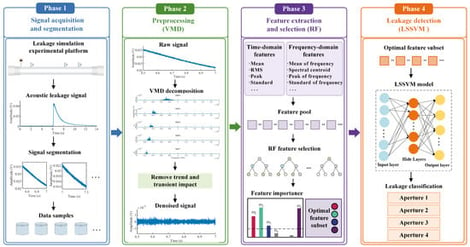
Overall framework of the proposed pipeline leakage detection method.

SECD: A String Ensemble Chords Dataset for Multi-Task Audio Classification

  • Angelos Geroulanos,
  • Panagiotis Zervas and
  • Giannis Tzimas

We introduce the String Ensemble Chords Dataset (SECD), a large-scale controlled compositional audio dataset comprising 287,088 harmonic-interval and chord instances constructed through additive superposition of professionally recorded isolated string notes from the Philharmonia Orchestra into duo-, trio-, and quartet-like four-voice mixtures. Each mixture includes exact per-voice metadata for absolute pitch, dynamic marking, and playing technique, and the corpus is organised into six dataset groups covering harmonic intervals, triads, and seventh chords under loose and strict metadata-consistency conditions. To demonstrate dataset utility, we define four representative and reproducible reference benchmarks: ensemble size recognition, triad chord quality identification, per-instrument dynamics classification, and playing technique-family recognition. Baseline Audio Spectrogram Transformer (AST) models achieve test accuracies of 98.67%, 93.73%, 98.19%, and 99.39%, with corresponding macro-F1 scores of 98.64%, 93.73%, 98.01%, and 97.29%, under a complete-instance-disjoint, in-domain evaluation protocol. These results provide reproducible reference performance for the selected SECD tasks and demonstrate the corpus’s utility for controlled analysis of harmonic, timbral, dynamic, and textural attributes in classical string audio. The full SECD corpus is released through Zenodo as constructed audio mixtures with accompanying metadata, while the project GitHub repository provides the EXP1–EXP4 benchmark code, saved split definitions, and the mini-SECD demonstration package for lightweight reproducibility.

7 July 2026

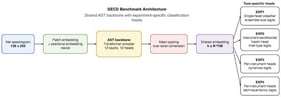
Unified architecture family used for the SECD benchmark tasks. A mel spectrogram input (
  
    128
    ×
    256
  
) is processed by a pre-trained Audio Spectrogram Transformer (AST) backbone, producing a shared embedding 
  
    h
    ∈
    
      R
      768
    
  
. Task-specific heads operate on this embedding: a single-head classifier (EXP1), instrument-conditioned fusion heads (EXP2), and per-instrument multi-head outputs for dynamics and technique-family prediction (EXP3–EXP4).

To address the lack of comprehensive quality evaluation indicators for heat treatment after bilateral induction hardening of high-speed linear guide rails, this study draws on the concept of geometric tolerance to innovatively propose a quantitative evaluation indicator for the “symmetry” of the hardening layer depth profile, and conducts non-destructive evaluation research based on ultrasonic transverse wave backscattering technology. Aiming at the complex cross-sectional profile of the guide rail and the problem of anisotropic acoustic scattering, a multi-dimensional symmetry characterization framework driven jointly by “local pair-wise tolerance zone constraints” and a “global equivalent case depth metric” was established. This dual-driven evaluation framework effectively eliminates the evaluation loophole of “false symmetry” caused by the mutual cancellation of opposite positive and negative local deviations. By constructing an equivalent hardened layer model based on discrete feature point mapping, the interference of non-parallel complex curved surfaces on traditional continuous B-scan imaging is successfully circumvented, achieving stable characterization of the overall hardening layer coverage under specific process parameters. A 15 MHz water-immersed point-focusing ultrasonic transverse wave oblique incidence detection system was developed, paired with a self-designed spring-loaded passive conformal tracking clamping mechanism for continuous automated scanning. Experimental results demonstrate that the overall equivalent symmetry of the tested guide rail specimens remains above 98%. Verified by the metallographic Vickers hardness gradient method, the equivalent relative error between the ultrasonically measured case depth and the physical case depth is only 1.0% and 1.6%. This proves that this non-destructive evaluation method possesses excellent measurement accuracy and holds significant industrial value for online non-destructive monitoring.

7 July 2026

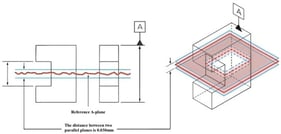
Schematic diagram of traditional symmetry evaluation method.

Leak Localization in Buried Pipes Using Frequency-Band Energy Features of Ground Surface Measurements and Machine Learning

  • Vinícius de Araújo Salmazo,
  • Oscar Scussel and
  • Amarildo Tabone Paschoalini
  • + 3 authors

Detecting and localizing leaks in buried pipelines typically requires direct access to the pipe, which is often impractical in real-world conditions. Although ground-surface vibration measurements offer a non-intrusive alternative, their potential for spatial leak localization remains underexplored, particularly in relation to frequency-dependent attenuation effects. This study investigates how frequency-dependent energy decay encodes spatial information in leak-induced ground vibrations. Experimental wok was conducted using an outdoor buried pipeline testbed, where surface acceleration data were collected with a movable array of piezoelectric sensors. The measurements were reorganized into L-shaped sensor trios to enable directional analysis and increase the number of spatial configurations. Energy-based features extracted from discrete frequency bands were used to represent the leak signatures, capturing both attenuation behavior and soil–pipe interaction effects. Artificial Neural Network and Random Forest models were trained to estimate leak coordinates in a local reference frame. The results demonstrate high localization accuracy at the centimeter scale and reveal consistent relationships between prediction error, distance, and signal-to-noise ratio. These findings show that frequency-dependent attenuation provides a robust basis for spatial inference, and that combining ground surface vibration measurements with lightweight machine learning models offers an effective and non-intrusive solution for leak localization in buried pipelines.

3 July 2026

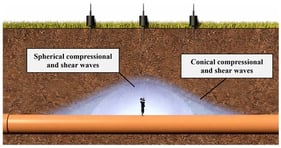
Schematic diagram of wave propagation in the system.

News & Conferences

Volumes

Latest Issues

Open for Submission

Editor's Choice

Reprints of Collections

Acoustics, Soundscapes and Sounds as Intangible Heritage
Reprint

Acoustics, Soundscapes and Sounds as Intangible Heritage

Editors: Lidia Alvarez-Morales, Margarita Díaz-Andreu
Historical Acoustics
Reprint

Historical Acoustics

Relationships between People and Sound over Time
Editors: Francesco Aletta, Jian Kang
XFacebookLinkedIn
Acoustics - ISSN 2624-599X